The Rucellai Family: Patrons of Renaissance Florence
Among the great families that shaped Renaissance Florence, the Rucellai family occupies a unique position. Unlike the Medici, who became rulers of the city, or the Pazzi, whose name is forever linked to political conspiracy, the Rucellai are remembered above all as enlightened patrons of art, architecture and humanist culture.
Through successful international trade, careful diplomacy and an enduring commitment to education, the family accumulated immense wealth during the fifteenth century. Rather than using this fortune solely to increase political influence, prominent members of the dynasty invested in architecture, literature and public works that transformed the appearance of Florence and left an enduring cultural legacy.
Today, visitors encounter the Rucellai name throughout the city. Palazzo Rucellai is considered one of the masterpieces of Renaissance architecture, while the elegant marble façade of Santa Maria Novella stands as one of Leon Battista Alberti’s greatest achievements—both commissioned by members of this remarkable family.
This guide explores the history of the Rucellai family, their rise to prominence, their partnership with the architect and humanist Leon Battista Alberti and the lasting influence they had on Renaissance Florence.
Historical Timeline of the Rucellai Family
| Year | Event |
|---|---|
| 13th century | The Rucellai family emerges among Florence’s prosperous merchant families. |
| 14th century | The family builds its fortune through banking, textile production and international trade. |
| 1446–1451 | Construction of Palazzo Rucellai begins. |
| 1456–1470 | Leon Battista Alberti designs the marble façade of Santa Maria Novella, commissioned by Giovanni Rucellai. |
| 1470s | The Rucellai family reaches the height of its cultural influence during the Florentine Renaissance. |
| 16th century | The family remains an important noble dynasty despite the growing political dominance of the Medici. |
| Today | The Rucellai legacy survives through Florence’s architecture, literature and artistic heritage. |
The Rise of the Rucellai Family
The origins of the Rucellai family can be traced to medieval Florence, where they established themselves as successful merchants during a period of remarkable economic growth. Like many Florentine dynasties, their prosperity was built upon international commerce rather than hereditary nobility.
The family became particularly successful in the wool and textile trade, industries that formed the economic backbone of Florence during the late Middle Ages. By exporting luxury textiles throughout Europe, the Rucellai accumulated considerable wealth while developing commercial networks that extended from Italy to northern Europe and the Mediterranean.
Unlike several rival families, the Rucellai generally pursued stability rather than political confrontation. Their influence was based less on military power or factional conflict and more on financial success, diplomacy and strategic marriages that strengthened relationships with other leading Florentine families.
This balanced approach allowed the dynasty to prosper even during periods of political uncertainty. By the middle of the fifteenth century, the Rucellai ranked among Florence’s most respected citizens, admired not only for their wealth but also for their intellectual interests and refined cultural taste.
Firenze Casa Insight: The Rucellai family demonstrates that Renaissance Florence was shaped not only by powerful rulers but also by merchants whose investments in architecture and scholarship transformed the city’s appearance for generations.
Giovanni Rucellai: Merchant, Humanist and Patron
No member of the family better represents its cultural ambitions than Giovanni Rucellai (1403–1481). A successful merchant, banker and respected civic figure, Giovanni believed that wealth carried a responsibility to support education, architecture and the arts.
His personal writings reveal an individual deeply influenced by the ideals of Renaissance humanism. Rather than seeking glory through political ambition, Giovanni valued learning, moderation and public service. These principles shaped many of the family’s most important commissions.
Giovanni’s greatest contribution was his patronage of the architect and scholar Leon Battista Alberti. Their collaboration produced some of the defining works of Renaissance architecture and helped introduce classical design principles into the heart of Florence.
Beyond architecture, Giovanni also encouraged literature and scholarship. His extensive memoirs provide valuable insights into daily life, commerce and social values during fifteenth-century Florence, making him one of the best-documented Florentine merchants of his era.
| Giovanni Rucellai’s Contributions | Lasting Impact |
|---|---|
| Merchant and banker | Strengthened Florence’s commercial prosperity. |
| Humanist scholar | Promoted Renaissance learning and education. |
| Architectural patron | Commissioned Alberti’s most influential Florentine works. |
| Author | Left valuable memoirs documenting Renaissance society. |
Leon Battista Alberti and the Rucellai Legacy
The partnership between Giovanni Rucellai and Leon Battista Alberti represents one of the most productive collaborations between patron and architect during the Italian Renaissance.
Alberti was far more than an architect. He was also a mathematician, philosopher, writer, linguist and one of the leading intellectuals of his generation. Inspired by the buildings of ancient Rome, he believed that architecture should be governed by harmony, proportion and rational order rather than medieval tradition.
The Rucellai family provided Alberti with an extraordinary opportunity to translate these theoretical ideas into reality. Through their patronage, he was able to design buildings that became milestones in the history of Renaissance architecture.
The collaboration reflected a broader Renaissance ideal: wealthy citizens supporting artists and scholars whose work would benefit not only private patrons but the city as a whole. The results continue to shape Florence’s architectural identity more than five centuries later.
Firenze Casa Tip: Palazzo Rucellai and the façade of Santa Maria Novella can both be visited on the same day. Together they offer one of the best introductions to Leon Battista Alberti’s revolutionary architectural ideas.
Palazzo Rucellai: A Renaissance Landmark
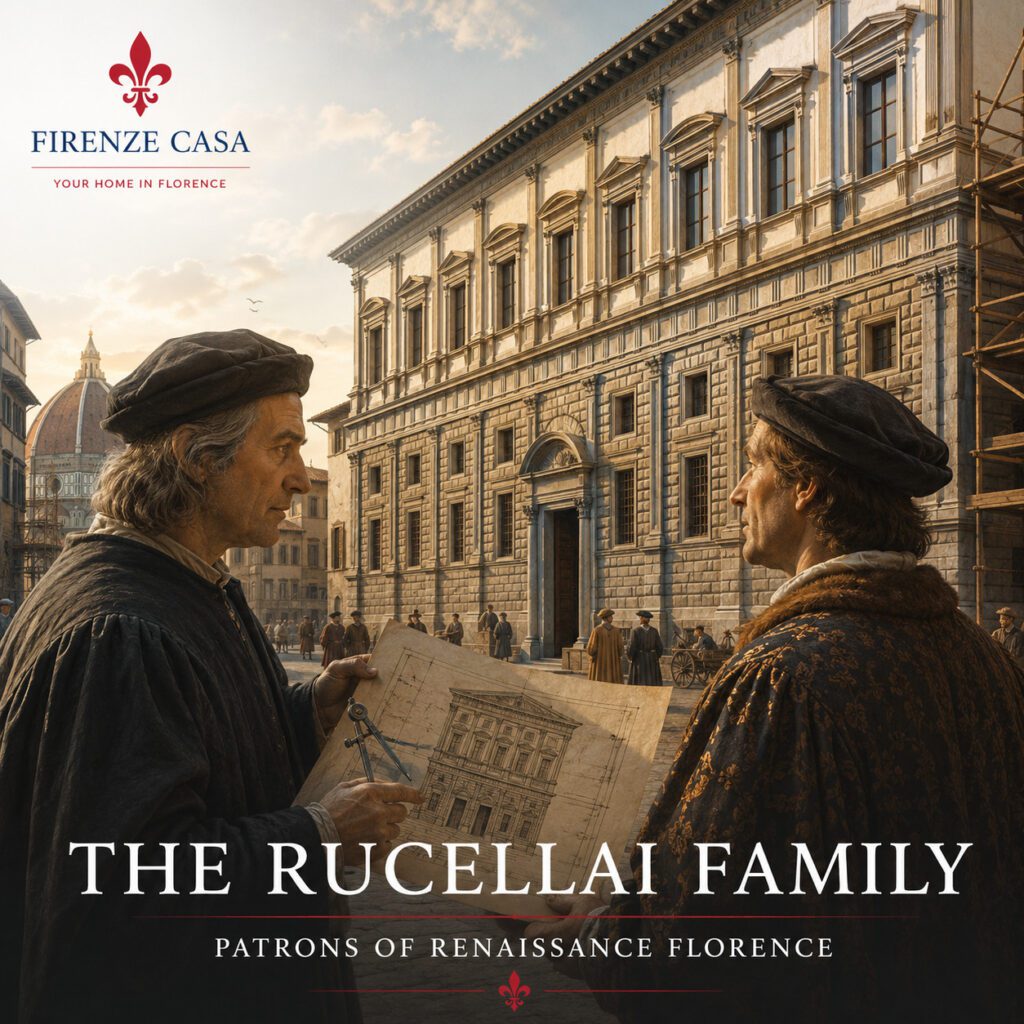
Perhaps the family’s greatest architectural legacy is Palazzo Rucellai, one of the most elegant Renaissance palaces in Florence. Designed by Leon Battista Alberti during the middle of the fifteenth century, the building departed dramatically from the fortress-like appearance of earlier Florentine palaces.
Instead of emphasising defensive strength, Alberti created a façade inspired by the orderly proportions of ancient Roman architecture. Three superimposed levels of classical pilasters—Doric, Ionic and Corinthian—organise the building with remarkable clarity and elegance.
The carefully balanced windows, geometric proportions and refined stonework introduced a new architectural language that would influence palace design throughout Italy and eventually across Europe. Palazzo Rucellai became a model for Renaissance domestic architecture and remains one of Alberti’s greatest achievements.
Although more restrained than the enormous residences later built by the Medici or Pitti families, Palazzo Rucellai perfectly expresses the humanist ideals of order, dignity and measured beauty. Rather than impressing through sheer size, it achieves distinction through proportion and architectural refinement.
| Architectural Feature | Importance |
|---|---|
| Classical Pilasters | Inspired by ancient Roman architectural orders. |
| Perfect Proportions | Create balance and visual harmony across the façade. |
| Rusticated Ground Floor | Provides stability while remaining more refined than earlier medieval palaces. |
| Elegant Cornice | Completes the composition with classical restraint. |
| Urban Integration | Designed to enhance the surrounding streetscape rather than dominate it. |
Today, Palazzo Rucellai remains one of the finest examples of early Renaissance architecture and stands as a lasting reminder that the Rucellai family shaped Florence not through political power, but through their vision, education and enduring support of the arts.
The Façade of Santa Maria Novella
One of the most visible expressions of Rucellai patronage is the magnificent marble façade of the Basilica of Santa Maria Novella. The lower section of the church had already been partially decorated during the medieval period, but its upper façade remained incomplete when Giovanni Rucellai commissioned Leon Battista Alberti to create a unified design.
Alberti faced a difficult architectural challenge. He could not begin with an empty structure, but instead had to harmonise the existing Gothic elements with the classical principles of Renaissance architecture. His solution was both practical and revolutionary.
The completed façade combines white and green marble, geometric patterns, classical proportions and elegant scroll-shaped volutes. These large curved elements visually connect the wider lower level of the church with the narrower upper section, creating a balanced and coherent composition.
Rather than rejecting the medieval structure, Alberti integrated it into a new Renaissance design. The result is one of the clearest demonstrations of his architectural intelligence: the façade appears harmonious even though it brings together elements created in different periods and artistic traditions.
| Feature | Architectural Significance |
|---|---|
| Green and white marble | Continues a traditional Florentine decorative language while introducing Renaissance order. |
| Classical pediment | Recalls the façades of ancient Roman temples. |
| Large volutes | Connect the broad lower façade with the narrower upper level. |
| Geometric decoration | Expresses Alberti’s interest in mathematics, proportion and visual harmony. |
| Rucellai emblems | Record the family’s role as patrons of the completed façade. |
The name of Giovanni Rucellai is still visible on the façade, together with the date 1470. The inscription ensured that future generations would remember the patron responsible for completing one of Florence’s most important churches.
Rucellai symbols were also incorporated into the decorative programme. Among the most recognisable are the family’s billowing sail emblems, which appear alongside other ornamental details and transform private identity into part of the public architecture of the city.
Firenze Casa Insight: The façade of Santa Maria Novella is not simply a Renaissance addition to a medieval church. It is a carefully designed bridge between two architectural eras, and the Rucellai family made that transformation possible.
The Rucellai Sepulchre and the Church of San Pancrazio
The family’s collaboration with Alberti extended beyond Palazzo Rucellai and Santa Maria Novella. Another remarkable commission can be found inside the former Church of San Pancrazio, close to the Rucellai palace.
There, Alberti designed the Rucellai Sepulchre, a small marble structure inspired by the Church of the Holy Sepulchre in Jerusalem. Created as a family funerary monument, it reflects the Renaissance fascination with classical geometry, sacred symbolism and the architecture of antiquity.
The monument is composed of carefully proportioned marble panels decorated with geometric designs and emblems. Although modest in scale, it possesses a striking architectural presence and demonstrates Alberti’s ability to transform a compact space into a monument of great dignity.
The sepulchre also reveals how Renaissance patronage united religious devotion and family commemoration. For Giovanni Rucellai, architecture offered a way to honour God, preserve family memory and contribute to the cultural prestige of Florence at the same time.
The Rucellai Family and the Medici
The Rucellai lived and worked in a city increasingly dominated by the Medici. Maintaining independence while avoiding conflict required political intelligence, careful diplomacy and well-chosen family alliances.
Relations between the two dynasties were strengthened through marriage. Giovanni Rucellai’s son Bernardo married Nannina de’ Medici, the sister of Lorenzo the Magnificent. The union connected the Rucellai directly to Florence’s most powerful family and placed them within the Medici political and cultural network.
The celebrations surrounding the marriage were held near Palazzo Rucellai and demonstrated how private family events could become major public occasions. Such marriages were not merely personal relationships; they reinforced commercial interests, social status and political security.
Despite this close connection, the Rucellai retained a distinct identity. Their cultural legacy is characterised less by the accumulation of political authority than by refined architectural patronage, intellectual curiosity and a preference for measured elegance.
The family’s relationship with the Medici was not always straightforward. During later periods of political unrest, individual members of the Rucellai circle participated in debates about republican government and the future of Florence. Their palace became associated not only with architectural innovation but also with intellectual discussion.
The Orti Oricellari and Renaissance Intellectual Life
Behind the family’s urban residences lay gardens known as the Orti Oricellari, or Rucellai Gardens. These became an important meeting place for scholars, writers and political thinkers during the late fifteenth and early sixteenth centuries.
The gardens offered a setting where members of Florence’s intellectual elite could discuss history, philosophy, literature and politics away from the formal institutions of government. Such gatherings reflected the humanist belief that the study of antiquity could provide guidance for contemporary civic life.
The Orti Oricellari are especially associated with discussions about republican government during a period when Florence’s political future remained uncertain. Writers and thinkers examined ancient Roman history and considered how its lessons might be applied to their own city.
Niccolò Machiavelli was among the figures connected with this intellectual environment. His participation demonstrates that Rucellai patronage extended beyond visual art and architecture into political thought and literary culture.
This aspect of the family’s legacy is particularly important. The Rucellai did not merely commission beautiful buildings; they helped create spaces in which Renaissance ideas could be discussed, questioned and developed.
Marriage Celebrations and the Loggia Rucellai
Opposite Palazzo Rucellai stands the elegant Loggia Rucellai, traditionally associated with Alberti’s architectural circle. The open structure was designed for public ceremonies, family celebrations and social gatherings.
The loggia formed part of a wider urban ensemble that included the palace, family residences and nearby religious foundations. Together, these buildings transformed the surrounding neighbourhood into a visible expression of Rucellai identity.
During major weddings and civic occasions, the loggia allowed festivities to extend into the street. It therefore occupied an intermediate position between private residence and public city, reflecting the role of wealthy merchant families in Florentine social life.
The architecture is restrained and harmonious, using classical columns and rounded arches rather than the heavy defensive forms found in many earlier palaces. Like Palazzo Rucellai itself, it communicates confidence through proportion rather than monumentality.
The Rucellai Emblems and Family Identity
Florentine families frequently used heraldic symbols to identify their buildings, chapels and commissions. The Rucellai were particularly skilled at incorporating their emblems into architecture without disturbing the overall harmony of the design.
The family coat of arms features a lion, while the famous billowing sail emblem became closely associated with Giovanni Rucellai and his descendants. These sails can still be seen in decorative programmes connected with the family, including the façade of Santa Maria Novella.
The symbolism of the sail has been interpreted as an expression of commercial success, favourable fortune and forward movement. It was especially appropriate for a dynasty whose wealth depended on international trade and whose influence extended far beyond Florence.
Visitors who learn to recognise these emblems begin to see the city differently. Architectural decoration becomes a historical map, revealing the patrons whose wealth and ambitions shaped individual streets, churches and palaces.
Later Generations of the Rucellai Family
The cultural influence of the Rucellai did not end with Giovanni. Later generations continued to participate in Florentine literary, political and religious life.
Giovanni di Bernardo Rucellai, born in the late fifteenth century, became known as a writer and humanist. His literary works reflected the family’s continued engagement with classical culture and demonstrated how intellectual patronage could evolve into direct artistic production.
Other members of the dynasty held important civic and ecclesiastical positions. Through marriage, diplomacy and service, the family remained connected to the leading institutions of Florence even as political authority became increasingly concentrated in Medici hands.
The family’s influence also extended beyond Tuscany. A later descendant, Giulio Rucellai, became associated with the cultural and administrative life of the eighteenth century, illustrating the remarkable longevity of the dynasty.
Although their political importance changed over time, the family name remained closely connected with refinement, education and architectural patronage. Their greatest achievements were therefore not temporary offices or military victories, but buildings and ideas that survived for centuries.
Where to Discover the Rucellai Legacy Today
The Rucellai legacy is concentrated in a relatively compact area of central Florence, making it possible to explore several important sites during a single walk.
Palazzo Rucellai
Located on Via della Vigna Nuova, Palazzo Rucellai is the clearest expression of the family’s architectural ideals. The building is privately used and is not generally visited as a conventional museum, but its celebrated façade can be admired from the street.
Loggia Rucellai
Standing opposite the palace, the loggia formed part of the family’s ceremonial and social space. Its elegant arches provide a valuable comparison with the more enclosed façade of the palace.
Santa Maria Novella
The basilica’s marble façade is the family’s most visible public commission. Visitors should look carefully for the Rucellai inscription and emblems incorporated into Alberti’s design.
Rucellai Sepulchre
The sepulchre is preserved within the former San Pancrazio complex, now associated with the Marino Marini Museum. Access conditions can vary, so visitors should consult the official museum information before planning a visit.
The Former Rucellai Gardens
The historic Orti Oricellari were located near Via della Scala. Although the area has changed considerably, its history remains important for understanding Florence’s humanist and political culture.
| Site | What to Look For |
|---|---|
| Palazzo Rucellai | Alberti’s ordered façade, classical pilasters and harmonious proportions. |
| Loggia Rucellai | Open arches and the relationship between family architecture and public space. |
| Santa Maria Novella | Marble geometry, volutes, Rucellai emblems and the 1470 inscription. |
| Rucellai Sepulchre | Geometric marble decoration and references to the Holy Sepulchre in Jerusalem. |
| Orti Oricellari area | The setting of important Renaissance literary and political discussions. |
A Self-Guided Rucellai Walk
A useful way to understand the family is to follow their architectural footprint through the western part of Florence’s historic centre. Begin at the façade of Santa Maria Novella, where the scale and public importance of Rucellai patronage are immediately visible.
From the piazza, walk towards Via della Vigna Nuova and Palazzo Rucellai. Take time to observe how the façade differs from the heavier appearance of Palazzo Medici Riccardi or Palazzo Strozzi. The building’s elegance lies in the regular rhythm of its pilasters, windows and carefully measured stonework.
Continue to the nearby Loggia Rucellai and then towards the former Church of San Pancrazio. This short route reveals how the family created not one isolated monument, but a network of buildings that shaped an entire Florentine neighbourhood.
Firenze Casa Tip: The Rucellai sites are best explored slowly and on foot. Most of their architectural details are subtle, so step back from the façades and look for repeating proportions, classical columns, family emblems and geometric patterns.
Why the Rucellai Family Matters
The Rucellai family offers a particularly revealing example of how Renaissance Florence developed. Their history demonstrates that the city’s cultural transformation was not created by artists alone. It depended on merchants and patrons who possessed the wealth, education and imagination required to support ambitious ideas.
Through Giovanni Rucellai’s collaboration with Alberti, abstract humanist theories became visible architecture. Classical proportion was applied to private palaces, sacred buildings and funerary monuments, influencing generations of architects throughout Europe.
The family also shows how private patronage could improve the public appearance of Florence. The façade of Santa Maria Novella was a religious commission, a family memorial and a gift to the city simultaneously.
Perhaps most importantly, the Rucellai represent a quieter form of power. Their legacy was not built primarily through political domination, but through culture, architecture, scholarship and civic identity.
Interesting Facts About the Rucellai Family
- ⚜️ The family’s name is traditionally connected with the discovery or production of a valuable reddish-purple dye used in textile manufacturing.
- 🏛️ Palazzo Rucellai became one of the most influential models for Renaissance palace architecture.
- 📐 Leon Battista Alberti designed several major projects for Giovanni Rucellai, creating one of the Renaissance’s most important partnerships between architect and patron.
- ⛪ The family financed the completion of the famous façade of Santa Maria Novella.
- ⛵ Billowing sails became one of the most recognisable Rucellai emblems.
- 💍 A marriage between Bernardo Rucellai and Nannina de’ Medici connected the family to Lorenzo the Magnificent.
- 📚 The Orti Oricellari became a meeting place for humanists and political thinkers.
- ✍️ Giovanni Rucellai left extensive writings that provide important evidence about the values and daily life of Florence’s merchant elite.
- 🏺 The Rucellai Sepulchre was inspired by the Holy Sepulchre in Jerusalem.
- 🚶 Several of the most important Rucellai sites can be visited during one short walk through central Florence.
Frequently Asked Questions
Who were the Rucellai?
The Rucellai were a wealthy Florentine merchant and banking family who became celebrated patrons of Renaissance architecture, literature and humanist culture.
How did the Rucellai family become wealthy?
The family built its fortune primarily through textile production, dyeing, international commerce and banking. These activities connected Florence with markets across Europe and the Mediterranean.
Who was Giovanni Rucellai?
Giovanni Rucellai was a fifteenth-century merchant, humanist, writer and architectural patron. He commissioned several major works by Leon Battista Alberti.
Which buildings are associated with the Rucellai family?
The most important sites include Palazzo Rucellai, the Loggia Rucellai, the façade of Santa Maria Novella and the Rucellai Sepulchre in the former San Pancrazio complex.
Who designed Palazzo Rucellai?
The palace is generally associated with Leon Battista Alberti, although the precise organisation and execution of the building involved other architects and craftsmen, including Bernardo Rossellino.
Why is Palazzo Rucellai important?
Its façade introduced a harmonious classical system of pilasters and proportions that became highly influential in Renaissance palace design.
What did the Rucellai contribute to Santa Maria Novella?
Giovanni Rucellai financed the completion of the church’s marble façade, which was designed by Leon Battista Alberti and completed during the fifteenth century.
How were the Rucellai connected to the Medici?
The families were linked through marriage when Bernardo Rucellai married Nannina de’ Medici, the sister of Lorenzo the Magnificent.
What were the Orti Oricellari?
The Orti Oricellari were the Rucellai family gardens, which became an important meeting place for humanists, writers and political thinkers during the Renaissance.
Can visitors enter Palazzo Rucellai?
The palace is not generally operated as a conventional public museum. Visitors can, however, admire its celebrated façade from Via della Vigna Nuova.
Can the Rucellai Sepulchre be visited?
The monument is located within the former San Pancrazio complex. Access arrangements may vary, so visitors should check current information from the Marino Marini Museum before visiting.
Why are the Rucellai remembered today?
They are remembered for transforming commercial wealth into a lasting cultural legacy through architecture, religious patronage, literature and humanist scholarship.
Further Reading from Firenze Casa
- Palazzo Rucellai: Alberti’s Renaissance Masterpiece
- Basilica of Santa Maria Novella: Florence’s Dominican Masterpiece
- Leon Battista Alberti: The Genius of the Renaissance
- The Medici Family: Florence’s Most Powerful Dynasty
- The Pazzi Family: Florence’s Most Famous Conspiracy
- The Pitti Family: Builders of Florence’s Largest Palace
- Palazzo Medici Riccardi: Where the Medici Empire Began
- Palazzo Strozzi: History, Architecture & Exhibitions
- Florence’s Symbols: The Lily & the Marzocco
- The Great Families of Renaissance Florence
References
- Treccani – Rucellai
- Encyclopaedia Britannica – Leon Battista Alberti
- Comune di Firenze
- Ministero della Cultura
- Santa Maria Novella – Official Monumental Complex
- Museo Marino Marini – Rucellai Chapel and Sepulchre
- Leon Battista Alberti – De re aedificatoria
- Giovanni Rucellai – Zibaldone
- John M. Najemy – A History of Florence 1200–1575
- Christopher Hibbert – Florence: The Biography of a City
- Peter Murray – The Architecture of the Italian Renaissance
- Giorgio Vasari – Lives of the Most Excellent Painters, Sculptors and Architects