
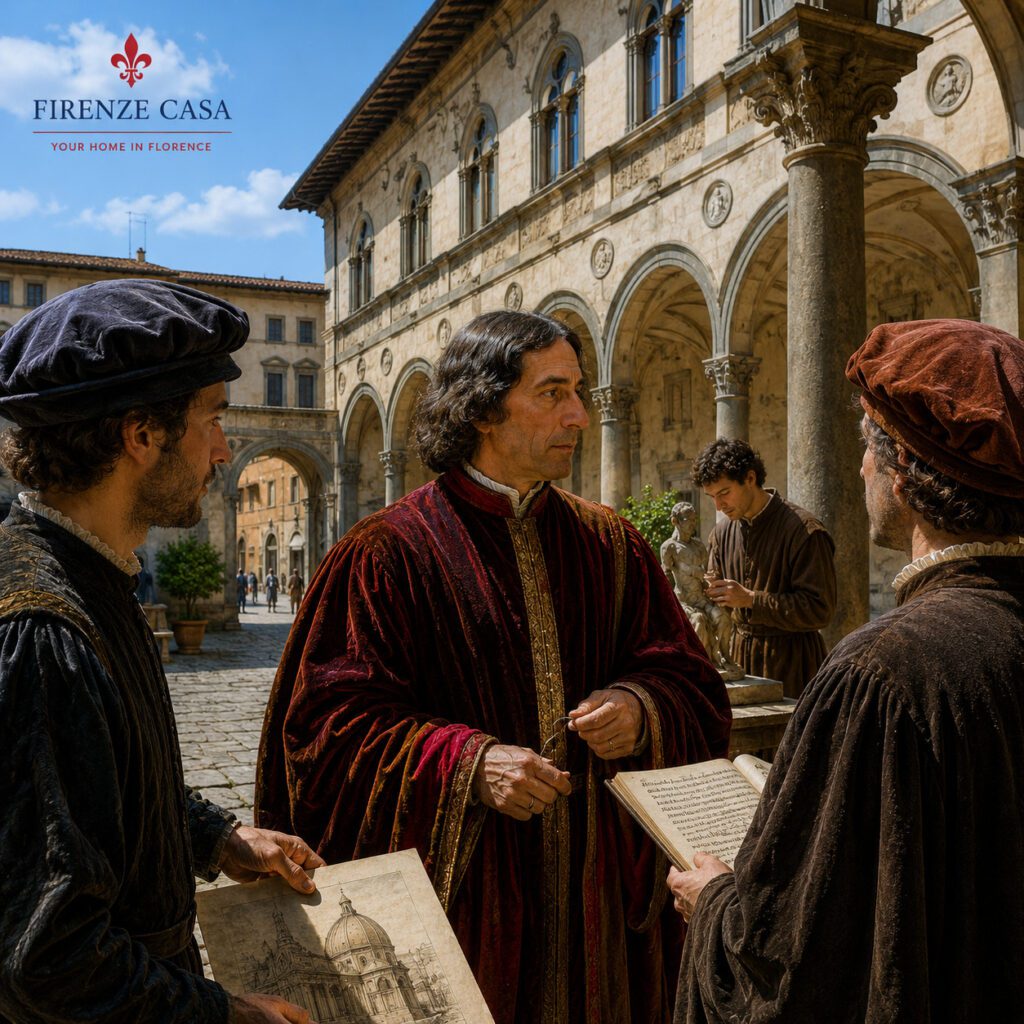
Lorenzo de’ Medici, known to history as Lorenzo the Magnificent, became one of the defining personalities of Renaissance Florence. As a politician, diplomat, poet and patron, he stood at the centre of a remarkable cultural world that included philosophers, writers and some of the greatest artists of the Italian Renaissance.
Yet Lorenzo was neither a king nor a duke. Florence formally remained a republic, while his power depended on family influence, political alliances and an extensive network of supporters. His lifetime also reveals that Renaissance Florence was far from peaceful: Lorenzo survived the Pazzi Conspiracy, faced war with the pope and Naples, and spent years protecting a fragile balance among the competing powers of Italy.
Born: 1 January 1449, Florence
Known as: Lorenzo the Magnificent
Political role: De facto leader of the Florentine Republic
Family: Medici
Major crisis: Pazzi Conspiracy of 1478
Key strength: Diplomacy and political influence
Cultural role: Patron, poet and supporter of humanist circles
Died: 8 April 1492, Careggi
Why he matters: Lorenzo linked political power, diplomacy and Renaissance culture at one of Florence’s most important historical moments
Lorenzo is one of the central personalities in our History of Florence – Important Florentine Figures and a key figure in the wider story of the Medici Family – The Dynasty That Shaped Florence.
Who Was Lorenzo de’ Medici?
Lorenzo de’ Medici was born in Florence on 1 January 1449. He belonged to a family that had risen through banking and commerce to become the dominant political force in the Florentine Republic.
His grandfather, Cosimo de’ Medici – later known as Cosimo the Elder – established the foundations of Medici political influence, while Lorenzo’s father, Piero di Cosimo de’ Medici, continued that position despite persistent health problems.
From an early age, Lorenzo received the sophisticated education expected of a member of Florence’s ruling elite. He studied literature, philosophy and classical culture while developing a genuine interest in poetry. At the same time, his education prepared him for diplomacy and public life.
When Piero died in December 1469, Lorenzo was only twenty years old. Together with his younger brother Giuliano, he inherited the family’s political position, and Lorenzo soon emerged as the leading Medici figure in Florence.
Lorenzo de’ Medici represents one of the most celebrated periods in Florentine history. His political influence, cultural patronage and diplomacy helped make Florence one of the intellectual and artistic centres of Renaissance Europe.
A Ruler Without a Crown
Describing Lorenzo as the ruler of Florence requires some explanation.
He did not occupy a throne, nor did he officially govern as the city’s sovereign. Florence retained its republican councils, magistrates and elected offices, yet the Medici exercised enormous influence over these institutions.
Family connections, patronage, financial resources and carefully managed political relationships allowed Lorenzo to shape government without formally abolishing the republican system.
This indirect form of rule offered important advantages. Lorenzo could present himself as a leading citizen rather than a prince while exercising extraordinary influence over Florentine political life.
However, the system also made his position vulnerable because Medici power depended heavily on alliances and personal loyalty. Political opponents within Florence never disappeared completely.
“Lorenzo the Magnificent” can sound like the title of a monarch, but Magnifico was an honorific used in Renaissance Italy. Lorenzo never became Duke of Florence. The Medici acquired hereditary ducal power only in the following century.
Lorenzo and Palazzo Medici Riccardi
One of the best places to understand Lorenzo’s Florence is Palazzo Medici Riccardi.
His grandfather Cosimo the Elder commissioned the palace from architect Michelozzo during the fifteenth century. Its massive rusticated façade communicated wealth and authority without resembling a royal residence.
Inside, the palace offered a sophisticated environment filled with art, symbolism and political significance. It functioned simultaneously as a family residence, meeting place and centre of Medici cultural life.
The Chapel of the Magi remains one of its greatest treasures. Benozzo Gozzoli covered the walls with an elaborate procession that includes portraits of members of the Medici family and their circle.
Lorenzo grew up in this extraordinary setting. Visiting the palace today provides one of the most direct connections with the world in which Medici power developed.
Lorenzo the Patron of Renaissance Culture
The cultural reputation of Lorenzo de’ Medici became almost as important as his political career.
He encouraged an intellectual environment in which classical philosophy, literature and the visual arts flourished. Lorenzo himself wrote poetry in both learned and popular forms, so he participated actively in Florentine literary culture rather than functioning merely as a wealthy sponsor.
His circle included poet Angelo Poliziano and philosopher Marsilio Ficino. Through his engagement with Plato and Neoplatonic thought, Ficino contributed significantly to the intellectual culture associated with Medici Florence.
Lorenzo also collected antiquities and supported artists. However, popular accounts sometimes exaggerate his role by presenting him as the personal patron behind virtually every great Florentine masterpiece.
In reality, guilds, religious institutions, the republican government and many wealthy families also financed Florence’s extraordinary artistic production.
Lorenzo did not create the Renaissance single-handedly. Florence already possessed a powerful tradition of artistic patronage. His particular importance lies in the exceptional cultural network surrounding the Medici and in his ability to connect politics, scholarship and the arts.
Lorenzo de’ Medici and Botticelli
Sandro Botticelli ranks among the artists most strongly associated with the Florence of Lorenzo the Magnificent.
His paintings have come to embody the elegance and intellectual sophistication of the late fifteenth-century Florentine Renaissance. The relationship between Botticelli, Lorenzo and the wider Medici circle was significant, although individual commissions are often simplified in popular accounts.
Members and associates of the Medici family supported Botticelli, and his work emerged from the same cultural environment in which Lorenzo played a prominent role.
Paintings such as the Primavera and The Birth of Venus reflect the fascination with classical mythology and humanist culture that characterised elite Florentine society during this period.
Visitors can see these works today in the Uffizi, where they offer a remarkable encounter with the artistic world that later became inseparable from Lorenzo’s historical reputation.
The Young Michelangelo and Lorenzo
Another famous connection involves Michelangelo Buonarroti.
According to early biographical traditions, Lorenzo recognised the young sculptor’s talent and welcomed him into the Medici environment. Michelangelo studied sculpture in the garden associated with the Medici collection near San Marco, where young artists could encounter ancient works and study classical sculpture.
Lorenzo’s support also brought Michelangelo into contact with the intellectual and cultural elite surrounding the family. This experience played an important role in the artist’s development because he absorbed artistic influences alongside the classical and humanist ideas shaping late fifteenth-century Florence.
Their personal relationship remained relatively brief because Lorenzo died while Michelangelo was still a teenager. Nevertheless, Medici support became an important chapter in the traditional story of the artist’s early career.
When Lorenzo de’ Medici died in 1492, Michelangelo was only seventeen. Within a few years, the young sculptor who had encountered the Medici cultural circle would begin creating works that transformed the history of Western art.
The Pazzi Conspiracy
The most dramatic day of Lorenzo’s political life came on 26 April 1478.
During Mass inside Florence Cathedral, conspirators attacked Lorenzo and his younger brother Giuliano. History remembers the plot as the Pazzi Conspiracy, named after the Florentine family at its centre, although powerful interests beyond Florence also participated.
The conspiracy grew partly from political and financial tensions between the Medici and Pope Sixtus IV.
Giuliano de’ Medici was killed, while Lorenzo suffered wounds but managed to escape and take refuge in the cathedral sacristy.
The attempted coup quickly failed. Florentine supporters of the Medici responded with extraordinary violence, killing several conspirators almost immediately and arresting others.
Authorities subsequently executed leading participants, and some bodies were famously displayed from the windows of Palazzo della Signoria, today’s Palazzo Vecchio.
Far from destroying the Medici, the conspiracy ultimately strengthened Lorenzo’s political position within Florence.
The Pazzi Conspiracy combined family rivalry, papal politics, banking interests and attempted assassination. It remains one of the clearest examples of how violent Renaissance political life could become.
War After the Pazzi Conspiracy
The failure of the conspiracy did not end the crisis.
Pope Sixtus IV and King Ferdinand I of Naples became involved in war against Florence, placing Lorenzo under enormous political and military pressure.
By 1479, the situation had become increasingly dangerous. Lorenzo responded with a bold diplomatic move by travelling personally to Naples to negotiate with King Ferdinand.
The journey carried considerable risk because Lorenzo effectively placed himself in the hands of a powerful opponent.
Nevertheless, his negotiations contributed to a settlement and helped relieve pressure on Florence. The episode strengthened Lorenzo’s reputation as a diplomat and later became central to the image of him as a statesman capable of protecting Florence through negotiation rather than conquest.
Renaissance Italy consisted of competing states including Florence, Venice, Milan, Naples and the Papal States. Survival depended not only on armies but also on alliances, negotiation and a constantly shifting balance of power.
Lorenzo and the Balance of Power in Italy
During the later years of his life, Lorenzo played an important diplomatic role among the Italian states.
His political objective was not Italian unification, an idea belonging to a much later period, but the preservation of a balance that protected Florence and Medici interests.
Relations among Milan, Venice, Naples, the Papal States and Florence remained complicated and frequently unstable. Alliances could shift rapidly, while conflicts in one region threatened to involve neighbouring powers.
Through diplomacy, Lorenzo cultivated relationships with rulers and political elites across Italy.
Later historians sometimes portrayed him as the central guarantor of Italian peace, although this interpretation exaggerates the ability of one individual to control the peninsula. His diplomatic importance was nevertheless considerable.
Within two years of his death in 1492, King Charles VIII of France invaded Italy. That dramatic sequence contributed to the later perception that Lorenzo’s disappearance marked the end of an era of relative stability.
Lorenzo and Savonarola
The final years of Lorenzo’s Florence also witnessed the growing influence of Girolamo Savonarola.
The Dominican preacher offered a striking contrast to the sophisticated cultural world associated with the Medici. Savonarola condemned corruption, luxury and moral decadence while warning Florence of divine punishment.
His increasingly powerful sermons attracted large audiences and introduced a very different vision of what Florence should become.
Over the centuries, the relationship between Lorenzo and Savonarola accumulated layers of legend. One famous story concerns Lorenzo’s deathbed at the Medici villa in Careggi, where later accounts claim that Savonarola refused absolution because Lorenzo would not agree to restore Florentine liberty.
Historians have questioned important details of this dramatic tradition. It is therefore safer to see Lorenzo and Savonarola as representatives of competing tendencies within late fifteenth-century Florence rather than reducing their relationship to a single legendary encounter.
The broader conflict between religious authority and political power is explored in Religion and Power in Renaissance Florence.
The Medici Bank During Lorenzo’s Lifetime
Lorenzo inherited not only political influence but also the legacy of one of Europe’s most famous banking families.
However, the Medici Bank experienced serious difficulties during his lifetime. Several branches weakened or failed, while management problems and changing political conditions reduced the strength of the institution.
This complicates the popular image of Lorenzo presiding effortlessly over unlimited Medici wealth.
By the end of the fifteenth century, the family’s political prestige remained enormous, but the banking system that had helped create Medici power was no longer as strong as it had been under earlier generations.
The wider economic context is explored in our Birth of Modern Banking in Florence – Complete Guide.
The Death of Lorenzo the Magnificent
Lorenzo de’ Medici died at the Villa Medici at Careggi on 8 April 1492 at only forty-three years of age.
His eldest son Piero inherited the family’s political position, but Piero lacked his father’s authority and ability to navigate the dangerous politics of Renaissance Italy.
King Charles VIII of France invaded Italy in 1494. Piero’s handling of the crisis provoked outrage in Florence, and the city expelled the Medici.
Only two years after Lorenzo’s death, the political system he had spent decades maintaining collapsed.
The Medici eventually returned to power, but Florence would never again be exactly the city Lorenzo had known.
Where Is Lorenzo de’ Medici Buried?
Lorenzo’s burial place lies within the Medici complex of San Lorenzo, the religious and dynastic centre of the family’s Florentine world.
Visitors to the Medici Chapels can easily become confused because several members of the dynasty shared the names Lorenzo and Giuliano.
The two monumental tombs dominating Michelangelo’s New Sacristy do not commemorate Lorenzo the Magnificent and his brother.
Instead, Michelangelo created those elaborate monuments for Lorenzo, Duke of Urbino, and Giuliano, Duke of Nemours.
Lorenzo the Magnificent and his brother Giuliano rest beneath a much more restrained monument associated with Michelangelo’s Madonna and Child and statues of the Medici patron saints Cosmas and Damian.
Do not let the repeated Medici names cause confusion. The famous sculptural tomb of “Lorenzo” in Michelangelo’s New Sacristy belongs to Lorenzo, Duke of Urbino – not Lorenzo the Magnificent.
Following Lorenzo de’ Medici Through Florence
Few historical personalities can be followed through Florence as easily as Lorenzo.
A good route begins at Palazzo Medici Riccardi on Via Cavour, where he grew up and where the Medici conducted much of their political and cultural life.
From there, walk to nearby San Lorenzo, where the church and Medici complex reveal the family’s close relationship with religion, architecture and dynastic memory.
Continue towards Florence Cathedral, where the Pazzi conspirators attacked Lorenzo and murdered Giuliano in 1478.
The Uffizi offer another perspective through paintings by Botticelli and other artists associated with Lorenzo’s cultural world, while Piazza della Signoria and Palazzo Vecchio recall the republican institutions that continued to function throughout his unofficial rule.
Together, these places make Lorenzo’s story unusually tangible and allow visitors to explore his Florence largely on foot.
For a compact Lorenzo de’ Medici walk, start at Palazzo Medici Riccardi, continue to San Lorenzo and the Duomo, and finish in Piazza della Signoria. The route connects some of the most important places in Lorenzo’s life within a relatively small part of central Florence.
Was Lorenzo Really “Magnificent”?
The famous name can make Lorenzo appear universally admired, but his historical legacy is more complicated.
Supporters celebrated his diplomacy, cultural sophistication and patronage, while critics regarded Medici dominance as a distortion of Florence’s republican traditions.
His family’s financial position also weakened during his lifetime, and the Medici Bank experienced serious difficulties as branches failed and management problems accumulated.
For this reason, Lorenzo should not simply appear as an ideal Renaissance prince presiding over an effortless golden age.
His Florence remained politically divided, financially complicated and surrounded by dangerous rivals. His ability to navigate this difficult environment while participating personally in the intellectual and cultural life of Florence helps explain his exceptional historical reputation.
Lorenzo becomes more interesting when we look beyond the legend. His success rested not on absolute power but on managing a republic, a family network, international diplomacy and a cultural world that was brilliant but politically fragile.
The Legacy of Lorenzo de’ Medici
Lorenzo’s historical reputation rests on an unusual combination of politics and culture.
He preserved Medici dominance during one of the family’s most dangerous periods, survived an assassination attempt and became an important diplomatic figure in Renaissance Italy.
At the same time, his name became associated with an extraordinary generation of writers, philosophers and artists. The cultural world surrounding him contributed greatly to Florence’s enduring reputation as a centre of the Renaissance.
Perhaps the most fascinating aspect of Lorenzo is the contradiction at the centre of his career. He became the dominant political figure of a republic that insisted it had no prince, celebrated classical culture within a deeply Christian society and supported artistic brilliance while managing a political system built heavily on family influence.
These contradictions make Lorenzo de’ Medici more interesting than the legend of Lorenzo the Magnificent alone.
Walking through Florence today, visitors can still encounter the palaces, churches, artworks and public spaces connected with the remarkable world he helped shape.
Further Reading on Firenze Casa
Continue exploring Lorenzo de’ Medici, his family and the political world of Renaissance Florence:
- History of Florence – Important Florentine Figures
- The Medici Family – The Dynasty That Shaped Florence
- Palazzo Medici Riccardi – Renaissance Palace in Florence
- The Pazzi Family – Florence’s Most Famous Conspiracy
- Girolamo Savonarola – The Preacher Who Challenged Florence
- Religion and Power in Renaissance Florence
- The Medici Bank – Europe’s Most Powerful Bank
- The Birth of Modern Banking in Florence – Complete Guide
- History of Florence – Complete Guide
References
- Encyclopaedia Britannica – Lorenzo de’ Medici
- Treccani – Dizionario Biografico degli Italiani: Lorenzo de’ Medici
- Palazzo Medici Riccardi – Historical Documentation on the Medici Family and the Palace
- Gallerie degli Uffizi – Historical and Collection Documentation on Lorenzo de’ Medici, Botticelli and Medici Patronage
- Musei del Bargello – Cappelle Medicee, Historical Documentation on the Medici Dynasty and the New Sacristy
- Hibbert, Christopher – The House of Medici: Its Rise and Fall
- Kent, F. W. – Lorenzo de’ Medici and the Art of Magnificence
- Najemy, John M. – A History of Florence 1200–1575
- Martines, Lauro – April Blood: Florence and the Plot Against the Medici

