The History of Florence: From Roman Florentia to the Renaissance and Beyond
The history of Florence spans from its Etruscan and Roman origins to its medieval rise as a trade and banking power, from its role as the birthplace of the Renaissance to the modern tourist city it is today. The city’s trajectory was defined by shifting struggles between republicanism and dynasty—most notably under the powerful Medici family.
Antiquity and Early Middle Ages
Etruscan settlement: An Etruscan settlement developed on the hill of modern Fiesole, with a crossing point on the Arno River near present-day Florence.
Roman founding: The Roman city of Florentia was established in 59 BCE as a military colony on the fertile Arno plain. Its Roman grid street plan (cardo and decumanus) remains legible in the historic center.
Turbulent centuries: After Rome’s fall, Florence alternated between Ostrogothic and Byzantine control. Population declined before stabilizing under Lombard rule in the 6th century.
Read more: Britannica: Florence, Treccani: Firenze.
Medieval Florence: Trade and Finance
A powerful commune: In 1115, after the death of Countess Matilda of Tuscany, Florence asserted independence from imperial control and evolved into a self-governing city-state (commune).
The gold florin (1252): Florence introduced the reliable gold florin, which became a dominant trade coin across Western Europe and anchored the city’s financial reputation.
Banking dynasties: Houses such as the Bardi, Peruzzi, and later the Medici financed European commerce and warfare, pioneering instruments like bills of exchange and the widespread use of double-entry bookkeeping.
Political conflict: Factional strife between Guelphs (pro-papal) and Ghibellines (pro-imperial) shaped civic life. Tensions between old aristocratic lineages and merchant guilds culminated in the 1378 Ciompi Revolt (wool workers), a brief but consequential uprising.
Read more: Smarthistory: Florence & Early Renaissance.
Renaissance: The Golden Age of Art and Humanism
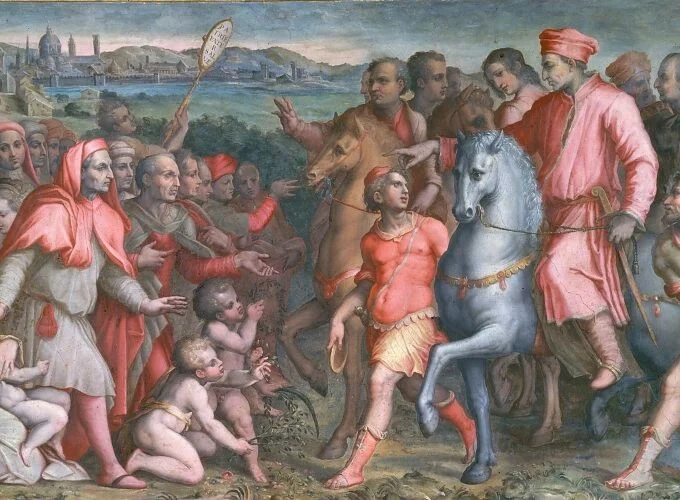
The Medici ascendancy: In 1434, Cosimo de’ Medici secured behind-the-scenes control, leveraging wealth from the Medici Bank. With interruptions, Medici influence would frame Florentine politics for nearly three centuries.
Patronage of the arts: Under Lorenzo the Magnificent (r. 1469–1492), Florence became the epicenter of the Italian Renaissance. Patronage nurtured Leonardo da Vinci, Michelangelo, Sandro Botticelli, Filippo Brunelleschi, and Donatello, and reshaped the city’s skyline.
Republican interludes: Twice exiled, the Medici gave way to republican restorations. The first, after Lorenzo’s death, saw the rise—and tragic fall—of the preacher Girolamo Savonarola and the famous “Bonfire of the Vanities.” The second ended after the 1530 siege by imperial and papal forces.
The birth of the Grand Duchy: In 1532, the Medici returned as hereditary rulers (Dukes of Florence). In 1569, Cosimo I was named Grand Duke of Tuscany, consolidating regional power.
See & learn: Palazzo Medici Riccardi, Uffizi Galleries, Opera di Santa Croce.
From Grand Duchy to Modern Era
End of the Medici: The dynasty ended in 1737 with the death of the last male heir. The Grand Duchy passed to the House of Habsburg-Lorraine.
Capital of Italy: During the Risorgimento, Florence served as the Kingdom of Italy’s capital from 1865 to 1871, before the seat moved to Rome.
World War II: German occupation (1943–1944) and partisan resistance scarred the city. Retreating forces destroyed all bridges except the Ponte Vecchio.
The Great Flood (1966): A devastating Arno flood damaged countless artworks. International volunteers—“Angels of Mud”—aided rescue and restoration, shaping modern conservation practice.
Read more: VisitFlorence: History Overview.
Florence Today
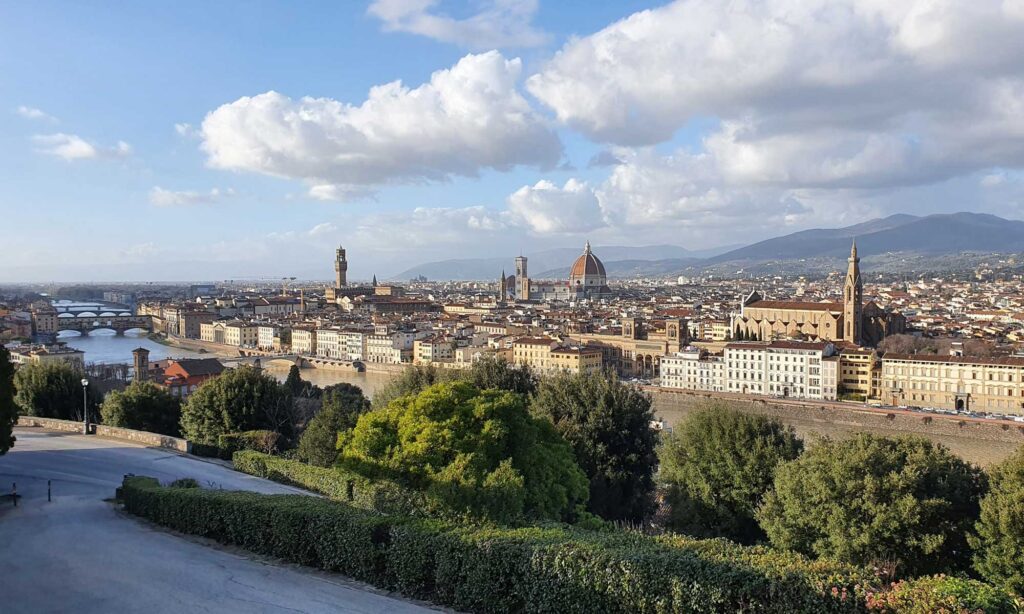
Cultural powerhouse: The Historic Centre of Florence was inscribed as a UNESCO World Heritage Site in 1982 for its unparalleled concentration of Renaissance art and architecture.
Global tourism hub: Florence remains a major economic center and international destination, where cultural heritage continues to influence arts, design, and fashion.
UNESCO: Historic Centre of Florence.
Sources & Further Reading
- Encyclopaedia Britannica – Florence
- Treccani Enciclopedia Italiana – Firenze
- Hibbert, Christopher. Florence: The Biography of a City. London: Penguin, 1988.
- Kent, Dale. The Rise of the Medici: Faction in Florence, 1426–1434. Oxford University Press, 1978.
- Brucker, Gene A. Florence: The Golden Age, 1138–1737. University of California Press, 1998.
- Gallerie degli Uffizi – Official
- Palazzo Medici Riccardi – Official
- Opera di Santa Croce – Official
- VisitFlorence – History Overview
- Smarthistory – Florence & the Early Renaissance
- UNESCO World Heritage Centre – Florence
Category: History of Florence