
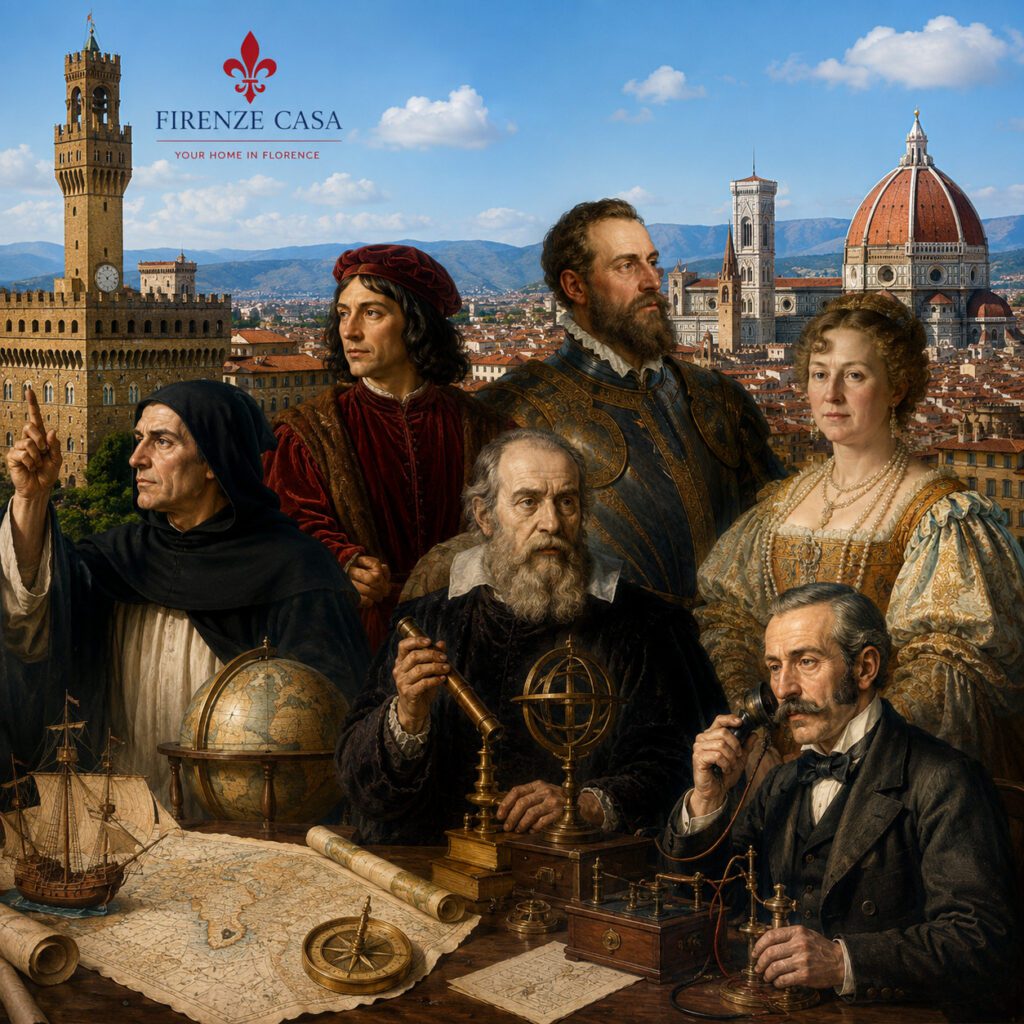
Important Florentine figures shaped far more than the history of Florence itself. Rulers, religious reformers, scientists, explorers and inventors connected with the city influenced Renaissance politics, modern science, European exploration and technological change.
Some of these names are inseparable from Florence. Lorenzo de’ Medici represents the cultural brilliance and political complexity of the Renaissance, while Girolamo Savonarola recalls one of its most turbulent moments. Others connect Florence with a much wider world, from Galileo Galilei and Amerigo Vespucci to Antonio Meucci.
Renaissance politics: Lorenzo de’ Medici and Girolamo Savonarola
Grand-ducal Florence: Cosimo I de’ Medici
Preservation of Medici art: Anna Maria Luisa de’ Medici
Science: Galileo Galilei
Exploration: Amerigo Vespucci
Technology: Antonio Meucci
Key periods: 15th–19th centuries
Why they matter: Their lives connect Florence with politics, religion, art, science, exploration and technological change
Contents – Important Florentine Figures
- Why People Matter in the History of Florence
- Girolamo Savonarola
- Lorenzo de’ Medici
- Cosimo I de’ Medici
- Anna Maria Luisa de’ Medici
- Galileo Galilei
- Amerigo Vespucci
- Antonio Meucci
- Not All Important Florentine Figures Were Born in Florence
- Where to Find Their Stories in Florence
- Who Else Shaped Florence?
- Frequently Asked Questions
This guide provides an overview of seven personalities and their importance to Florence. For more detail, continue with our individual articles on Girolamo Savonarola, Lorenzo de’ Medici, Cosimo I de’ Medici, Anna Maria Luisa de’ Medici, Galileo Galilei, Amerigo Vespucci and Antonio Meucci.
Why People Matter in the History of Florence
Florence is often described through its monuments. The Cathedral, Palazzo Vecchio, the Uffizi, Ponte Vecchio and the great Renaissance churches provide an extraordinary architectural record of the city’s past. Yet buildings alone cannot explain why Florence developed as it did.
Behind these monuments were people making political decisions, financing churches and palaces, challenging established authority and conducting experiments. Moreover, individuals and families shaped institutions, collected works of art and determined how Florence interacted with the wider world.
The History of Florence – Complete Guide is therefore also a history of personalities. Some exercised enormous power during their lifetimes, whereas others became even more influential after their deaths.
The figures in this guide were selected not simply because they are famous. Instead, each opens a different window onto Florence and its relationship with the wider world.
Florence becomes easier to understand when monuments are connected with the people behind them. A palace becomes a political statement, a museum reveals the history of collecting and patronage, while a piazza can become the stage for real human conflict.
Girolamo Savonarola – The Preacher Who Challenged Florence
Few figures capture the political and religious tensions of Renaissance Florence as dramatically as Girolamo Savonarola. Although born in Ferrara in 1452, the Dominican friar became permanently associated with Florence.
From the pulpit of San Marco, Savonarola delivered powerful sermons condemning corruption, moral decadence and what he regarded as excessive luxury. His influence increased dramatically after the expulsion of Piero de’ Medici in 1494.
During the following years, Savonarola promoted the idea of Florence as a Christian republic guided by moral renewal. His followers also became associated with campaigns against luxury and worldly possessions, culminating in the famous Bonfire of the Vanities of 1497.
However, his conflict with Pope Alexander VI eventually proved fatal. After being excommunicated, Savonarola was arrested and tried. On 23 May 1498, he and two fellow Dominican friars were executed in Piazza della Signoria.
His extraordinary rise and fall also forms one of the central episodes in our article on Religion and Power in Renaissance Florence.
A circular plaque in Piazza della Signoria marks the place traditionally associated with Savonarola’s execution. His story is also closely connected with the Dominican convent and Museum of San Marco.
Lorenzo de’ Medici – The Magnificent
While Savonarola represents conflict with Renaissance luxury and Medici influence, Lorenzo de’ Medici represents Florence at the height of its fifteenth-century cultural prestige.
Born in Florence in 1449, Lorenzo became the leading figure of the Medici family in 1469. Although Florence remained formally a republic, Medici wealth, alliances and political influence allowed him to exercise extraordinary power.
His importance extended far beyond government because Lorenzo also supported poets, philosophers and artists. As a result, he helped foster the intellectual environment associated with Renaissance Florence. His circle included figures such as Angelo Poliziano and Marsilio Ficino, while the young Michelangelo benefited from Medici patronage.
At the same time, Lorenzo was a skilled political operator. After surviving the Pazzi Conspiracy of 1478, in which his brother Giuliano was murdered inside Florence Cathedral, he consolidated his position and played an important role in diplomacy between the Italian states.
His story belongs to the wider history of the Medici Family – The Dynasty That Shaped Florence.
Lorenzo de’ Medici was never king or duke of Florence. Nevertheless, his wealth, alliances, patronage and political influence gave him extraordinary power within the structures of the Florentine Republic.
Cosimo I de’ Medici – The Duke Who Transformed Florence
Several decades later, another Medici ruler changed Florence in a very different way. Cosimo I de’ Medici, born in 1519, came to power in 1537 following the assassination of Alessandro de’ Medici.
Cosimo strengthened central authority and expanded Florentine control across Tuscany. Following the conquest of Siena, his state encompassed much of the region. Eventually, in 1569, Pope Pius V granted him the title of Grand Duke of Tuscany.
His impact remains extraordinarily visible in Florence. Palazzo Vecchio became a ducal residence before the court moved to Palazzo Pitti, while the Uffizi were commissioned as administrative offices for the state. In addition, the Vasari Corridor connected the political centre with the Medici residence across the Arno.
Today, these transformations can still be followed through several of the Historic Palaces of Florence. Cosimo’s reign therefore marks a crucial transition from the political culture of the Renaissance republic to the dynastic Florence of the grand dukes.
Palazzo Vecchio, the Uffizi, the Vasari Corridor and Palazzo Pitti can all be connected with the political world of Cosimo I. Consequently, walking between them is almost a journey through the geography of Medici power.
Anna Maria Luisa de’ Medici – The Woman Who Preserved Florence’s Art
Anna Maria Luisa de’ Medici occupies a very different place in Florentine history. Born in 1667, she was the daughter of Grand Duke Cosimo III and the last surviving member of the principal Medici line.
Her importance rests particularly on the agreement known as the Patto di Famiglia, or Family Pact. After the extinction of the ruling Medici dynasty, Tuscany passed to the House of Habsburg-Lorraine.
Crucially, Anna Maria Luisa helped ensure that the extraordinary collections accumulated by generations of Medici remained connected with Florence and Tuscany rather than being dispersed as private dynastic possessions.
The consequences are difficult to overstate. Paintings, sculptures, precious objects and other collections remained in Florence and consequently helped form the cultural inheritance encountered today in institutions such as the Uffizi and Palazzo Pitti.
The history of the Uffizi Gallery and its Medici legacy demonstrates particularly clearly how dynastic collecting eventually became part of Florence’s public cultural heritage.
Anna Maria Luisa did not create Florence’s Medici collections. However, her actions helped keep that inheritance in Tuscany, and her legacy therefore surrounds visitors throughout the city’s museums.
Galileo Galilei – Florence and the Birth of Modern Science
Galileo Galilei was born in Pisa in 1564, but his life and career became deeply intertwined with Florence and the Medici court.
Galileo made fundamental contributions to astronomy, physics and experimental science. Through telescopic observation, he revealed mountains on the Moon, numerous stars invisible to the naked eye and four large moons orbiting Jupiter.
Significantly, he named those moons the Medicean Stars in honour of the Medici family. The choice illustrates how closely scientific achievement and courtly patronage could interact in seventeenth-century Florence.
However, Galileo’s support for the Copernican model brought him into conflict with the Roman Inquisition. In 1633, he was convicted of vehement suspicion of heresy and subsequently spent the remainder of his life under house arrest.
Galileo died in 1642 at Arcetri in the hills immediately south of Florence. Today, his monumental tomb can be seen inside the Basilica of Santa Croce.
The Museo Galileo near the Uffizi contains one of the world’s most important collections of historic scientific instruments. Moreover, it provides the perfect continuation of Galileo’s Florentine story.
Amerigo Vespucci – The Florentine Who Gave America Its Name
Few Florentines left their name on the world quite as literally as Amerigo Vespucci. Born in Florence in 1454, Vespucci belonged to a respected Florentine family and became involved in commercial networks connecting Renaissance Florence with the expanding Atlantic world.
Around the turn of the sixteenth century, Vespucci participated in voyages across the Atlantic. Accounts associated with his journeys helped popularise the idea that the lands encountered across the ocean formed a continental landmass distinct from Asia from the European geographical perspective.
Then, in 1507, German cartographer Martin Waldseemüller used the name America on a world map, deriving it from the Latinised form of Amerigo’s name, Americus.
Eventually, the name came to designate both North and South America. A Florentine first name was therefore permanently embedded in global geography.
The Vespucci family had important connections with the Church of Ognissanti. For visitors interested in Amerigo’s Florentine origins, the church provides one of the strongest surviving connections with his native city.
Antonio Meucci – Florence and the Invention of the Telephone
Antonio Meucci takes the story of important Florentine figures into the industrial and technological age. Born in Florence in 1808, Meucci studied at the Accademia di Belle Arti and later worked as a technician at the Teatro della Pergola.
After spending time in Cuba, he eventually settled on Staten Island in New York. There, Meucci experimented with the electrical transmission of the human voice and developed devices he called the telettrofono.
His precise role in the invention of the telephone remains historically debated. Alexander Graham Bell received the famous US telephone patent in 1876, whereas supporters of Meucci argued that the Florentine inventor had developed important voice-transmission technology earlier.
Much later, in 2002, the United States House of Representatives passed a resolution recognising Meucci’s work in the development of the telephone. Nevertheless, this did not resolve every historical and technical debate surrounding priority.
His early career also creates an unexpected link with Florence’s performing-arts history through the Teatro della Pergola.
Before his experiments in America, Antonio Meucci worked at Teatro della Pergola. As a result, his story creates an unexpected connection between one of Florence’s historic theatres and the history of telecommunications.
From Renaissance Politics to Modern Technology
Seen together, these personalities reveal how widely Florence’s influence extended across time. Lorenzo de’ Medici and Savonarola represent competing visions of Renaissance society, while Cosimo I marks the transition towards a territorial dynastic state.
Anna Maria Luisa, meanwhile, connects Florence with the preservation of its Medici inheritance. Galileo links the city with the scientific revolution, whereas Vespucci connects it with European Atlantic exploration. Finally, Meucci carries the story into nineteenth-century communications technology.
This variety is precisely what makes Florentine history so fascinating. Although the Renaissance remains central to Florence’s identity, the city’s influence did not end with Renaissance art.
Instead, people associated with Florence participated in political, intellectual, scientific and technological transformations extending across several centuries.
Not All Important Florentine Figures Were Born in Florence
There is an important distinction behind the title of this guide. Savonarola was born in Ferrara, while Galileo was born in Pisa.
Nevertheless, both became so closely connected with Florence that excluding them would leave major gaps in the city’s history. Their lives demonstrate that historical influence does not always correspond neatly with birthplace.
The term important Florentine figures is therefore used here in a broader historical sense. It includes people whose lives, careers or legacies became deeply intertwined with Florence.
“Florentine” does not always mean “born in Florence”. Indeed, some of the city’s most influential historical personalities arrived from elsewhere but made Florence central to their lives and legacies.
Where to Find Their Stories in Florence
One of the pleasures of exploring these biographies is that their stories remain physically embedded throughout Florence.
For example, Savonarola leads visitors to San Marco and Piazza della Signoria, while Lorenzo de’ Medici opens the door to Palazzo Medici Riccardi, San Lorenzo and the world of Renaissance patronage.
Cosimo I, meanwhile, can be followed through Palazzo Vecchio, the Uffizi, the Vasari Corridor and Palazzo Pitti. In contrast, Anna Maria Luisa’s legacy is most clearly encountered through the collections that remained in Florence after the end of the Medici dynasty.
Beyond the Medici world, Galileo leads to the Museo Galileo, Santa Croce and Arcetri. Vespucci brings visitors to Ognissanti, whereas Meucci provides an unexpected reason to look more closely at Teatro della Pergola.
Consequently, these connections turn biography into geography. Florence becomes not simply a collection of monuments but a network of human stories.
Choose one historical figure before setting out for the day and follow their traces through Florence. In this way, familiar monuments can feel very different because they become part of a personal story rather than simply another stop on a sightseeing list.
Seven Figures, Seven Ways to Read Florence
Girolamo Savonarola – Religion and Political Conflict
Through Savonarola, visitors can explore the struggle between religious reform, republican politics and Medici Florence at the end of the fifteenth century.
Lorenzo de’ Medici – Patronage and Renaissance Power
Lorenzo’s life reveals how political influence, culture, philosophy and artistic patronage came together during the Florentine Renaissance.
Cosimo I de’ Medici – The Creation of Grand-Ducal Florence
With Cosimo I, the story moves towards the transformation of Florence from republic to the centre of a territorial dynasty extending across Tuscany.
Anna Maria Luisa de’ Medici – Preservation and Cultural Memory
Her story, by contrast, explains why so much of the Medici artistic inheritance remained in Florence after the dynasty disappeared.
Galileo Galilei – Science and Patronage
Galileo connects Florence with the scientific revolution and, at the same time, demonstrates the complicated relationship between research, political patronage and religious authority.
Amerigo Vespucci – Florence and the Wider World
Vespucci links Florentine commerce with Atlantic exploration and one of the most remarkable naming stories in world geography.
Antonio Meucci – Florence and Modern Technology
Finally, Meucci carries the story beyond the Renaissance into nineteenth-century migration, experimentation and telecommunications.
Who Else Shaped Florence?
No selection of important Florentine figures can ever be complete. Dante Alighieri, Niccolò Machiavelli and Giovanni Boccaccio, for example, profoundly shaped the city’s literary and intellectual identity.
Their relationship with the city is explored throughout our Florence in Literature – Complete Guide. Meanwhile, artists including Michelangelo, Leonardo da Vinci, Sandro Botticelli, Donatello and Brunelleschi made Florence synonymous with the Renaissance and naturally belong to other thematic clusters within Firenze Casa.
Powerful families also influenced politics, banking, architecture and patronage across generations. Although the Medici became the most famous, they belonged to a wider network that included the Strozzi, Rucellai, Pazzi, Albizzi, Salviati and others explored in The Most Famous Florentine Families in History.
This guide is therefore deliberately selective. Rather than creating an exhaustive list of famous Florentines, it highlights seven people whose lives illuminate particularly important turning points in the history of the city.
Frequently Asked Questions About Important Florentine Figures
Who are some of the most important people in the history of Florence?
Important figures connected with Florence include Lorenzo de’ Medici, Girolamo Savonarola, Cosimo I de’ Medici, Anna Maria Luisa de’ Medici, Galileo Galilei, Amerigo Vespucci and Antonio Meucci. Together, they represent different aspects of Florence’s political, cultural, scientific and technological history.
Who was Lorenzo de’ Medici?
Known as Lorenzo the Magnificent, Lorenzo de’ Medici was the leading figure of the Medici family during the late fifteenth century. Besides exercising enormous political influence, he became one of the most famous patrons of Renaissance art and humanist culture.
Why is Girolamo Savonarola important to Florence?
After the fall of Medici rule in 1494, Savonarola became one of the most powerful religious voices in Florence. His sermons, political influence and eventual execution in Piazza della Signoria consequently made him one of the most dramatic figures of Renaissance Florence.
What did Cosimo I de’ Medici do for Florence?
Cosimo I strengthened Medici rule, expanded Florentine power across Tuscany and transformed Florence into the centre of a territorial state. Moreover, major projects associated with his rule include the Uffizi and the Vasari Corridor.
Why is Anna Maria Luisa de’ Medici important?
Anna Maria Luisa helped ensure that the Medici collections remained in Florence after the dynasty ended. Consequently, her Family Pact played an important role in preserving the artistic heritage visitors encounter in the city’s museums today.
Was Galileo Galilei Florentine?
Although Galileo was born in Pisa, his career became closely connected with Florence and the Medici court. He later lived near the city at Arcetri and is buried in the Basilica of Santa Croce.
Why is America named after Amerigo Vespucci?
The name America derives from the Latinised form of Amerigo Vespucci’s first name. In 1507, German cartographer Martin Waldseemüller used the name on a world map, after which its geographical use gradually expanded.
Did Antonio Meucci invent the telephone?
Meucci developed early devices for transmitting the human voice electrically. However, his exact place in the invention of the telephone remains historically debated, although his experiments form an important chapter in the development of telecommunications.
Why Important Florentine Figures Are Worth Discovering
Important Florentine figures are worth discovering because they reveal how individual lives shaped political institutions, artistic collections, scientific ideas and even the geography of the wider world.
Lorenzo de’ Medici and Savonarola embody competing visions of Renaissance Florence, while Cosimo I transformed the city into the centre of a grand-ducal state. Anna Maria Luisa, meanwhile, helped protect the artistic inheritance accumulated by her dynasty.
Beyond politics and patronage, Galileo connects Florence with the scientific revolution. Vespucci links the city with Atlantic exploration, whereas Meucci carries its story into nineteenth-century technological innovation.
Following these lives therefore allows visitors to see Florence not simply as the preserved capital of the Renaissance. Instead, it emerges as a city whose people participated in developments extending far beyond Tuscany.
Florence is easier to remember through people. Once a name becomes connected with a palace, church, piazza or museum, the history of the city begins to form a much more coherent story.
Further Reading on Firenze Casa
Continue exploring the rulers, reformers, scientists and other personalities who shaped Florence:
- Girolamo Savonarola – The Preacher Who Challenged Florence
- Lorenzo de’ Medici – The Magnificent Ruler of Renaissance Florence
- Cosimo I de’ Medici – The Duke Who Transformed Florence
- Anna Maria Luisa de’ Medici – The Woman Who Preserved Florence’s Art
- Galileo Galilei – Science, the Medici and Florence
- Amerigo Vespucci – The Florentine Who Gave America Its Name
- Antonio Meucci – Florence and the Invention of the Telephone
- The Medici Family – The Dynasty That Shaped Florence
- The Most Famous Florentine Families in History
- Religion and Power in Renaissance Florence
- Florence in Literature – Complete Guide
- History of Florence – Complete Guide
References
- Encyclopaedia Britannica – Biographical Reference Entries on Girolamo Savonarola, Lorenzo de’ Medici, Cosimo I de’ Medici, Galileo Galilei and Amerigo Vespucci
- Treccani – Dizionario Biografico degli Italiani, Biographical Entries on Major Florentine Historical Figures
- Gallerie degli Uffizi – Historical Documentation on the Medici Dynasty and the Collections of Florence
- Museo Galileo, Florence – Historical and Biographical Documentation on Galileo Galilei
- Museo di San Marco, Florence – Historical Documentation on Girolamo Savonarola
- Basilica di Santa Croce, Florence – Historical Documentation on Galileo Galilei and Florentine Memorial Monuments
- United States House of Representatives – H.Res.269, 107th Congress, Concerning the Life and Achievements of Antonio Meucci, 2002
- Hibbert, Christopher – The House of Medici: Its Rise and Fall
- Najemy, John M. – A History of Florence 1200–1575

