

Florence Cathedral dominates the city with one of the most recognisable skylines in the world. Officially known as Santa Maria del Fiore, the cathedral combines medieval ambition, Renaissance innovation and more than six centuries of Florentine art and religious history. Its enormous red-tiled dome, designed by Filippo Brunelleschi, remains the largest masonry dome ever built.
Yet the cathedral is much more than its famous dome. Giotto’s Bell Tower, the nineteenth-century marble façade, Paolo Uccello’s unusual clock, Vasari and Zuccari’s monumental Last Judgment and the archaeological remains of Santa Reparata all reveal different chapters in the history of Florence. The surrounding square has an equally fascinating story, explored in our History of Piazza del Duomo.
Official name: Cattedrale di Santa Maria del Fiore
Location: Piazza del Duomo, Florence
Construction began: 1296
Original architect: Arnolfo di Cambio
Dome: Filippo Brunelleschi, 1420–1436
Bell tower: Begun by Giotto in 1334
Present façade: Emilio De Fabris, completed in 1887
Archaeological site: Santa Reparata beneath the cathedral
Essential experience: Cathedral interior, Santa Reparata and the Duomo complex
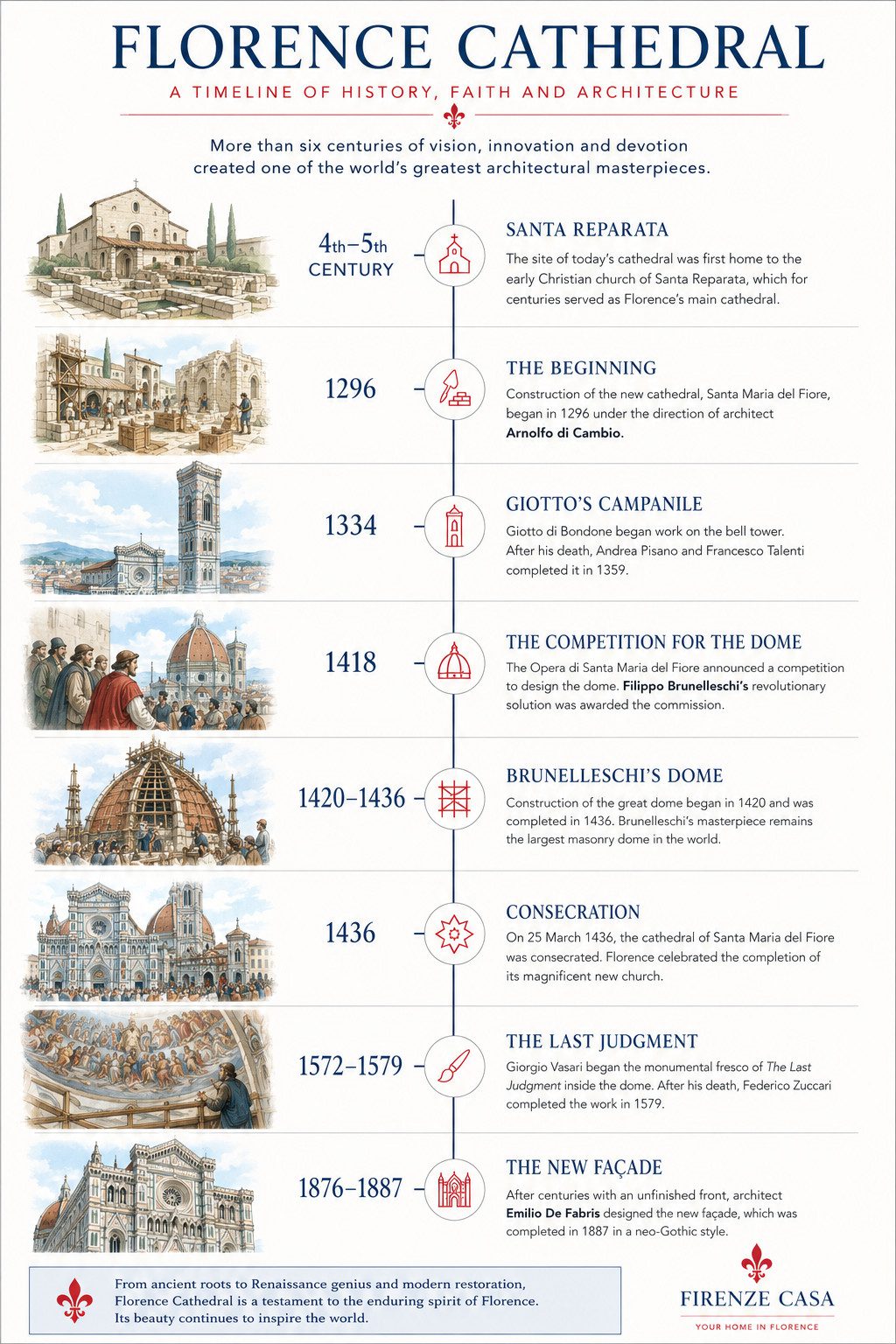
Timeline at a Glance
| Year | Milestone |
|---|---|
| 4th–5th century | The early Christian Church of Santa Reparata develops on the site. |
| 1296 | Construction of Florence Cathedral begins under Arnolfo di Cambio. |
| 1334 | Giotto begins work on the cathedral’s bell tower. |
| 1418 | Florence announces a competition for the cathedral dome. |
| 1420–1436 | Filippo Brunelleschi constructs his revolutionary dome. |
| 1436 | Pope Eugene IV consecrates the cathedral. |
| 1572–1579 | Giorgio Vasari and Federico Zuccari create The Last Judgment inside the dome. |
| 1887 | Work on the present neo-Gothic marble façade is completed. |
The History of Florence Cathedral
The story of Florence Cathedral begins long before the building visible today. For centuries, the early Christian Church of Santa Reparata occupied the site and served as one of the religious centres of the growing city.
By the late thirteenth century, Florence had become one of Europe’s wealthiest commercial cities. Its citizens wanted a cathedral that expressed this prosperity and civic ambition while rivalling the great religious buildings of other Tuscan cities. The project belongs to the remarkable transformation of medieval Florence explored more broadly in our History of Florence.
Arnolfo di Cambio and the New Cathedral
Construction began in 1296 under Arnolfo di Cambio, one of the leading architects of medieval Florence. His ambitious vision combined Italian Gothic architecture with the monumental scale expected by the powerful Florentine Republic.
Arnolfo died before seeing much of the project completed, and construction continued under successive architects. By the early fifteenth century, most of the enormous church had taken shape, but one seemingly impossible problem remained: nobody knew how to cover the vast opening above the crossing.
The Challenge of the Dome
For years, the unfinished cathedral waited for an engineering solution. Florence finally announced a competition in 1418, and Filippo Brunelleschi proposed the revolutionary approach that would transform both the cathedral and architectural history.
Construction of the dome began in 1420 and continued until 1436. Its completion gave Florence the architectural symbol that still defines the city today. The extraordinary engineering story deserves its own exploration in our guide to Brunelleschi’s Dome.
The Architecture of Florence Cathedral
Florence Cathedral combines Italian Gothic architecture with ideas that anticipated the Renaissance. Its enormous dimensions are impressive, yet the building relies less on the extreme verticality associated with many northern European Gothic cathedrals and more on proportion, geometry and clearly defined architectural volumes.
White Carrara marble, green Prato marble and red marble cover much of the exterior, creating the characteristic colour palette shared by the cathedral, bell tower and surrounding Duomo complex.
The Interior
The interior often surprises first-time visitors. In contrast with the richly decorated exterior, the vast nave appears relatively restrained, allowing the enormous scale of the architecture to dominate the experience.
The eye is naturally drawn towards Brunelleschi’s dome and the monumental painted surface above. Throughout the cathedral, medieval construction, Renaissance engineering and later artistic interventions coexist within the same extraordinary building.

Giotto’s Bell Tower
Beside Florence Cathedral stands Giotto’s Bell Tower, one of the finest examples of Italian Gothic architecture. Construction began in 1334 under Giotto, whose importance to Florence extended far beyond painting.
After Giotto’s death, Andrea Pisano continued the project before Francesco Talenti completed the tower and modified parts of the original design. The Campanile rises to almost 85 metres and uses the same combination of white, green and red marble that visually unites the Duomo complex.
Visitors can climb 414 steps to the top. The reward is an exceptional panorama across Florence and one of the best close-range perspectives of Brunelleschi’s dome.
If you want an unobstructed view of Brunelleschi’s Dome itself, Giotto’s Bell Tower provides one of the best perspectives. The climb is demanding, but the panorama makes the relationship between the cathedral and the surrounding city exceptionally clear.
The Cathedral Façade
The magnificent façade visitors see today is much younger than most of Florence Cathedral. Arnolfo di Cambio designed the original medieval façade, but work never reached completion.
In 1587, Grand Duke Francesco I de’ Medici ordered much of the unfinished medieval façade removed in preparation for a replacement. The planned new front never materialised, leaving the cathedral without a complete façade for almost three centuries. The episode belongs to the wider history of the Medici family and their profound influence on the appearance of Florence.
The Nineteenth-Century Façade
Architect Emilio De Fabris designed the present neo-Gothic façade, constructed between 1876 and 1887. He used white Carrara, green Prato and red marble to connect the new front visually with the medieval cathedral and Giotto’s Bell Tower.
Statues, mosaics and geometric decoration create an elaborate composition that appears much older than it actually is. The façade is therefore a striking reminder that Florence’s most famous monuments often contain layers from very different periods.
The façade of Florence Cathedral was completed in 1887, more than four centuries after Brunelleschi’s Dome. What appears to be a unified medieval and Renaissance monument is actually the result of centuries of construction and change.
Brunelleschi’s Dome
No feature of Florence Cathedral is more famous than its extraordinary dome. Rising above the historic centre, its red-tiled structure became the defining silhouette of Florence and one of the great architectural achievements of the Renaissance.
The challenge was enormous. The opening above the crossing measured more than 45 metres across, while traditional wooden centring on the necessary scale would have been extraordinarily difficult and expensive.
Brunelleschi’s Revolutionary Solution
Filippo Brunelleschi developed a double-shell structure that allowed construction to progress without the enormous temporary wooden framework normally required. A sophisticated arrangement of bricks, structural reinforcement and carefully controlled geometry allowed the dome to rise progressively above the cathedral.
Brunelleschi also designed cranes, hoists and other machinery needed to move stone, bricks and materials high above the city. Workers completed the dome in 1436, creating the largest masonry dome ever built.
Brunelleschi’s achievement was not an isolated moment. His work at the Basilica of San Lorenzo, Santo Spirito and the Ospedale degli Innocenti helped establish a new architectural language based on geometry, proportion and classical principles.
The dome is only one part of Brunelleschi’s contribution to Florence. Comparing it with San Lorenzo, Santo Spirito or the Ospedale degli Innocenti reveals how radically his ideas transformed Renaissance architecture.
The Last Judgment Inside the Dome
More than a century after the dome was completed, its vast interior received an equally ambitious artistic programme. Giorgio Vasari began The Last Judgment in 1572, and Federico Zuccari continued the project after Vasari’s death.
The enormous fresco covers around 3,600 square metres. Angels, saints, scenes of salvation and terrifying visions of Hell fill the interior surface, creating a dramatic contrast with Brunelleschi’s carefully engineered structure.
Visitors climbing the dome pass remarkably close to the paintings before continuing through parts of the double-shell construction towards the panoramic terrace. The climb therefore combines art, engineering and one of Florence’s most memorable views.
Masterpieces of the Cathedral Complex
Florence Cathedral belongs to a larger complex containing works from many centuries of Florentine art. Several masterpieces originally created for the cathedral, bell tower and Baptistery are now preserved in the Museo dell’Opera del Duomo.
Michelangelo’s Pietà Bandini
Michelangelo created the Pietà Bandini, also known as the Florentine Pietà, during the later years of his life. The sculpture depicts the body of Christ supported by the Virgin Mary, Mary Magdalene and Nicodemus, whose face is often interpreted as a self-portrait of the ageing artist.
Michelangelo originally intended the sculpture for his own tomb but later abandoned the project. Today, the Pietà Bandini is one of the great masterpieces displayed in the Museo dell’Opera del Duomo behind the cathedral.
Paolo Uccello’s Liturgical Clock
Near the main entrance of the cathedral, visitors can see Paolo Uccello’s unusual liturgical clock from the fifteenth century. Its dial follows the historic Italian system in which the twenty-fourth hour corresponded approximately with sunset.
The clock is easy to overlook in a building filled with monumental architecture, yet it provides a fascinating connection with the way medieval and Renaissance Florentines experienced time.

Santa Reparata Beneath Florence Cathedral
Beneath Florence Cathedral lies one of the city’s most fascinating archaeological sites. The remains of Santa Reparata reveal the religious history of this location centuries before construction of Santa Maria del Fiore began.
Archaeological excavations uncovered walls, mosaic floors, tombs and traces of earlier structures. Walking through the remains creates a striking contrast with the enormous cathedral overhead and helps visitors understand how Florence developed layer upon layer on the same urban sites.
The Tomb of Brunelleschi
The archaeological area also contains the tomb of Filippo Brunelleschi. His burial within the cathedral complex reflects the extraordinary honour Florence gave to the architect responsible for its defining monument.
Santa Reparata therefore adds an entirely different dimension to a Duomo visit. Within a few metres, visitors can move from early Christian Florence to the medieval city and the architectural revolution of the Renaissance.
Do not overlook Santa Reparata. The archaeological area beneath the cathedral is one of the best places to understand how many different historical layers survive beneath modern Florence.
The Pazzi Conspiracy Inside Florence Cathedral
Florence Cathedral was not only a place of worship and artistic creation. On 26 April 1478, it became the setting for one of the most dramatic political events of the Renaissance: the Pazzi Conspiracy.
During High Mass, conspirators attacked Lorenzo and Giuliano de’ Medici. Giuliano was killed, while Lorenzo escaped wounded into the cathedral sacristy. The failed assassination ultimately strengthened Medici power and triggered brutal reprisals against the conspirators.
Standing beneath Brunelleschi’s dome today, it can be difficult to imagine such violence unfolding inside the cathedral. Yet the episode demonstrates how closely religion, politics and family rivalry were intertwined in Renaissance Florence.
The Pazzi Conspiracy transformed Florence Cathedral into the stage for one of the Renaissance’s most famous assassination attempts. Giuliano de’ Medici died inside the church, while his brother Lorenzo survived.
Artists and Architects Who Shaped Florence Cathedral
Few buildings bring together so many major figures in Florentine art and architecture. The cathedral complex developed across centuries, allowing successive generations to leave their mark.
Arnolfo di Cambio
Arnolfo di Cambio established the monumental vision for the new cathedral when construction began in 1296. Although he never saw the completed building, his design determined its extraordinary scale.
Giotto
Giotto is remembered primarily as the painter who helped transform medieval European art, but he also served as master architect of the cathedral works. His Campanile remains one of Florence’s greatest Gothic monuments.
Filippo Brunelleschi
Brunelleschi solved the cathedral’s greatest architectural challenge. His dome transformed Florence’s skyline and became one of the defining achievements of Renaissance engineering.
Giorgio Vasari and Federico Zuccari
Vasari and Zuccari transformed the interior of the dome with the enormous Last Judgment. Their work added a dramatic sixteenth-century artistic layer to Brunelleschi’s fifteenth-century architecture.
These figures belong to a much larger artistic world explored in our Great Artists of Florence – Complete Guide.
Planning Your Visit to Florence Cathedral
The cathedral stands in Piazza del Duomo at the heart of the historic centre. Because the Duomo complex contains several separate monuments, it is worth deciding in advance whether you want to see only the cathedral or combine it with Santa Reparata, Brunelleschi’s Dome, Giotto’s Bell Tower and the Museo dell’Opera del Duomo.
Allow at least two to three hours for a meaningful visit to the cathedral and archaeological area, and considerably longer if you plan to climb the dome or bell tower. Opening arrangements, ticket combinations and access conditions can change, so current information should always be checked with the Opera di Santa Maria del Fiore before visiting.
Address: Piazza del Duomo, Florence
Area: Historic centre
Suggested visit: At least 2–3 hours for the cathedral and Santa Reparata
Allow more time for: Brunelleschi’s Dome, Giotto’s Bell Tower and the Museo dell’Opera del Duomo
Before visiting: Check current opening times, ticket requirements and access conditions
What Not to Miss
- Brunelleschi’s extraordinary dome and its double-shell construction.
- Vasari and Zuccari’s monumental Last Judgment.
- Paolo Uccello’s unusual fifteenth-century clock.
- The archaeological remains of Santa Reparata beneath the cathedral.
- Giotto’s Bell Tower and its close view of the dome.
- The nineteenth-century façade and its coloured marble decoration.
- Michelangelo’s Pietà Bandini in the nearby Museo dell’Opera del Duomo.
Frequently Asked Questions
What is the official name of Florence Cathedral?
The official name is Cattedrale di Santa Maria del Fiore. Visitors also commonly call it Florence Cathedral or simply the Duomo.
When was Florence Cathedral built?
Construction began in 1296 under Arnolfo di Cambio. The cathedral developed over generations, with Brunelleschi’s dome completed in 1436 and the present façade finished in 1887.
Why is Brunelleschi’s Dome so important?
Brunelleschi solved an unprecedented engineering challenge without relying on the enormous wooden centring normally required for a dome of this scale. It remains the largest masonry dome ever built.
Can you visit Santa Reparata?
Yes. The archaeological remains beneath Florence Cathedral include ancient walls, mosaics and tombs and reveal the history of the earlier church on the site.
Where is Michelangelo’s Pietà Bandini?
Michelangelo’s Pietà Bandini is displayed in the Museo dell’Opera del Duomo behind the cathedral.
Did the Pazzi Conspiracy really take place inside the cathedral?
Yes. Giuliano de’ Medici was assassinated during High Mass inside Florence Cathedral on 26 April 1478, while Lorenzo de’ Medici survived the attack.
How long should I allow for Florence Cathedral?
Allow around two to three hours for the cathedral and Santa Reparata. Add more time if you plan to climb Brunelleschi’s Dome or Giotto’s Bell Tower.
Why Florence Cathedral Is Worth Visiting
Florence Cathedral is worth visiting because no other monument expresses the ambition of the city quite so powerfully. Medieval civic pride, Gothic architecture, Renaissance engineering and centuries of artistic creation come together within a single extraordinary complex.
The dome alone changed architectural history, but concentrating only on Brunelleschi means missing much of the story. Giotto’s Campanile, Santa Reparata, Paolo Uccello’s clock, the cathedral façade and the works preserved in the Museo dell’Opera del Duomo reveal how generations of Florentines continually reshaped their most important church.
The cathedral also witnessed Florence’s political history, including the dramatic Pazzi Conspiracy of 1478. It was simultaneously a religious centre, a civic symbol, a workplace for some of the city’s greatest artists and one of the most ambitious construction projects of medieval Europe.
Understanding Santa Maria del Fiore therefore means understanding Florence itself – a city in which faith, wealth, politics, engineering and art repeatedly came together to create something extraordinary.
Further Reading on Firenze Casa
- Brunelleschi’s Dome
- The History of Piazza del Duomo
- Filippo Brunelleschi – The Architect Who Changed Florence
- Giotto – The Artist Who Transformed Medieval Florence
- Michelangelo – Florence and the Making of a Renaissance Genius
- Giorgio Vasari – Artist, Architect and Chronicler of Florence
- The Most Beautiful Churches in Florence – Complete Guide
- History of Florence
References
- Opera di Santa Maria del Fiore.
- King, Ross. Brunelleschi’s Dome.
- Murray, Peter. The Architecture of the Italian Renaissance.
- Hartt, Frederick. History of Italian Renaissance Art.
- UNESCO World Heritage Centre – Historic Centre of Florence.
- Biblioteca Nazionale Centrale di Firenze.

