
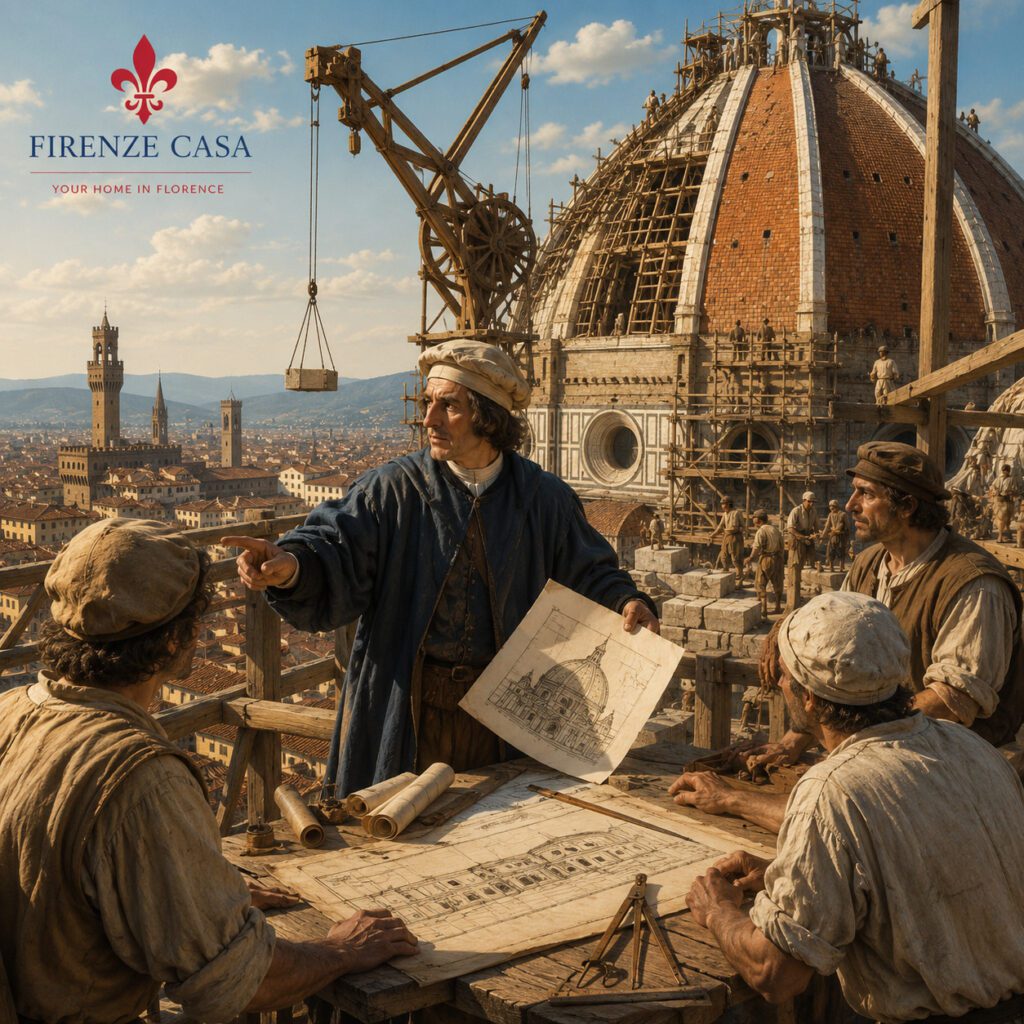
Filippo Brunelleschi Florence is a story written across the skyline, churches and piazzas of the city. Few individuals changed Florence as profoundly as Brunelleschi. His revolutionary dome for Santa Maria del Fiore became the city’s defining landmark, while his buildings helped establish a new architectural language for the Renaissance.
Yet Brunelleschi was far more than the architect of one extraordinary dome. He was a sculptor, engineer and experimenter whose fascination with geometry, mechanics and perspective changed the way artists and architects understood space. He therefore stands among the essential figures in our The Great Artists of Florence – Complete Guide.
Born: 1377, Florence
Died: 15 April 1446, Florence
Early training: goldsmith and sculptor
Greatest achievement: dome of Santa Maria del Fiore
Major buildings: Ospedale degli Innocenti, San Lorenzo, Old Sacristy, Santo Spirito and Pazzi Chapel
Key innovation: mathematical linear perspective
Why he matters: he helped define Renaissance architecture through proportion, geometry and engineering
Who Was Filippo Brunelleschi?
Filippo Brunelleschi was born in Florence in 1377. His father, Brunellesco di Lippo, was a notary, and Filippo received an education that included mathematics and practical knowledge that later proved invaluable.
He initially trained as a goldsmith rather than an architect. This background gave him experience with metals, mechanisms, precision work and construction techniques – skills that became crucial when he later confronted architectural problems that seemed almost impossible to solve.
Brunelleschi joined the Arte della Seta, Florence’s powerful Silk Guild, which also included goldsmiths and other highly skilled craftsmen. His career therefore began within the same artisan and guild culture that supported much of Florence’s artistic development.
Florence already possessed extraordinary medieval architecture before Brunelleschi. His achievement was to introduce a new architectural language based on proportion, geometry, classical principles and technical experimentation.
The Baptistery Competition of 1401
At the beginning of the fifteenth century, Brunelleschi entered one of the most famous artistic competitions in Renaissance history. Florence needed new bronze doors for the Baptistery of San Giovanni, and several artists were asked to produce a relief depicting the Sacrifice of Isaac.
The two most celebrated entries came from Brunelleschi and Lorenzo Ghiberti.
Ghiberti ultimately received the commission. His victory became a landmark in Florentine art, while Brunelleschi increasingly turned his attention towards architecture, engineering and the study of space.
The competition illustrates the intense artistic rivalry that characterised Florence. Public and religious commissions could bring enormous prestige, encouraging artists to challenge one another technically and intellectually.
Brunelleschi and Donatello
Brunelleschi belonged to the same remarkable generation as Donatello. Later accounts describe the two travelling to Rome and studying surviving monuments and sculptures of antiquity.
Whether every detail of those stories is historically exact, both artists clearly absorbed lessons from the ancient world. Donatello transformed those discoveries into a new language of sculpture, while Brunelleschi reinterpreted classical principles through architecture.
Their careers show how Renaissance innovation rarely belonged to one discipline. Sculpture, architecture, perspective and engineering developed within the same compact Florentine artistic environment.
Donatello and Brunelleschi approached antiquity differently, but together they helped redefine the possibilities of sculpture, architecture and spatial representation in early Renaissance Florence.
The Rediscovery of Ancient Rome
Rome offered Brunelleschi something Florence could not: the surviving remains of monumental ancient structures. Roman arches, vaults, temples and domes demonstrated engineering solutions created more than a thousand years earlier.
Brunelleschi studied proportions and construction techniques rather than simply copying ancient buildings. He absorbed the principles behind them and adapted those ideas to contemporary Florentine needs.
Classical columns, rounded arches and carefully calculated proportions could now become part of a distinctly modern architectural language.
This approach – studying antiquity in order to create something new – became one of the central characteristics of the Renaissance.
Brunelleschi and Linear Perspective
Brunelleschi is traditionally associated with the development of mathematical linear perspective in the early fifteenth century. His experiments demonstrated how a three-dimensional scene could be represented convincingly on a flat surface.
One famous experiment involved a painted representation of Florence’s Baptistery. By controlling the viewer’s position and using a mirror, Brunelleschi demonstrated the relationship between geometry, vision and pictorial space.
The implications were enormous. Artists could organise buildings, streets and figures around a coherent vanishing point, making them appear to recede naturally into the distance.
Masaccio soon demonstrated the artistic possibilities of this approach spectacularly in painting. His celebrated Holy Trinity in Santa Maria Novella became one of the defining demonstrations of Renaissance perspective.
The Baptistery and Piazza del Duomo were not merely monuments for Renaissance artists. They also became a laboratory for thinking about geometry, proportion and how the eye perceives architectural space.
The Impossible Problem of Florence Cathedral
The project that made Filippo Brunelleschi Florence inseparable from the city had begun long before his birth.
Construction of Santa Maria del Fiore began in 1296 under Arnolfo di Cambio. Later architects expanded the cathedral dramatically, leaving Florence with a vast crossing that still required a dome.
By the early fifteenth century, the problem had become urgent. The opening was enormous, and traditional wooden centring capable of supporting a masonry dome of that scale would have been exceptionally difficult and costly.
Florence had created a cathedral that seemed almost impossible to finish.
Brunelleschi and the Dome
In 1418, the Opera del Duomo announced a competition for solutions to the cathedral dome. Brunelleschi became the central figure in the project, initially sharing responsibility with Ghiberti.
Construction began in 1420.
Brunelleschi developed a double-shell structure with an inner and outer dome connected by structural elements. Eight major ribs rose above the octagonal crossing, while additional ribs strengthened the masonry.
Most importantly, the structure could rise without the vast traditional wooden centring normally required for a masonry dome of this scale.
The Herringbone Brick Pattern
One of the most famous elements of the construction is the herringbone arrangement of bricks. Vertically positioned bricks interrupted horizontal courses and helped organise and stabilise the masonry as construction progressed.
Brunelleschi also designed specialised lifting machines for stone, timber and other materials. Ox-powered hoists could raise and lower loads efficiently, while other devices allowed heavy components to be positioned with remarkable precision.
Architecture, engineering and mechanics became parts of the same extraordinary project.
Imagine Piazza del Duomo during these decades: masons working high above Florence while machines designed by Brunelleschi lifted enormous quantities of material towards a dome unlike anything the city had seen before.
How the Dome Changed Florence
The dome was substantially completed by 1436, when Pope Eugene IV consecrated Florence Cathedral. Brunelleschi designed the lantern at its summit, although it was completed after his death.
The result changed Florence permanently. The dome rose above the dense medieval city and became visible from the surrounding hills, transforming the cathedral into a symbol of Florentine ambition.
It also demonstrated a central Renaissance idea: the ancient world could provide inspiration without dictating the final result.
Brunelleschi had created something that appeared simultaneously classical and unprecedented.
Ospedale degli Innocenti
While the cathedral dome dominates Brunelleschi’s reputation, the Ospedale degli Innocenti reveals his architectural language with exceptional clarity.
The building stands on Piazza della Santissima Annunziata and was created for an institution caring for abandoned children. Construction began in 1419.
Its famous loggia presents a regular sequence of rounded arches supported by slender Corinthian columns. Brunelleschi organised the architecture through simple mathematical relationships, creating a calm visual rhythm very different from the vertical complexity associated with Gothic buildings.
The Ospedale also helped shape the urban harmony of Piazza Santissima Annunziata, whose wider religious and artistic setting can be explored through our guide to the Basilica della Santissima Annunziata.
Brunelleschi and San Lorenzo
The Basilica of San Lorenzo offers one of the best opportunities to experience Brunelleschi’s architecture at close range.
Inside, a carefully ordered sequence of columns, rounded arches and geometric spaces creates an immediate sense of clarity. Grey pietra serena contrasts elegantly with pale plaster walls, making the architectural structure easy to read.
The church’s transformation also connects Brunelleschi directly with the Medici family. Giovanni di Bicci de’ Medici supported important work at San Lorenzo, and the complex eventually became the religious centre most closely associated with the dynasty.
The Old Sacristy
The Sagrestia Vecchia, or Old Sacristy, offers an especially concentrated expression of Brunelleschi’s ideas.
Squares, circles and semicircular arches form a coherent geometric system. The architecture does not depend on abundant decoration; instead, proportion itself becomes the source of visual harmony.
Donatello later contributed sculptural decoration to this Brunelleschian environment, bringing architecture and sculpture together within one of the defining interiors of the early Renaissance.
Look at the grey pietra serena rather than only at individual artworks. It outlines arches, columns and structural relationships almost like a geometric drawing placed directly onto the walls.
The Pazzi Chapel at Santa Croce
The Pazzi Chapel in the complex of Santa Croce is traditionally associated with Brunelleschi and represents another important expression of early Renaissance architectural ideals.
Its clear geometry, classical forms and restrained decoration create an atmosphere very different from the vast Gothic basilica nearby. The contrast allows visitors to experience the shift from medieval to Renaissance architecture within a single religious complex.
The chapel was commissioned by the Pazzi family, one of Florence’s wealthy banking dynasties. Their later political history became dominated by the famous conspiracy against the Medici, but the chapel preserves a very different legacy: patronage of one of Florence’s great architectural masterpieces.
The Pazzi Chapel reminds us that Renaissance architecture was also a form of family representation. Wealthy Florentines used churches and chapels to express devotion, status and cultural ambition.
Santo Spirito and Brunelleschi’s Vision of Space
Across the Arno, the Basilica of Santo Spirito provides one of the purest surviving experiences of Brunelleschian architecture.
Repeated columns and rounded arches create a continuous rhythm, while the side chapels follow a coherent geometric system. Rather than overwhelming the visitor with isolated decorative effects, the entire building feels organised as one spatial idea.
Brunelleschi died before Santo Spirito was completed, and later architects altered some aspects of his project. Nevertheless, his fundamental approach still dominates the interior.
The church also creates a fascinating cross-generational connection with Michelangelo, whose youthful wooden crucifix is preserved there.
Brunelleschi and Florence’s Churches
Brunelleschi’s influence becomes particularly clear when his buildings are compared with other Florentine churches.
San Lorenzo and Santo Spirito demonstrate the clarity and proportional order of early Renaissance architecture. Santa Croce, by contrast, preserves the scale and vertical character of medieval Gothic Florence while containing the later Pazzi Chapel.
The contrast is one reason our The Most Beautiful Churches in Florence guide works especially well as a companion to Brunelleschi’s story. His architecture can be understood most clearly when placed within the longer evolution of Florentine religious buildings.
Brunelleschi and Florence’s Artistic Revolution
Brunelleschi did not work in isolation. Florence in the early fifteenth century brought together artists whose discoveries continually influenced one another.
Donatello was revolutionising sculpture, Masaccio introduced unprecedented spatial realism into painting and Ghiberti created sophisticated bronze reliefs.
Brunelleschi contributed new systems of architectural proportion and pictorial space.
Together, these developments helped establish Florence as one of the principal centres of Renaissance innovation.
The Man Behind the Architecture
Historical accounts portray Brunelleschi as intelligent, determined and sometimes intensely protective of his technical solutions.
Such secrecy was understandable. The cathedral dome was an enormous public commission, and rivalry among Florentine artists could be fierce.
His relationship with Ghiberti remained particularly competitive. The two men had already confronted one another in the Baptistery competition before becoming involved together in the dome project.
Brunelleschi ultimately became the figure most closely associated with the engineering achievement that completed the cathedral.
Where to See Brunelleschi’s Florence Today
One of the great pleasures of exploring Florence is that Brunelleschi’s legacy does not belong to a single museum. His architecture forms part of the living city.
- Santa Maria del Fiore: Brunelleschi’s monumental dome.
- Piazza del Duomo: the setting traditionally associated with his perspective experiments.
- Ospedale degli Innocenti: one of the earliest landmarks of Renaissance architecture.
- San Lorenzo: Brunelleschi’s ordered Renaissance interior and Old Sacristy.
- Santa Croce: the Pazzi Chapel and the contrast between Gothic and Renaissance Florence.
- Santo Spirito: one of the finest places to experience his mature approach to proportion and spatial harmony.
Do not experience Brunelleschi only from Piazza del Duomo. San Lorenzo, Santissima Annunziata, Santa Croce and Santo Spirito reveal how deeply his architectural ideas became woven into Florence.
A Brunelleschi Walk Through Florence
A rewarding Brunelleschi route can be completed largely on foot.
Begin at Piazza del Duomo beneath the dome that transformed Florence’s skyline. Continue north towards Piazza della Santissima Annunziata and the Ospedale degli Innocenti, where Brunelleschi’s use of proportion becomes easier to study at human scale.
Walk back towards San Lorenzo to experience his interior architecture and Old Sacristy. From there, cross the historic centre to Santa Croce and the Pazzi Chapel.
Finally, cross the Arno and continue to Santo Spirito. The route moves from Brunelleschi’s most spectacular engineering achievement to increasingly intimate spaces where geometry, proportion and repetition can be experienced directly.
Brunelleschi’s Tomb in Florence Cathedral
Filippo Brunelleschi died in Florence on 15 April 1446.
He received the exceptional honour of burial in Santa Maria del Fiore. His tomb lies beneath the cathedral whose skyline he transformed.
The symbolism is difficult to miss: above his burial place rises the structure that had once appeared almost impossible to build.
Frequently Asked Questions
Was Filippo Brunelleschi born in Florence?
Yes. Brunelleschi was born in Florence in 1377 and spent most of his career transforming the architecture of his native city.
Did Brunelleschi build Florence Cathedral?
No. The cathedral had been under construction for more than a century before Brunelleschi. His great contribution was designing and constructing its enormous dome.
Why was Brunelleschi’s dome revolutionary?
Its immense masonry structure was built without the vast conventional wooden centring normally expected for such a dome, using an ingenious combination of shells, ribs, masonry patterns and specialised lifting machinery.
Did Brunelleschi invent perspective?
He is traditionally credited with pioneering mathematical linear-perspective experiments in early fifteenth-century Florence, providing principles that painters soon adopted.
Which Brunelleschi church should I visit?
San Lorenzo and Santo Spirito are both essential. San Lorenzo reveals his early Renaissance system particularly clearly, while Santo Spirito offers one of the most coherent experiences of his mature spatial ideas.
Did Brunelleschi design the Pazzi Chapel?
The chapel is traditionally attributed to Brunelleschi and is widely associated with his architectural language, although aspects of its design and construction history remain subjects of scholarly discussion.
Where is Brunelleschi buried?
He is buried beneath Florence Cathedral, directly below the architectural masterpiece that made him famous.
Why Filippo Brunelleschi Still Defines Florence
Filippo Brunelleschi changed more than the skyline of Florence. He changed how buildings could be conceived, how spatial relationships could be organised and how artists understood the geometry of vision.
The dome remains his most spectacular achievement, but San Lorenzo, Santo Spirito, the Ospedale degli Innocenti and the Pazzi Chapel reveal another Brunelleschi: an architect who could transform mathematical proportion into calm, intelligible spaces.
His career also demonstrates why Renaissance Florence became so influential. Craftsmanship, engineering, antiquity, geometry and artistic competition all converged within one city.
Michelangelo, Leonardo, Botticelli and Donatello created works that made Florence famous throughout the world. Brunelleschi did something slightly different: he helped create the architectural Florence in which the Renaissance could take form.
Further Reading on Firenze Casa
- The Great Artists of Florence – Complete Guide
- Donatello – The Sculptor Who Changed Renaissance Florence
- Basilica of San Lorenzo – The Medici Church of Florence
- Basilica of Santo Spirito – Brunelleschi’s Renaissance Church
- Basilica of Santa Croce – Florence’s Monumental Church
- The Pazzi Family – Florence’s Most Famous Conspiracy
- The Medici Family – The Dynasty That Shaped Florence
- The Most Beautiful Churches in Florence
References
- Ross King – Brunelleschi’s Dome: How a Renaissance Genius Reinvented Architecture.
- Marvin Trachtenberg – Building-in-Time: From Giotto to Alberti and Modern Oblivion.
- Giovanni Fanelli – Brunelleschi.
- Antonio di Tuccio Manetti – The Life of Brunelleschi.
- Heinrich Klotz – Filippo Brunelleschi: The Early Works and the Medieval Tradition.
- Opera di Santa Maria del Fiore – historical documentation on the Cathedral and Brunelleschi’s dome.

