
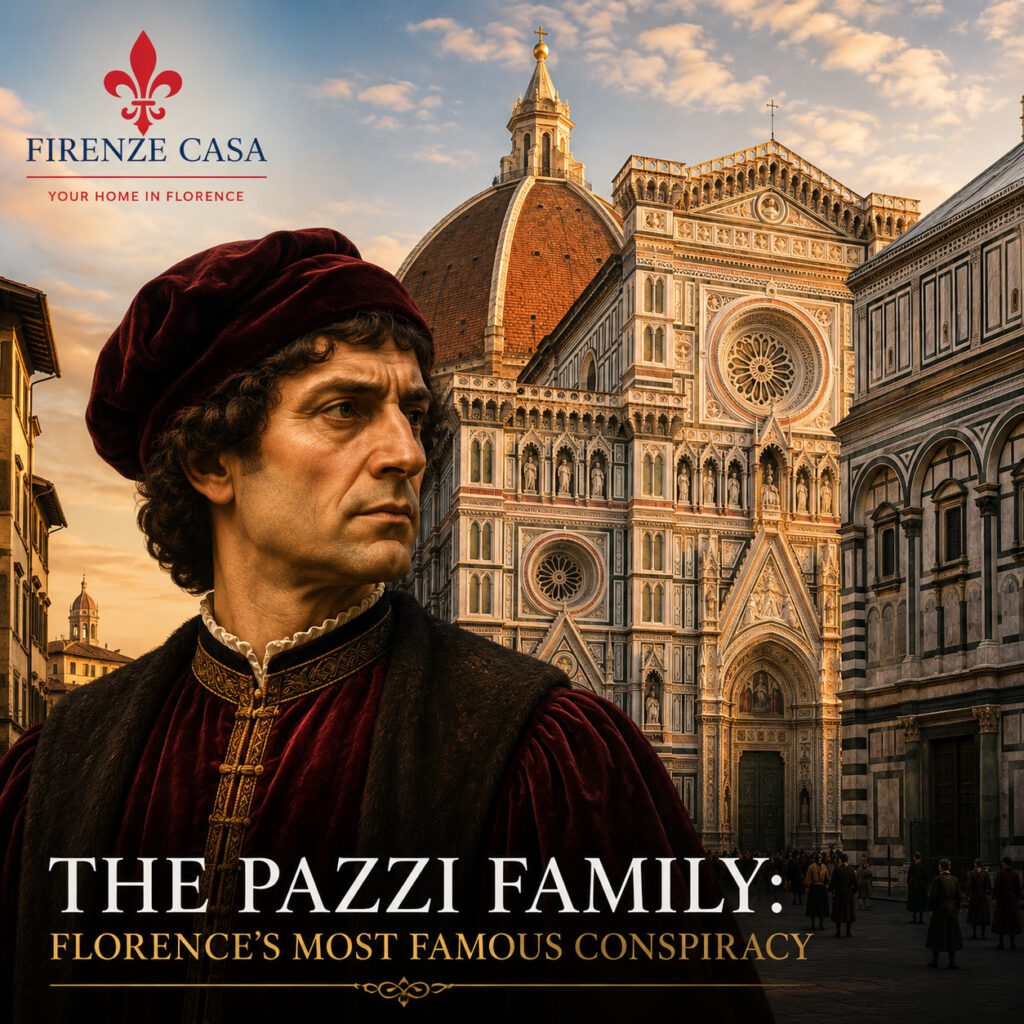
The Pazzi family was one of the wealthiest and most influential dynasties of Renaissance Florence. Their name is remembered above all because of the Pazzi Conspiracy of 1478, the dramatic attempt to assassinate Lorenzo and Giuliano de’ Medici during Mass inside Florence Cathedral.
Yet the Pazzi were much more than conspirators. Long before 1478, they belonged to Florence’s merchant and banking elite, participated in republican politics and supported important religious and architectural projects. Their famous chapel at Santa Croce remains one of the most elegant monuments of the early Renaissance.
Origins: Medieval Florence
Main activities: Banking, commerce, property and politics
Key figures: Jacopo de’ Pazzi and Francesco de’ Pazzi
Most famous event: Pazzi Conspiracy, 26 April 1478
Targets: Lorenzo and Giuliano de’ Medici
Outcome: Giuliano killed, Lorenzo survived
Political result: Medici power strengthened
Greatest architectural legacy: Pazzi Chapel at Santa Croce
The Pazzi belong to the wider network explored in our Most Famous Florentine Families – Complete Guide.
Historical Timeline of the Pazzi Family
| Date | Event |
|---|---|
| 12th century | The Pazzi family emerges among Florence’s established families. |
| 14th century | The family expands its commercial and financial activities. |
| 15th century | The Pazzi become one of Florence’s prominent banking and merchant dynasties. |
| 1440s | Work progresses on the Pazzi Chapel at Santa Croce. |
| 1469 | Lorenzo de’ Medici becomes Florence’s leading political figure. |
| 26 April 1478 | The Pazzi Conspiracy takes place inside Florence Cathedral. |
| 1478 | Leading conspirators are executed, while the family faces exile, confiscation and political suppression. |
| 1494 | The Medici are expelled from Florence and surviving Pazzi are able to return. |
| Today | The Pazzi Chapel remains the family’s most celebrated architectural legacy. |
Who Were the Pazzi Family?
The Pazzi were one of Florence’s old and distinguished families. Their presence in the city can be traced back to the Middle Ages, when Florence was developing into one of Europe’s wealthiest commercial republics.
Like the Medici, Strozzi, Pitti and other successful dynasties, the Pazzi did not owe their importance to royal status. Their position grew through commerce, banking, property and participation in public life.
By the fifteenth century, the family belonged firmly to Florence’s wealthy governing elite. Members held civic offices, developed commercial relationships outside Tuscany and invested wealth in urban property and religious patronage.
The Pazzi belonged to the same competitive world as the Medici, Strozzi and Pitti. Banking, politics, marriage and patronage were closely interconnected in Renaissance Florence.
The Rise of the Pazzi Banking Dynasty
Banking transformed Florence during the late Middle Ages. International merchants needed systems for transferring money, extending credit and supporting trade across long distances.
The Pazzi participated in this expanding financial world and developed important commercial connections. Their clients and partners included members of the merchant elite, aristocratic circles and ecclesiastical institutions.
Their economic interests extended beyond finance alone. They were involved in commerce, textile production, agricultural property and urban real estate.
This wider financial world is explored in our Birth of Modern Banking in Florence guide.
In Renaissance Florence, a banking house was rarely only a financial business. Wealth could finance land, chapels, political alliances and public prestige.
Florence: A Republic Dominated by Powerful Families
Florence formally remained a republic, but real influence depended heavily on wealth, alliances and family networks. A relatively small number of dynasties repeatedly occupied public office and shaped political decisions.
The Medici, Strozzi, Pazzi, Pitti, Albizzi, Rucellai and Tornabuoni all belonged to this competitive environment. Their relationships could involve cooperation, marriage, rivalry or outright hostility depending on the political moment.
This structure explains why family conflicts could become citywide crises. Business, politics and reputation were inseparable within the compact world of Renaissance Florence.
The political background is explored in The Medieval Republic of Florence – Guilds, Power and Civic Life.
The Pazzi Chapel: Faith, Prestige and Architecture
Long before the conspiracy, the Pazzi demonstrated their status through religious patronage. During the fifteenth century, the family supported the construction of a new chapter house for the Franciscan complex of Santa Croce.
Today, this building is known as the Pazzi Chapel. It is closely associated with Filippo Brunelleschi and with the architectural ideals of the early Renaissance.
Its carefully balanced proportions, geometric clarity and restrained decoration create a very different image of the family from the violence later associated with its name.
Many visitors enter Santa Croce for Michelangelo, Galileo and Machiavelli. Do not miss the Pazzi Chapel in the monastery courtyard. It is one of the clearest introductions to early Renaissance architectural harmony.
The Growing Power of the Medici
During the middle of the fifteenth century, Florence’s political balance increasingly shifted towards the Medici family. Cosimo de’ Medici had built an extraordinary network of alliances while preserving the outward forms of republican government.
After his death in 1464, Medici influence eventually passed to Lorenzo de’ Medici. Lorenzo combined political skill, diplomacy and cultural prestige with an extensive network of supporters.
Not every prominent family accepted this growing concentration of influence. Rivalries intensified as wealthy dynasties competed for political and financial opportunities.
The Rivalry Between the Pazzi and the Medici
The conflict between the Pazzi and Medici did not result from one single dispute. Banking competition, political tensions, papal interests and family prestige gradually became intertwined.
| Cause | Why It Created Conflict |
|---|---|
| Banking | Both families competed for financial opportunities and international influence. |
| Politics | Medici influence increasingly dominated Florentine political life. |
| Papal finances | Competition surrounding papal banking business intensified tensions. |
| Prestige | Leading dynasties competed through architecture, patronage and public reputation. |
| Personal ambition | Prominent individuals sought greater influence within Florence. |
Relations deteriorated further because Pope Sixtus IV and members of his circle had their own political disputes with Lorenzo de’ Medici.
The Pazzi possessed important financial connections with the papal court, which drew the family into a wider political conflict extending far beyond Florence.
Jacopo and Francesco de’ Pazzi
Two members of the family became particularly important during the events of 1478.
Jacopo de’ Pazzi was a senior figure within the dynasty and one of the principal leaders associated with the conspiracy. His nephew Francesco de’ Pazzi was closely connected with the family’s banking activities and became directly involved in the attack.
By the spring of 1478, financial competition, papal politics and opposition to Medici dominance had combined into an increasingly dangerous situation.
The Pazzi Conspiracy of 1478
By April 1478, the conspirators had concluded that Medici political power could not be removed through ordinary competition alone.
The plan aimed to eliminate both Lorenzo and Giuliano de’ Medici and then seize control of the Florentine government.
After changes to earlier arrangements, the decisive attack was scheduled during Mass in Florence Cathedral.
The choice of location was extraordinary. One of the most sacred spaces in Florence became the setting for an assassination attempt designed to transform the government of the republic.
The Attack Inside Florence Cathedral
On 26 April 1478, Florence’s elite gathered inside the Cathedral of Santa Maria del Fiore for High Mass.
As the service reached a crucial moment, conspirators attacked the Medici brothers. Francesco de’ Pazzi and Bernardo Bandini Baroncelli assaulted Giuliano, who suffered multiple wounds and died on the cathedral floor.
Lorenzo was attacked separately but managed to escape with relatively minor injuries. Supporters helped him reach the sacristy, where he was protected.
The assassination had therefore achieved only half of its objective. Giuliano was dead, but Lorenzo – the principal political leader – had survived.
Standing beneath Brunelleschi’s dome today, it is difficult to imagine that on 26 April 1478 this sacred space became the setting for one of Renaissance Europe’s most notorious political assassinations.
The Failure of the Conspiracy
The conspirators expected the deaths of the Medici brothers to trigger a political revolution. Instead, Lorenzo’s survival allowed his supporters to respond immediately.
News of Giuliano’s murder spread rapidly, but the expected popular uprising against the Medici did not occur. Many Florentines instead rallied around Lorenzo.
| Conspirators’ Objective | Actual Outcome |
|---|---|
| Kill both Medici brothers | Giuliano was killed, but Lorenzo survived. |
| Remove Medici leadership | Lorenzo retained control of Florence. |
| Destroy Medici influence | The failed attack strengthened Lorenzo’s position. |
| Transform Florentine politics | The conspiracy accelerated Medici dominance. |
The plot therefore produced almost exactly the opposite of what its organisers had intended.
The Punishment of the Pazzi Family
The response was swift and violent. Francesco de’ Pazzi was captured and executed shortly after the attack.
Archbishop Francesco Salviati, another leading conspirator, was killed during the chaotic aftermath at the Palazzo della Signoria.
Jacopo de’ Pazzi initially escaped but was soon captured, returned to Florence and executed.
Punishment extended beyond those directly involved. Pazzi property was confiscated, relatives were exiled and the family’s public presence was deliberately suppressed.
The authorities did more than punish individual conspirators. They also attempted to erase the Pazzi name and heraldic presence from public life, demonstrating how important family reputation was in Renaissance Florence.
Lorenzo the Magnificent After the Conspiracy
Paradoxically, the failed assassination strengthened Lorenzo the Magnificent. He emerged from the crisis with increased political authority and considerable public sympathy.
The conflict did not end immediately because the conspiracy also contributed to wider tensions between Florence, the papacy and other Italian states.
Lorenzo’s diplomatic response during the following years further enhanced his reputation and helped establish him as one of the leading political figures in Italy.
The attempt to destroy Medici dominance had instead reinforced it.
The Return of the Pazzi
Political fortunes in Renaissance Florence rarely remained permanent. When the Medici were expelled from the city in 1494, the political landscape changed dramatically.
Surviving Pazzi were able to return, and the family gradually re-entered Florentine society.
Nevertheless, the dynasty never recovered the political position it had held before 1478. The conspiracy permanently altered how the family was remembered.
The Pazzi Chapel: A Lasting Legacy
Ironically, the family’s greatest surviving contribution to Florence has little to do with conspiracy.
The Pazzi Chapel at Santa Croce remains one of the celebrated monuments of early Renaissance architecture. Its classical inspiration, geometric harmony and controlled decorative language offer a striking contrast to the violence of 1478.
This contrast makes the Pazzi story unusually compelling. The same dynasty associated with one of Florence’s darkest political episodes also helped create one of its most serene architectural spaces.
Important Members of the Pazzi Family
| Name | Role | Historical Significance |
|---|---|---|
| Andrea de’ Pazzi | Merchant and patron | Closely associated with the family’s patronage at Santa Croce. |
| Jacopo de’ Pazzi | Senior family figure | One of the principal leaders associated with the conspiracy. |
| Francesco de’ Pazzi | Banker and conspirator | Participated directly in the fatal attack on Giuliano de’ Medici. |
Places Connected with the Pazzi Family
| Place | Connection | Why Visit? |
|---|---|---|
| Florence Cathedral | Site of the attack on Lorenzo and Giuliano de’ Medici. | The defining event of the Pazzi story occurred here. |
| Pazzi Chapel | Monument associated with Pazzi patronage. | One of the masterpieces of early Renaissance architecture. |
| Santa Croce | Franciscan complex containing the Pazzi Chapel. | Places the family within Florence’s wider world of dynastic patronage. |
| Palazzo Vecchio | Centre of Florentine government. | The political aftermath of the conspiracy unfolded around the palace. |
| Piazza della Signoria | Civic heart of Florence. | Helps explain the political geography of the crisis. |
The broader architectural world of Florence’s great dynasties can be explored in our Historic Palaces of Florence – Complete Guide.
A Pazzi Walk Through Florence
The story can be explored almost entirely on foot. Begin at Florence Cathedral, where the conspiracy reached its dramatic climax.
Continue to Piazza della Signoria and Palazzo Vecchio, the political centre of the republic and the setting for the immediate aftermath.
From there, walk east to Santa Croce and finish at the Pazzi Chapel. The route moves from political violence to architectural patronage and reveals two very different sides of the same family.
Duomo → Piazza della Signoria → Palazzo Vecchio → Santa Croce → Pazzi Chapel creates one of the most compelling political-history walks in central Florence.
Interesting Facts About the Pazzi Family
- The Pazzi belonged to Florence’s wealthy merchant and banking elite.
- The conspiracy reached its climax during Mass inside Florence Cathedral.
- Giuliano de’ Medici was killed during the attack.
- Lorenzo de’ Medici survived with relatively minor injuries.
- The failed plot strengthened Medici political power rather than weakening it.
- Francesco Salviati, Archbishop of Pisa, participated in the conspiracy.
- The Pazzi family faced exile, confiscation and suppression after 1478.
- The Pazzi Chapel remains their greatest architectural legacy.
Frequently Asked Questions About the Pazzi Family
Who were the Pazzi family?
The Pazzi were a wealthy Florentine merchant and banking family whose history included commerce, politics and major architectural patronage. They are remembered above all for the conspiracy of 1478.
What was the Pazzi Conspiracy?
The Pazzi Conspiracy was an attempt to remove Medici leadership in Florence. Its most dramatic moment occurred on 26 April 1478, when Lorenzo and Giuliano de’ Medici were attacked during Mass in Florence Cathedral.
Why did the Pazzi attack the Medici?
The plot developed from a combination of political rivalry, financial interests, papal politics and opposition to growing Medici influence. It was therefore much more complex than a simple family feud.
Did the Pazzi Conspiracy succeed?
No. Giuliano de’ Medici was killed, but Lorenzo survived. The conspiracy failed to remove Medici power and ultimately strengthened Lorenzo’s political position.
What happened to the Pazzi afterwards?
Leading conspirators were executed, while other relatives faced exile, confiscation and political restrictions. Some members returned after the Medici were expelled from Florence in 1494.
What is the Pazzi Chapel?
The Pazzi Chapel is a Renaissance chapter house within the Santa Croce complex. Closely associated with Filippo Brunelleschi, it is admired for its geometric clarity, balanced proportions and restrained design.
Can visitors still see places connected with the conspiracy?
Yes. Florence Cathedral, Palazzo Vecchio, Piazza della Signoria, Santa Croce and the Pazzi Chapel all help visitors reconstruct the political and architectural world of the family.
Why the Pazzi Family Is Worth Discovering
The Pazzi family is worth discovering because its story captures both the brilliance and violence of Renaissance Florence. The same dynasty that supported one of the city’s most beautiful early Renaissance buildings also became involved in one of its most notorious political assassinations.
The conspiracy reveals how closely banking, papal politics, family prestige and republican government could become intertwined. Its failure also marked a decisive strengthening of Medici power.
Yet the Pazzi Chapel prevents the family from being reduced to 26 April 1478. Together, the conspiracy and the chapel reveal two sides of Renaissance Florence: extraordinary cultural ambition and ruthless competition for political influence.
The Pazzi story is a perfect example of why Florence cannot be understood through art or politics alone. The same family could finance beautiful architecture, operate international banking interests and participate in a deadly conspiracy.
Further Reading on Firenze Casa
Continue exploring the families and political rivalries surrounding the Pazzi Conspiracy:
- The Most Famous Florentine Families – Complete Guide
- The Medici Family: The Dynasty That Shaped Florence
- Lorenzo de’ Medici – The Magnificent Ruler of Renaissance Florence
- The Salviati Family: Wealth, Politics and Medici Connections
- The Strozzi Family: Florence’s Greatest Rivals of the Medici
- The Pitti Family: Ambition, Power and Palazzo Pitti
- The Medieval Republic of Florence – Guilds, Power and Civic Life
- Palazzo Vecchio – Florence’s Historic Seat of Government
- Historic Palaces of Florence – Complete Guide
References
- Treccani – Pazzi (famiglia)
- Treccani – Congiura dei Pazzi
- Encyclopaedia Britannica – Pazzi Conspiracy
- Opera di Santa Maria del Fiore
- Museo di Palazzo Vecchio
- Najemy, John M. – A History of Florence 1200–1575
- Hibbert, Christopher – The House of Medici: Its Rise and Fall
- Martines, Lauro – April Blood: Florence and the Plot Against the Medici
- Brucker, Gene – Renaissance Florence

