Palazzo Vecchio is Florence’s historic seat of government and one of the city’s most important palaces. Standing on Piazza della Signoria, the monumental building has represented Florentine political power for more than seven centuries. Construction began at the end of the 13th century, and tradition attributes its design to Arnolfo di Cambio.
Over time, the palace changed from a fortified headquarters of the Florentine Republic into the residence of Cosimo I de’ Medici and later returned to a primarily civic role. Today, it remains Florence’s city hall while large sections welcome visitors as a museum. Few buildings illustrate so clearly how Florence evolved from a medieval republic into a Medici state and eventually a modern municipality.
Location: Piazza della Signoria, Florence
Origins: Late 13th century
Traditional architect: Arnolfo di Cambio
Historic function: Seat of Florentine government and later Medici residence
Current function: Florence City Hall and museum
Most recognisable feature: Torre di Arnolfo
Public access: Yes
Worth visiting? Absolutely – for architecture, art and Florentine political history
Palazzo Vecchio differs fundamentally from the private residences featured in our Historic Palaces of Florence – Complete Guide. Merchant wealth did not create this building. Instead, its massive stone walls, battlements and soaring tower expressed the authority of the Florentine state itself.
Where Is Palazzo Vecchio?
Palazzo Vecchio occupies the eastern side of Piazza della Signoria, Florence’s historic civic square. The Uffizi begins immediately beside it, while Ponte Vecchio, the Arno and Florence Cathedral all lie within easy walking distance.
This prominent location reflects the building’s political purpose. Piazza della Signoria developed as the civic centre of Florence, and the palace gave architectural form to the authority exercised there.
Unlike many aristocratic residences hidden within ordinary streets, Palazzo Vecchio dominates an open public space. Consequently, palace and piazza form a single political and architectural ensemble.
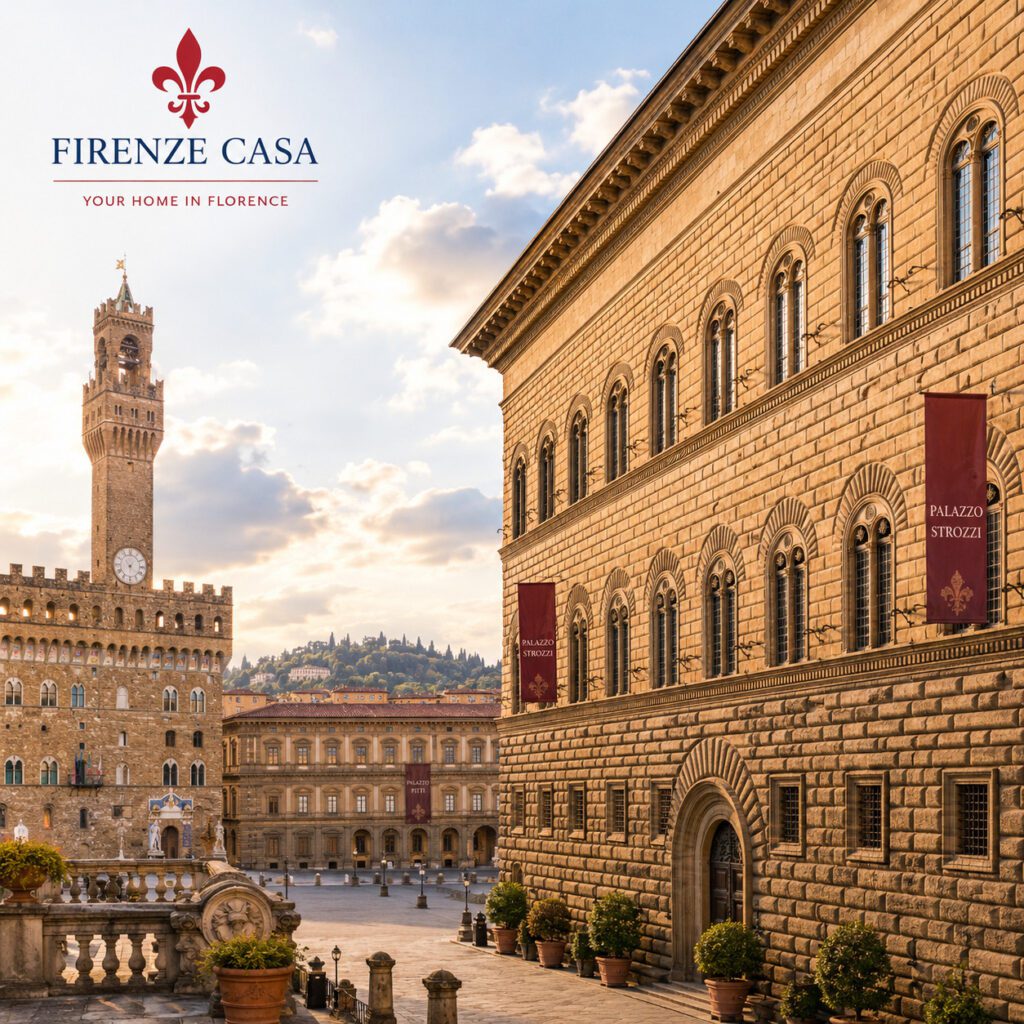
Before entering Palazzo Vecchio, walk to the opposite side of Piazza della Signoria and study the entire façade. From here, the relationship between the massive palace, the Torre di Arnolfo and the open civic square becomes much easier to understand.
Why Is It Called Palazzo Vecchio?
The name Palazzo Vecchio means the “Old Palace”, although Florentines originally knew the building by other names. Those changing names provide a concise history of the palace itself.
At first, people called it the Palazzo dei Priori, referring to the Priori who formed an important part of republican government. Later, the name Palazzo della Signoria reflected its function as the seat of the governing Signoria.
A dramatic change followed during the 16th century. Cosimo I de’ Medici moved his court into the building and transformed the former republican headquarters into a ducal residence.
Eventually, the Medici transferred their principal residence across the Arno to Palazzo Pitti. Their former home then became the “old palace” – Palazzo Vecchio.
Palazzo dei Priori, Palazzo della Signoria, ducal palace and finally Palazzo Vecchio: few Florentine buildings preserve the political evolution of the city so clearly through their successive names.
A Palace Built for the Florentine Republic
Construction began at the end of the 13th century, traditionally around 1299. By then, Florence had become one of Europe’s wealthiest commercial cities. However, economic success did not guarantee political stability.
Competition between powerful families and political factions repeatedly created conflict. Florence’s governing officials therefore needed a secure headquarters from which they could exercise authority.
The new palace answered both practical and symbolic needs. Administrative spaces supported government, while the fortress-like architecture offered protection and projected strength.
For this reason, Palazzo Vecchio looks strikingly different from the elegant Renaissance residences that appeared in Florence during the following centuries.
Arnolfo di Cambio and the Medieval Palace
Tradition attributes the design of Palazzo Vecchio to Arnolfo di Cambio, one of the central figures of medieval Florentine architecture. His name also connects with major projects such as Florence Cathedral and the Basilica of Santa Croce.
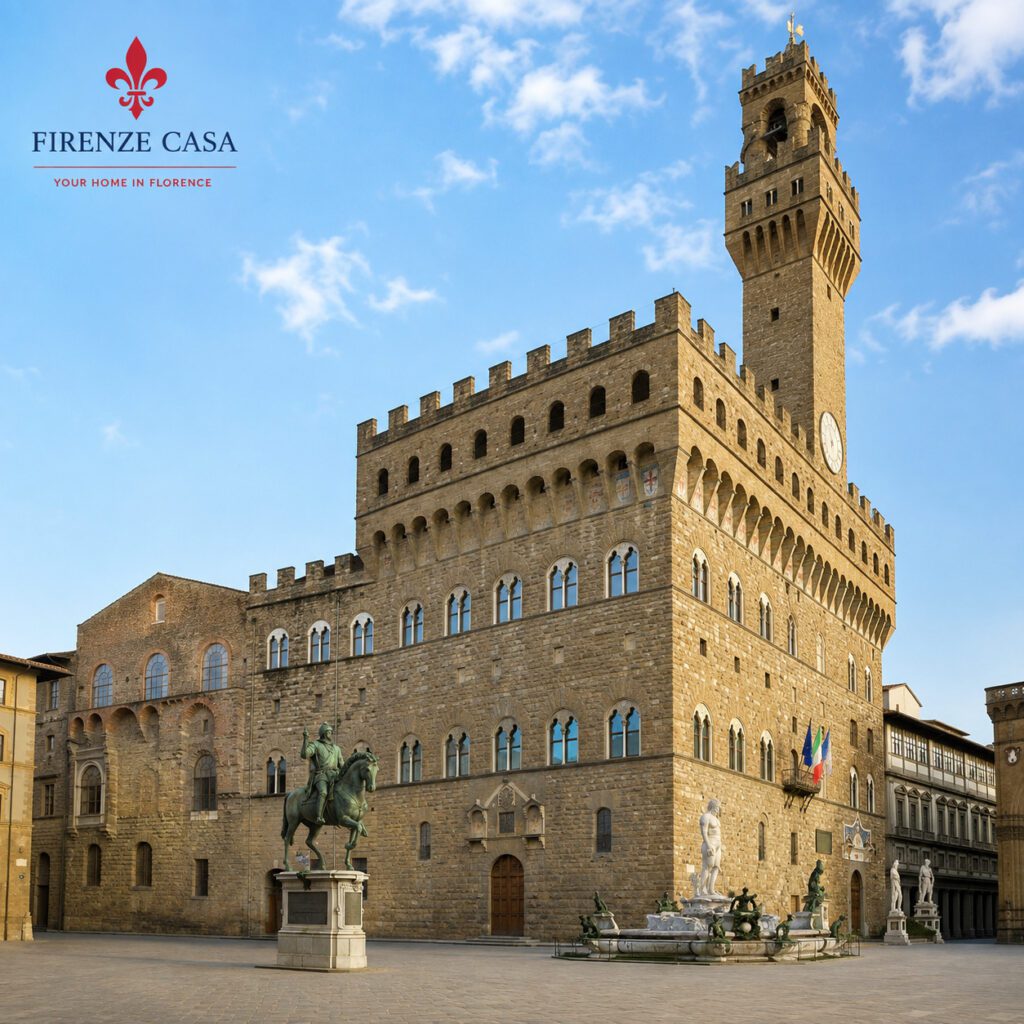
Massive rusticated stone gives the palace an extraordinary physical presence above Piazza della Signoria. Relatively small windows, crenellations and the towering vertical silhouette strengthen its fortress character.
Rather than concealing the building’s defensive purpose, its architecture turns strength into a visual statement. Florence wanted its seat of government to appear secure, permanent and authoritative.
Compare Palazzo Vecchio with Palazzo Strozzi or Palazzo Medici Riccardi. All three use powerful stone façades, yet Palazzo Vecchio retains a much stronger fortress character. The contrast shows how Florentine palace architecture evolved between the Middle Ages and the Renaissance.
The Torre di Arnolfo
The Torre di Arnolfo makes Palazzo Vecchio instantly recognisable. Rising to approximately 95 metres, the tower became one of the great symbols of Florentine civic authority.
Interestingly, it does not rise symmetrically from the centre of the façade. Its position relates partly to earlier structures incorporated into the medieval palace complex.
The tower combined practical and symbolic purposes. Bells could communicate important events to the population, while its extraordinary height projected the presence of civic government across Florence.
Even today, the silhouette of Palazzo Vecchio and its tower remains one of the defining images of the city.
Fortress or Palace?
Palazzo Vecchio demonstrates how closely fortress and palace architecture could overlap in medieval Florence. Government required both representative spaces and physical security.
Councils and officials worked inside the complex, while its heavy walls and elevated defensive elements protected political leaders during periods of factional conflict.
Later Florentine residences retained elements of this visual language. Even when defence became less important, rustication and massive stone façades continued to communicate permanence, wealth and authority.
Piazza della Signoria and the Architecture of Government
Understanding Palazzo Vecchio also requires understanding Piazza della Signoria. For centuries, the square has served as Florence’s principal civic stage, bringing together architecture, politics and public life.
Decisions made inside the palace affected the population gathered outside. Meanwhile, ceremonies, political announcements, celebrations and executions turned the piazza into a public extension of government.
The nearby Loggia dei Lanzi added another architectural element to this civic landscape. Over time, monumental sculptures further transformed the square into an extraordinary display of political imagery.
Thus, Palazzo Vecchio did more than occupy Piazza della Signoria. It helped define the meaning and function of the entire space.
From Medieval Fortress to Renaissance Palace
Florence changed considerably during the centuries after Palazzo Vecchio first rose above the city. Inevitably, the palace changed with it.
Successive governments enlarged and modified the complex as administrative needs increased. Renaissance architects then introduced increasingly refined spaces behind the severe medieval exterior.
The contrast remains visible today. Visitors approach an imposing fortress façade but discover elegant courtyards, ceremonial halls and richly decorated apartments inside.
Consequently, Palazzo Vecchio does not represent a single architectural period. Instead, it records centuries of political and artistic transformation.
Michelozzo and the Renaissance Courtyard
The first courtyard provides one of the clearest examples of this transformation. Michelozzo, the architect closely associated with Medici Florence, helped introduce a more elegant Renaissance language into the medieval complex.
Columns and arches create an ordered interior space that contrasts sharply with the defensive exterior. Later decorative campaigns enriched the courtyard even further.
This gradual development reflects a recurring characteristic of Florence. Rather than demolishing important older buildings, successive generations often adapted them to new architectural tastes and political requirements.
Cosimo I Turns the Government Palace into a Residence
The most dramatic change began after Cosimo I de’ Medici became Duke of Florence in 1537. He gradually consolidated his authority and transformed Florence from a politically turbulent city into the centre of a hereditary territorial state.
In 1540, Cosimo and his family moved into Palazzo della Signoria. Suddenly, a building created for republican magistrates also had to accommodate a Renaissance court.
This change carried enormous symbolic significance. Cosimo did not simply choose a convenient residence; he placed Medici dynastic power inside the architectural heart of the former republic.
Private apartments, ceremonial halls and elaborate decorative programmes increasingly presented the Medici as rulers rather than merely influential Florentine citizens.
By moving into Palazzo della Signoria, Cosimo I occupied the traditional centre of republican government. Architecture now helped communicate the transformation from civic republic to Medici dynastic rule.
Giorgio Vasari and Palazzo Vecchio
Giorgio Vasari played a central role in adapting Palazzo Vecchio for Cosimo I. As architect, painter and organiser of complex decorative programmes, he reshaped both the physical building and its political message.
His most spectacular interventions affected the ceremonial interiors, particularly the Salone dei Cinquecento. Nevertheless, Vasari’s importance extends far beyond a single room.
His work formed part of a much larger transformation of central Florence. Palazzo Vecchio, the Uffizi and eventually the Vasari Corridor became interconnected elements within a new architectural landscape of Medici government.
Visitors interested in Vasari’s more personal story can also discover his former residence in our article about Casa Vasari in Florence.
The Salone dei Cinquecento
The magnificent Salone dei Cinquecento provides perhaps the clearest example of Palazzo Vecchio’s changing political identity.
Originally, the vast hall served the republican Great Council. Its enormous dimensions reflected the political ambitions of Florence during a very different period of government.
Under Cosimo I, however, Vasari transformed the space into a monumental ceremonial setting. Architecture and decoration now celebrated ducal authority, Florentine victories and Medici power.
As a result, a hall created for republican government became a theatre of princely representation. Few rooms demonstrate more vividly how rulers can adapt architecture to new political purposes.
The Salone dei Cinquecento is not simply a spectacular hall. Its scale and decoration reflect two different political systems: the Florentine Republic that created it and the Medici state that later transformed it.
Why the Medieval Exterior Survived
Perhaps surprisingly, Cosimo I did not replace the medieval civic fortress with an entirely new palace. Instead, the Medici adapted the existing building to their own requirements.
This decision offered something that a new residence could never provide: direct architectural continuity with Florence’s historic government.
The severe façade therefore retained its association with civic authority even as the political system behind it changed fundamentally. Inside, meanwhile, increasingly elaborate rooms communicated the new language of dynastic rule.
From Palazzo Vecchio to Palazzo Pitti
Eventually, the limitations of the old government palace became increasingly apparent for a dynasty developing a more elaborate court culture. Palazzo Pitti offered a dramatically different environment across the Arno.
Its enormous scale and proximity to the Boboli Gardens allowed the Medici to develop a grand-ducal residence more comparable with other European courts. Yet the move did not diminish Palazzo Vecchio’s political significance.
Instead, Florence now possessed two contrasting expressions of Medici authority. Palazzo Vecchio remained closely associated with government, whereas Palazzo Pitti increasingly represented dynastic residence and courtly splendour.
Palazzo Vecchio and Palazzo Pitti make a fascinating architectural pair. One grew from a fortified medieval seat of republican government; the other developed into the monumental residence of a grand-ducal court.
The Vasari Corridor and a Connected Medici City
In 1565, Vasari created an extraordinary elevated route connecting the principal centres of Medici power. Beginning in the Palazzo Vecchio and Uffizi area, the corridor crossed Ponte Vecchio and continued towards Palazzo Pitti.
This intervention turned existing buildings into parts of a larger architectural system. Government, administration and dynastic residence now connected physically across the city.
Moreover, the project demonstrates how dramatically the role of Palazzo Vecchio had evolved. The medieval civic fortress now formed one end of an architectural network created for Florence’s ruling dynasty.
Palazzo Vecchio Compared with Florence’s Family Palaces
Most buildings in our historic-palace collection began as residences for powerful families. Palazzo Medici Riccardi expressed Medici wealth, while Palazzo Strozzi represented the ambitions of one of their great rivals.
Palazzo Vecchio belongs to another category because the Florentine state effectively acted as its original patron. Civic government, rather than one merchant dynasty, shaped its initial purpose.
This distinction makes architectural comparisons especially revealing. Private palaces borrowed visual ideas associated with strength and authority, whereas Palazzo Vecchio embodied civic power from the beginning.
For that reason, the building provides an essential starting point for understanding the distinctive combination of solidity, prestige and refinement found throughout Florentine palace architecture.
Can You Visit Palazzo Vecchio?
Yes. Palazzo Vecchio welcomes visitors as a museum while continuing to function as Florence’s city hall. This combination of historic monument, museum and active government building gives the palace an unusual continuity.
Visitors can explore the Salone dei Cinquecento, Medici apartments, decorated chambers and numerous works of art. Under appropriate conditions, access to the Torre di Arnolfo provides another memorable experience.
Opening hours, ticket arrangements, tower access and special tours can change. Therefore, check current official visitor information before planning your visit.
Location: Piazza della Signoria, Florence
Historic function: Seat of Florentine government and Medici residence
Current function: Florence City Hall and museum
Architectural origins: Late 13th century
Traditional architect: Arnolfo di Cambio
Main highlights: Salone dei Cinquecento, Medici apartments and Torre di Arnolfo
Public access: Yes
Why Palazzo Vecchio Is Worth Visiting
Palazzo Vecchio is worth visiting because few buildings reveal Florence’s political and architectural history so completely. Its walls preserve the transition from medieval republican government to Medici dynastic rule and, ultimately, to the modern municipality.
The experience also changes dramatically as visitors move through the building. A fortress-like medieval exterior gives way to Renaissance courtyards, monumental halls and lavish Medici interiors.
Furthermore, Palazzo Vecchio provides an ideal reference point for understanding Florence’s private family residences. Its massive stonework and civic authority influenced the architectural language that wealthy merchant and banking families later adapted for their own palaces.
Most remarkably, the building still performs a version of its original purpose. More than seven centuries after its construction, Florence continues to govern itself from Palazzo Vecchio.
Palazzo Vecchio is famous enough to be easy to take for granted. Look at it instead as a building that has served a republic, a duke, a ruling dynasty and a modern municipality. Few European palaces preserve such extraordinary continuity between architecture and political life.
Frequently Asked Questions
Where is Palazzo Vecchio?
Palazzo Vecchio stands on Piazza della Signoria in the historic centre of Florence, immediately beside the Uffizi.
When was Palazzo Vecchio built?
Construction began at the end of the 13th century, traditionally around 1299.
Who designed Palazzo Vecchio?
Tradition attributes the medieval palace to Arnolfo di Cambio, one of the most important architects of medieval Florence.
Why is it called Palazzo Vecchio?
The name means “Old Palace”. Florentines began using it after the Medici transferred their principal residence from the former ducal palace to Palazzo Pitti.
Did the Medici live in Palazzo Vecchio?
Yes. Cosimo I de’ Medici and his family moved into the palace in 1540 and transformed large parts of the former republican government building into a ducal residence.
What is inside Palazzo Vecchio?
Highlights include the Salone dei Cinquecento, richly decorated Medici apartments, historic chambers, courtyards and numerous works of art.
Can you visit the Torre di Arnolfo?
Visitors can normally access the tower under appropriate conditions, although restrictions may apply. Check current arrangements before visiting.
Is Palazzo Vecchio still Florence’s city hall?
Yes. Remarkably, Palazzo Vecchio continues to serve as the seat of Florence’s municipal government while substantial parts of the building operate as a museum.
Further Reading on Firenze Casa
Continue exploring Florence’s great palaces and discover how political power, dynastic ambition and architecture shaped the city:
- Historic Palaces of Florence – Complete Guide
- Palazzo Medici Riccardi – Renaissance Palace
- Palazzo Pitti – Grand Ducal Palace of Florence
- Casa Vasari in Florence – Giorgio Vasari’s Home and Studio
- Palazzo Strozzi – Renaissance Palace of a Powerful Florentine Family
References
- Musei Civici Fiorentini – Historical Information on Palazzo Vecchio
- Comune di Firenze – Palazzo Vecchio and Florence’s Civic History
- UNESCO World Heritage Centre – Historic Centre of Florence
- Vasari, Giorgio – Le Vite de’ più eccellenti pittori, scultori e architettori
- Touring Club Italiano – Firenze e provincia
- Historical Studies of Medieval and Renaissance Civic Architecture in Florence