Palazzo Strozzi in Florence is one of the finest examples of Renaissance palace architecture. Standing between Piazza degli Strozzi and Via de’ Tornabuoni, the monumental residence reflects the wealth, ambition and political influence of the Strozzi family, one of the great rivals of the Medici.
Construction began in 1489 for the wealthy banker Filippo Strozzi the Elder. Its massive rusticated façade, harmonious proportions and elegant courtyard turned Palazzo Strozzi into one of the defining models of Florentine Renaissance architecture. Today, the building has a very different role as one of Florence’s leading venues for major exhibitions of modern, contemporary and historical art.
Location: Piazza degli Strozzi, Florence
Original family: Strozzi
Commissioned by: Filippo Strozzi the Elder
Construction began: 1489
Architectural period: Renaissance
Associated architects: Benedetto da Maiano and Simone del Pollaiolo, known as Il Cronaca
Known for: Monumental rusticated façade, Renaissance courtyard and historic ironwork
Current use: Major exhibition and cultural centre
Public access: Yes; exhibitions require admission
Worth visiting? Absolutely – for both Renaissance architecture and changing exhibitions
Palazzo Strozzi is one of the essential buildings in our Historic Palaces of Florence – Complete Guide. It is particularly rewarding when compared with Palazzo Medici Riccardi, because the two residences reveal how architecture became part of the rivalry between Florence’s most powerful families.
Where Is Palazzo Strozzi?
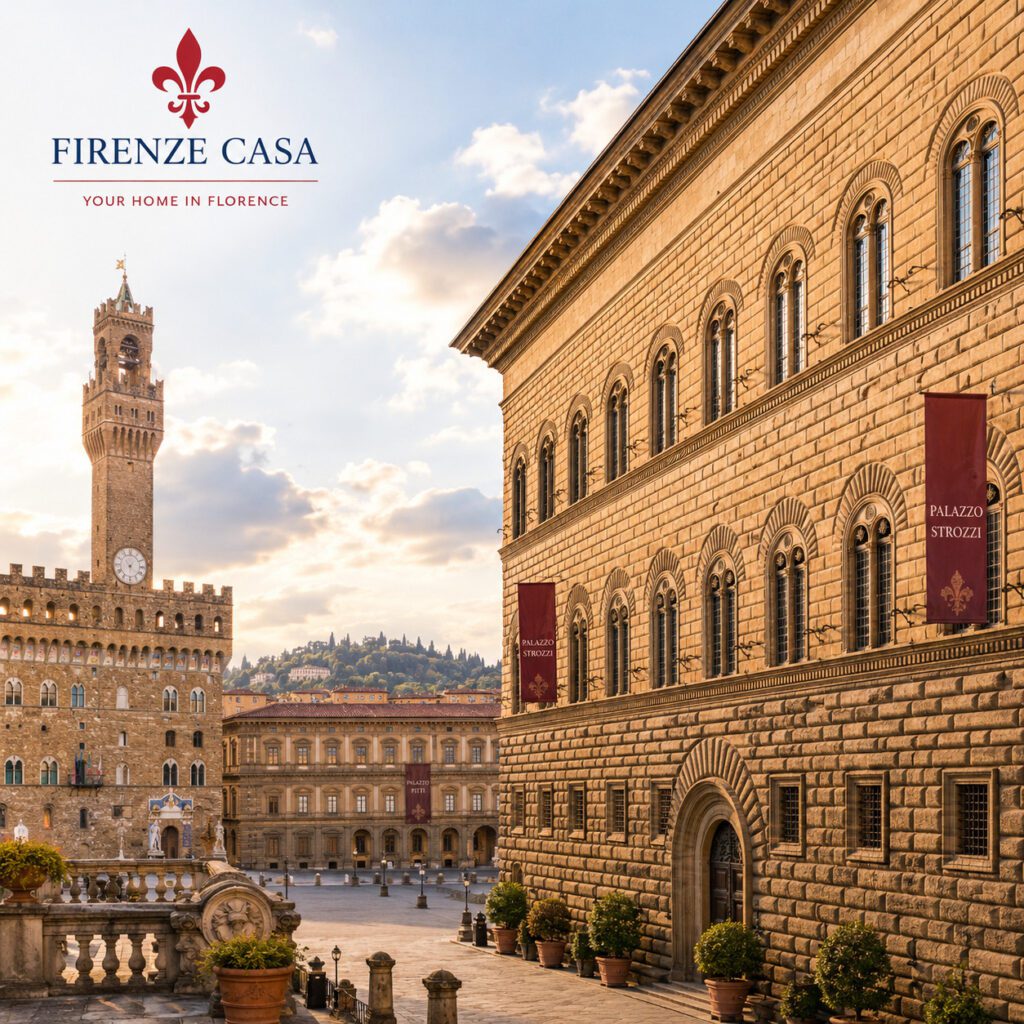
Palazzo Strozzi occupies an entire block in the historic centre of Florence. Its principal façades face Piazza degli Strozzi, Via degli Strozzi and Via de’ Tornabuoni.
The location could hardly be more central. Piazza della Repubblica lies only a short walk away, while Via de’ Tornabuoni leads towards the Arno and Ponte Santa Trinita. Florence Cathedral, Piazza della Signoria and the Uffizi are also within easy walking distance.
This prestigious setting was no accident. Building such an enormous residence in the heart of Florence allowed the Strozzi family to make its wealth and social position visible within the urban landscape.
Do not look at Palazzo Strozzi from only one side. Walk around the entire block. Seeing several façades makes the enormous scale and unusually regular design of the palace much easier to appreciate.
The Strozzi Family and Renaissance Florence
The history of Palazzo Strozzi cannot be separated from the Strozzi family. Bankers, merchants and politicians, the Strozzi belonged for generations to the economic and political elite of Florence.
Their relationship with the Medici was often difficult. Political conflicts eventually forced several members of the family into exile, including Filippo Strozzi the Elder. After returning to Florence, Filippo rebuilt his fortune and sought to restore the prestige of his family.
A monumental new residence became part of that ambition. Palazzo Strozzi would stand in one of the most prominent areas of Florence and compete architecturally with the residences of other powerful families.
Consequently, the palace was never simply a comfortable home. Its scale and architecture communicated lineage, financial strength and political confidence.
In Renaissance Florence, architecture could function almost like a public statement. A family palace expressed wealth and prestige while establishing a permanent presence within the streets of the city.
Filippo Strozzi and the Creation of the Palace
Filippo Strozzi the Elder commissioned the new residence after his return to Florence. Creating a palace of the desired scale required the acquisition of numerous neighbouring properties.
Existing buildings were subsequently demolished to create enough space for the enormous project. Construction officially began in 1489.
Filippo, however, enjoyed his ambitious project only briefly. He died in 1491, just two years after work began, and therefore never saw Palazzo Strozzi completed.
His descendants continued construction over the following decades. The long building process ultimately produced one of the most unified and influential palaces of the Florentine Renaissance.
According to historical tradition, Filippo Strozzi consulted astrologers when determining an auspicious moment to begin construction. Renaissance Florence combined banking, politics, religion and astrology in ways that can seem surprising today.
Who Designed Palazzo Strozzi?
The architectural authorship of Palazzo Strozzi is more complicated than the story of a building created by a single architect. The original design is traditionally associated with Benedetto da Maiano, one of the important architects and sculptors of late fifteenth-century Florence.
Later, Simone del Pollaiolo, known as Il Cronaca, played a significant role in continuing the project. He is particularly associated with important later phases of construction and the great cornice.
Despite the long construction period and involvement of different architects, the palace appears remarkably unified. Proportion, stonework and repeated architectural elements give the enormous building a coherent visual identity.
A Palace Designed to Impress
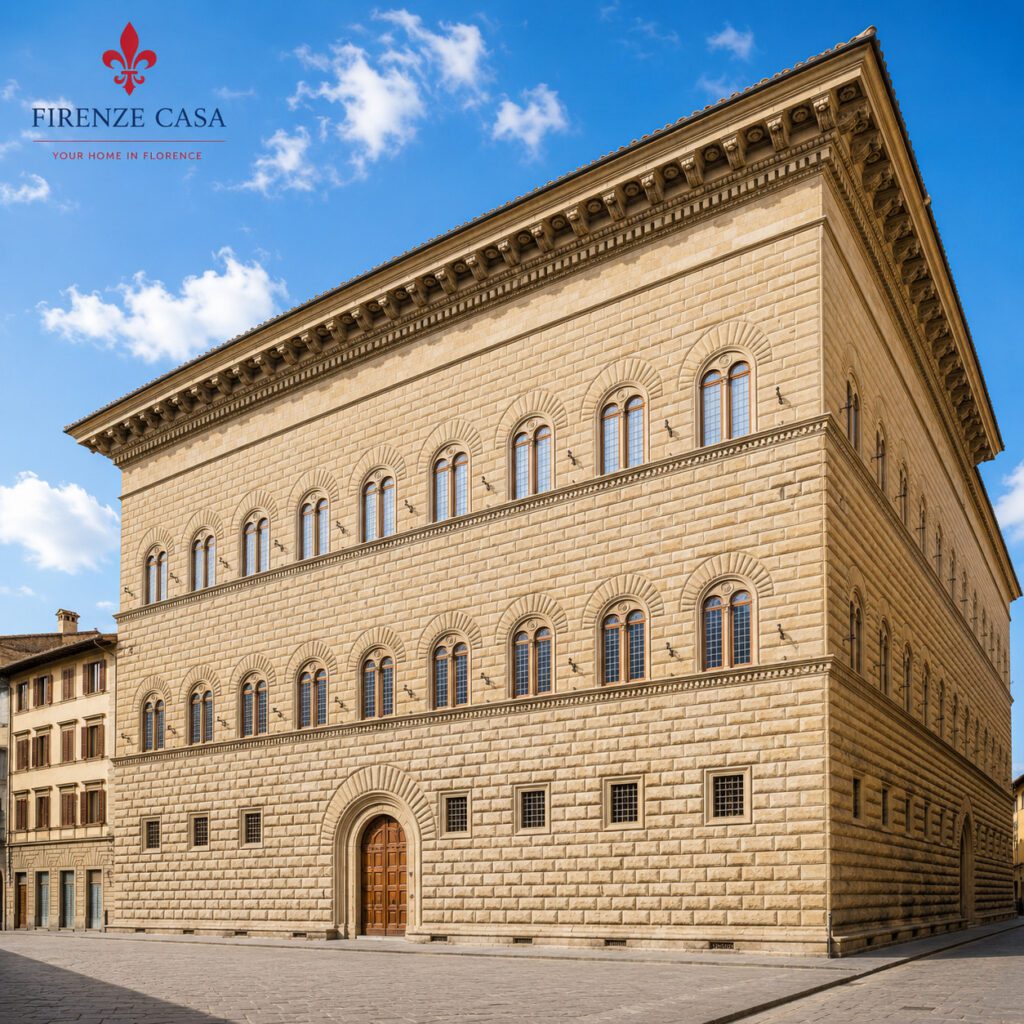
At first sight, Palazzo Strozzi appears powerful rather than decorative. Its impact comes from scale, proportion and the carefully worked stone of its façades.
The exterior uses extensive rustication, leaving the individual stone blocks strongly defined. Their treatment gradually changes across the different levels, creating a transition from the heavy ground floor towards greater refinement above.
Rows of elegant arched biforate windows introduce rhythm into the massive walls. Above them, the enormous projecting cornice provides a dramatic horizontal conclusion to the façade.
The result is monumental but controlled. Palazzo Strozzi does not require towers or elaborate exterior sculpture to demonstrate wealth. Architecture itself makes the statement.
Look at how the stonework changes as your eye moves upwards. The increasingly refined masonry prevents the huge façade from appearing excessively heavy and creates a carefully controlled architectural hierarchy.
Palazzo Strozzi and Palazzo Medici Riccardi
One of the best ways to understand Palazzo Strozzi is to compare it with Palazzo Medici Riccardi. Michelozzo’s earlier Medici residence had already established an influential model for the Florentine Renaissance palace.
Palazzo Strozzi adopted several related ideas. Both buildings use rusticated stonework, regular window arrangements, strong horizontal divisions and a central courtyard.
However, the Strozzi residence develops these principles on a more monumental and remarkably regular scale. Its façades appear almost self-contained, as though the palace were conceived as an ideal architectural object placed within the city.
The comparison also reflects the rivalry between the families. Architecture allowed the Strozzi to compete with the Medici in stone, scale and urban presence.
Palazzo Medici Riccardi established one of the great models of the Renaissance urban palace. Palazzo Strozzi took many of the same principles and transformed them into an even more monumental architectural statement.
The Courtyard of Palazzo Strozzi
Behind the fortress-like exterior lies a very different architectural environment. The central courtyard introduces a lighter and more ordered Renaissance language.
Rounded arches, columns and carefully controlled proportions create a sense of balance within the enormous building. Natural light reaches the surrounding spaces, while the open centre provides visual relief from the massive stone façades outside.
This contrast between a powerful street exterior and an elegant internal courtyard became characteristic of Florentine palace architecture. The façade projected strength towards the city, whereas the courtyard created a more refined world within the residence.
Today, the courtyard remains one of the most accessible ways to experience the architecture of Palazzo Strozzi, even when visitors are not attending an exhibition.
Step into the courtyard and then look back towards the entrance. The transition from the heavy exterior to the elegant internal architecture is one of the defining experiences of a Florentine Renaissance palace.
The Famous Ironwork of Palazzo Strozzi
Some of the most remarkable details of Palazzo Strozzi are surprisingly easy to overlook. Attached to the stone exterior are outstanding examples of Renaissance ironwork traditionally associated with Niccolò Grosso, known as Il Caparra.
Large torch holders, rings and other metal fittings transform functional objects into decorative works of art. Against the heavy rusticated masonry, their intricate forms create a striking visual contrast.
These details also remind us that Renaissance architecture depended on far more than famous architects. Stonecutters, metalworkers, carpenters and numerous other craftsmen contributed to the appearance and character of Florence’s great palaces.
Before entering the palace, examine the iron fittings attached to the façade. They are among the finest surviving examples of decorative Renaissance metalwork in Florence.
Palazzo Strozzi and the Florentine Streetscape
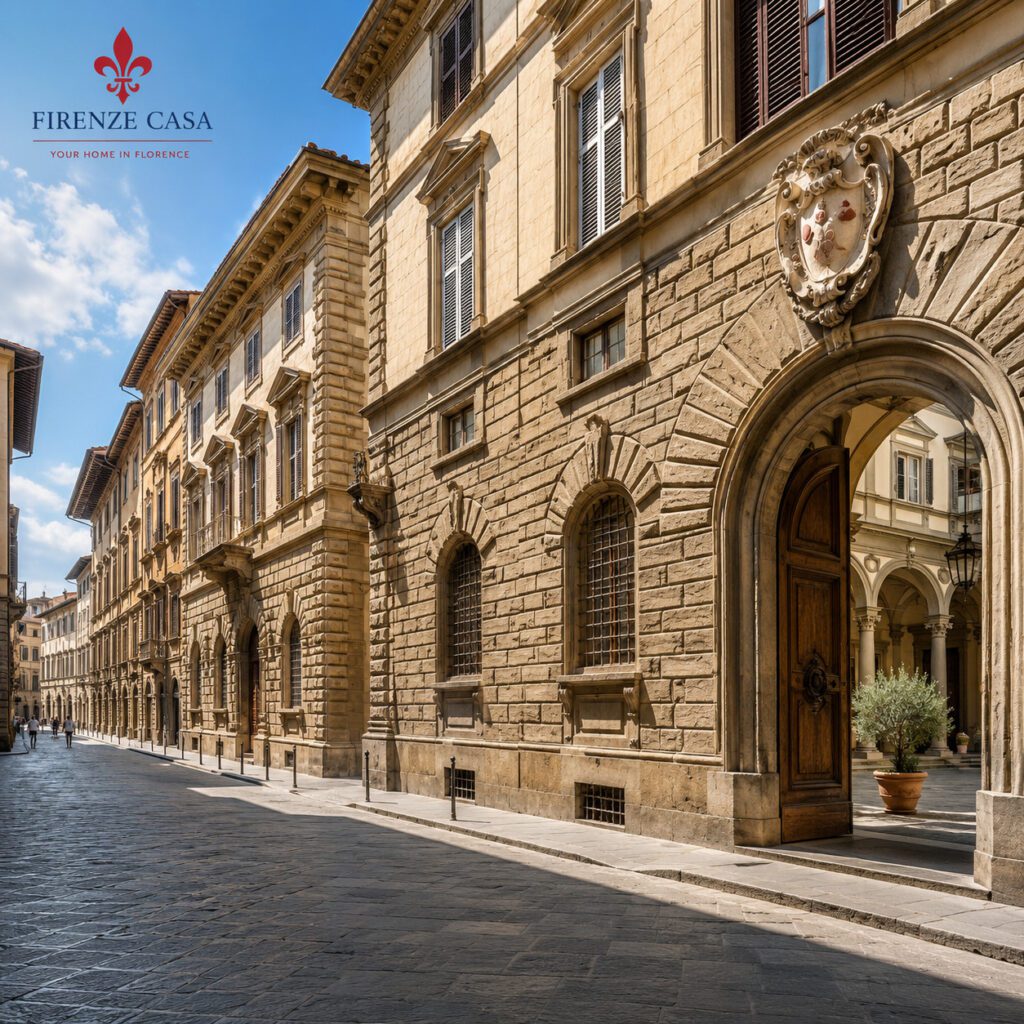
The palace becomes even more interesting when viewed as part of the surrounding neighbourhood. Via de’ Tornabuoni has long been associated with wealthy Florentine families, prestigious residences and commercial activity.
Several important historic palaces stand nearby. Together, they show how banking and merchant families shaped entire streets through private architecture.
Walking through this part of Florence therefore reveals more than a collection of beautiful façades. It shows how economic and political power became embedded in the physical structure of the Renaissance city.
Palazzo Strozzi stands out because of its extraordinary scale, yet it belongs to this broader urban landscape of family residences and commercial wealth.
From Private Residence to Cultural Institution
Palazzo Strozzi remained associated with the Strozzi family for centuries, although its role changed considerably over time. Eventually, the building entered a new phase as a public cultural space.
Today, the Fondazione Palazzo Strozzi organises major exhibitions within the historic building. Programmes range from Renaissance and historical subjects to internationally recognised modern and contemporary artists.
Unlike a conventional museum, Palazzo Strozzi does not depend primarily on a permanent collection. Instead, its changing programme continually introduces new artworks and ideas into the Renaissance setting.
This combination gives the palace a distinctive place within Florence. The architecture preserves the ambitions of a fifteenth-century banking family, while the exhibitions connect the building with contemporary cultural life.
Palazzo Strozzi is one of the best examples of Florence allowing a historic building to remain culturally active. Renaissance architecture and changing exhibitions continually create new relationships between the city’s past and the art of later periods.
Why Palazzo Strozzi Matters
Palazzo Strozzi represents much more than an impressive Renaissance residence. Its history captures the competitive world of Florence’s great banking and merchant families.
Filippo Strozzi wanted a building worthy of his family’s restored wealth and prestige. The result became one of the clearest architectural statements of private power in Renaissance Florence.
At the same time, Palazzo Strozzi influenced the development of urban palace architecture. Its carefully controlled proportions, monumental façades and harmonious courtyard demonstrate the maturity of a building type that had developed rapidly during the fifteenth century.
Its modern cultural role adds another layer to that history. Rather than becoming simply a preserved monument, the palace continues to attract new audiences through changing exhibitions and events.
Palazzo Strozzi and Other Renaissance Palaces
Within Florence, Palazzo Strozzi belongs to an extraordinary sequence of Renaissance family residences. Each palace reveals a different approach to wealth, architecture and public identity.
Palazzo Rucellai uses a more explicitly classical architectural language associated with Leon Battista Alberti. Palazzo Medici Riccardi combines powerful rustication with the political restraint required by Cosimo the Elder.
Palazzo Strozzi, meanwhile, brings the monumental Florentine palace to an extraordinary level of scale and regularity. Comparing these buildings makes the development of Renaissance architecture visible while walking through the city.
For a compact Renaissance palace walk, compare Palazzo Medici Riccardi, Palazzo Rucellai and Palazzo Strozzi. Together, they provide an excellent introduction to three different interpretations of elite residential architecture in fifteenth-century Florence.
Can You Visit Palazzo Strozzi?
Yes. Palazzo Strozzi is open to the public as an active exhibition and cultural centre. Temporary exhibitions provide the main reason to explore the interior spaces, while the Renaissance courtyard is also worth seeing for its architecture alone.
Because Palazzo Strozzi does not function like a museum with one permanent collection, every visit can be different. Exhibitions, opening hours, ticket prices and special events change throughout the year.
For this reason, check the current programme and visitor information before planning a visit, particularly if a specific exhibition interests you.
Address: Piazza degli Strozzi, 50123 Florence
Area: Historic centre / Via de’ Tornabuoni
Current use: Exhibition and cultural centre
Exhibitions: Changing programme throughout the year
Public access: Yes
Courtyard: Worth visiting even without seeing an exhibition
Suggested visit: Approximately 1–2 hours for an exhibition
Best advice: Check the current programme and opening arrangements before visiting
What to See near Palazzo Strozzi
Palazzo Strozzi stands in one of the most rewarding areas of Florence for exploring historic architecture. Via de’ Tornabuoni leads past several important residences towards Piazza Santa Trinita and the Arno.
Piazza della Repubblica lies only a few minutes away, while Palazzo Rucellai can easily be included in the same walk. Continuing towards the river brings visitors to Ponte Santa Trinita and views across the Oltrarno.
Because the distances are short, Palazzo Strozzi works particularly well as part of an architectural walk rather than as an isolated destination.
Why Palazzo Strozzi Is Worth Visiting
Palazzo Strozzi is worth visiting because it brings together Renaissance architecture, family rivalry and contemporary cultural life. Few buildings demonstrate the ambitions of Florence’s great banking dynasties more clearly.
The palace also rewards careful observation. Its rusticated stonework, enormous cornice, historic iron fittings and elegant courtyard reveal how Renaissance architects and craftsmen transformed a private residence into a monumental statement of prestige.
Finally, its changing exhibitions prevent Palazzo Strozzi from becoming merely a monument to the past. Five centuries after Filippo Strozzi began his ambitious residence, the building remains one of the most active cultural spaces in Florence.
Palazzo Strozzi is especially rewarding after visiting Palazzo Medici Riccardi. The two buildings turn the rivalry of Renaissance Florence into architecture: similar ideas of solidity, proportion and prestige expressed with very different degrees of monumentality.
Frequently Asked Questions
Where is Palazzo Strozzi?
Palazzo Strozzi stands on Piazza degli Strozzi in the historic centre of Florence, immediately beside Via de’ Tornabuoni and only a short walk from Piazza della Repubblica.
Who commissioned Palazzo Strozzi?
Filippo Strozzi the Elder commissioned the palace after returning to Florence and rebuilding his family’s wealth and political position.
When was Palazzo Strozzi built?
Construction began in 1489 and continued for several decades after Filippo Strozzi died in 1491.
Who designed Palazzo Strozzi?
The original design is traditionally associated with Benedetto da Maiano, while Simone del Pollaiolo, known as Il Cronaca, played an important role during later phases of construction.
Why is Palazzo Strozzi important?
It is one of the finest and most influential examples of Florentine Renaissance palace architecture. Its monumental design also reflects the wealth and political ambitions of the Strozzi family.
How does Palazzo Strozzi compare with Palazzo Medici Riccardi?
Both palaces use characteristic elements of Florentine Renaissance architecture, including rusticated stonework and central courtyards. Palazzo Strozzi develops these ideas on a larger and more monumental scale.
What is Palazzo Strozzi used for today?
Today, Palazzo Strozzi is a major cultural and exhibition centre presenting changing programmes of historical, modern and contemporary art.
Can you visit Palazzo Strozzi?
Yes. Visitors can attend exhibitions and experience the historic building. The courtyard is also an important architectural space in its own right.
Does Palazzo Strozzi have a permanent art collection?
Palazzo Strozzi is primarily known for temporary exhibitions rather than a conventional permanent museum collection. As a result, the artistic experience changes throughout the year.
How much time should you allow for Palazzo Strozzi?
Allow approximately one to two hours if you plan to see an exhibition. Architecture enthusiasts should also leave time to walk around the exterior and explore the courtyard.
Further Reading on Firenze Casa
Continue exploring Florence’s historic palaces and discover how architecture expressed family wealth, rivalry and political power during the Renaissance:
- Historic Palaces of Florence – Complete Guide
- Palazzo Medici Riccardi – The First Renaissance Palace in Florence
- Palazzo Rucellai – Alberti’s Renaissance Palace in Florence
- Palazzo Vecchio – Florence’s Historic Seat of Government
- Palazzo Gianfigliazzi – Historic Palace on the Arno
References
- Fondazione Palazzo Strozzi – History and Architecture of Palazzo Strozzi
- Comune di Firenze – Palazzo Strozzi
- Treccani – Strozzi Family and Filippo Strozzi
- Goldthwaite, Richard A. – The Building of Renaissance Florence
- Najemy, John M. – A History of Florence 1200–1575
- Hibbert, Christopher – Florence: The Biography of a City
- Brucker, Gene – Renaissance Florence