Palazzo Gianfigliazzi is a historic noble residence on Lungarno Corsini in the centre of Florence, overlooking the Arno between Ponte Santa Trinita and Ponte alla Carraia. The palace takes its name from the Gianfigliazzi family, an old Florentine dynasty whose wealth and political influence reached back to the Middle Ages. The building is not a conventional public museum, but its façade and exceptional riverside setting can be admired while walking along the Lungarno. We have included Palazzo Gianfigliazzi in our collection because it connects three characteristic elements of Florence: a powerful medieval family, centuries of changing architecture and the aristocratic palaces that transformed the banks of the Arno.
The palace also illustrates an important feature of Florence. Many buildings that appear harmonious today are the result of centuries of rebuilding, enlargement and changing ownership. Behind their façades often lies a much older urban history.
The Gianfigliazzi Family
The Gianfigliazzi were established in Florence by the 13th century. Their name is traditionally derived from Giovanni, son of Azzo. The family accumulated wealth through financial activities and lending, both in Florence and beyond Tuscany.
Like several powerful Florentine dynasties, the Gianfigliazzi were initially classified among the city’s magnate families. This status restricted their participation in public office. In 1369 they became politically eligible as popolani, opening the way to an important role in Florentine government.
From then until the middle of the 16th century, members of the family served Florence repeatedly. The Gianfigliazzi produced numerous priors and Gonfalonieri di Giustizia, placing them firmly within the political history of the republic.
A Palace with Medieval Origins
The history of Palazzo Gianfigliazzi is older than its present appearance suggests. The area around today’s Lungarno was already occupied by residences belonging to prominent Florentine families during the medieval period.
As Florence changed, these fortified urban houses gradually evolved into more comfortable aristocratic residences. Successive alterations transformed their appearance and adapted them to new ideas about prestige, domestic life and architecture.
This process explains why Palazzo Gianfigliazzi should not be understood as the product of a single architectural moment. It represents several layers of Florentine history.
Palazzo Gianfigliazzi and the Arno
The location of the palace is one of its greatest attractions. It stands on Lungarno Corsini, facing the Arno in a part of Florence lined with historic residences.
Today this stretch of riverfront feels elegant and open. In earlier centuries, however, proximity to the river had practical as well as prestigious significance. The Arno formed an essential part of Florence’s commercial and economic life.
Over time, noble families increasingly transformed the riverbanks into desirable residential addresses. Their palaces helped create the monumental appearance of the Lungarni that visitors see today.
Architecture of Palazzo Gianfigliazzi
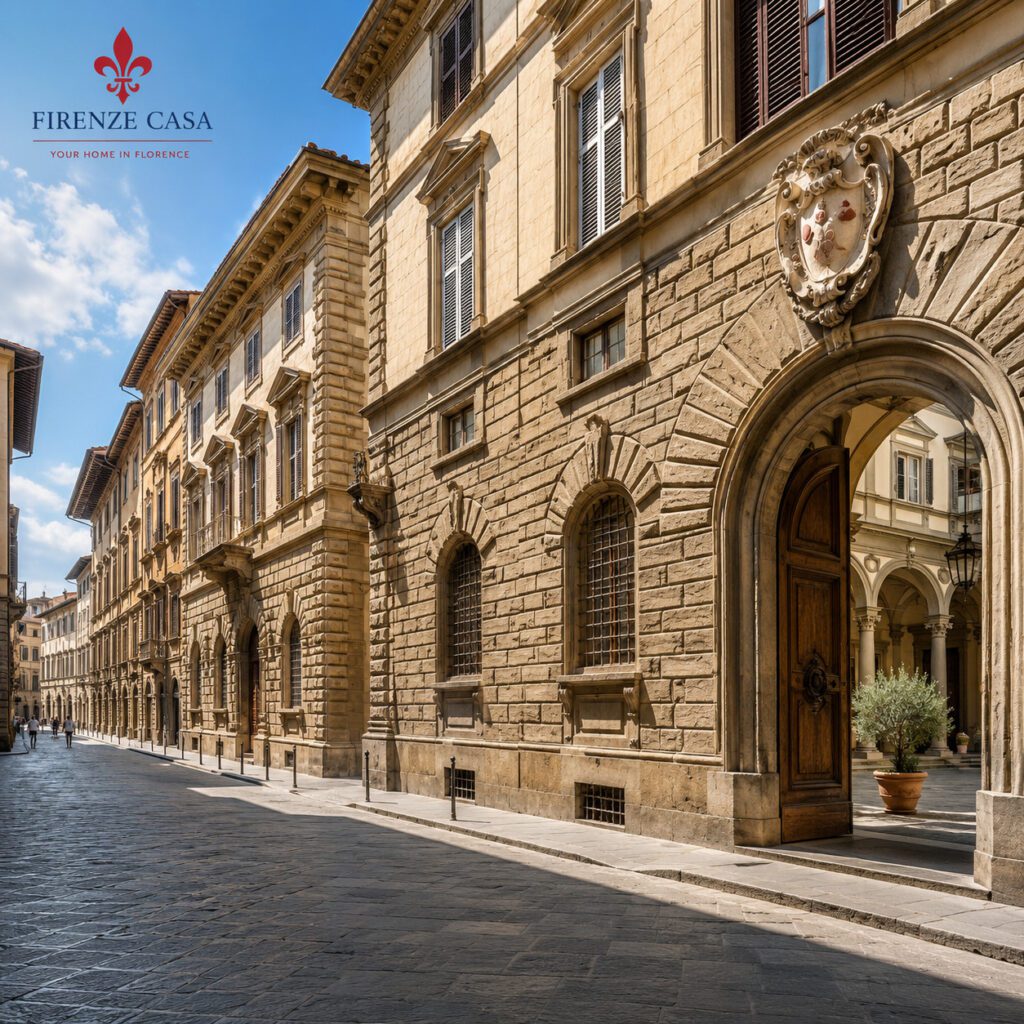
The present palace has the restrained elegance typical of many Florentine noble residences. Its ordered façade creates a strong horizontal presence along the river.
Regular rows of windows and carefully balanced proportions give the building a more refined appearance than the defensive residences associated with medieval Florence. Yet the site’s history reaches back to that earlier urban world.
This contrast makes the palace particularly interesting. It shows how families adapted their residences as Florence evolved from a medieval commune into one of Europe’s great Renaissance and early modern cities.
Later Owners and Changes
The history of the building did not end with the Gianfigliazzi. Like many Florentine palaces, it passed through different owners and underwent alterations over the centuries.
Historic records refer to two buildings known as the Palazzi Gianfigliazzi on Lungarno Corsini. This is useful to remember because the name can refer to a broader historic complex rather than simply one isolated residence.
Changes in ownership also reflect a wider pattern in Florence. Old family properties were divided, sold and adapted as the fortunes of aristocratic dynasties changed.
Can You Visit Palazzo Gianfigliazzi?
Palazzo Gianfigliazzi is not a conventional public museum. Visitors should therefore not expect regular access to historic interiors simply by arriving at the building.
The exterior, however, is easy to include in a walk through central Florence. Its location on Lungarno Corsini makes it particularly convenient when exploring the area around Via de’ Tornabuoni, Ponte Santa Trinita and the historic palaces along the Arno.
What to See Nearby
Palazzo Gianfigliazzi lies in one of the best areas of Florence for exploring aristocratic architecture. Palazzo Corsini al Parione stands nearby and provides a striking contrast with its monumental Baroque character.
Via de’ Tornabuoni is also only a short walk away. Several important Florentine palaces stand along or near this famous street, including Palazzo Strozzi.
Ponte Santa Trinita provides another natural continuation. From the bridge, visitors have excellent views along the Arno and towards the historic buildings lining both banks.
Why Palazzo Gianfigliazzi Is Worth Seeing
Palazzo Gianfigliazzi will not compete for attention with Palazzo Vecchio, Palazzo Pitti or Palazzo Strozzi. That is precisely why it belongs in our collection.
It helps explain the Florence that exists between the major monuments. Powerful families did not shape the city only through churches, public offices and famous works of art. They also shaped entire streets through their private residences.
The palace therefore offers another piece of the larger Florentine story. Its medieval family history, later architectural transformation and position beside the Arno connect politics, wealth and urban development in a single building.
Further Reading on Firenze Casa
Explore more of Florence’s historic palaces and discover the residences that shaped the architectural character of the city and the Arno riverfront.
- Historic Palaces of Florence – Complete Guide
- Palazzo Corsini al Parione
- Palazzo Rucellai – Alberti’s Renaissance Palace in Florence
- Palazzo Strozzi – Renaissance Palace of a Powerful Florentine Family
- Palazzo Pitti – Grand Ducal Palace of Florence
References
- Sistema Informativo Unificato per le Soprintendenze Archivistiche (SIUSA), Gianfigliazzi family records.
- Archivio di Stato di Firenze, historical and family records.
- Ministero della Cultura, archival documentation concerning Florentine noble families and properties.
- Comune di Firenze, historical and cultural resources on Florence.