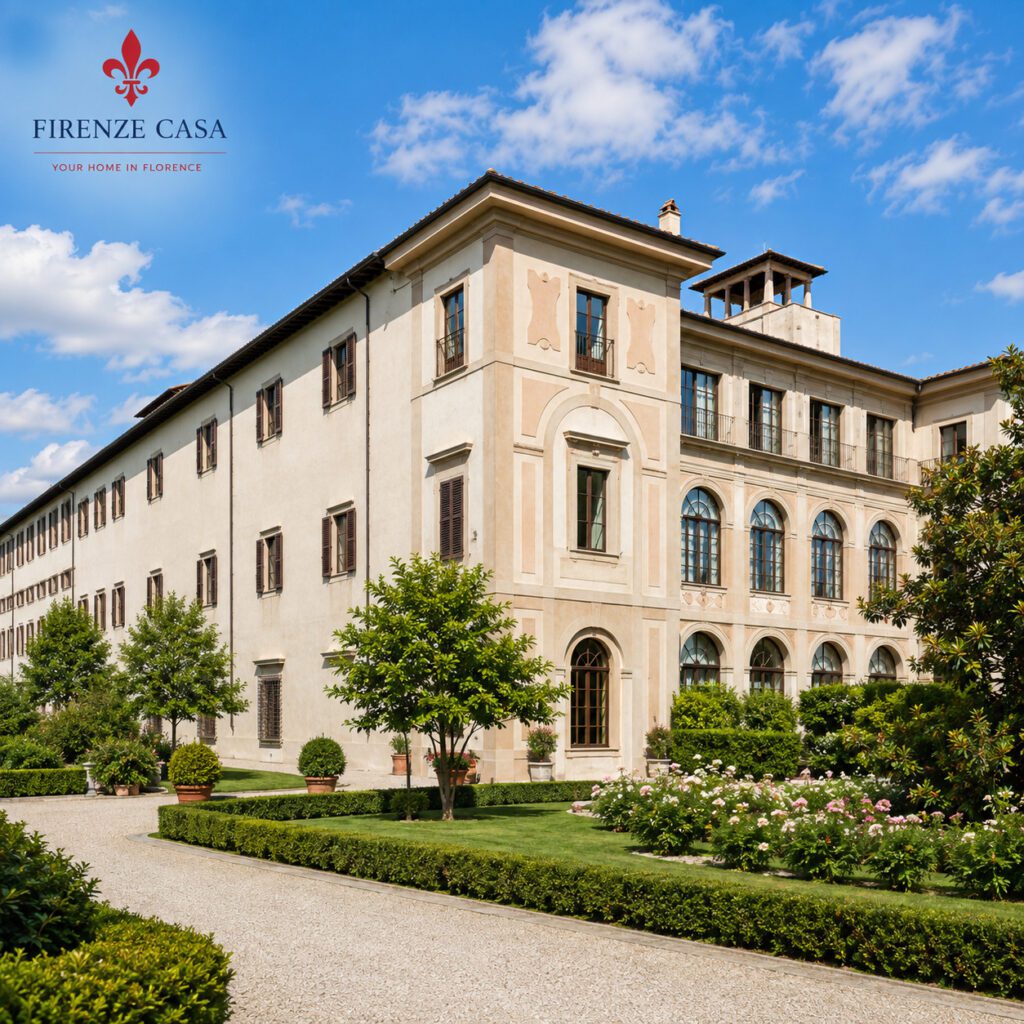
Palazzo Gherardesca in Florence is a Renaissance residence with one of the most remarkable private gardens in the historic centre. Located at Borgo Pinti 99, northeast of the Duomo, the palace began as the home of humanist and Florentine chancellor Bartolomeo Scala before passing to the ancient Della Gherardesca family.
Today, the complex forms part of the Four Seasons Hotel Firenze and is not a conventional public museum. Nevertheless, its Renaissance origins, aristocratic history and extraordinary garden make Palazzo Gherardesca especially interesting for visitors who want to discover a quieter side of historic Florence.
Address: Borgo Pinti 99, Florence
Original name: Palazzo Scala
Founder: Bartolomeo Scala
Later family: Della Gherardesca
Architectural period: Renaissance with later alterations
Known for: Historic palace and large private garden
Current use: Four Seasons Hotel Firenze
Public access: No regular museum-style access
Worth seeing for: Renaissance history, gardens and aristocratic Florence
Palazzo Gherardesca forms part of the wider architectural story explored in our Historic Palaces of Florence – Complete Guide.
Where Is Palazzo Gherardesca?
Palazzo Gherardesca stands on Borgo Pinti, northeast of Florence Cathedral and close to the eastern edge of the historic centre. Although the area is only a short walk from the Duomo and Santissima Annunziata, it generally feels quieter than the busiest central streets.
The palace occupies an unusual position within Florence because a large garden extends behind the urban façade. This creates a very different relationship between residence and city from the compact Renaissance palaces built along narrow commercial streets.
For visitors, this makes Palazzo Gherardesca especially rewarding as part of a walk through eastern Florence.
Walk from Piazza della Santissima Annunziata towards Borgo Pinti. Knowing that an extensive historic garden lies behind the palace façade completely changes the way you perceive this part of Florence.
From Palazzo Scala to Palazzo Gherardesca
The origins of the palace lead back to Bartolomeo Scala, one of the most interesting figures of fifteenth-century Florence. Born near Colle di Val d’Elsa in 1430, Scala rose through education and political service to become Chancellor of the Florentine Republic.
His career brought him into the intellectual and political world surrounding the Medici. Unlike members of ancient Florentine dynasties, Scala demonstrated that exceptional ability, learning and powerful connections could also lead to remarkable social advancement.
He acquired property in Borgo Pinti and created a residence suited to his new position. At the time, the building was known as Palazzo Scala.
The palace did not originally belong to the Della Gherardesca family. Its first important identity was Palazzo Scala, named after Bartolomeo Scala, the Florentine chancellor who created the Renaissance residence.
Bartolomeo Scala and Renaissance Florence
Bartolomeo Scala was more than the owner of an impressive house. As Chancellor of the Florentine Republic, he held an important position within the administration of Renaissance Florence.
He was also a humanist and writer. His career unfolded during the age of Lorenzo de’ Medici, when politics, scholarship, literature and patronage were closely intertwined.
Palazzo Scala therefore reflected several aspects of its owner’s identity. It functioned as a residence, a symbol of social success and an architectural expression of the humanist culture in which Scala participated.
Renaissance Florence was not shaped only by old banking dynasties. Figures such as Bartolomeo Scala could rise through education and public service, and architecture became one way to make that new status visible.
The Renaissance Architecture
Palazzo Gherardesca has a complex architectural history because successive owners altered the building over several centuries. Nevertheless, its Renaissance origins remain fundamental to its character.
The palace has traditionally been associated with Giuliano da Sangallo, one of the leading architects of Renaissance Florence. The relationship between the rooms and the internal courtyard reflects the interest in proportion and classical architectural ideas that shaped elite Florentine residences during this period.
Later owners enlarged and modified the complex, yet the Renaissance core continued to define its architectural identity.
Palazzo Gherardesca differs from fortress-like Renaissance palaces such as Palazzo Strozzi. Its setting, courtyard and later garden create a more residential and open aristocratic environment.
The Della Gherardesca Family
The family that eventually gave the palace its modern name was far older than the building itself. The Della Gherardesca belonged to one of Tuscany’s most ancient aristocratic dynasties.
Their documented history reaches deep into the Middle Ages, especially in Pisa and along the Tuscan coast. Members of the family controlled territories, held titles and participated in the complex political struggles of medieval Tuscany.
For readers of Dante, the name is especially familiar. Count Ugolino della Gherardesca became one of the most memorable figures in the Inferno of the Divine Comedy.
The later association of this ancient Tuscan dynasty with a Florentine Renaissance palace adds another layer to the building’s extraordinary history.
The Della Gherardesca name connects medieval Pisa, Dante’s Divine Comedy, aristocratic Tuscany and Renaissance Florence. Few palace histories bring together so many different periods.
Why Is It Called Palazzo Gherardesca?
The answer lies in the changing ownership of the residence. After the Scala period, the property passed through other hands and eventually became closely associated with the Della Gherardesca family.
The family’s connection with the residence became so strong that the earlier name Palazzo Scala gradually gave way to Palazzo della Gherardesca.
This pattern appears throughout Florence. Historic palaces do not always preserve the names of their original builders; later owners sometimes became so closely identified with a residence that their family name replaced the earlier one.
Giardino della Gherardesca
One of the most remarkable features of the complex lies behind the palace: the Giardino della Gherardesca.
The garden occupies land once close to the outer edge of historic Florence and the old city walls. Over the centuries, its design changed as ideas about aristocratic leisure, botany and landscape architecture evolved.
Today, the garden is widely regarded as one of the largest private gardens within Florence’s historic centre. Mature trees, lawns and carefully organised spaces create an unexpected green retreat only a short distance from busy city streets.
Architectural features include a small Neoclassical temple and an Ionic tepidarium, while rare botanical species and old trees add further interest.
Florence has many palace courtyards and formal gardens, but the scale of the Giardino della Gherardesca is exceptional for the historic centre. Behind a city façade lies an unexpectedly extensive private landscape.
A Garden Restored for a New Era
The garden underwent several important transformations during its long history. Among the specialists involved in its restoration was the celebrated Italian landscape architect Pietro Porcinai.
Later work under garden historian and landscape expert Giorgio Galletti helped preserve the historic character of the site while adapting it to contemporary use.
These interventions are important because the garden is not simply decorative scenery. It forms an essential part of the identity of Palazzo Gherardesca and helps explain how aristocratic life extended beyond the palace interiors.
From Noble Residence to Four Seasons Hotel Firenze
Palazzo Gherardesca eventually entered another phase in its long history when the restored complex became part of the Four Seasons Hotel Firenze.
This modern use distinguishes it from historic palaces that became museums, universities or government buildings. The residence continues to serve a hospitality function while preserving significant architectural and landscape features.
Its transformation also illustrates a recurring question throughout Florence: how can historic buildings remain alive without becoming frozen monuments?
Palazzo Gherardesca offers one answer. Its function has changed dramatically, yet the palace and garden remain active parts of contemporary Florence.
Many Florentine palaces survive because their uses changed. Palazzo Gherardesca demonstrates how historic architecture can be adapted to modern hospitality while retaining an important connection with its past.
Can You Visit Palazzo Gherardesca?
Palazzo Gherardesca is not a conventional public museum. The complex forms part of the Four Seasons Hotel Firenze, so access to the palace and garden primarily depends on hotel operations.
However, non-resident visitors may sometimes experience parts of the historic setting through restaurant, bar or seasonal hospitality offerings. These arrangements vary, and access should never be assumed simply because the property functions as a hotel.
Anyone hoping specifically to see the garden or historic interiors should therefore check current arrangements directly before visiting.
Address: Borgo Pinti 99, 50121 Florence
Historic names: Palazzo Scala / Palazzo della Gherardesca
Current use: Four Seasons Hotel Firenze
Public access: No regular museum-style access
Possible access: Hotel, dining or organised experiences depending on current arrangements
Best advice: Check directly before planning a visit
Palazzo Gherardesca and Other Historic Palaces
Palazzo Gherardesca adds an important type of residence to our palace cluster because its large garden distinguishes it from many compact urban palaces.
Palazzo Marucelli-Fenzi represents seventeenth-century aristocratic architecture on Via San Gallo, while Palazzo Capponi all’Annunziata reveals another noble residence in the nearby Santissima Annunziata district.
By contrast, Palazzo Pitti combines palace and garden on a grand-ducal scale. Comparing Pitti with Gherardesca shows two very different ways in which elite residences could connect architecture with landscape.
Palazzo Gherardesca is especially valuable within the cluster because it reminds us that aristocratic Florence was not only a city of stone façades and courtyards. Gardens could be equally important expressions of wealth, privacy and status.
What to See Near Palazzo Gherardesca
The palace fits naturally into a walk through the quieter eastern part of central Florence.
Piazza della Santissima Annunziata lies within walking distance, while Palazzo Capponi all’Annunziata and Palazzo Marucelli-Fenzi can easily be combined with the same route.
Borgo Pinti itself is worth exploring slowly. Historic residences, former religious institutions and stretches of surprisingly quiet urban fabric provide a different experience from the crowded streets around the Duomo.
Combine Borgo Pinti with Santissima Annunziata, Via Gino Capponi and Via San Gallo. This route reveals several lesser-known historic palaces within a relatively small area.
Why Palazzo Gherardesca Is Worth Seeing
Palazzo Gherardesca is worth seeing because it combines Renaissance architecture, political history and one of Florence’s most remarkable private gardens. Its story begins with Bartolomeo Scala and Renaissance humanism before moving through the ancient Della Gherardesca family and into modern hospitality.
The garden adds something especially unusual. Few historic residences in central Florence preserve such an extensive green landscape behind an urban façade.
Even when access is limited, knowing the history of the complex changes the experience of Borgo Pinti. What appears from the street as another elegant historic building conceals a remarkably large aristocratic world of architecture and landscape.
Palazzo Gherardesca reveals a Florence of humanists, aristocrats, gardens and private urban retreats. That combination makes it one of the most distinctive residences in our historic-palace cluster.
Frequently Asked Questions
Where is Palazzo Gherardesca?
Palazzo Gherardesca stands at Borgo Pinti 99 in Florence, northeast of the cathedral and close to the Santissima Annunziata area.
Was Palazzo Gherardesca built by the Della Gherardesca family?
No. The Renaissance residence originated with Bartolomeo Scala and was originally known as Palazzo Scala. The Della Gherardesca family became associated with it later.
Who was Bartolomeo Scala?
Bartolomeo Scala was a humanist, writer and Chancellor of the Florentine Republic during the fifteenth century. His rise in Florentine society led to the creation of the residence that later became Palazzo Gherardesca.
Who were the Della Gherardesca family?
The Della Gherardesca were one of Tuscany’s ancient aristocratic families, particularly associated with medieval Pisa and the Tuscan coast. Count Ugolino della Gherardesca is famously portrayed in Dante’s Inferno.
Does Palazzo Gherardesca have a garden?
Yes. The Giardino della Gherardesca is one of the largest private gardens in Florence’s historic centre and forms an essential part of the palace complex.
What is Palazzo Gherardesca used for today?
The historic complex forms part of the Four Seasons Hotel Firenze.
Can you visit Palazzo Gherardesca?
It is not a conventional public museum. Access depends on hotel operations, dining reservations, events and current arrangements.
Can non-hotel guests see the garden?
Possibly, depending on current restaurant, bar, seasonal or event arrangements. Visitors should check directly with the hotel before planning a visit specifically for the garden.
Why is Palazzo Gherardesca important?
The palace combines Renaissance humanist culture, one of Tuscany’s ancient noble families, a major historic garden and the modern adaptation of a Florentine aristocratic residence.
Further Reading on Firenze Casa
Continue exploring Florence’s historic residences, noble families and palace gardens:
- Historic Palaces of Florence – Complete Guide
- Palazzo Marucelli-Fenzi in Florence
- Palazzo Capponi all’Annunziata in Florence
- Palazzo Medici Riccardi – Renaissance Palace
- Palazzo Pitti – Grand Ducal Palace of Florence
- Dante Alighieri and the Divine Comedy
References
- Comune di Firenze / FeelFlorence – Giardino della Gherardesca
- Archivio di Stato di Firenze – Della Gherardesca Family Archives
- Archivio di Stato di Firenze – Historical Documentation on Bartolomeo Scala and Palazzo della Gherardesca
- Ministero della Cultura – Historical and Architectural Studies on Renaissance Florence
- Historical Studies of Florentine Renaissance Palaces and Gardens