Palazzo Capponi all’Annunziata in Florence is a historic noble residence closely associated with one of the city’s prominent families. Located at Via Gino Capponi 26, only a short walk from Piazza della Santissima Annunziata, the palace represents the quieter aristocratic architecture that survives between Florence’s famous monuments.
The building is not a conventional museum and its historic interiors are not normally open for casual visits. Nevertheless, Palazzo Capponi all’Annunziata is worth seeing for its architecture, its connection with the influential Capponi family and its location in one of the most rewarding historic areas north of the Duomo.
Address: Via Gino Capponi 26, Florence
Area: Santissima Annunziata / San Marco
Historic family: Capponi
Known for: Florentine noble architecture and family history
Nearby landmark: Piazza della Santissima Annunziata
Public access: Not normally open as a public museum
Worth seeing for: Architecture, Florentine family history and its historic neighbourhood
Best combined with: Santissima Annunziata, Ospedale degli Innocenti and San Marco
Palazzo Capponi all’Annunziata forms part of the wider architectural story explored in our Historic Palaces of Florence – Complete Guide.
Where Is Palazzo Capponi all’Annunziata?
Palazzo Capponi all’Annunziata stands at Via Gino Capponi 26, northeast of Florence Cathedral and close to Piazza della Santissima Annunziata. The geographical addition to its name distinguishes the building from other Florentine residences historically associated with different branches of the Capponi family.
The surrounding district is particularly rich in religious, artistic and institutional architecture. Although it lies only a short walk from the Duomo, the streets around Santissima Annunziata and San Marco generally feel quieter than Florence’s busiest visitor routes.
This makes the palace an ideal discovery during a walk through the neighbourhood rather than a monument requiring a separate excursion.
Approach the palace as part of a walk through Santissima Annunziata and San Marco. The area rewards slow exploration, with historic residences, churches and institutional buildings appearing along streets that many visitors simply use as connecting routes.
The Capponi Family and Florence
The history of Palazzo Capponi all’Annunziata is inseparable from the Capponi family, whose members belonged to Florence’s political and economic elite for centuries. Like the Medici, Strozzi, Rucellai and other important dynasties, different branches of the family owned residences and properties in the city and surrounding countryside.
Political office, commerce, landownership and social alliances helped establish the family’s position. Architecture, meanwhile, provided a visible expression of continuity and status from one generation to the next.
The Capponi name remains particularly associated with Piero Capponi, one of the best-known political figures of late fifteenth-century Florence. His confrontation with King Charles VIII of France in 1494 became one of the celebrated episodes in Florentine historical tradition.
A Florentine family palace was much more than an impressive home. Its location, architecture and scale communicated the family’s position within the city, making Florence’s streets a visible map of political and social influence.
Piero Capponi and Charles VIII of France
Piero Capponi became famous during the French invasion of Italy in 1494. When King Charles VIII entered Florence, negotiations over the conditions imposed on the city became increasingly tense.
According to the traditional account, Capponi rejected the French demands and dramatically tore up the proposed agreement. When the French threatened to sound their trumpets, he responded that Florence would ring its bells.
The episode became a symbol of Florentine resistance and civic independence. Although Palazzo Capponi all’Annunziata should not be reduced to the story of one family member, understanding figures such as Piero Capponi helps explain the political world in which powerful Florentine dynasties operated.
A Palace near Santissima Annunziata
The location of Palazzo Capponi all’Annunziata is one of its greatest attractions. Nearby Piazza della Santissima Annunziata is among the most harmonious architectural spaces in Florence.
Filippo Brunelleschi’s Ospedale degli Innocenti established an influential Renaissance vocabulary of columns, arches and proportion along one side of the square. The Basilica della Santissima Annunziata, meanwhile, developed into one of Florence’s most important religious centres.
Noble residences existed alongside these religious and charitable institutions. Consequently, the neighbourhood provides an excellent example of the way different aspects of Florentine society occupied the same urban landscape.
Do not view Palazzo Capponi in isolation. Piazza della Santissima Annunziata, the Ospedale degli Innocenti, the basilica and the surrounding palaces together create one of Florence’s most rewarding architectural environments.
Architecture of Palazzo Capponi all’Annunziata
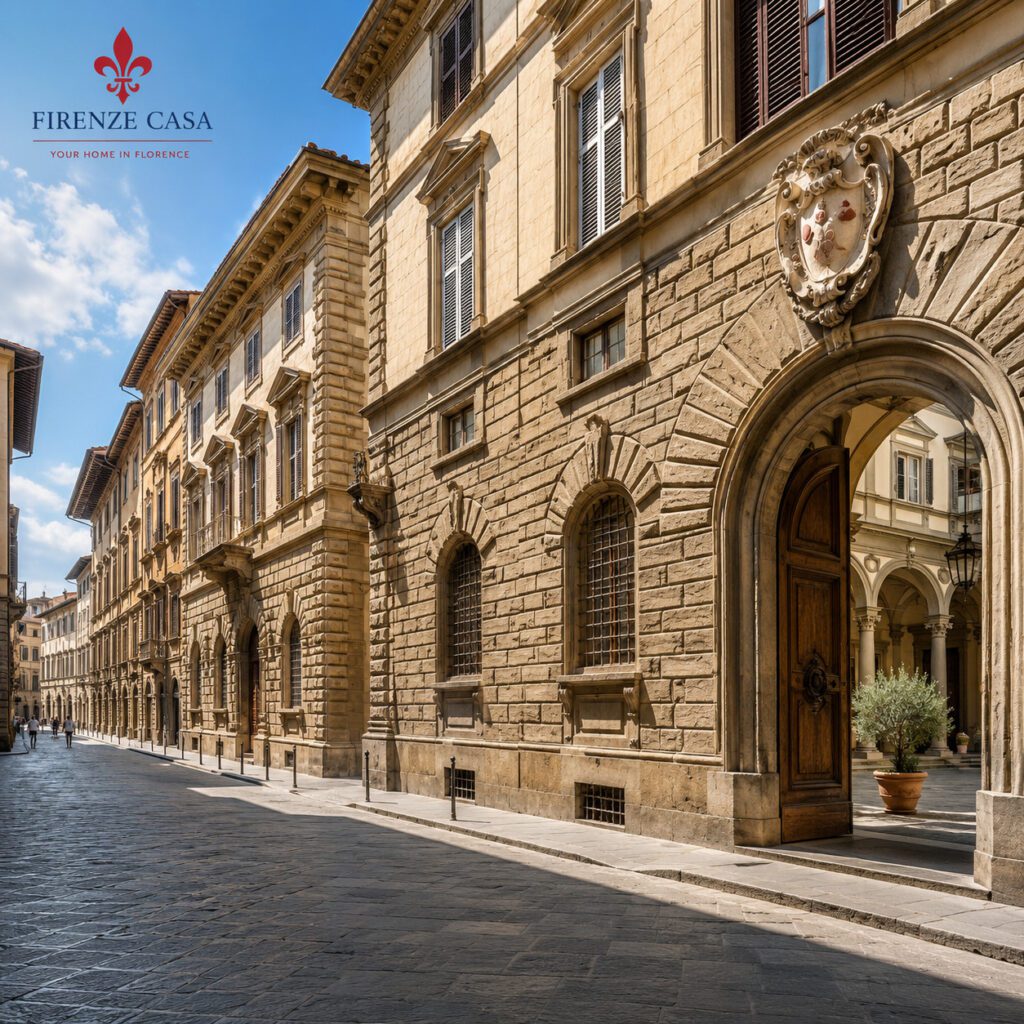
Palazzo Capponi all’Annunziata belongs to Florence’s long tradition of monumental urban residences. Rather than depending on excessive exterior decoration, Florentine palace architecture often creates an impression of status through proportion, scale and carefully organised façades.
Windows, portals, stone details and horizontal divisions establish a controlled architectural rhythm. At the same time, the building remains integrated into the surrounding street rather than standing apart as an isolated aristocratic residence.
This balance between private prestige and urban discipline is one of the characteristics that makes Florence’s historic palaces so distinctive.
Look at the façade as a complete composition rather than searching only for ornament. The proportions, arrangement of the windows and relationship between the palace and Via Gino Capponi reveal much about Florentine residential architecture.
The Palace and the Florentine Streetscape
Visitors naturally associate Florence with public monuments such as Palazzo Vecchio, the cathedral and the city’s great basilicas. However, private residences were equally important in shaping the historic centre.
Powerful families built their palaces near churches, political institutions, commercial streets and properties belonging to relatives. Over generations, these residences helped determine the appearance and social character of entire neighbourhoods.
Palazzo Capponi all’Annunziata illustrates this less obvious layer of the city particularly well. It does not need a famous museum collection to be historically meaningful; its importance lies partly in the way it remains embedded within Florence’s urban fabric.
Palazzo Capponi and Other Florentine Palaces
Comparing Palazzo Capponi all’Annunziata with other residences makes the diversity of Florence’s palace architecture easier to recognise.
Nearby Palazzo Marucelli-Fenzi reflects the development of seventeenth-century aristocratic architecture and richer Baroque interiors. Palazzo Medici Riccardi, by contrast, represents one of the defining models of the fifteenth-century Renaissance palace.
Palazzo Pucci, closer to the cathedral district, provides another example of the close relationship between a prominent Florentine family and the architecture of a particular street.
Together, these buildings show that Florence’s aristocratic landscape cannot be understood through a handful of famous palaces alone.
The individual palace articles are most useful when read together. Comparing different residences reveals how architecture changed according to period, family ambitions, location and later adaptations.
Can You Visit Palazzo Capponi all’Annunziata?
Palazzo Capponi all’Annunziata is not normally operated as a public museum with regular visitor access. Travellers should therefore not plan a visit expecting to tour its historic interiors.
Fortunately, the palace works well as an architectural stop from the street. Its location also means that seeing it requires almost no detour when exploring Santissima Annunziata or San Marco.
If interior access is particularly important, check current arrangements before visiting because the use and accessibility of privately or institutionally occupied historic buildings can change.
Address: Via Gino Capponi 26, Florence
Public access: No regular museum-style access
Time needed: A few minutes from the exterior
Best combined with: Piazza della Santissima Annunziata and San Marco
A Walk through Santissima Annunziata and San Marco
Palazzo Capponi all’Annunziata fits naturally into one of the most attractive short architectural walks in central Florence. Begin at Piazza della Santissima Annunziata, where the Ospedale degli Innocenti and surrounding loggias create an exceptional Renaissance setting.
From the square, continue towards Via Gino Capponi and the palace. Afterwards, the San Marco area lies only a short distance away, while Via San Gallo provides another route rich in historic architecture.
This walk offers something different from the crowded axis between the Duomo, Piazza della Signoria and Ponte Vecchio. Instead, it reveals a quieter Florence of religious institutions, noble residences and streets that preserve much of their historic character.
Combine Palazzo Capponi all’Annunziata with Palazzo Marucelli-Fenzi on Via San Gallo. The two buildings provide a useful introduction to the lesser-known aristocratic architecture north of the Duomo.
Why Palazzo Capponi all’Annunziata Is Worth Seeing
Palazzo Capponi all’Annunziata is worth seeing because it reveals the aristocratic Florence that survives between the city’s famous monuments. Its architecture, location and association with the Capponi family add historical depth to an already fascinating neighbourhood.
The palace is particularly rewarding for visitors who have already seen Florence’s major attractions and want to understand how influential families actually occupied the city. Here, history is not presented inside a museum but remains visible within an ordinary street.
Rather than making Palazzo Capponi all’Annunziata a destination on its own, include it in a walk through Santissima Annunziata and San Marco. In that context, the building becomes part of a much larger historical landscape.
Frequently Asked Questions
Where is Palazzo Capponi all’Annunziata?
Palazzo Capponi all’Annunziata stands at Via Gino Capponi 26 in Florence, close to Piazza della Santissima Annunziata and the San Marco district.
Why is it called Palazzo Capponi all’Annunziata?
The name combines the Capponi family with the palace’s location near Santissima Annunziata. The geographical designation also helps distinguish it from other residences associated with branches of the Capponi family.
Who were the Capponi family?
The Capponi were an important Florentine family whose members participated in the city’s political, economic and social life over several centuries.
Who was Piero Capponi?
Piero Capponi was a Florentine statesman remembered especially for his confrontation with King Charles VIII of France during the French occupation of Florence in 1494.
Can you visit Palazzo Capponi all’Annunziata?
The palace is not normally operated as a public museum, so regular access to the historic interiors should not be assumed. The exterior can easily be seen from Via Gino Capponi.
Is Palazzo Capponi all’Annunziata worth seeing?
Yes, particularly as part of an architectural walk through Santissima Annunziata and San Marco. Its value lies in its family history, architecture and relationship with the surrounding neighbourhood.
What can you see near Palazzo Capponi all’Annunziata?
Piazza della Santissima Annunziata, the Basilica della Santissima Annunziata, the Ospedale degli Innocenti and San Marco are all nearby. Palazzo Marucelli-Fenzi on Via San Gallo can also be included in the same walk.
Further Reading on Firenze Casa
Continue exploring Florence’s historic palaces and the families who shaped the city’s architectural landscape:
- Historic Palaces of Florence – Complete Guide
- Palazzo Marucelli-Fenzi in Florence
- Palazzo Pucci – Historic Noble Palace in Florence
- Palazzo Medici Riccardi – Renaissance Palace
- Casa Vasari Florence – Giorgio Vasari’s Home and Studio
References
- Comune di Firenze – Historical and Architectural Documentation on Florence
- Regione Toscana – Cultural Heritage Resources
- Repertorio delle Architetture Civili di Firenze
- Guido Carocci – Firenze scomparsa
- Walther Limburger – Die Gebäude von Florenz
- Historical Studies on the Capponi Family and Florentine Residential Architecture