Palazzo Pucci in Florence is a historic noble residence with one of the city’s most intriguing political stories. Located at Via de’ Pucci 2, only a few steps from Florence Cathedral, the palace was the home of the influential Pucci family and preserves an unusual reminder of a failed conspiracy against Cosimo I de’ Medici.
Palazzo Pucci is not a conventional public museum, and its historic interiors are not normally accessible for casual visits. Nevertheless, the palace is well worth seeing from the street, particularly for the famous bricked-up window traditionally associated with an assassination plot against the Medici duke.
Address: Via de’ Pucci 2, Florence
Area: Historic centre, close to the Duomo
Historic family: Pucci
Known for: The Pucci conspiracy against Cosimo I de’ Medici
What to look for: The famous bricked-up window
Public access: No regular museum-style access
Historic interiors: Some spaces are used for organised events
Worth seeing for: Medici history, family politics and an unusual architectural detail
Palazzo Pucci forms part of the wider architectural landscape explored in our Historic Palaces of Florence – Complete Guide.
Where Is Palazzo Pucci?
Palazzo Pucci stands on Via de’ Pucci, immediately north of Florence Cathedral. Its exceptionally central location placed the family close to the religious, political and ceremonial heart of Renaissance Florence.
From Piazza del Duomo, the palace can be reached within only a few minutes. Via de’ Pucci also connects naturally with Via de’ Servi, one of the historic routes leading towards Piazza della Santissima Annunziata.
This makes Palazzo Pucci particularly easy to include in a walk through central Florence. Even visitors with little time can see its façade and search for the architectural detail that made the palace famous.
When walking between the Duomo and Santissima Annunziata, stop near the corner of Via de’ Pucci and Via de’ Servi. Look carefully at the lower part of the palace façade for one of Florence’s most unusual reminders of Renaissance political intrigue.
The Pucci Family and Florence
The Pucci family belonged to Florence’s established elite. Their presence in the city can be traced back to the Middle Ages, and family members repeatedly occupied important public positions.
Like other prominent Florentine dynasties, the Pucci combined political influence, property, patronage and carefully cultivated family alliances. Their residence near the cathedral therefore reflected both wealth and their position within the social hierarchy of the city.
For much of their history, the Pucci maintained close relations with the Medici. These connections placed them within the political networks surrounding Florence’s dominant dynasty and initially benefited the family’s position.
However, the relationship eventually produced one of the most dramatic episodes associated with Palazzo Pucci.
Florentine palaces were more than luxurious homes. Their size, location and architecture communicated family identity and political status, which is why the names of historic dynasties still survive throughout Florence on palaces, streets, chapels and monuments.
The Origins of Palazzo Pucci
The first nucleus of Palazzo Pucci dates to the late fifteenth century. In 1480, Antonio Pucci acquired houses and gardens in this part of Florence, providing the basis for the family’s expanding residence.
Further work followed during the sixteenth century as neighbouring properties were incorporated and the complex became increasingly unified. Like many Florentine palaces, Palazzo Pucci therefore developed gradually rather than emerging from one single architectural campaign.
Successive generations adapted the residence according to changing family requirements and artistic tastes. Consequently, the building visible today preserves several layers of Florentine architectural history.
Palazzo Pucci and the Renaissance City
The location of Palazzo Pucci was particularly prestigious. Santa Maria del Fiore stood only a short distance away, while Via de’ Servi connected the cathedral district with Santissima Annunziata.
This placed the Pucci close to important religious institutions and ceremonial routes. For an influential family, living here provided both visibility and proximity to the central spaces of Florentine public life.
Nearby Palazzo Capponi all’Annunziata provides another example of the noble residences that shaped the area between the Duomo, Santissima Annunziata and San Marco.
The Pucci Conspiracy Against Cosimo I de’ Medici
The most memorable chapter in the palace’s history concerns Pandolfo Pucci and a conspiracy against Cosimo I de’ Medici.
Despite the family’s longstanding relationship with the Medici, Pandolfo became involved in a plot against the duke during the sixteenth century. According to the traditional account, the conspirators planned to exploit Cosimo’s predictable movements through the city.
The duke regularly travelled through this area on his way towards religious ceremonies at the Basilica della Santissima Annunziata. The position of Palazzo Pucci therefore offered the conspirators an opportunity to attack him as his procession passed below.
The plan was to assassinate Cosimo from a window of the palace. However, the conspiracy was discovered before the attack could take place.
Renaissance Florence was not simply a world of art and architecture. Rivalries, conspiracies and struggles for political power repeatedly involved the same families whose palaces still line the city’s streets today.
The Famous Bricked-Up Window
After the plot was uncovered, Pandolfo Pucci and his accomplices were arrested. Pandolfo was subsequently executed.
The failed assassination attempt left behind one of Florence’s most unusual architectural curiosities. The window traditionally associated with the conspiracy was bricked up and can still be identified near the corner of Via de’ Pucci and Via de’ Servi.
Without knowing the story, the sealed opening is remarkably easy to overlook. Once its historical context is understood, however, this modest feature transforms the palace façade into a physical reminder of the dangers surrounding political power in Medici Florence.
The bricked-up window of Palazzo Pucci is traditionally linked to the failed plot against Cosimo I de’ Medici. More than four centuries later, visitors can still look for this small architectural trace from the street.
Architecture of Palazzo Pucci
Beyond its famous political story, Palazzo Pucci belongs to Florence’s long tradition of aristocratic urban architecture. The complex developed over several centuries as the family expanded and modified its residence.
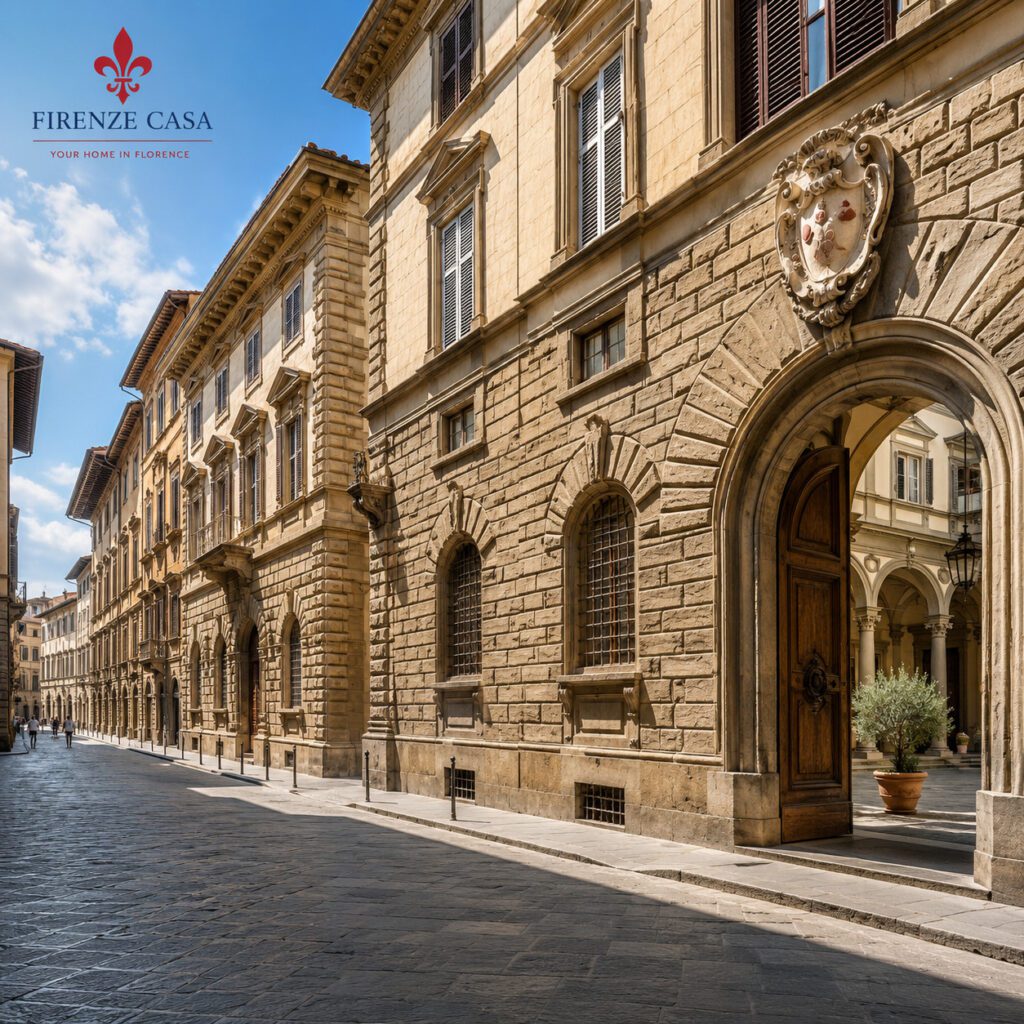
Its façade remains integrated into the surrounding streetscape rather than standing apart as an isolated monument. This relationship between palace and street is characteristic of Florence, where important families built substantial residences directly within densely populated neighbourhoods.
Proportion, organised windows, substantial portals and restrained architectural details communicate status without requiring extravagant exterior decoration.
Do not look only for the sealed window. Step back and examine the palace as part of Via de’ Pucci. Its scale and regular façade reveal how an aristocratic residence could establish a strong presence within a narrow Florentine street.
Historic Interiors of Palazzo Pucci
Behind the relatively restrained exterior, generations of the Pucci family created interiors suited to aristocratic life. Reception rooms provided settings for formal meetings, hospitality and social occasions, while decorative programmes expressed family prestige.
Later artistic campaigns enriched parts of the palace with paintings, frescoes and ornamental decoration. In particular, seventeenth-century additions demonstrate how the residence continued to evolve long after its Renaissance origins.
This contrast between controlled exterior architecture and richer interiors appears repeatedly in Florence’s historic palaces. Families could maintain an appropriately dignified public façade while creating much more elaborate private and ceremonial spaces inside.
A Palace Divided Over Time
Palazzo Pucci did not remain an intact family residence indefinitely. During the nineteenth and twentieth centuries, parts of the large complex changed ownership and acquired new functions.
One section eventually became associated with the Holy See and later the Archdiocese of Florence, while other portions retained connections with the Pucci family. Such divisions were common as enormous aristocratic residences became increasingly difficult to maintain in their original form.
Restoration work in the twenty-first century helped preserve important historic spaces. Some restored interiors are now used for conferences, receptions and organised events rather than functioning as a conventional museum.
Many Florentine palaces survived because they adapted. Residences became offices, institutions, hotels, apartments or event spaces while retaining important elements of their historic architecture.
The Pucci Name from Renaissance Florence to Modern Fashion
The Pucci name did not disappear with the political world of Renaissance Florence. Centuries later, it acquired an entirely different international association through Emilio Pucci.
Born into the Florentine aristocratic family in 1914, Emilio Pucci became one of the most recognisable Italian fashion designers of the twentieth century. His colourful geometric designs and innovative approach to clothing made the Pucci name internationally famous far beyond Tuscany.
This creates an unusual historical continuity. Few Florentine family names connect Renaissance politics, aristocratic palace culture and modern Italian fashion so directly.
The Pucci family offers an unusual bridge between old and modern Florence. A name associated with Renaissance politics later became internationally recognised through Emilio Pucci and twentieth-century Italian fashion.
Can You Visit Palazzo Pucci?
Palazzo Pucci should not be approached like Palazzo Pitti, Palazzo Vecchio or another major public museum. There is no standard visitor route through the entire historic residence.
Some restored interiors are used for organised events, so access depends on specific occasions and arrangements. Visitors should therefore not assume that they can enter the palace during an ordinary sightseeing walk.
Fortunately, the most memorable historical feature requires no ticket at all. The exterior can be seen freely from the street, including the famous bricked-up window associated with the Pucci conspiracy.
Address: Via de’ Pucci 2, Florence
Nearest landmark: Florence Cathedral
Public access: No regular museum-style access
Best viewed: During a walk between the Duomo and Santissima Annunziata
Look for: The bricked-up window near Via de’ Pucci and Via de’ Servi
What to See Near Palazzo Pucci
Because of its central location, Palazzo Pucci fits naturally into a wider architectural walk. Florence Cathedral is only a few minutes away, while Via de’ Servi leads towards Piazza della Santissima Annunziata.
Continue towards Palazzo Capponi all’Annunziata to explore another historic family residence. From there, Via San Gallo and Palazzo Marucelli-Fenzi can easily be added to the route.
This short walk reveals a Florence very different from a conventional checklist of museums. Instead, noble residences, churches and ordinary streets combine to show how influential families occupied the city.
A particularly rewarding route runs from the Duomo along Via de’ Pucci and Via de’ Servi to Santissima Annunziata, then towards San Marco and Via San Gallo. Several lesser-known historic palaces can be discovered along the way.
Why Palazzo Pucci Is Worth Seeing
Palazzo Pucci is worth seeing because a single architectural detail opens an extraordinary window onto Renaissance Florence. The sealed opening associated with the Pucci conspiracy connects an otherwise discreet palace façade with the dangerous political world surrounding Cosimo I de’ Medici.
At the same time, the palace tells a broader story. Its architecture reflects the status of an important Florentine family, its changing interiors reveal centuries of aristocratic life, and its later history demonstrates how large private residences adapted to modern Florence.
Most importantly, Palazzo Pucci rewards curiosity. It is precisely the kind of place that shows why Florence remains fascinating beyond its museums: history survives not only behind ticket counters but also in small details along streets that thousands of people walk every day.
You do not need to enter Palazzo Pucci to understand why it matters. Find the sealed window, learn the story behind it and suddenly an ordinary façade becomes evidence of conspiracy, political power and family rivalry in Renaissance Florence.
Frequently Asked Questions
Where is Palazzo Pucci?
Palazzo Pucci stands on Via de’ Pucci in the historic centre of Florence, only a few minutes’ walk from Piazza del Duomo.
Who were the Pucci family?
The Pucci were an established Florentine family whose members held public offices and maintained important political and social connections, including a long relationship with the Medici.
What was the Pucci conspiracy?
The Pucci conspiracy was a failed sixteenth-century plot associated with Pandolfo Pucci against Cosimo I de’ Medici. According to tradition, the conspirators planned to attack the duke as he passed Palazzo Pucci.
Why is there a bricked-up window at Palazzo Pucci?
The sealed window is traditionally associated with the planned assassination of Cosimo I. After the conspiracy failed, the opening connected with the plot was bricked up.
Can you still see the bricked-up window?
Yes. Visitors can look for it from the street near the corner of Via de’ Pucci and Via de’ Servi.
Can you visit Palazzo Pucci?
Palazzo Pucci does not operate as a conventional public museum. Some historic spaces are used for organised events, but regular visitor access to the entire palace should not be expected.
Is Palazzo Pucci connected with Emilio Pucci?
Yes. Fashion designer Emilio Pucci belonged to the historic Florentine Pucci family, giving the family name an important twentieth-century connection with Italian fashion and design.
Is Palazzo Pucci worth seeing?
Yes, especially because it lies only minutes from the Duomo. Its architecture, family history and famous bricked-up window make it an excellent stop during a walk towards Santissima Annunziata.
Further Reading on Firenze Casa
Continue exploring Florence’s historic palaces and the families who shaped the city’s architectural and political landscape:
- Historic Palaces of Florence – Complete Guide
- Palazzo Capponi all’Annunziata in Florence
- Palazzo Marucelli-Fenzi in Florence
- Palazzo Medici Riccardi – Renaissance Palace
- Palazzo Rucellai – Alberti’s Renaissance Palace in Florence
- Casa Vasari Florence – Giorgio Vasari’s Home and Studio
References
- Archivio di Stato di Firenze – Historical Records Concerning the Pucci Family
- SIUSA – Sistema Informativo Unificato per le Soprintendenze Archivistiche, Pucci Family Records
- Palazzo Pucci – Historical Documentation on the Palace and the Pucci Conspiracy
- Fondazione CR Firenze – Restoration and Historical Documentation of Palazzo Pucci
- Comune di Firenze – Historical and Architectural Resources on Florence