Palazzo Rucellai in Florence is one of the most influential examples of Renaissance palace architecture. Standing on Via della Vigna Nuova, the residence is famous above all for its elegant façade designed by Leon Battista Alberti for the wealthy Rucellai family. Rather than expressing prestige through sheer mass, Alberti introduced a remarkably ordered composition based on classical proportion and architectural rhythm.
Created during the 15th century for Giovanni di Paolo Rucellai, the palace represents an important step in the evolution of the Florentine urban residence. Its restrained rustication, superimposed pilasters and carefully organised windows distinguish it from the heavier architecture of Palazzo Medici Riccardi and Palazzo Strozzi. Although the historic interiors are not normally open as a conventional museum, the façade alone makes Palazzo Rucellai essential for anyone interested in Renaissance architecture.
Location: Via della Vigna Nuova, Florence
Historic family: Rucellai
Principal patron: Giovanni di Paolo Rucellai
Architectural design: Leon Battista Alberti
Execution traditionally associated with: Bernardo Rossellino
Period: 15th century
Known for: Classical façade and harmonious proportions
Public access: No regular museum-style access
Worth seeing? Absolutely – especially for Renaissance architecture
Palazzo Rucellai forms one of the essential architectural landmarks in our Historic Palaces of Florence – Complete Guide.
Where Is Palazzo Rucellai?
Palazzo Rucellai stands on Via della Vigna Nuova in the western part of Florence’s historic centre. Via de’ Tornabuoni lies only a short distance away, while Santa Maria Novella and Piazza della Repubblica are also easily reached on foot.
The location places the palace within an area historically associated with wealthy merchant and banking families. Numerous important residences still line the surrounding streets, making this one of the best parts of Florence for exploring Renaissance domestic architecture.
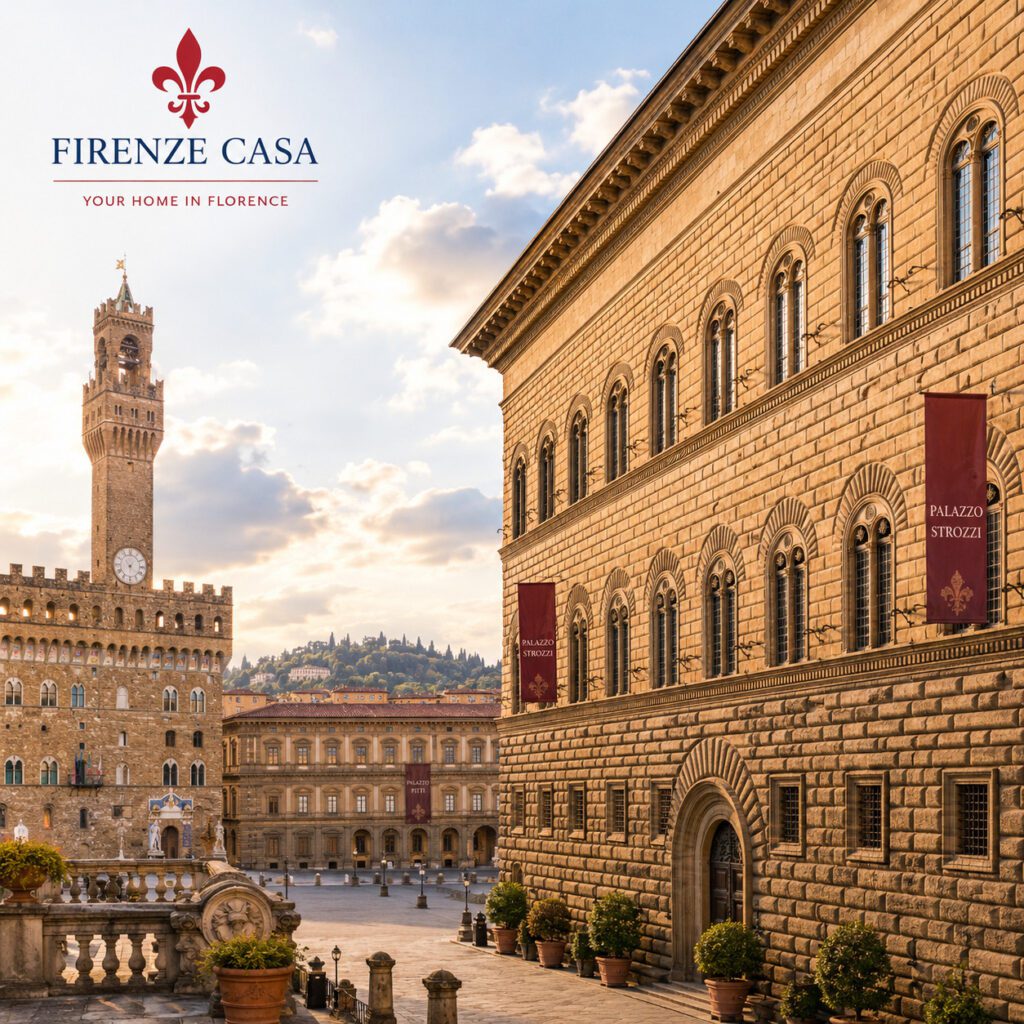
Because Palazzo Strozzi stands nearby, visitors can compare two very different interpretations of the Florentine palace within only a few minutes.
Approach Palazzo Rucellai from Piazza Santa Trinita or Via de’ Tornabuoni and then continue towards Santa Maria Novella. This short walk connects several important buildings associated with Renaissance families and patronage.
The Rucellai Family in Renaissance Florence
The Rucellai family belonged to the wealthy merchant elite that shaped Renaissance Florence. Commerce, banking and the textile trade provided the foundations of their fortune, while political connections and cultural patronage strengthened their position within the city.
One of the family’s most important members was Giovanni di Paolo Rucellai. A successful merchant, intellectual and patron, Giovanni commissioned architectural projects that demonstrated both his wealth and his engagement with Renaissance humanist culture.
The family also developed close ties with the Medici. Giovanni’s son Bernardo married Nannina de’ Medici, sister of Lorenzo the Magnificent. Such marriages created powerful networks between Florence’s leading dynasties.
Architecture gave these relationships a permanent physical presence. Palazzo Rucellai became the most visible expression of the family’s position within the city.
Florentine merchant families used architecture not simply to create comfortable homes but also to communicate lineage, prosperity and cultural sophistication. Palazzo Rucellai provides one of the clearest examples.
Building Palazzo Rucellai
The palace developed during the middle decades of the 15th century. Like many large Florentine residences, it did not rise on an empty site. Instead, the project gradually incorporated several existing family properties.
Leon Battista Alberti provided the architectural concept for the celebrated façade. Historians traditionally associate the practical execution with Bernardo Rossellino, an architect and sculptor who collaborated with Alberti on other projects.
The urban setting imposed practical limitations on the design. Nevertheless, Alberti created a repeating architectural system that gives the façade an extraordinary sense of unity.
The result differs markedly from the more fortress-like appearance of many earlier Florentine residences.
The palace did not reach the full extent apparently envisioned for it. Alberti’s repeating façade system nevertheless makes the surviving building appear remarkably coherent.
Leon Battista Alberti and the Renaissance Façade
The fame of Palazzo Rucellai rests above all on its façade. Alberti organised the elevation into three horizontal levels separated by entablatures, while pilasters create a regular vertical rhythm across the surface.
This combination of horizontal and vertical elements produces a carefully balanced architectural grid. Rather than treating classical details as isolated decoration, Alberti made them fundamental to the organisation of the entire façade.
The masonry also becomes visually lighter towards the upper levels. Compared with the heavy rustication of Palazzo Medici Riccardi or Palazzo Strozzi, the stonework appears notably restrained.
As a result, the palace communicates prestige through intellectual refinement rather than defensive strength. Alberti transformed the façade of a Florentine family residence into a coherent classical composition.
Stand across Via della Vigna Nuova and follow the façade from bottom to top. Notice how pilasters, horizontal divisions and repeated windows create a precise rhythm. The remarkable sense of order is the essence of Alberti’s design.
Classical Architecture Reinterpreted
Leon Battista Alberti was not simply an architect. He was one of the great humanist intellectuals of the Renaissance and wrote influential works on architecture, painting and other subjects.
Ancient Roman architecture provided an important source of inspiration for his designs. At Palazzo Rucellai, however, Alberti did not attempt to reproduce an ancient building. Instead, he adapted classical principles to the requirements of a 15th-century Florentine residence.
The superimposed architectural orders recall Roman monuments in which different orders organise successive levels. This classical vocabulary gives the façade an intellectual dimension beyond simple ornament.
Consequently, Palazzo Rucellai became an important demonstration of how Renaissance architects could transform ancient ideas into a new architectural language.
Alberti’s achievement was not to copy Rome but to reinterpret it. Palazzo Rucellai shows how classical architectural principles could serve the social and practical needs of Renaissance Florence.
The Windows of Palazzo Rucellai
The windows contribute significantly to the palace’s distinctive appearance. Elegant round arches frame paired openings divided by slender central supports.
Repeated across the upper levels, these windows create a measured rhythm between the pilasters. Their curved forms also soften the strong horizontal and vertical lines of the façade.
Every element therefore contributes to the larger composition. Alberti treated windows, stonework, pilasters and entablatures as interconnected parts of a unified architectural system.
Palazzo Rucellai and Palazzo Medici Riccardi
Comparing Palazzo Rucellai with Palazzo Medici Riccardi reveals two distinct approaches to the Renaissance family residence.
Michelozzo gave the Medici palace a powerful ground floor covered with heavy rusticated masonry. Although highly sophisticated, the building retains something of the strength associated with earlier Florentine urban residences.
Alberti chose a different approach. Palazzo Rucellai uses flatter masonry, classical pilasters and more regular architectural divisions to create a refined and ordered façade.
Both residences communicate wealth and influence. Yet Palazzo Medici Riccardi emphasises controlled solidity, whereas Palazzo Rucellai places greater emphasis on classical harmony.
Palazzo Medici Riccardi demonstrates how Renaissance order could emerge from the tradition of the fortified Florentine residence. Palazzo Rucellai moves further towards an explicitly classical architectural language.
Palazzo Rucellai and Palazzo Strozzi
A comparison with Palazzo Strozzi reveals another important contrast. Both buildings belong to wealthy Florentine families, yet their architecture communicates prestige in very different ways.
Palazzo Strozzi impresses through enormous scale, powerful rustication and monumental physical presence. Palazzo Rucellai appears smaller and considerably more restrained.
Nevertheless, Alberti’s palace is no less ambitious. Instead of overwhelming the viewer through size, it demonstrates the cultural sophistication of its patron through proportion and classical order.
Together with Palazzo Medici Riccardi, these three residences provide an exceptional introduction to the evolution of Renaissance palace architecture in Florence.
Palazzo Medici Riccardi, Palazzo Strozzi and Palazzo Rucellai lie close enough to visit during the same walk. Comparing their façades is one of the best ways to understand Renaissance architecture directly in the streets of Florence.
The Rucellai Loggia
Opposite the palace stands the Loggia Rucellai, another important element of the family’s architectural presence in the neighbourhood.
The elegant Renaissance loggia provided a setting connected with family ceremonies and social life. Its open arches contrast with the more enclosed character of the residence across the street.
Together, palace and loggia transformed this section of Florence into an architectural expression of Rucellai identity. The family therefore shaped not merely one building but an entire urban setting.
Do not study Palazzo Rucellai in isolation. Turn towards the Loggia Rucellai and consider how the two structures work together within the surrounding streetscape.
Santa Maria Novella and the Rucellai Family
Giovanni Rucellai’s architectural ambitions extended beyond his family residence. His patronage also contributed to one of Florence’s most famous churches: Santa Maria Novella.
Alberti designed the celebrated Renaissance completion of the church façade under Rucellai patronage. White and green marble, geometric organisation and classical proportions created one of the defining architectural images of Renaissance Florence.
The project also demonstrates the close relationship between private wealth, religious patronage and public prestige. By supporting a major church façade, Giovanni Rucellai placed his family identity within one of the city’s most important public spaces.
Visitors can still identify the Rucellai emblem of the billowing sail among decorations associated with the family.
See Palazzo Rucellai and Santa Maria Novella during the same walk. Together, the two buildings reveal how Giovanni Rucellai and Alberti brought the same culture of classical order into both private and religious architecture.
The Rucellai Sepulchre at San Pancrazio
Another remarkable monument associated with Giovanni Rucellai and Alberti survives nearby at the former church of San Pancrazio.
Here, Alberti designed the small marble structure generally known as the Rucellai Sepulchre or Tempietto del Santo Sepolcro. Created as a family funerary monument, it draws inspiration from the Holy Sepulchre in Jerusalem.
Its geometric marble decoration demonstrates once again Alberti’s ability to combine classical principles, mathematical order and Christian symbolism.
Palazzo Rucellai, Santa Maria Novella and the Rucellai Sepulchre therefore form an exceptional group. Together, they reveal the scale and intellectual ambition of Giovanni Rucellai’s patronage.
Alberti and Giovanni Rucellai – An Extraordinary Partnership
The relationship between Giovanni Rucellai and Leon Battista Alberti produced far more than a single successful building. Patron and architect shared an interest in classical culture, proportion and the social meaning of architecture.
At the palace, Alberti created a new language for an elite urban residence. At Santa Maria Novella, he brought Renaissance order to the façade of a medieval church. At San Pancrazio, he designed an intimate funerary monument inspired by one of Christianity’s holiest sites.
These projects demonstrate how Renaissance patronage could shape different parts of the city while expressing a coherent cultural identity.
Palazzo Rucellai becomes much more meaningful when seen as part of Giovanni Rucellai’s wider programme of patronage. His family residence, church façade and funerary monument connect private life, public prestige and religious devotion.
Palazzo Rucellai and the Florentine Streetscape
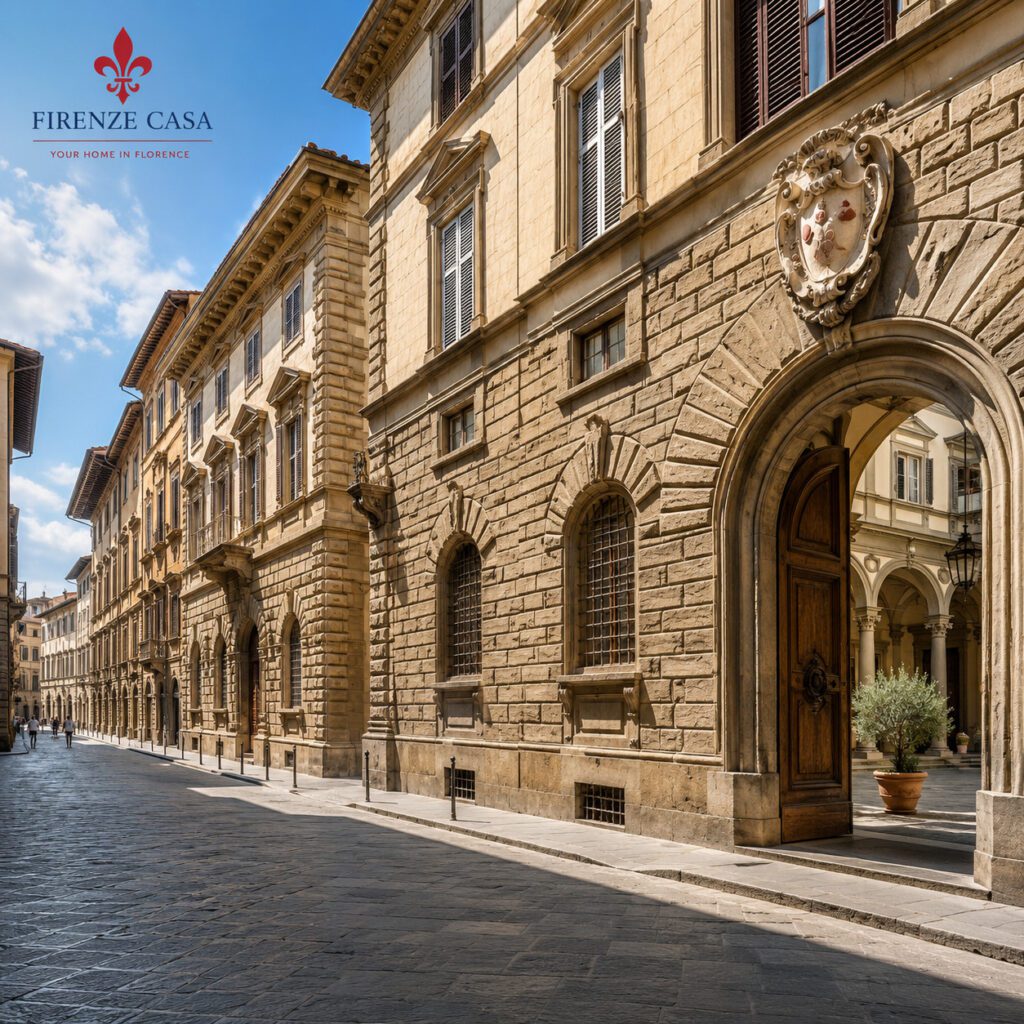
Palazzo Rucellai also demonstrates how Renaissance families transformed Florence without creating isolated monumental complexes. The palace remains closely integrated into the surrounding street.
Its façade follows the urban fabric rather than standing behind a large ceremonial square. As a result, visitors encounter Alberti’s architecture almost unexpectedly while walking along Via della Vigna Nuova.
This relationship between monumental architecture and ordinary city life remains one of Florence’s great attractions. Important Renaissance buildings continue to function as parts of streets and neighbourhoods rather than as isolated monuments.
Can You Visit Palazzo Rucellai?
Palazzo Rucellai does not operate as a conventional public museum with regular access to its historic interiors. Visitors should therefore approach it primarily as an architectural landmark to appreciate from the street.
Fortunately, the façade is also the most influential part of Alberti’s design. Via della Vigna Nuova allows visitors to examine its proportions, pilasters, windows and restrained masonry at close range.
Access arrangements for privately used historic buildings can change. Anyone particularly interested in entering the palace should check current information before planning a visit.
Location: Via della Vigna Nuova, Florence
Area: Historic centre / Santa Maria Novella
Architectural period: Renaissance
Principal architect: Leon Battista Alberti
Public museum: No
Main attraction: The exterior façade
Nearby: Loggia Rucellai, Santa Maria Novella and Palazzo Strozzi
Best advice: Include the palace in an architectural walk through this part of Florence
Why Palazzo Rucellai Is Worth Seeing
Palazzo Rucellai is worth seeing because it changed the architectural language of the Renaissance city palace. Alberti demonstrated that a wealthy family residence could express prestige through classical order and proportion rather than relying primarily on massive scale.
The details reward careful observation. Pilasters establish a measured vertical rhythm, entablatures organise the horizontal levels, paired windows soften the façade and restrained rustication gives the stone surface subtle depth.
Moreover, the palace belongs to a much larger story of Rucellai patronage. The nearby loggia, Santa Maria Novella and the Rucellai Sepulchre allow visitors to follow the relationship between one family, one extraordinary architect and Renaissance Florence across several different buildings.
Palazzo Medici Riccardi expresses controlled power, Palazzo Strozzi monumental ambition and Palazzo Rucellai intellectual refinement. Seen together, the three façades provide a remarkably clear lesson in Florentine Renaissance architecture.
Frequently Asked Questions
Where is Palazzo Rucellai?
Palazzo Rucellai stands on Via della Vigna Nuova in the historic centre of Florence, close to Via de’ Tornabuoni, Palazzo Strozzi and Santa Maria Novella.
Who commissioned Palazzo Rucellai?
Giovanni di Paolo Rucellai, a wealthy Florentine merchant, intellectual and patron, commissioned the palace during the 15th century.
Who designed Palazzo Rucellai?
Leon Battista Alberti designed the celebrated Renaissance façade. The practical execution of the project is traditionally associated with Bernardo Rossellino.
Why is Palazzo Rucellai important?
The palace introduced an exceptionally coherent classical order to the Florentine urban residence. Its façade became one of the most influential works of Renaissance domestic architecture.
What is special about the façade?
Alberti organised the façade with superimposed pilasters, horizontal entablatures, restrained rustication and regularly repeated windows. Together, these elements create its famous sense of harmony and proportion.
How does Palazzo Rucellai differ from Palazzo Strozzi?
Palazzo Strozzi emphasises scale, heavy rustication and monumentality. Palazzo Rucellai communicates prestige more subtly through classical order, proportion and architectural refinement.
What else did Alberti design for the Rucellai family?
Under Giovanni Rucellai’s patronage, Alberti also designed the Renaissance completion of the façade of Santa Maria Novella and the Rucellai Sepulchre at San Pancrazio.
Can you visit Palazzo Rucellai?
The palace does not operate as a conventional public museum with regular access to its historic interiors. Its celebrated façade, however, can be appreciated freely from Via della Vigna Nuova.
Is Palazzo Rucellai worth seeing?
Yes, particularly for visitors interested in Renaissance architecture. Its location also makes it easy to combine with Palazzo Strozzi, Santa Maria Novella and Via de’ Tornabuoni.
Further Reading on Firenze Casa
Continue exploring Florence’s Renaissance palaces and discover how different families used architecture to express wealth, status and cultural ambition:
- Historic Palaces of Florence – Complete Guide
- Palazzo Medici Riccardi – The First Renaissance Palace in Florence
- Palazzo Strozzi – Renaissance Palace in Florence
- Palazzo Pucci in Florence
- Palazzo Gianfigliazzi – Historic Palace on the Arno
References
- Saalman, Howard – The Palazzo Rucellai
- Murray, Peter – The Architecture of the Italian Renaissance
- Trachtenberg, Marvin – Dominion of the Eye: Urbanism, Art, and Power in Early Modern Florence
- Alberti, Leon Battista – On the Art of Building in Ten Books
- Comune di Firenze – Historical and Architectural Resources on Florence