Palazzo delle Cento Finestre in Florence is one of the city’s most distinctive historic residences. Standing at Piazza di Santa Maria Maggiore and extending along Via de’ Cerretani, the palace lies on one of the busiest routes between Santa Maria Novella and the Duomo, yet many visitors pass without knowing its name.
Its unusual identity comes from the extraordinary rhythm of windows across its façades, but the building’s history is equally interesting. Aristocratic families, Neoclassical decoration, Giuseppe Poggi and the period when Florence became capital of Italy all left their mark on the palace. Today, it is best appreciated from the surrounding streets rather than as a conventional museum.
Address: Piazza di Santa Maria Maggiore 1, Florence
Area: Historic centre, between Santa Maria Novella and the Duomo
Known for: Long façades and an extraordinary number of windows
Former name: Palazzo del Centauro
Main architectural development: Eighteenth century with later nineteenth-century transformations
Important architect: Giuseppe Poggi
Historic role: Former seat of the Prefecture of Florence
Public access: No regular museum-style access to the historic interiors
Best viewed from: Piazza di Santa Maria Maggiore and Via de’ Cerretani
Palazzo delle Cento Finestre belongs to the wider story explored in our Historic Palaces of Florence – Complete Guide.
Why Is It Called the Palace of a Hundred Windows?
The name Palazzo delle Cento Finestre literally means the “Palace of a Hundred Windows.” The expression is slightly poetic rather than mathematically exact, but it perfectly captures the building’s most memorable architectural feature.
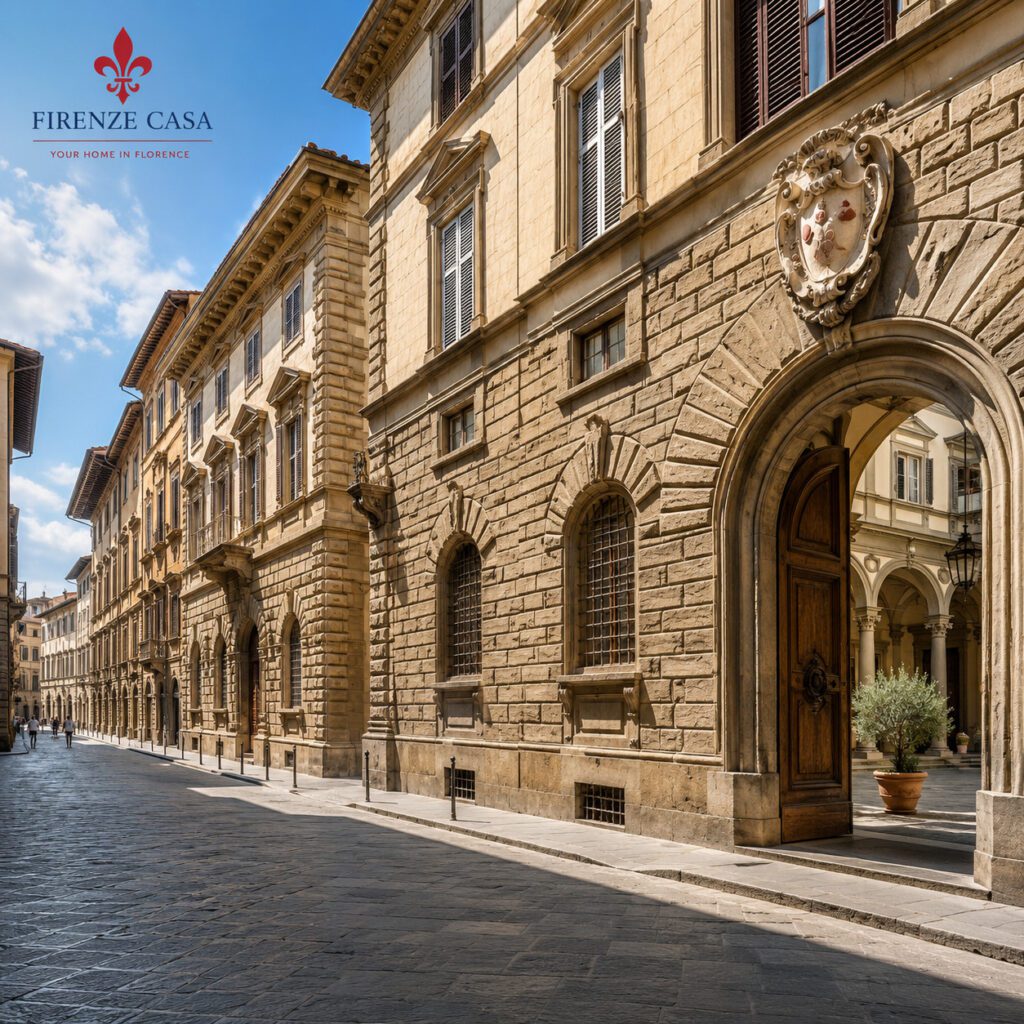
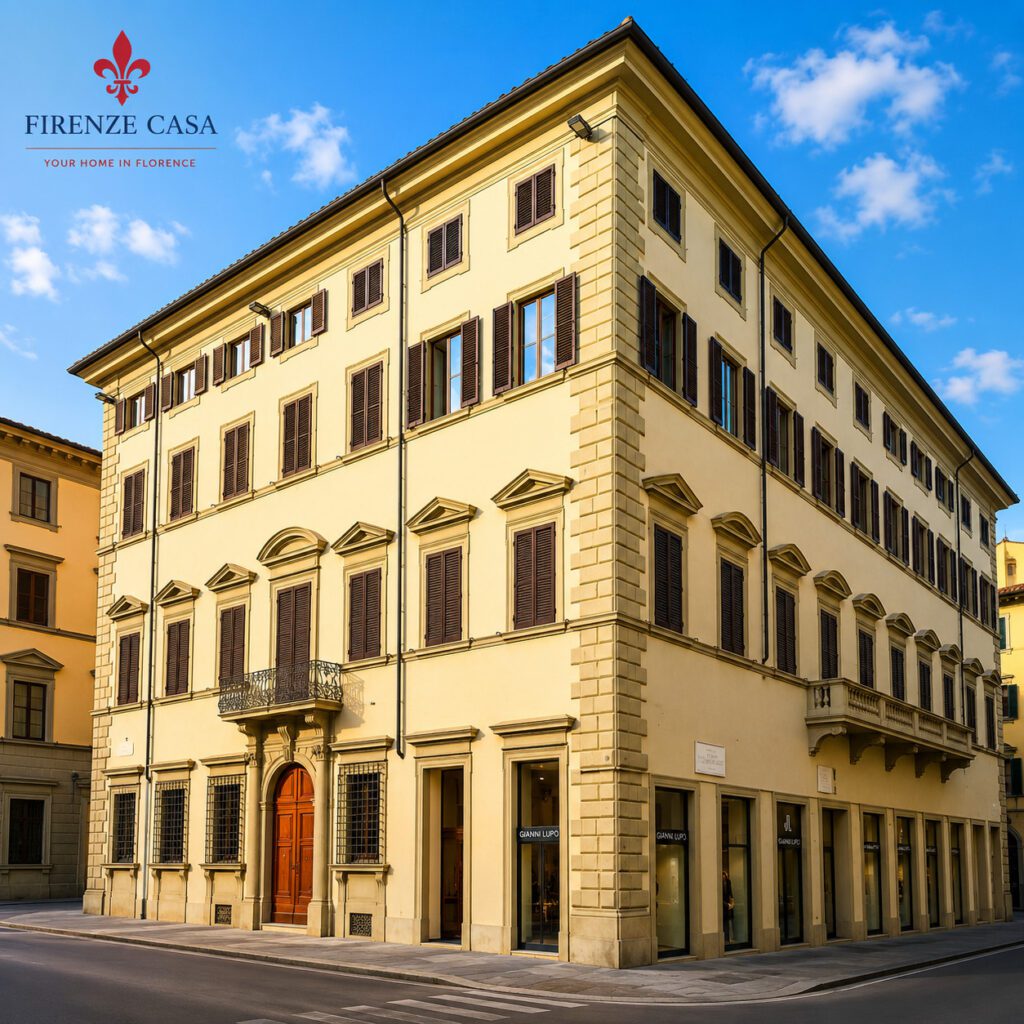
Instead of relying on one dramatic element, the façades create their effect through repetition, scale and regularity. Window after window extends across the building, making its enormous urban footprint increasingly apparent as you walk around it.
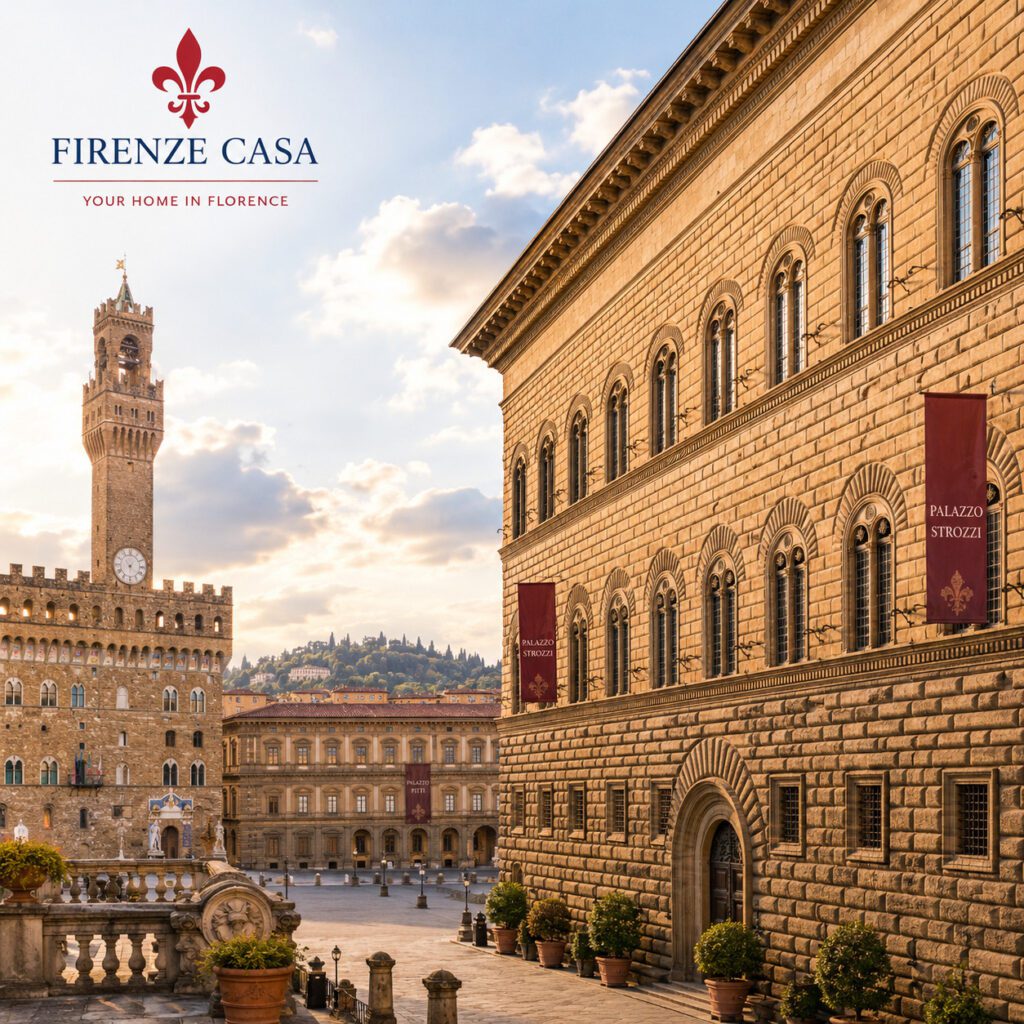
This unusual rhythm gives the palace an identity very different from the massive rusticated façades of Palazzo Medici Riccardi or Palazzo Strozzi.
Look up while walking along Via de’ Cerretani. The palace is easy to overlook at street level, but the repeated windows reveal how large and architecturally coherent the building really is.
Palazzo del Centauro – The Palace’s Earlier Name
Before becoming known for its many windows, the building was associated with another memorable name: Palazzo del Centauro.
The name referred to Giambologna’s sculptural group Hercules and the Centaur Nessus, which once stood near the crossroads traditionally known as the Canto dei Carnesecchi.
The sculpture was later moved and can now be seen beneath the Loggia dei Lanzi in Piazza della Signoria. As the original geographical connection disappeared, the name based on the palace’s many windows gradually became more familiar.
Florentine place names often preserve vanished landmarks. In this case, the centaur moved elsewhere, while the palace remained and eventually acquired a completely different name.
From Medieval Houses to an Aristocratic Palace
The site occupied by Palazzo delle Cento Finestre originally contained several separate houses associated with Florentine families including the Manovelli and Carnesecchi.
By the end of the fifteenth century, members of the Strozzi family had acquired properties in this area. However, the decisive transformation came much later, when earlier buildings were gradually brought together into a substantial aristocratic residence.
Around the early eighteenth century, the complex assumed much of the scale that defines it today. Historical sources differ over the precise architectural attribution, with both Giovanni Battista Bettini and Gherardo Silvani associated with phases of its development.
By the middle of the century, the palace was already a significant feature of central Florence and appeared in Giuseppe Zocchi’s celebrated eighteenth-century views of the city.
The Palace and Its Florentine Families
Like many great Florentine residences, Palazzo delle Cento Finestre changed owners repeatedly. Its history is connected with families including the Strozzi, Martini, Ganucci Galli Tassi and Franchetti.
Each period introduced new requirements and tastes. As a result, the palace should not be understood as the product of one moment but as a building shaped by several generations.
This layered history is typical of Florence. Noble families enlarged, modernised and redecorated their residences as wealth, fashion and social expectations changed.
Florentine palaces often contain several architectural periods within one building. Their long histories reflect changing owners and changing ideas about prestige, comfort and representation.
Neoclassical Interiors
Some of the palace’s most remarkable features are hidden from the street. Rooms on the piano nobile preserve decorative schemes associated with Florentine Neoclassical painter Luigi Catani.
Mythological and allegorical subjects transformed these interiors into sophisticated settings for elite social life. Classical deities, literary themes and personifications of the arts and seasons helped create an atmosphere suited to aristocratic representation.
The ballroom became one of the most impressive ceremonial spaces in the building. Its decoration reflects the importance of entertainment and social display in nineteenth-century noble residences.
Florence is famous for Renaissance interiors, but many historic palaces also preserve important Baroque and Neoclassical layers. Palazzo delle Cento Finestre is a strong example of this later artistic history.
Giuseppe Poggi and the Transformation of the Palace
Another major chapter began after Isacco Franchetti acquired the palace in 1868. He commissioned Giuseppe Poggi, one of the most influential architects and urban planners of nineteenth-century Florence, to modernise the property.
Poggi is best known for reshaping Florence during the period when the city became capital of the Kingdom of Italy. His projects included the new boulevards around the historic centre and the creation of Piazzale Michelangelo.
At Palazzo delle Cento Finestre, he altered practical and decorative elements, including parts of the entrance, ground floor, courtyard and piano nobile. The balcony above the entrance and several window treatments are also associated with this phase.
These interventions connected an older aristocratic residence directly with the transformation of nineteenth-century Florence.
Florence as Capital of Italy
The palace also acquired an administrative role during one of the most important moments in modern Florentine history. It housed the Prefecture of Florence, including during the years when Florence served as capital of Italy.
From 1865 to 1871, government institutions, officials and political elites transformed the city. New offices, residences and infrastructure were required almost overnight.
Palazzo delle Cento Finestre therefore links aristocratic family history with the modernisation of Florence as a national capital.
This broader transformation is explored in our article on Florence as Capital of Italy.
The palace’s history stretches from aristocratic residence to administrative use. That transition mirrors Florence itself as the city moved from dynastic Tuscany into modern unified Italy.
Architecture and the Rhythm of the Façade
Palazzo delle Cento Finestre is best understood by walking around it rather than looking from a single point.
Begin at Piazza di Santa Maria Maggiore and then follow the long elevation along Via de’ Cerretani. As you move, the repeated windows create a strong horizontal rhythm that emphasises the palace’s scale.
The effect is very different from a fortress-like Renaissance palace. Here, repetition and regularity create monumentality without relying on massive rustication.
This makes the building particularly useful when comparing different types of Florentine aristocratic architecture.
Compare Palazzo delle Cento Finestre with Palazzo Strozzi or Palazzo Medici Riccardi. The earlier palaces emphasise mass and rustication, while Cento Finestre relies much more on scale, rhythm and repeated openings.
What to See Nearby
The palace occupies an exceptionally central position, making it easy to include within a wider architectural walk.
Santa Maria Maggiore stands directly opposite, while the Duomo lies only a short distance away. Piazza della Repubblica and Santa Maria Novella are also close, creating a natural route through several layers of Florentine history.
Because of this location, Palazzo delle Cento Finestre works best as a discovery along the way rather than as a destination requiring a separate journey.
Can You Visit Palazzo delle Cento Finestre?
Palazzo delle Cento Finestre is not a conventional palace museum with regular public access to its historic rooms.
The building has served private, administrative and commercial functions, so visitors should not assume that the decorated interiors can be entered freely.
For most travellers, the main experience is therefore the exterior and the historical context. Fortunately, the palace can be appreciated very well from Piazza di Santa Maria Maggiore and Via de’ Cerretani.
Address: Piazza di Santa Maria Maggiore 1, Florence
Area: Historic centre, between Santa Maria Novella and the Duomo
Public access: No regular museum-style access to the historic interiors
Best viewed: From Piazza di Santa Maria Maggiore and Via de’ Cerretani
Palazzo delle Cento Finestre and Other Historic Palaces
The palace becomes more interesting when compared with other residences from the same cluster.
Palazzo Rinuccini reveals a layered noble residence in the Oltrarno, while Palazzo Marucelli-Fenzi introduces seventeenth-century aristocratic architecture and Baroque interiors.
Palazzo Corsini al Parione offers a more monumental riverfront expression of Baroque Florence, whereas Palazzo Gherardesca combines aristocratic architecture with an exceptional garden setting.
Together, these residences demonstrate how varied Florence’s palace architecture became after the Renaissance.
Why Palazzo delle Cento Finestre Is Worth Seeing
Palazzo delle Cento Finestre is worth seeing because it reveals how much architectural history can hide along an ordinary route through central Florence. Its location could hardly be more central, yet many visitors walk past without noticing either its scale or its unusual history.
The palace brings together noble families, eighteenth-century architecture, Neoclassical decoration, Giuseppe Poggi and the period when Florence became capital of Italy.
Its memorable name also encourages a simple but valuable habit: look up. Once you begin noticing the rhythm of the windows and the size of the building, an apparently familiar street becomes much more interesting.
Do not make a special journey across Florence solely for this palace. Instead, look for it while walking between Santa Maria Novella and the Duomo. It is exactly the kind of discovery that makes a slow walk through Florence so rewarding.
Frequently Asked Questions
Where is Palazzo delle Cento Finestre?
The palace stands at Piazza di Santa Maria Maggiore 1 and extends along Via de’ Cerretani in the historic centre of Florence.
Why is it called Palazzo delle Cento Finestre?
The name means the “Palace of a Hundred Windows” and refers to the remarkable number of openings distributed across its long façades.
Does the palace really have one hundred windows?
The name is descriptive rather than a precise mathematical count. The number of openings is close to one hundred, which explains the memorable name.
What was Palazzo delle Cento Finestre called before?
It was formerly known as Palazzo del Centauro, after Giambologna’s Hercules and the Centaur Nessus, which once stood nearby.
Who designed Palazzo delle Cento Finestre?
The palace developed through several phases, and historical sources differ over precise attribution. Giovanni Battista Bettini and Gherardo Silvani are both associated with its architectural history.
What did Giuseppe Poggi change?
During the nineteenth century, Poggi modernised parts of the entrance, ground floor, courtyard and piano nobile and introduced several exterior and interior changes for owner Isacco Franchetti.
Was the palace connected with Florence as capital of Italy?
Yes. The building housed the Prefecture of Florence during part of the period when Florence served as capital of the Kingdom of Italy.
Can you visit Palazzo delle Cento Finestre?
There is no regular museum-style public access to the historic interiors. For most visitors, the exterior and its architectural history provide the main experience.
What should I see nearby?
Santa Maria Maggiore, the Duomo, Piazza della Repubblica and Santa Maria Novella are all within easy walking distance.
Further Reading on Firenze Casa
Continue exploring Florence’s historic residences and the evolution of palace architecture:
- Historic Palaces of Florence – Complete Guide
- Palazzo Rinuccini in Florence
- Palazzo Marucelli-Fenzi in Florence
- Palazzo Corsini al Parione – Baroque Palace in Florence
- Palazzo Gherardesca – Renaissance Palace in Florence
- Florence as Capital of Italy
References
- Repertorio delle Architetture Civili di Firenze, Palazzo Spinelli – Palazzo delle Cento Finestre
- Catalogo Generale dei Beni Culturali – Palazzo delle Cento Finestre, Firenze
- Regione Toscana – Cultural Heritage Resources on Palazzo delle Cento Finestre
- Carlini, Sandra; Mercanti, Lara; Straffi, Giovanni. I Palazzi. Arte e storia degli edifici civili di Firenze.
- Historical Studies on Giuseppe Poggi and Nineteenth-Century Florence