Palazzo Rinuccini in Florence is a historic noble residence in the Oltrarno, closely connected with one of the city’s established aristocratic families. Standing on Via Santo Spirito, the palace reflects centuries of architectural change, family ambition and cultural life in a neighbourhood shaped by noble residences, churches and artisan traditions.
Its history developed gradually rather than through one single building campaign. Successive generations enlarged and redecorated the residence, while the Rinuccini family’s connections with literature, music and the Medici court add another dimension to its significance. Today, Palazzo Rinuccini remains a useful example of how private architecture shaped Florence beyond its most famous public monuments.
Location: Via Santo Spirito, Oltrarno
Historic family: Rinuccini
Known for: Noble residence with several architectural phases
Cultural connection: Ottavio Rinuccini and the early history of opera
Architectural character: Layered Florentine palace with later decorative interiors
Neighbourhood: Santo Spirito / Oltrarno
Public access: Limited; check current arrangements
Worth seeing for: Family history, architecture and Florentine cultural heritage
Palazzo Rinuccini belongs to the wider architectural landscape explored in our Historic Palaces of Florence – Complete Guide.
Where Is Palazzo Rinuccini?
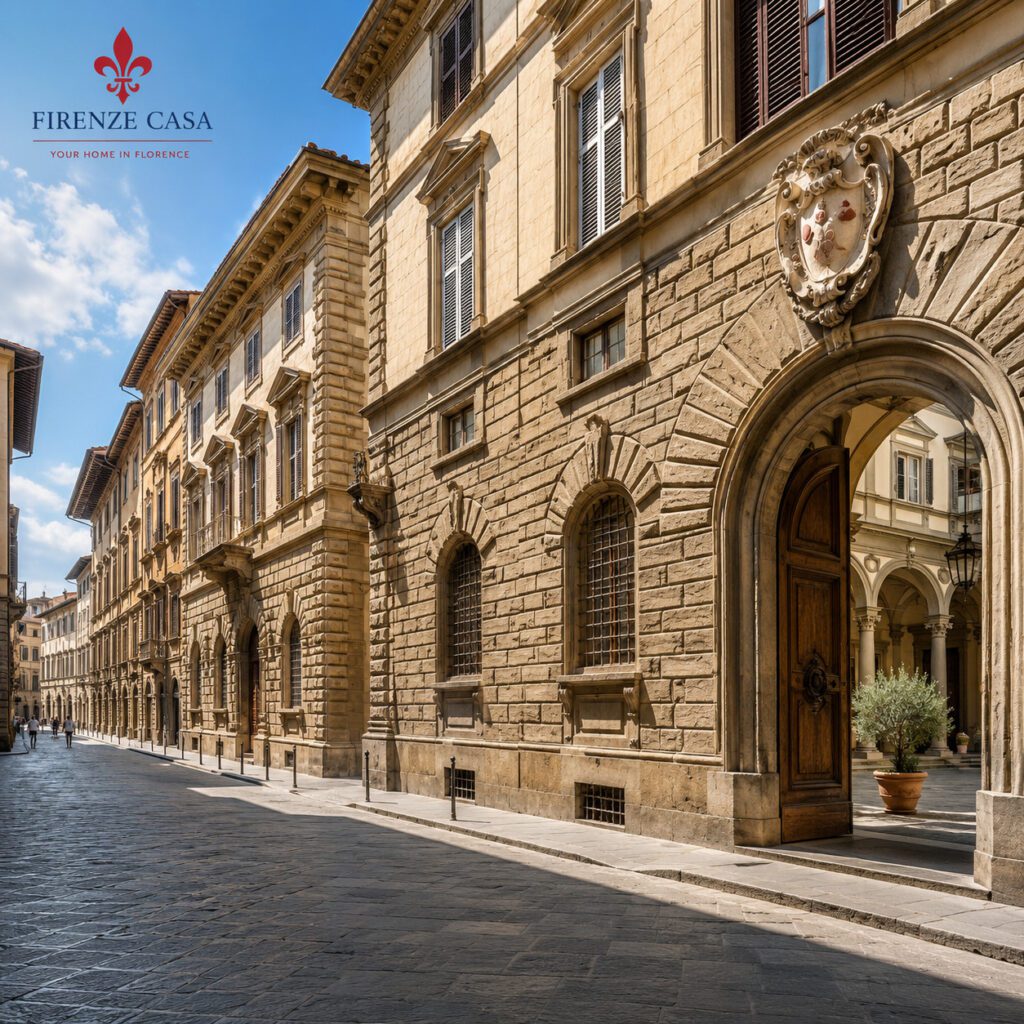
Palazzo Rinuccini stands on Via Santo Spirito in the Oltrarno, not far from the Arno and Piazza Santo Spirito. This part of Florence is especially rich in historic residences, churches and buildings associated with important Florentine families.
The palace forms part of the street rather than standing as an isolated monument. That relationship is typical of Florence, where noble residences were woven directly into dense residential neighbourhoods.
For visitors, this means the building is best understood while walking through the surrounding streets and comparing it with other historic palaces of the Oltrarno.
Via Santo Spirito is one of the best streets for noticing Florence’s aristocratic architecture. Look beyond individual landmarks and compare façades, entrances and coats of arms as you walk.
The Rinuccini Family in Florence
The history of Palazzo Rinuccini is inseparable from the Rinuccini family, whose members belonged to Florence’s established elite. Like other prominent families, they combined wealth, social standing and cultural patronage.
The family participated in the political and intellectual life of the city and maintained connections with the Medici court. Architecture and artistic patronage therefore became important ways of expressing status within Florentine society.
A noble palace served several purposes at once. It was a family home, a ceremonial setting and a visible statement about the household’s position within the city.
Florentine palaces were never simply private homes. Their location, size, decoration and reception rooms all communicated family status to visitors and to the city outside.
Ottavio Rinuccini and the Birth of Opera
The Rinuccini name also belongs to Florence’s literary and musical history. Ottavio Rinuccini, born in Florence in 1562, became an important poet and librettist associated with the Medici court.
His career places the family within one of the most important cultural developments of late sixteenth- and early seventeenth-century Florence: the emergence of opera.
Rinuccini wrote texts for works associated with composers including Jacopo Peri and Giulio Caccini. As a result, the family story connects palace architecture with the artistic experimentation taking place in aristocratic and courtly circles.
Our article on the birth of opera in Florence explores this broader cultural context in greater detail.
Ottavio Rinuccini wrote libretti for some of the earliest works in the history of opera. The Rinuccini name therefore belongs not only to Florence’s aristocratic heritage but also to its musical history.
The Development of Palazzo Rinuccini
Like many large residences in Florence, Palazzo Rinuccini developed through successive building phases rather than one single architectural campaign.
Florentine families often acquired neighbouring properties and gradually combined them into larger residences. Consequently, medieval structures, Renaissance alterations and later decorative programmes can coexist within the same building.
Palazzo Rinuccini reflects this process. Its architecture records changing requirements of aristocratic life as well as shifts in taste over several centuries.
Architecture and the Florentine Palace Tradition
Florence developed one of Europe’s most recognisable traditions of urban palace architecture. Earlier Renaissance examples often relied on imposing stone façades, regular windows, powerful cornices and carefully controlled proportions.
Later residences adapted this vocabulary to changing expectations of comfort and representation. Palazzo Rinuccini belongs to this broader evolution rather than to one single stylistic moment.
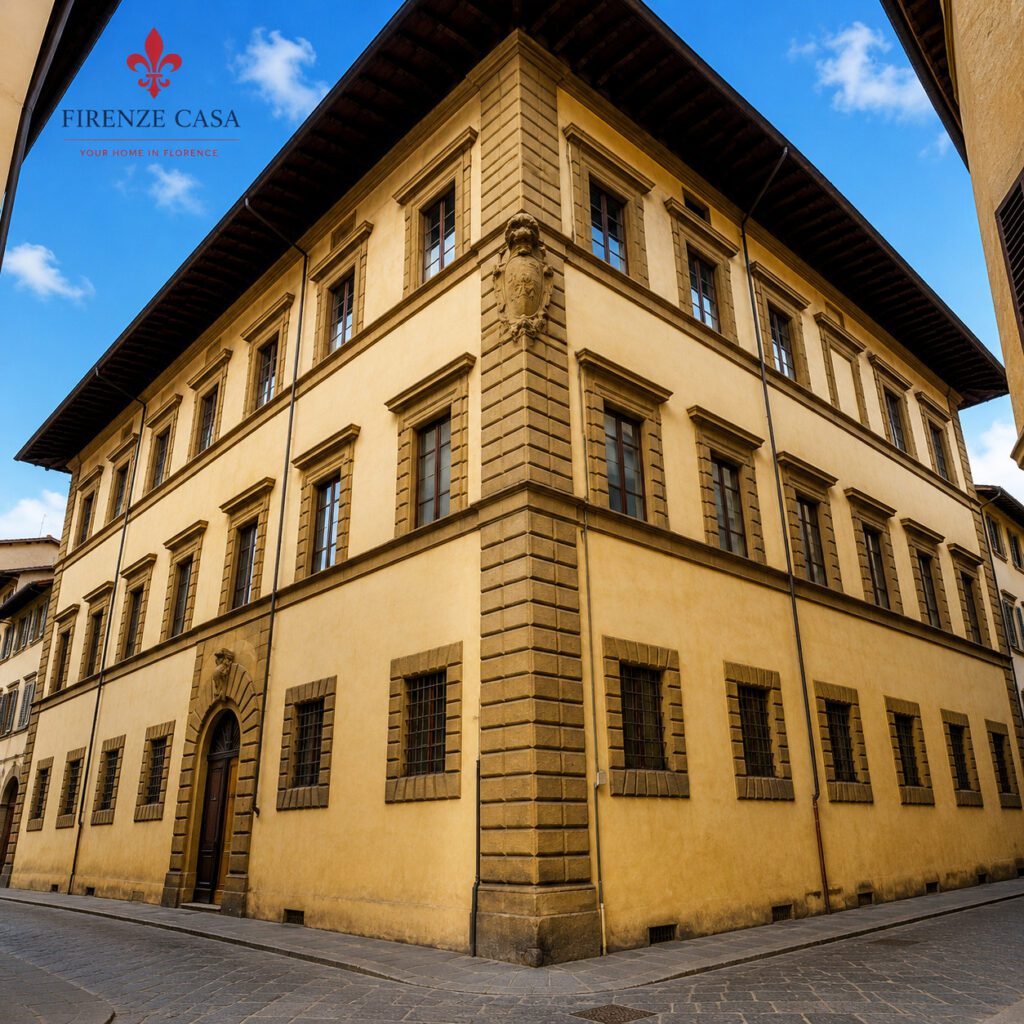
Its exterior remains integrated into the continuous urban fabric of the Oltrarno. This relationship between palace and street is fundamental to understanding Florentine architecture, because noble residences helped shape entire neighbourhoods rather than existing separately from them.
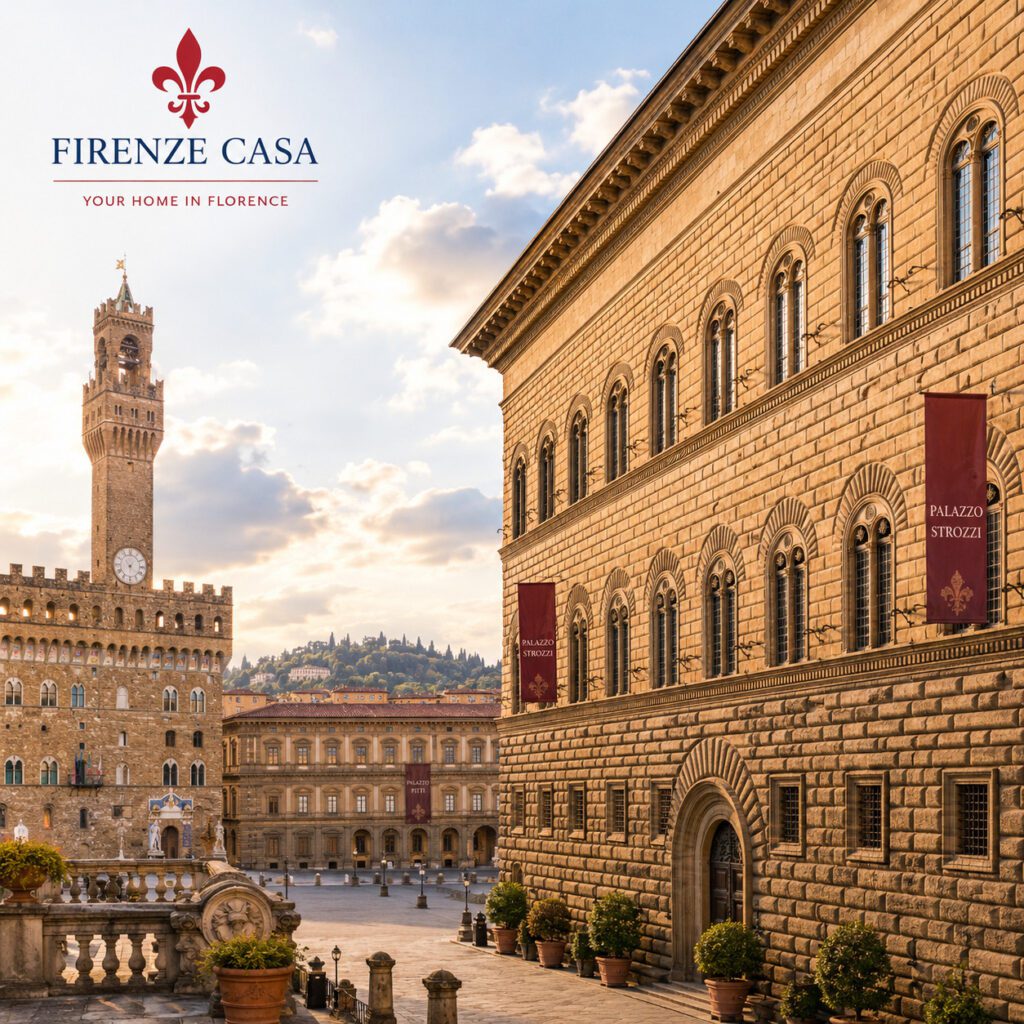
Compare Palazzo Rinuccini with more monumental Renaissance buildings such as Palazzo Strozzi or Palazzo Medici Riccardi. The differences show how Florentine palace architecture evolved over time.
Behind the Façade
One of the most characteristic features of historic Florentine palaces is the contrast between exterior restraint and interior richness.
A relatively sober street façade could conceal reception rooms, decorated ceilings, ceremonial staircases and carefully organised private spaces. These interiors allowed families to display a level of luxury that was less obvious from the street.
Inside Palazzo Rinuccini, this contrast becomes part of the architectural experience. The building demonstrates how aristocratic life unfolded through a sequence of spaces designed for different levels of access and formality.
Never judge a Florentine palace only by its street façade. Some of the city’s richest decorative programmes were deliberately placed inside private residences rather than on the exterior.
The Decorated Interiors
Historic interior decoration forms an important part of Palazzo Rinuccini’s character. Over time, successive generations adapted the residence to changing artistic fashions rather than preserving it unchanged.
Painted ceilings, architectural ornament and formal reception rooms transformed the palace into a suitable setting for an important household. Moreover, these later decorative campaigns demonstrate that Florence’s artistic history continued well beyond the period usually labelled the Renaissance.
The result is a layered interior in which several periods of Florentine taste coexist.
Life Inside a Florentine Noble Palace
A residence such as Palazzo Rinuccini functioned simultaneously as a home and a public statement. Family members lived there, while certain rooms served ceremonial, political and social purposes.
Guests entered according to established hierarchies. Formal reception rooms provided settings for meetings and entertainment, whereas private areas remained separated from spaces intended to represent the family.
Behind these elegant rooms, servants, kitchens, storage areas and service routes supported a complex household. Therefore, the surviving decorative interiors represent only one part of the everyday organisation of palace life.
Historic palaces were working households as well as symbols of prestige. Their architecture separated ceremonial display from private family life and the practical spaces required to support both.
Palazzo Rinuccini and a Changing Florence
The history of Palazzo Rinuccini also illustrates how Florence’s great private buildings adapted as society changed. Political systems disappeared, family fortunes shifted and the purposes of aristocratic residences evolved.
After the Renaissance, Florence passed through Medici rule, the House of Lorraine and eventually the political transformations of modern Italy. Meanwhile, owners altered palaces to suit new expectations and circumstances.
This continuous adaptation helps explain why so many historic residences still survive. Their architecture was preserved not because the buildings remained unchanged, but because new generations repeatedly found new uses for them.
Florence’s noble palaces should not be viewed as buildings frozen in the Renaissance. Many were enlarged, redecorated and repurposed repeatedly as families, tastes and political circumstances changed.
What to Notice at Palazzo Rinuccini
Begin with the relationship between the palace and Via Santo Spirito. The building belongs to a dense historic neighbourhood where architecture accumulated over many centuries.
Next, look at the proportions of the façade, the arrangement of the windows and the treatment of the entrance. Even within an existing urban block, architects could create a strong sense of status and formality.
If historic interiors are accessible, notice the contrast between the street exterior and the decorative spaces beyond. That transition is one of the defining characteristics of Florentine palace architecture.
Palazzo Rinuccini and Other Historic Palaces
Palazzo Rinuccini becomes even more interesting when compared with other residences from the same cluster.
Palazzo Marucelli-Fenzi demonstrates the development of seventeenth-century aristocratic architecture, while Palazzo Corsini al Parione offers a more monumental expression of Baroque Florence.
Nearby in the Oltrarno, Palazzo Guicciardini provides another example of a major family residence integrated into the residential fabric south of the Arno.
Together, these buildings show that Florence’s palace tradition is far more varied than the great fifteenth-century landmarks alone suggest.
Can You Visit Palazzo Rinuccini?
Palazzo Rinuccini should not be approached like Palazzo Pitti or Palazzo Vecchio. Historic private buildings can have changing uses, and regular museum-style access should not be assumed.
The exterior nevertheless deserves attention while exploring Via Santo Spirito and the surrounding Oltrarno. Understanding the family and architectural history adds considerably to the experience even when the interiors are not accessible.
If entering the palace is particularly important, check current access arrangements before planning a special visit.
Use lesser-known palaces as stops on a wider architectural walk rather than expecting every residence to function as a museum. This approach often reveals Florence more naturally.
Why Palazzo Rinuccini Is Worth Seeing
Palazzo Rinuccini is worth seeing because it connects architecture, aristocratic life and Florence’s cultural history within one building. Its layered development reveals how noble residences changed over time rather than remaining fixed in a single period.
The Rinuccini family’s connection with Ottavio Rinuccini also gives the palace unusual cultural significance. Through him, the story reaches directly into the early history of opera and the artistic environment of the Medici court.
Finally, its location in the Oltrarno provides another reason to visit. Palazzo Rinuccini forms part of a neighbourhood where noble residences, workshops, churches and everyday city life still coexist.
Combine Palazzo Rinuccini with a walk along Via Santo Spirito and Piazza Santo Spirito. The palace makes most sense as part of the wider architectural landscape of the Oltrarno.
Frequently Asked Questions
Where is Palazzo Rinuccini?
Palazzo Rinuccini stands on Via Santo Spirito in the Oltrarno district of Florence, not far from Piazza Santo Spirito and the Arno.
Who were the Rinuccini family?
The Rinuccini were an established Florentine family involved in the political and cultural life of the city. Their history is particularly notable for its connection with poet and librettist Ottavio Rinuccini.
What is Ottavio Rinuccini famous for?
Ottavio Rinuccini wrote libretti for some of the earliest works associated with the development of opera in Florence around the turn of the seventeenth century.
Is Palazzo Rinuccini a Renaissance palace?
The palace developed across several periods rather than belonging neatly to one architectural phase. Its history includes later modifications and decorative campaigns beyond the Renaissance.
What makes Palazzo Rinuccini architecturally interesting?
Its layered development, restrained urban façade and richer historic interiors illustrate the evolution of Florentine aristocratic architecture over several centuries.
Can you visit Palazzo Rinuccini?
Regular museum-style access should not be assumed. If you specifically want to see the interiors, check current access information before visiting.
What should I see nearby?
Via Santo Spirito, Piazza Santo Spirito and the wider Oltrarno contain many historic residences, churches and artisan streets. Palazzo Guicciardini is another important palace in the same part of Florence.
Why is Palazzo Rinuccini important?
The palace combines noble family history, changing architectural tastes and an important cultural connection with the early development of opera in Florence.
Further Reading on Firenze Casa
Continue exploring Florence’s aristocratic residences and the families who shaped the city’s architectural landscape:
- Historic Palaces of Florence – Complete Guide
- Palazzo Marucelli-Fenzi in Florence
- Palazzo Guicciardini – Historic Palace in Florence
- Palazzo Borghese – Neoclassical Palace in Florence
- Palazzo Corsini al Parione – Baroque Palace in Florence
- Palazzo delle Cento Finestre
- The Birth of Opera in Florence
References
- Comune di Firenze – Historical and Architectural Resources on Florentine Buildings
- Touring Club Italiano – Guida d’Italia: Firenze e provincia
- Studies on the Rinuccini Family and Florentine Noble Families
- Studies on Florentine Palace Architecture and Interior Decoration
- Historical Studies on Ottavio Rinuccini and the Origins of Opera in Florence