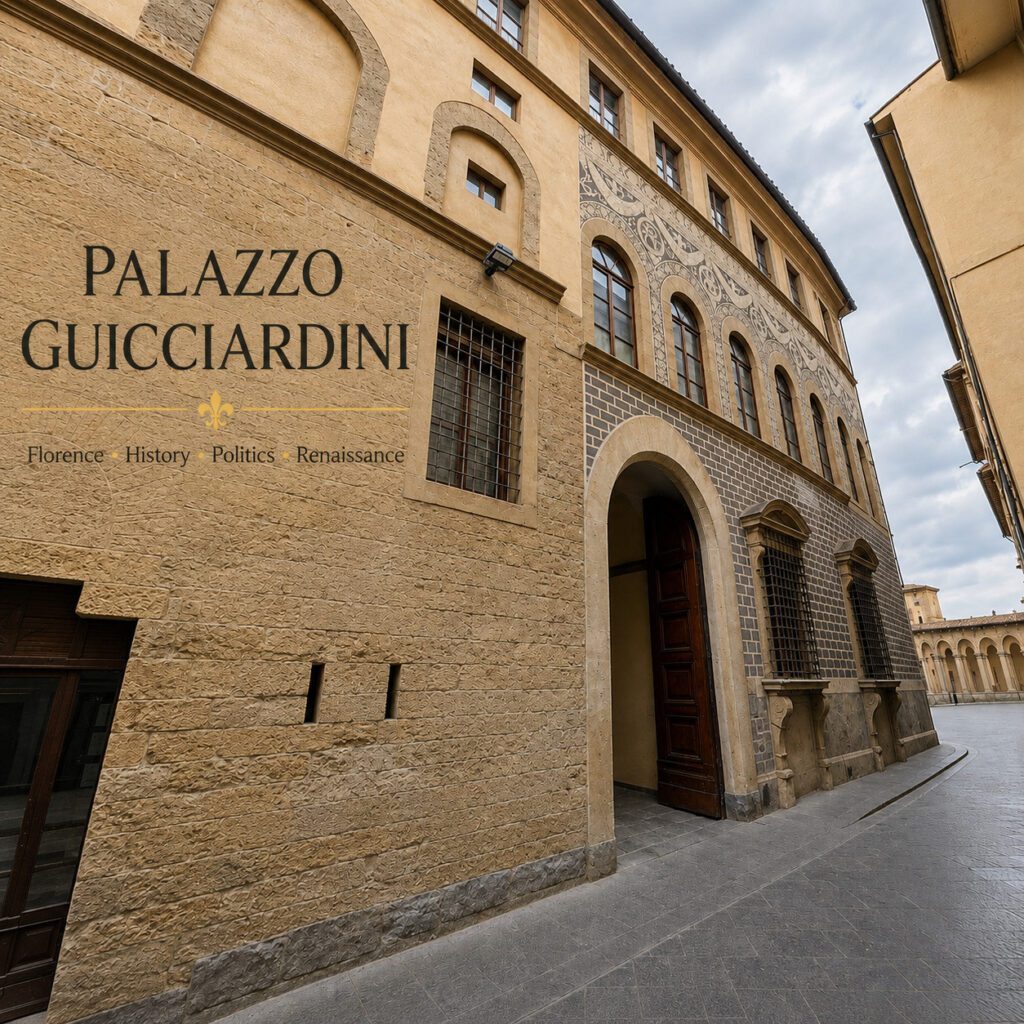
Palazzo Guicciardini in Florence is a historic noble residence closely connected with one of the city’s important Renaissance families. Located on Via de’ Guicciardini in the Oltrarno, between Ponte Vecchio and Palazzo Pitti, the palace forms part of a street that thousands of visitors cross every day. However, many pass through without noticing its deeper history.
Although the building is not a conventional public museum, its location and association with the Guicciardini family make it especially interesting for visitors who want to understand Florence beyond its major monuments. Moreover, the palace provides a natural link between family history, Renaissance politics and the development of the Oltrarno.
Location: Via de’ Guicciardini, Florence
Area: Oltrarno, between Ponte Vecchio and Palazzo Pitti
Historic family: Guicciardini
Known for: Association with Francesco Guicciardini and Renaissance political history
Architectural character: Historic urban palace integrated into the Oltrarno streetscape
Public access: No regular museum-style access
Worth seeing for: Family history, Renaissance politics and the historic Oltrarno
Best combined with: Ponte Vecchio, Palazzo Pitti and Santo Spirito
Palazzo Guicciardini forms part of the wider architectural landscape explored in our Historic Palaces of Florence – Complete Guide. While some Florentine palaces impress through monumental architecture, this residence tells a quieter story about family influence and the historic fabric of the city.
Where Is Palazzo Guicciardini?
Palazzo Guicciardini stands on Via de’ Guicciardini in the Oltrarno. After crossing Ponte Vecchio from the historic centre, visitors follow this street directly towards Piazza de’ Pitti and Palazzo Pitti.
Because of its location, the palace is exceptionally easy to pass without noticing. For most visitors, Via de’ Guicciardini functions primarily as a busy route between two famous landmarks. Nevertheless, the street has a much deeper identity.
Its name preserves the memory of the Guicciardini family, whose political and intellectual influence formed part of Florence for centuries. Therefore, understanding the family also changes the way we experience this familiar route through the Oltrarno.
Slow down after crossing Ponte Vecchio. Instead of treating Via de’ Guicciardini only as the route to Palazzo Pitti, look at the façades and architectural details along the street. As a result, the history of the Oltrarno becomes much more visible.
The Guicciardini Family and Florence
The Guicciardini family belonged to Florence’s established elite. Over the centuries, its members participated in politics, diplomacy and public life. Consequently, the family formed part of the dense network of influential dynasties that shaped the Florentine Republic.
Like other prominent families, the Guicciardini expressed their status through property, political office, marriage alliances and architectural presence. Their residence therefore represented more than private comfort. It also helped establish the family physically within the city.
Among the family’s many members, Francesco Guicciardini, born in Florence in 1483, became the most famous. As a statesman, diplomat and historian, he developed into one of the most important political thinkers and historical writers of Renaissance Italy.
Florence cannot be understood through the Medici alone. Families such as the Guicciardini, Strozzi, Rucellai and Capponi also participated in the political, economic and intellectual life of the city. Together, these dynasties created the complex social world of Renaissance Florence.
Francesco Guicciardini – Historian and Statesman
Francesco Guicciardini grew up in a city shaped by powerful families, unstable alliances and intense political competition. Later, his career took him well beyond Florence into diplomacy and administration within the Papal States.
Through these experiences, he gained direct knowledge of the political forces reshaping Italy during the early sixteenth century. Rather than observing politics from a distance, Guicciardini participated in government and witnessed major events at close range.
His best-known work, the Storia d’Italia, examines the conflicts that transformed the Italian peninsula from the end of the fifteenth century into the sixteenth century. For modern visitors, the connection with Palazzo Guicciardini gives this intellectual history a physical setting within Florence.
Francesco Guicciardini was a contemporary of Niccolò Machiavelli. Although both analysed political power and instability, their methods, careers and historical perspectives differed considerably.
Guicciardini and Machiavelli
The connection between Francesco Guicciardini and Niccolò Machiavelli adds another dimension to the palace’s history. Both men belonged to the political world of Renaissance Florence and observed an era of extraordinary instability.
Foreign invasions, changing alliances and struggles among the Italian states shaped their experiences. However, the two Florentine thinkers responded to this political environment in different ways.
Machiavelli is remembered above all for The Prince, whereas Guicciardini approached politics strongly through historical experience and detailed observation. Reading them together therefore reveals two different Florentine responses to the instability of Renaissance Italy.
For this reason, Palazzo Guicciardini connects naturally not only with our palace cluster but also with the literary and political history of Florence.
Architecture and the Florentine Urban Palace
Palazzo Guicciardini belongs to the long tradition of Florentine urban residences. Unlike a royal palace surrounded by open land, the building forms part of the dense architectural fabric of the Oltrarno.
Its architecture appears less spectacular than Palazzo Medici Riccardi or Palazzo Strozzi. Yet that difference is important, because not every influential family required a monumental architectural statement on the scale of Florence’s most famous residences.
Many Florentine palaces developed gradually as owners acquired neighbouring properties, altered interiors and adapted buildings to changing needs. As a result, family residences often preserve several periods of architecture rather than one perfectly unified Renaissance design.
Do not judge every Florentine palace by the standards of Palazzo Strozzi. Instead, look at how individual buildings relate to the street around them. Some historically important residences are quieter structures whose significance comes from family history, location and centuries of integration into the city.
Via de’ Guicciardini and the Rise of the Oltrarno
The location of Palazzo Guicciardini became increasingly important as the Oltrarno developed into a major aristocratic and courtly district. In particular, the political geography of Florence changed significantly during the sixteenth century.
This transformation accelerated after the Medici acquired Palazzo Pitti. Once the grand-ducal court established itself south of the Arno, streets connecting Ponte Vecchio with the palace gained new political and social significance.
Consequently, noble families, officials and people connected with the court increasingly occupied this part of Florence. Via de’ Guicciardini therefore became more than a simple route. Instead, it formed part of an important urban corridor between the old civic centre and the grand-ducal residence.
The move from Palazzo Vecchio to Palazzo Pitti changed the geography of political life in Florence. As a consequence, streets such as Via de’ Guicciardini became part of the route linking the old centre of government with the Medici court in the Oltrarno.
War Damage near Ponte Vecchio
Via de’ Guicciardini also carries the memory of one of the most destructive episodes in modern Florentine history. In August 1944, as German forces withdrew from Florence, bridges across the Arno were destroyed with the notable exception of Ponte Vecchio.
However, buildings around both approaches to the bridge suffered extensive demolition. Consequently, the destruction dramatically altered the medieval urban fabric near the river.
Post-war reconstruction subsequently reshaped parts of the streetscape visitors see today. Although the walk between Ponte Vecchio and Palazzo Pitti can feel like an uninterrupted journey through old Florence, the area actually combines surviving historic buildings with significant reconstruction.
Ponte Vecchio survived the destruction of Florence’s bridges in 1944, but the neighbourhood around its approaches changed considerably. Therefore, the streets beside the bridge preserve both older architecture and the memory of wartime loss.
Palazzo Guicciardini and Other Oltrarno Palaces
Palazzo Guicciardini becomes more meaningful when compared with other historic residences south of the Arno. Most obviously, Palazzo Pitti represents aristocratic and courtly architecture on an enormous scale.
By contrast, Palazzo Guicciardini remains much more closely integrated into the ordinary street fabric of the Oltrarno. Palazzo Rinuccini, meanwhile, provides another example of a historic noble residence in this part of Florence.
Together, these residences show that the Oltrarno was never simply the location of Palazzo Pitti. Instead, it developed as a complex social and architectural district containing palaces, family residences, churches, workshops and institutions.
What Can You See Today?
Today, Palazzo Guicciardini works best as part of a wider architectural walk rather than as a monument requiring a long independent visit. Its exterior and surrounding streets reveal the close relationship between family residence and neighbourhood.
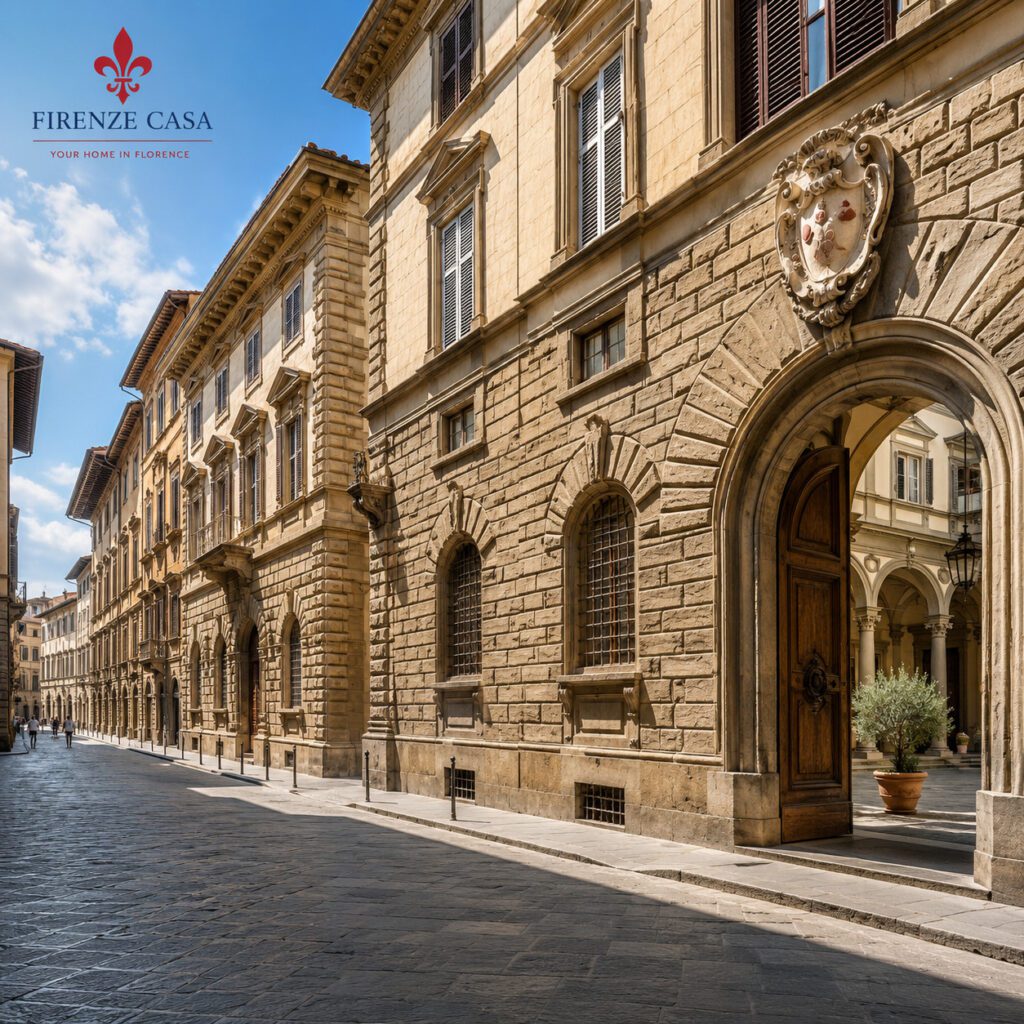
While walking along Via de’ Guicciardini, look for proportions, historic masonry, entrances and coats of arms rather than expecting the theatrical monumentality of Florence’s best-known palaces. In this case, context matters more than spectacle.
Once you know who the Guicciardini were, the experience of the street changes. A busy tourist route then becomes part of the political and intellectual geography of Renaissance Florence.
Can You Visit Palazzo Guicciardini?
Palazzo Guicciardini does not operate as a conventional public museum with regular visitor access. Since different parts of historic buildings can have different uses, interior access should not be assumed.
For most travellers, seeing the palace while walking along Via de’ Guicciardini between Ponte Vecchio and Palazzo Pitti provides the most practical experience. Nevertheless, anyone particularly interested in entering should check current arrangements before planning a special visit.
Location: Via de’ Guicciardini, Florence
Area: Oltrarno
Route: Between Ponte Vecchio and Palazzo Pitti
Public museum: No
Interior access: Limited and dependent on current use
Best combined with: Ponte Vecchio, Palazzo Pitti and Santo Spirito
A Walk from Ponte Vecchio to Palazzo Pitti
Because of its location, Palazzo Guicciardini fits naturally into one of the most frequently walked routes in Florence. Begin at Ponte Vecchio and continue south along Via de’ Guicciardini.
Instead of heading directly towards Palazzo Pitti, slow down and observe the street as an architectural space. Afterwards, continue across Piazza de’ Pitti towards Santo Spirito if time allows.
Once you move beyond the busiest route between the bridge and the palace, the atmosphere changes noticeably. Here, a more residential Oltrarno emerges, with historic houses, workshops, churches and smaller palaces.
If possible, walk Via de’ Guicciardini in both directions. Buildings often look surprisingly different when approached from the opposite side. Moreover, architectural details missed on the first walk frequently become obvious on the return.
Why Palazzo Guicciardini Is Worth Seeing
Palazzo Guicciardini is worth seeing because it reveals the quieter aristocratic Florence hidden between two of the city’s most famous landmarks. Rather than depending on one spectacular architectural feature, its significance comes from the history of the family, the street and the surrounding Oltrarno.
Furthermore, the connection with Francesco Guicciardini adds an important intellectual dimension. Here, palace history intersects with the political thought and historical writing of Renaissance Italy.
Most importantly, knowing the building changes the way visitors experience Via de’ Guicciardini. What might otherwise seem like a crowded corridor between Ponte Vecchio and Palazzo Pitti becomes part of Florence’s political, social and architectural history.
Palazzo Guicciardini is exactly the kind of building that rewards a second visit to Florence. Once the major monuments are familiar, quieter palaces and historic family streets reveal another city beneath the famous one.
Frequently Asked Questions
Where is Palazzo Guicciardini?
You will find Palazzo Guicciardini on Via de’ Guicciardini in the Oltrarno, along the route between Ponte Vecchio and Palazzo Pitti.
Who were the Guicciardini family?
For centuries, the Guicciardini belonged to Florence’s established elite. Members of the family participated in politics, diplomacy and public life.
Who was Francesco Guicciardini?
Born in Florence in 1483, Francesco Guicciardini became an influential statesman, diplomat and historian. His Storia d’Italia ranks among the major historical works of the Italian Renaissance.
Was Francesco Guicciardini connected with Machiavelli?
Yes. Although Guicciardini and Niccolò Machiavelli approached politics from different perspectives, both experienced and analysed the instability of Renaissance Italy.
Can you visit Palazzo Guicciardini?
Regular museum-style access is not available. Since parts of the historic building can have different uses, visitors should check current arrangements if interior access is important.
Why is Via de’ Guicciardini important?
Besides connecting Ponte Vecchio with Palazzo Pitti, the street gained greater significance after the Medici court established itself in the Oltrarno.
Was the area damaged during the Second World War?
Yes. During the German withdrawal in 1944, extensive demolition around the approaches to Ponte Vecchio altered parts of the surrounding historic urban fabric.
Is Palazzo Guicciardini worth seeing?
For visitors interested in Florence beyond its major monuments, certainly. Its family history and location add considerable depth to one of the most frequently travelled routes in the historic centre.
Further Reading on Firenze Casa
Continue exploring the historic palaces, families and political culture of Florence:
- Historic Palaces of Florence – Complete Guide
- Palazzo Pitti – Grand Ducal Palace of Florence
- Palazzo Rinuccini in Florence
- Palazzo Vecchio – Florence’s Historic Seat of Government
- Niccolò Machiavelli and The Prince
References
- Comune di Firenze – Historical and Cultural Information on Florence and the Oltrarno
- Treccani – Dizionario Biografico degli Italiani: Francesco Guicciardini
- Encyclopaedia Britannica – Francesco Guicciardini
- Guicciardini, Francesco – Storia d’Italia
- Archivio di Stato di Firenze – Historical Records Relating to Florentine Families and Institutions