
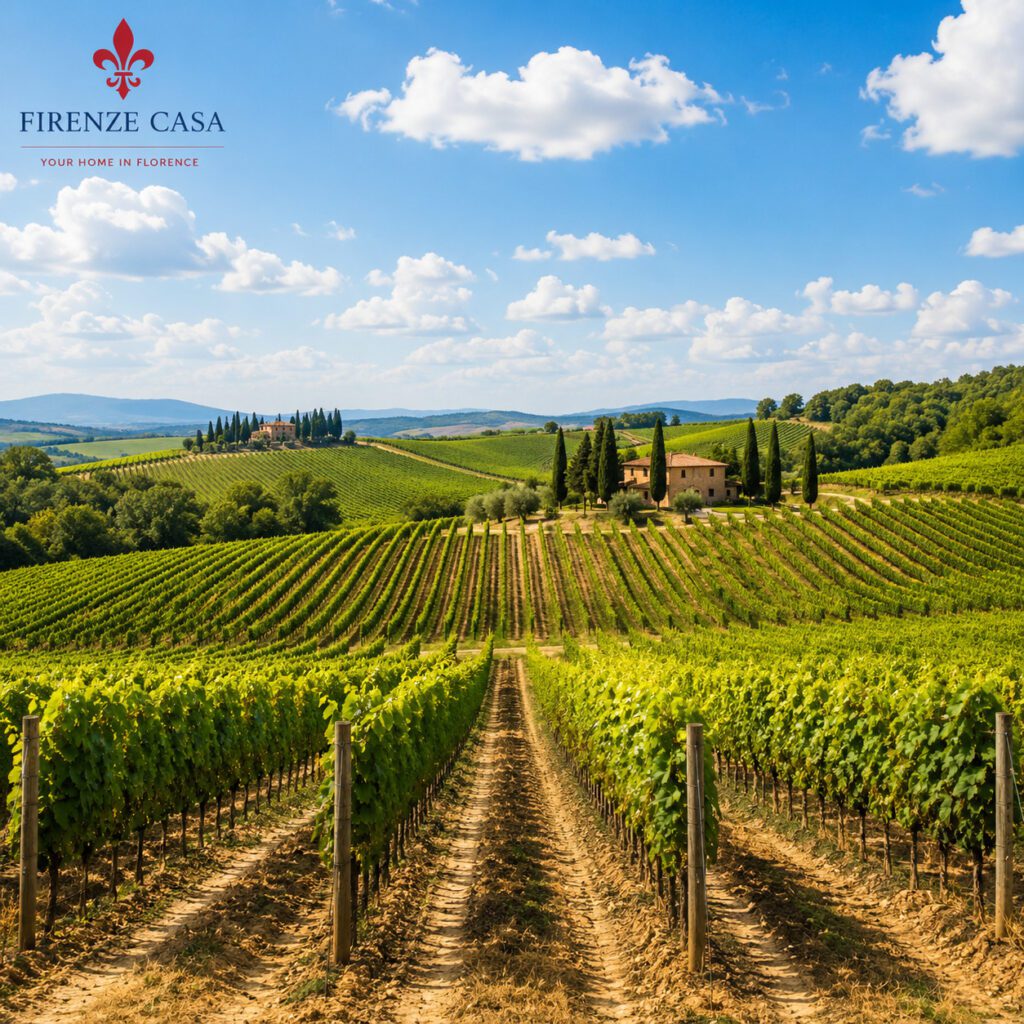
The Biondi Santi family occupies a unique place in the history of Tuscan wine. At Tenuta Greppo near Montalcino, generations of the family helped transform Sangiovese into Brunello di Montalcino, creating one of Italy’s most celebrated and long-lived wines.
During the nineteenth century, Clemente Santi began experimenting with the local Sangiovese traditionally known as Brunello. His grandson Ferruccio Biondi Santi continued this work and produced the historic 1888 vintage, while later generations refined the style and demonstrated its exceptional ageing potential. For the broader context of the region’s wines, see our Wines of Tuscany – Complete Guide.
Historic estate: Tenuta Greppo
Location: Montalcino, Tuscany
Main grape: Sangiovese
Early pioneer: Clemente Santi
Landmark vintage: 1888 Brunello
Famous later vintage: 1955 Riserva
Montalcino Before Brunello
Today, Montalcino is internationally famous for wine, but its landscape has supported agriculture for centuries. The hilltop town south of Siena is surrounded by vineyards, olive groves, woodland and cultivated fields, while differences in altitude and exposure create varied growing conditions.
Wine was produced around Montalcino long before Brunello became famous. During the nineteenth century, however, local growers began paying closer attention to a particular expression of Sangiovese cultivated in the area and commonly known as Brunello.
At a time when much Italian wine was intended for relatively rapid consumption, experiments at Tenuta Greppo explored whether this grape could produce a more structured wine capable of long ageing.
Brunello is not a separate grape variety. The historic local name refers to Sangiovese, the great red grape of central Tuscany. Brunello di Montalcino is produced entirely from Sangiovese.
Clemente Santi and the Origins of Brunello
The first crucial figure in the family story was Clemente Santi. A pharmacist by profession and an educated landowner, he experimented with agriculture and winemaking at Tenuta Greppo during the nineteenth century.
Rather than following the common practice of producing wines for relatively early consumption, Santi explored the potential of vinifying local Sangiovese and ageing the resulting wine for considerably longer periods.
His experiments attracted attention. In 1869, a wine from the 1865 vintage described as Brunello received an important award, providing an early landmark in the development of the wine later known throughout the world as Brunello di Montalcino.
Ferruccio Biondi Santi and the Birth of Brunello di Montalcino
Clemente’s grandson, Ferruccio Biondi Santi, carried these experiments further. His work at Tenuta Greppo established important foundations for the style that became Brunello di Montalcino.
The decisive vintage was 1888. Ferruccio produced a Sangiovese wine designed for extended ageing, and surviving bottles from this historic vintage remain preserved in the Biondi Santi cellars. Another celebrated vintage followed in 1891.
These wines demonstrated something remarkable for nineteenth-century Italian viticulture: carefully produced Sangiovese from Montalcino could develop complexity and survive for decades. Ferruccio’s achievement therefore provided a model that later generations of producers could build upon.
Bottles of the historic 1888 Brunello are still preserved at Tenuta Greppo. The estate’s collection of old vintages forms an extraordinary archive of Tuscan wine history.
Tenuta Greppo: The Heart of the Story
The historic centre of the Biondi Santi story is Tenuta Greppo, situated near Montalcino. Its vineyards occupy elevated terrain where soils, exposure and drainage provide favourable conditions for Sangiovese.
Generations of observation have created a detailed understanding of how different vineyard sites influence the grape. Although winemaking techniques have evolved dramatically since the nineteenth century, Greppo remains the geographical and historical centre of the Biondi Santi identity.
Why Brunello Was Revolutionary
Much nineteenth-century Italian wine was produced for local consumption rather than decades of ageing. The approach developed at Greppo was fundamentally different: careful selection of Sangiovese, controlled winemaking and extended maturation created a wine conceived for longevity.
This was significant at a time when Europe’s benchmarks for long-lived red wine were strongly associated with regions such as Bordeaux and Burgundy. Brunello demonstrated that Tuscany could also produce wines capable of remarkable development over time.
The transformation was gradual. Brunello remained relatively rare for decades, and its international reputation developed primarily during the twentieth century.
Tancredi Biondi Santi and a New Generation
After Ferruccio’s death, his son Tancredi Biondi Santi continued the family’s work at Greppo and became an important figure in Brunello’s twentieth-century development.
He refined vineyard and cellar practices while preserving the principles established by previous generations. Tancredi also shared knowledge with other producers around Montalcino, contributing to the wider improvement of the region’s wines.
He became particularly associated with the careful preservation of historic bottles through a procedure known as ricolmatura. Old bottles could be opened, inspected, topped up when appropriate and recorked, helping preserve exceptional vintages for future generations.
The Legendary 1955 Riserva
Among the historic Biondi Santi wines, the Brunello di Montalcino Riserva 1955 achieved exceptional fame. Produced during Tancredi Biondi Santi’s era, it became an international symbol of Brunello’s extraordinary ageing potential.
Its significance extends beyond rarity or value. The wine demonstrated the central idea behind generations of work at Greppo: Sangiovese grown in the right conditions and handled carefully could continue developing for an exceptionally long period.
Brunello’s reputation rests partly on longevity. Good examples can evolve for decades, gradually developing complex aromas while retaining the acidity and structure characteristic of Sangiovese.
Franco Biondi Santi and the BBS11 Selection
The next major figure was Franco Biondi Santi, who took responsibility for Tenuta Greppo during the later twentieth century. Like his predecessors, he combined respect for tradition with careful experimentation.
One of his important projects involved studying different selections of Sangiovese grown at the estate. A particular selection known as BBS11 emerged as especially well suited to the conditions at Greppo and became an important part of the estate’s vineyards.
Franco also strongly defended the principle that Brunello di Montalcino should remain a pure expression of Sangiovese, reinforcing the connection between grape and territory.
From Family Wine to an International Symbol
For much of its early history, Brunello was produced in very limited quantities. Montalcino itself was a relatively isolated Tuscan hill town, far removed from the international wine destination it has become today.
During the second half of the twentieth century, more producers began bottling Brunello, international demand increased and Montalcino became synonymous with prestigious Italian wine. Brunello received DOC status in 1966 and DOCG status in 1980, becoming one of the first Italian wines to receive the country’s highest classification.
Throughout this transformation, Biondi Santi remained a historical reference point because the family’s pioneering work predated the modern denomination by generations.
Brunello di Montalcino Today
Modern Brunello di Montalcino must be produced entirely from Sangiovese grown within the territory of Montalcino. Vineyards occupy a surprisingly varied landscape, with differences in altitude, soil and exposure creating distinct expressions of the grape.
The world of Brunello is now far larger than the pioneering experiments at Greppo. Yet the central idea established by Clemente Santi and Ferruccio Biondi Santi remains recognisable: carefully grown Sangiovese from Montalcino can produce a profound and exceptionally long-lived wine.
For visitors beginning to explore Italian wine, our Tuscan Wine for Beginners – Complete Guide explains Sangiovese, ageing, tannins and other fundamentals encountered when tasting Brunello.
Biondi Santi and the Other Great Tuscan Wine Families
The Biondi Santi story differs significantly from those of Tuscany’s other historic wine dynasties. The Antinori family and Frescobaldi family developed activities across several wine territories, while the Ricasoli family became inseparable from Castello di Brolio and the history of Chianti.
The Mazzei family created an extraordinary continuity at Fonterutoli in Chianti Classico. Biondi Santi, by contrast, is associated above all with one estate and one wine: Tenuta Greppo and Brunello di Montalcino.
That concentration gives the family a distinctive position in Tuscan wine history. Generations of Biondi Santi did not simply contribute to an existing tradition; their work played a central role in defining the wine itself.
Montalcino and Its Landscape
Montalcino stands on a hill south of Siena overlooking valleys, vineyards, woodland and distant mountains. The medieval town is dominated by its fortress and retains much of the architectural character that developed long before Brunello brought international visitors.
The surrounding wine territory varies considerably in elevation, orientation and local climate. These differences help explain why Brunello can display noticeably different characteristics depending on where within Montalcino its grapes are grown.
Wine, landscape and medieval architecture make Montalcino one of southern Tuscany’s most rewarding destinations. It can also be combined naturally with a wider exploration of the Val d’Orcia from Florence.
Visiting Montalcino and Tenuta Greppo
Montalcino makes an excellent full-day or overnight excursion from Florence, particularly for visitors with a strong interest in Tuscan wine. The journey south of Siena also introduces a landscape quite different from Chianti Classico.
Tenuta Greppo lies outside the historic town. Because access to working wine estates and tasting arrangements can change, visitors interested in Biondi Santi should check current information before planning a visit.
Even without a winery visit, Montalcino deserves time. Its historic centre, fortress, viewpoints and wine shops provide an excellent introduction to Brunello and the landscape that created it.
Montalcino is considerably farther from Florence than the Chianti Classico villages. Allow a full day rather than rushing there and back, and combine the wine experience with time in the historic town and surrounding countryside.
The Biondi Santi Family at a Glance
| Topic | Key Information |
|---|---|
| Historic estate | Tenuta Greppo |
| Location | Montalcino, Tuscany |
| Main grape | Sangiovese |
| Early pioneer | Clemente Santi |
| Historic recognition | 1865 vintage awarded in 1869 |
| Landmark Brunello | Ferruccio Biondi Santi, 1888 vintage |
| Important later figure | Tancredi Biondi Santi |
| Later family figure | Franco Biondi Santi |
| Notable Sangiovese selection | BBS11 |
Interesting Facts About the Biondi Santi Family
- Clemente Santi received recognition in 1869 for a Brunello wine produced from the 1865 vintage.
- Ferruccio Biondi Santi produced the historic 1888 Brunello at Tenuta Greppo.
- Bottles from early Biondi Santi vintages remain preserved in the estate’s historic cellar.
- Tancredi Biondi Santi contributed to the development of Brunello during the twentieth century.
- The 1955 Riserva became one of the most celebrated historic Italian wines.
- Franco Biondi Santi conducted extensive research into selections of Sangiovese.
- BBS11 is a selection of Sangiovese associated with Tenuta Greppo.
- Brunello di Montalcino is produced entirely from Sangiovese.
Frequently Asked Questions
Who are the Biondi Santi family?
The Biondi Santi are a historic Tuscan wine family closely associated with Tenuta Greppo in Montalcino. Generations of the family played a central role in the development of Brunello di Montalcino.
Did Biondi Santi invent Brunello?
The family’s work was fundamental to the development of Brunello as we know it. Clemente Santi pioneered long-lived Sangiovese wines at Greppo, while Ferruccio Biondi Santi established the historic style associated with the celebrated 1888 vintage.
What grape is used for Brunello di Montalcino?
Brunello di Montalcino is produced entirely from Sangiovese grown within the territory of Montalcino.
Where is Tenuta Greppo?
Tenuta Greppo lies near the historic town of Montalcino in the province of Siena.
Why is the 1888 vintage important?
The 1888 Biondi Santi vintage is one of the defining landmarks in Brunello history and helped establish the style associated with the wine.
What is BBS11?
BBS11 is an important selection of Sangiovese identified through work carried out at Tenuta Greppo during Franco Biondi Santi’s era.
Can Brunello age for a long time?
Yes. Brunello di Montalcino is renowned for its ageing potential, and exceptional examples can continue developing for several decades.
Why the Biondi Santi Family Is Worth Discovering
The history of the Biondi Santi family is one of the defining stories of Tuscan wine. At Tenuta Greppo, Clemente Santi recognised the potential of local Sangiovese, Ferruccio Biondi Santi transformed that potential into the historic Brunello associated with the 1888 vintage, and later generations refined and protected the style.
Their work also helped transform the reputation of Montalcino. What began as experiments on a Tuscan estate eventually contributed to one of Italy’s most prestigious wine denominations.
For anyone exploring the wines of Tuscany, Biondi Santi provides a fitting conclusion to the story of the region’s historic wine families: one estate, one grape and generations of patient work that helped create an international symbol of Tuscany.
Further Reading on Firenze Casa
- The Wines of Tuscany – Complete Guide
- Tuscan Wine for Beginners: The Complete Guide
- The Antinori Family: Wine, Tradition and Renaissance Influence
- The Frescobaldi Family: Florence’s Banking and Wine Dynasty
- The Ricasoli Family: Wine and Chianti
- The Mazzei Family: Wine and Chianti
- Chianti Wine – The Wine That Shaped Tuscany
- Val d’Orcia from Florence
References
- Biondi-Santi – History of Tenuta Greppo and the Biondi Santi family.
- Consorzio del Vino Brunello di Montalcino – Biondi-Santi Tenuta Greppo.
- Consorzio del Vino Brunello di Montalcino – History of Brunello di Montalcino.
- Historical material on Clemente Santi, Ferruccio Biondi Santi and Tancredi Biondi Santi.
- Historical studies on Tuscan viticulture and Sangiovese.
- Historical studies on Montalcino and the development of Brunello.

