
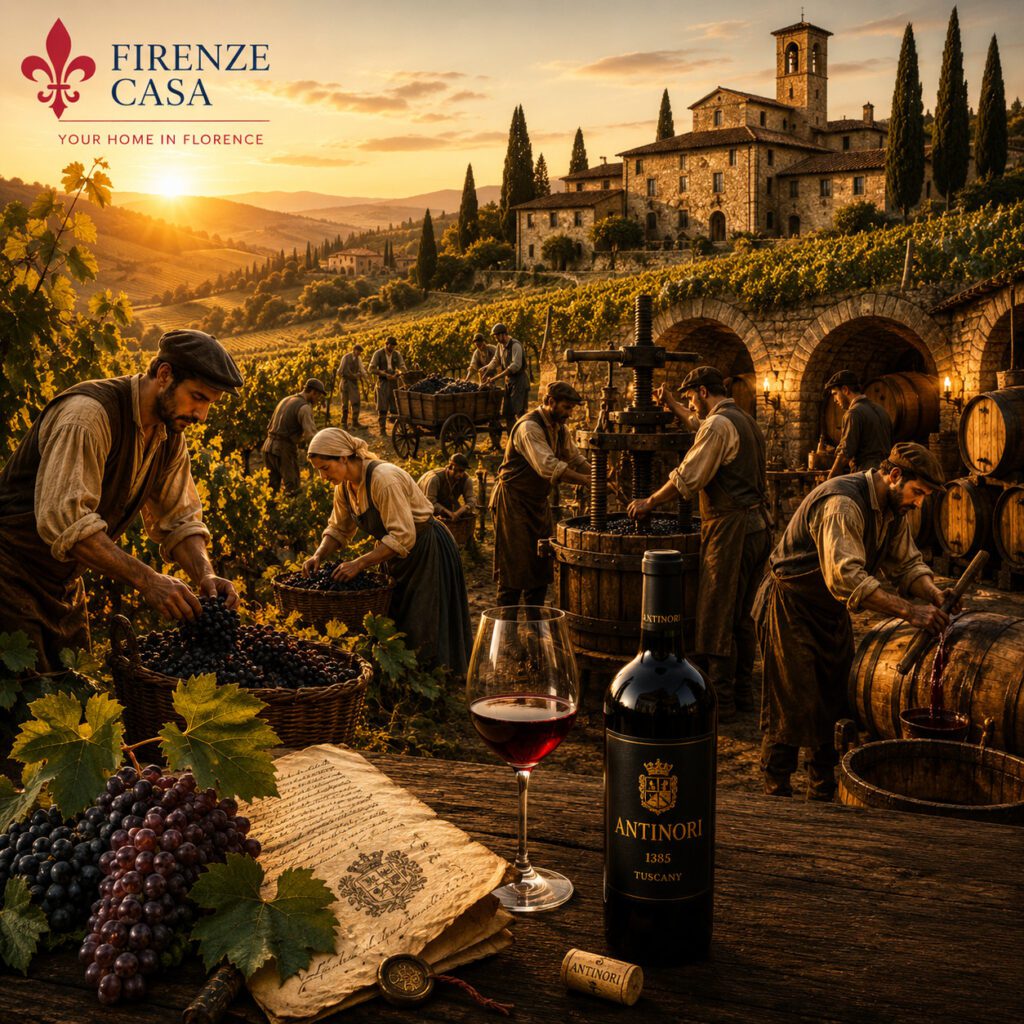
The Antinori family is one of Florence’s most historic dynasties and one of the best-known names in Tuscan wine. For more than six centuries, the family has combined entrepreneurship, innovation and tradition, creating one of Italy’s longest-running family wine businesses.
Their story extends far beyond vineyards and cellars. The Antinori were deeply rooted in the commercial and civic world of Florence, while today their name connects Palazzo Antinori in the historic centre with renowned estates across Tuscany. This unusual continuity makes the family an important link between Renaissance Florence and modern Tuscan wine culture.
Wine tradition: Documented since 1385
Generations: 26
Historic Florence residence: Palazzo Antinori
Important wines: Tignanello and Solaia
Modern landmark: Antinori nel Chianti Classico at Bargino
Historic importance: Commerce, landownership and wine
Legacy today: One of Italy’s most influential family wine businesses
For a broader introduction to Tuscany’s wine regions, grape varieties and traditions, see our Wines of Tuscany – Complete Guide.
Historical Timeline of the Antinori Family
| Year | Event |
|---|---|
| 1385 | Giovanni di Piero Antinori joins the Florentine Winemakers’ Guild, marking the documented beginning of the family’s wine tradition. |
| 15th century | The Antinori strengthen their position through commerce, landownership and public life in Florence. |
| 1506 | Niccolò di Tommaso Antinori acquires Palazzo Antinori, then known as Palazzo Boni. |
| 16th–18th centuries | The family continues developing agricultural estates and wine activities while remaining part of Florentine society. |
| 20th century | Antinori becomes an important force in the modernisation of Tuscan winemaking. |
| 1970s | Tignanello becomes one of the influential wines associated with the rise of the Super Tuscan movement. |
| 2012 | The new Antinori nel Chianti Classico winery opens at Bargino. |
| Today | The twenty-sixth generation continues the family wine business. |
Who Are the Antinori?
The Antinori are one of Florence’s historic families and one of the world’s longest-running family wine businesses. Their documented involvement with wine dates to 1385, when Giovanni di Piero Antinori entered the Arte Fiorentina dei Vinattieri, Florence’s Winemakers’ Guild.
Across twenty-six generations, the family has survived political upheaval, wars, economic crises and profound changes in agriculture and international trade. Its longevity has depended on balancing respect for tradition with a willingness to innovate.
Like many prominent Florentine dynasties, the Antinori were never defined by a single activity. Commerce, property, agriculture and participation in civic life all contributed to their position within the complex society of Florence.
The wider context of these merchant dynasties is explored in our Most Famous Florentine Families – Complete Guide.
Six Centuries of Winemaking
The year 1385 is central to the Antinori story. Giovanni di Piero Antinori’s admission to the Florentine Winemakers’ Guild provides the family’s traditional starting point for more than six centuries of documented involvement in wine.
Over time, the family acquired vineyards and agricultural estates in different parts of Tuscany. Successive generations combined local knowledge with changing methods of cultivation and cellar management, allowing Antinori to remain relevant as both tastes and markets evolved.
This ability to adapt without abandoning a strong regional identity eventually became one of the defining characteristics of the company. Visitors unfamiliar with wine tasting can explore the basic principles in our Tuscan Wine for Beginners guide.
The Antinori Family and Renaissance Florence
Renaissance Florence was not only a centre of art and humanism but also one of Europe’s great commercial cities. Banking, textile production, international trade and agriculture created fortunes that allowed merchant families to exercise considerable civic and cultural influence.
The Antinori belonged to this world. Their history therefore sits alongside that of other major Florentine dynasties such as the Medici, Strozzi and Tornabuoni. Each family followed a different political and economic path, but together they demonstrate how strongly commerce, land, patronage and family identity shaped Florence.
Unlike many historic families whose influence today is largely preserved through buildings, archives or works of art, the Antinori remain associated with an active international business. This continuity makes their story particularly distinctive.
The Antinori demonstrate a recurring Florentine pattern: wealth created through commerce was often reinvested in land, agriculture and urban property, linking the city closely with the Tuscan countryside.
Palazzo Antinori
One of the most visible symbols of the family in Florence is Palazzo Antinori, standing on Piazza Antinori at the northern end of Via de’ Tornabuoni.
The palace was built during the second half of the fifteenth century and is traditionally associated with the architect Giuliano da Maiano. It did not originally belong to the Antinori. On 2 February 1506, Niccolò di Tommaso Antinori acquired the building, then known as Palazzo Boni, for 4,000 florins.
Since then, Palazzo Antinori has remained closely connected with the family for more than five centuries. Its restrained façade, harmonious proportions and interior courtyard make it an important example of Florentine Renaissance domestic architecture.
The dates 1461–1469 refer to the traditional dating of the palace’s construction, not to its acquisition by the Antinori. The family purchased the property in 1506.
The palace remains privately associated with the family and therefore differs from residences such as Palazzo Strozzi, which today functions as a major public cultural venue. Even from the street, however, Palazzo Antinori provides a tangible connection between Renaissance commerce and the continuing Antinori story.
Innovation in Tuscan Wine
The family’s modern reputation rests not only on longevity but also on a willingness to challenge established winemaking conventions. During the twentieth century, Antinori played an important role in the transformation of Tuscan wine and its international reputation.
Tignanello and the Super Tuscans
Piero Antinori became one of the central figures in this modern chapter. Under his leadership, the family experimented with vineyard practices, blending and ageing techniques at a time when some of Tuscany’s formal wine regulations were considered restrictive by ambitious producers.
Tignanello, produced from vineyards in the Chianti Classico area, became one of the landmark wines of this transformation. Developed during the 1970s, it placed Sangiovese at the centre of an innovative approach that also incorporated international grape varieties and ageing in smaller oak barrels.
The wine became closely associated with the emergence of the so-called Super Tuscans and helped demonstrate that Tuscan producers could pursue new stylistic directions while maintaining a strong connection to the region.
Solaia and a Continuing Spirit of Experimentation
Solaia further strengthened Antinori’s international reputation. Together with Tignanello, it illustrates a philosophy that has become characteristic of the family: tradition provides the foundation, but it should not prevent innovation.
Antinori nel Chianti Classico
The modern Antinori nel Chianti Classico winery at Bargino is perhaps the clearest architectural expression of this philosophy. Opened in 2012, the complex is largely integrated into the hillside and combines wine production, contemporary architecture, art and hospitality.
Its terraced form, vineyard-covered roof and extensive underground spaces allow a large modern winery to sit remarkably discreetly within the Chianti landscape. Visitors can tour the cellars, learn about Antinori’s production and taste wines on site.
Because Firenze Casa has a dedicated guide to the winery, its architecture and visitor experience are covered only briefly here.
Antinori nel Chianti Classico works especially well as a day trip from Florence because the winery combines wine, architecture and landscape in one experience.
From Florence to the Tuscan Countryside
The Antinori story illustrates the close historical relationship between Florence and its surrounding countryside. The city provided commercial connections, capital and prestige, while rural estates supplied wine, olive oil and other agricultural products.
Over the centuries, the family expanded into several important Italian wine areas. Its Tuscan activities include estates associated with Chianti Classico, Montalcino and other distinctive landscapes, while the wider business now extends considerably beyond Florence.
Chianti wine remains particularly important to understanding the region’s identity. The landscape south of Florence demonstrates how vineyards, villages, castles and agricultural estates became inseparable from the economic history of the city.
Other Florentine and Tuscan families followed comparable paths between urban commerce and rural estates. The Frescobaldi family, for example, combined banking and landownership with a wine tradition that also survives today, while the Ricasoli family became closely associated with the history of Chianti.
A Family Business Across Twenty-Six Generations
Few aspects of the Antinori story are more remarkable than the continuity of family leadership. Twenty-six generations have participated in a business that has survived enormous changes in politics, agriculture, technology and international commerce.
Today, Piero Antinori’s daughters Albiera, Allegra and Alessia Antinori represent the twenty-sixth generation involved in the family enterprise. Their role combines continuity with the challenges of managing an international wine company in the twenty-first century.
The Antinori therefore differ from many historic Florentine dynasties. Their legacy is not confined to monuments or historical memory: it continues as a working family enterprise rooted in Tuscany.
Antinori and the Wider Tuscan Wine Tradition
The importance of the Antinori becomes even clearer when their history is compared with other major Tuscan wine families. Frescobaldi represents a similarly long connection between Florentine wealth and rural estates, while Ricasoli became central to the historical development of Chianti.
The Biondi Santi family occupies a different but equally important place in Tuscan wine history through the development of Brunello di Montalcino. Together, these families demonstrate that Tuscany’s wine culture evolved through a combination of local tradition, family estates and continuous experimentation.
Antinori’s distinctive contribution lies in combining exceptional historical continuity with a particularly visible role in the modern international transformation of Tuscan wine.
The Antinori Legacy
The Antinori occupy a distinctive position in the history of Florence and Tuscan wine. Their story connects Renaissance commerce, agricultural estates, architecture and more than six centuries of family entrepreneurship.
Palazzo Antinori preserves their urban identity in Florence, while vineyards and wineries across Tuscany illustrate the agricultural foundation of the family’s success. Modern wines such as Tignanello and Solaia demonstrate how that inheritance has continued to evolve.
The family’s most remarkable achievement may therefore be its ability to preserve continuity without becoming static. By treating tradition as a foundation rather than a limitation, the Antinori have remained relevant for more than six hundred years.
The Antinori story links two Florences: the merchant city of Renaissance palaces and guilds, and the modern city that remains closely connected with the vineyards and agricultural traditions of Tuscany.
Interesting Facts About the Antinori Family
- The Antinori family’s documented wine tradition dates to 1385.
- The business has continued through twenty-six generations.
- Palazzo Antinori was built before it belonged to the family; the Antinori acquired it in 1506.
- Piero Antinori played an important role in the modern transformation of Tuscan wine.
- Tignanello and Solaia became internationally celebrated examples of modern Tuscan winemaking.
- Antinori nel Chianti Classico opened at Bargino in 2012.
- The twenty-sixth generation includes Albiera, Allegra and Alessia Antinori.
Frequently Asked Questions
Who are the Antinori family?
The Antinori are a historic Florentine family whose documented involvement in winemaking dates to 1385. Today, they remain one of Italy’s best-known family wine producers.
How old is the Antinori wine business?
Its traditional documented starting point is 1385, when Giovanni di Piero Antinori joined Florence’s Winemakers’ Guild.
When did the Antinori acquire Palazzo Antinori?
Niccolò di Tommaso Antinori purchased the palace on 2 February 1506. The building itself had been constructed earlier in the fifteenth century.
What are the Antinori family’s most famous wines?
Tignanello and Solaia are among the family’s most internationally recognised wines and played an important role in the modern reputation of Tuscan wine.
What is Antinori nel Chianti Classico?
It is the family’s modern winery at Bargino, south of Florence. Opened in 2012, it combines wine production with distinctive contemporary architecture, tastings and visitor experiences.
Is the Antinori family still involved in the business?
Yes. The twenty-sixth generation remains directly involved, including Piero Antinori’s daughters Albiera, Allegra and Alessia.
Why the Antinori Family Is Worth Discovering
The Antinori family is worth discovering because its history connects Florence with more than six centuries of Tuscan wine culture. The dynasty emerged from the commercial world of medieval and Renaissance Florence while gradually developing agricultural estates whose wines became internationally recognised.
Palazzo Antinori preserves the family’s urban presence, while estates across Tuscany reveal the importance of land, vineyards and regional identity. Tignanello and Solaia add a modern chapter in which innovation helped reshape the international reputation of Tuscan wine.
For visitors to Florence, the Antinori story therefore offers far more than a famous wine label. It demonstrates how commerce, family continuity, architecture and the Tuscan countryside have remained closely connected across centuries.
Further Reading on Firenze Casa
Explore the Antinori story within the wider history of Florence’s families and Tuscan wine:
- The Most Famous Florentine Families – Complete Guide
- Wines of Tuscany – Complete Guide
- Antinori nel Chianti Classico
- Tuscan Wine for Beginners
- The Frescobaldi Family: Florence’s Banking and Wine Dynasty
- The Ricasoli Family: Wine and Chianti
- The Mazzei Family: Wine and Chianti
- The Biondi Santi Family: Brunello and Montalcino
- The Medici Family: The Dynasty That Shaped Florence
- The Tornabuoni Family: Wealth, Art and Influence in Florence
References
- Marchesi Antinori – Family History and Palazzo Antinori
- Marchesi Antinori – Antinori nel Chianti Classico
- Brucker, Gene – Florence: The Golden Age 1138–1737
- Najemy, John M. – A History of Florence 1200–1575
- Kent, Dale – The Rise of the Medici
- Treccani – Enciclopedia Italiana
- Consorzio Vino Chianti Classico
- Comune di Firenze

