
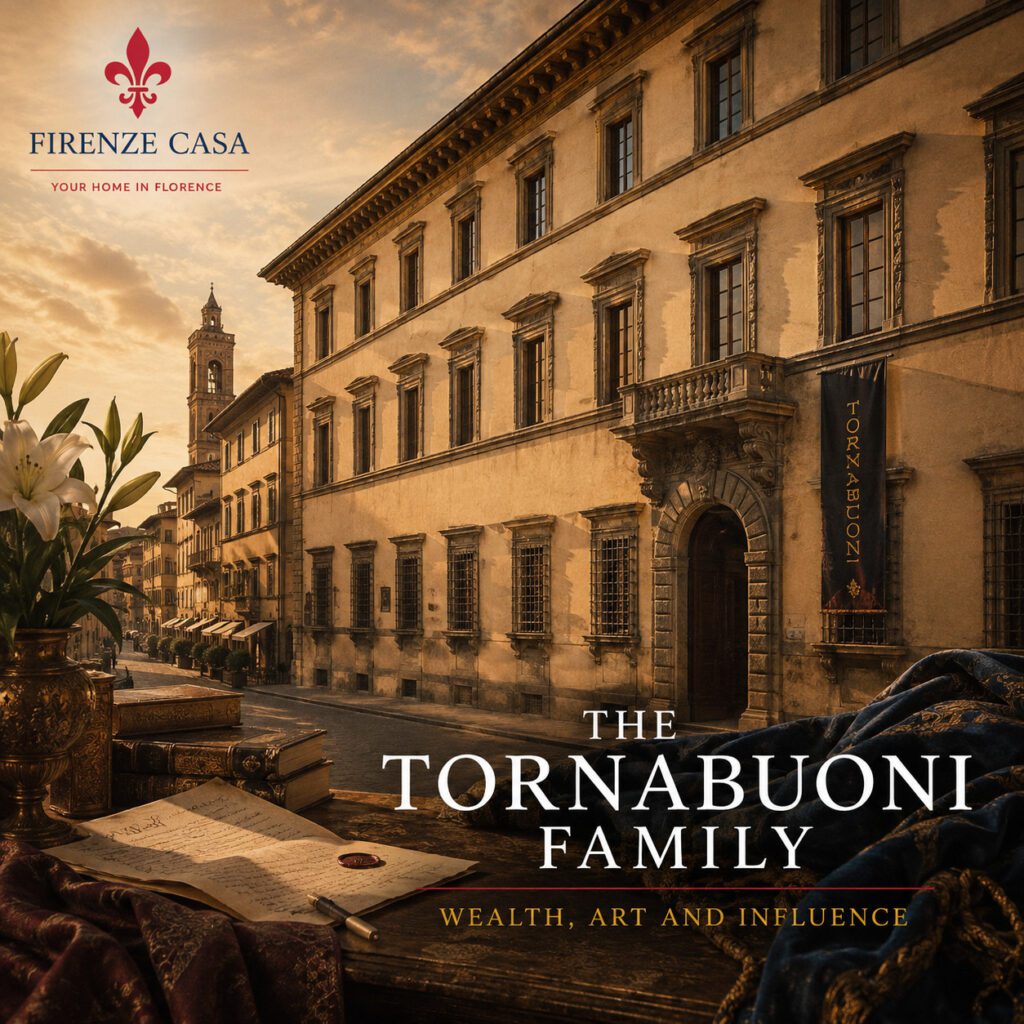
The Tornabuoni family was one of the wealthiest and most influential dynasties of Renaissance Florence. Through banking, commerce, political alliances and artistic patronage, the family became closely connected with the Medici and helped shape the cultural world of fifteenth-century Florence.
Their legacy remains remarkably visible today. Via de’ Tornabuoni is still one of the city’s most elegant streets, while the Tornabuoni Chapel in Santa Maria Novella preserves one of the finest fresco cycles of the Renaissance. At the same time, figures such as Lucrezia and Giovanni Tornabuoni reveal how deeply family networks, finance, politics and culture were intertwined.
Origins: Medieval Florence
Main sources of wealth: Banking, commerce, property and public office
Key figures: Lucrezia Tornabuoni and Giovanni Tornabuoni
Medici connection: Lucrezia married Piero de’ Medici
Most famous descendant: Lorenzo the Magnificent
Greatest artistic legacy: Tornabuoni Chapel in Santa Maria Novella
Major urban legacy: Via de’ Tornabuoni
Historical importance: Finance, diplomacy, family alliances and Renaissance patronage
The Tornabuoni belong to the wider network explored in our Most Famous Florentine Families – Complete Guide.
Who Were the Tornabuoni Family?
The Tornabuoni were one of the prominent merchant families of Renaissance Florence. Their fortunes developed through commerce, banking, property and participation in the civic institutions of the Florentine Republic.
Like other successful Florentine dynasties, they understood that wealth alone was not enough. Political alliances, strategic marriages and public reputation were equally important for maintaining influence over generations.
By the fifteenth century, the family had become firmly established among Florence’s governing elite. However, their enduring reputation rests especially on their close relationship with the Medici and their exceptional artistic patronage.
The Tornabuoni demonstrate how Renaissance Florence worked through family networks. Banking, marriage, politics and patronage were rarely separate worlds; instead, they reinforced one another.
The Rise of the Tornabuoni Family
Florence during the fourteenth and fifteenth centuries offered extraordinary opportunities to successful merchants. Textile production, international trade and banking generated enormous wealth, while republican institutions allowed prosperous citizens to participate directly in government.
The Tornabuoni used these opportunities effectively. Successive generations expanded family resources through careful commercial management and strengthened their position through alliances with other prominent households.
Meanwhile, the cultural climate of Florence was changing. Humanist ideas encouraged wealthy citizens to value education, architecture and the arts as expressions of civic identity and personal prestige.
The Tornabuoni embraced this culture enthusiastically. Consequently, their financial success became increasingly visible through churches, artistic commissions and urban property.
Florence During the Age of the Tornabuoni
The fifteenth century was one of the most extraordinary periods in the history of Florence. Merchants and bankers connected the city with markets throughout Europe, while artists, architects and scholars transformed its cultural identity.
The Tornabuoni reached their greatest prominence within this dynamic environment. Their financial expertise gave them access to international networks, whereas their Medici connections placed them close to the centre of Florentine politics.
At the same time, artistic patronage became an important language of status. Families competed through chapels, palaces, religious commissions and public generosity.
The Tornabuoni excelled in this world because they combined economic strength with sophisticated cultural ambition.
The Medici Connection
No relationship was more important to the Tornabuoni than their connection with the Medici family. While many Florentine houses competed directly with the Medici, the Tornabuoni became close allies.
The most important bond came through Lucrezia Tornabuoni, daughter of Francesco Tornabuoni. She married Piero de’ Medici and became the mother of Lorenzo de’ Medici, later known as Lorenzo the Magnificent.
This marriage connected the Tornabuoni directly with Florence’s emerging dominant dynasty. Yet Lucrezia was far more than a link between two families.
She became an influential political adviser, estate manager, writer and diplomat in her own right, making her one of the most remarkable women of Renaissance Florence.
Lorenzo the Magnificent was half Tornabuoni through his mother Lucrezia. The relationship therefore placed the Tornabuoni at the very centre of Medici family and political life.
Lucrezia Tornabuoni: Writer, Adviser and Medici Matriarch
Lucrezia Tornabuoni (1427–1482) deserves particular attention because her life demonstrates the influence elite Florentine women could exercise even though they were excluded from formal public office.
She wrote religious poetry and devotional works, managed financial and property matters and advised members of her family on political questions. Moreover, she maintained networks that helped strengthen the Medici position in Florence.
Her marriage to Piero de’ Medici produced several children, including Lorenzo the Magnificent and Giuliano de’ Medici.
Lucrezia’s intelligence and judgement became especially important as the Medici expanded their influence. Her story adds a crucial dimension to the political history of the dynasty because it reveals how family power operated through both men and women.
Giovanni Tornabuoni: Banker, Diplomat and Patron
Giovanni Tornabuoni (1428–1497) became another central figure in the family’s history. A banker, diplomat and patron, he represented the close relationship between finance and culture in Renaissance Florence.
Giovanni directed the Roman branch of the Medici Bank, one of the most important positions within the Medici financial network. The branch maintained significant business relationships with the papal court and therefore required considerable diplomatic as well as financial skill.
His success brought substantial wealth and influence. Instead of keeping that prosperity entirely private, Giovanni invested heavily in religious and artistic patronage.
His greatest commission survives in Santa Maria Novella and remains one of the most extraordinary visual records of fifteenth-century Florence.
The Tornabuoni Chapel: A Renaissance Masterpiece
The Tornabuoni Chapel occupies the principal choir chapel of the Basilica of Santa Maria Novella. Between 1485 and 1490, Giovanni Tornabuoni commissioned Domenico Ghirlandaio and his workshop to decorate the space with an extensive fresco cycle.
The paintings depict episodes from the lives of the Virgin Mary and Saint John the Baptist. However, Ghirlandaio also filled the scenes with portraits of contemporary Florentines.
Members of the Tornabuoni family, wealthy citizens and figures connected with the Medici world appear alongside biblical characters. As a result, sacred history becomes a vivid portrait of late fifteenth-century Florence.
The frescoes also preserve details of clothing, architecture, furnishings and social ceremony. They therefore function not only as masterpieces of Renaissance painting but also as exceptional historical documents.
Look beyond the biblical stories in the Tornabuoni Chapel. Ghirlandaio populated them with recognisable Florentine faces and contemporary settings, effectively bringing Renaissance society into sacred history.
Ghirlandaio and the Florence of the Tornabuoni
Domenico Ghirlandaio specialised in combining religious narrative with highly detailed observations of contemporary life. This made him an ideal artist for a family interested in both devotion and public reputation.
The Tornabuoni frescoes therefore reveal two worlds simultaneously. On one level, they tell sacred stories. On another, they present the wealthy society that financed and inhabited Renaissance Florence.
Members of the family appear elegantly dressed within architectural settings inspired by contemporary Florentine interiors and streets.
This fusion of faith, family and civic identity helps explain why the chapel remains so important for understanding Renaissance patronage.
Via de’ Tornabuoni
The Tornabuoni name also survives in the urban landscape through Via de’ Tornabuoni, one of Florence’s most prestigious streets.
Running between Piazza Antinori and the Ponte Santa Trinita, the street passes through an area historically associated with banking, merchant wealth and noble residences.
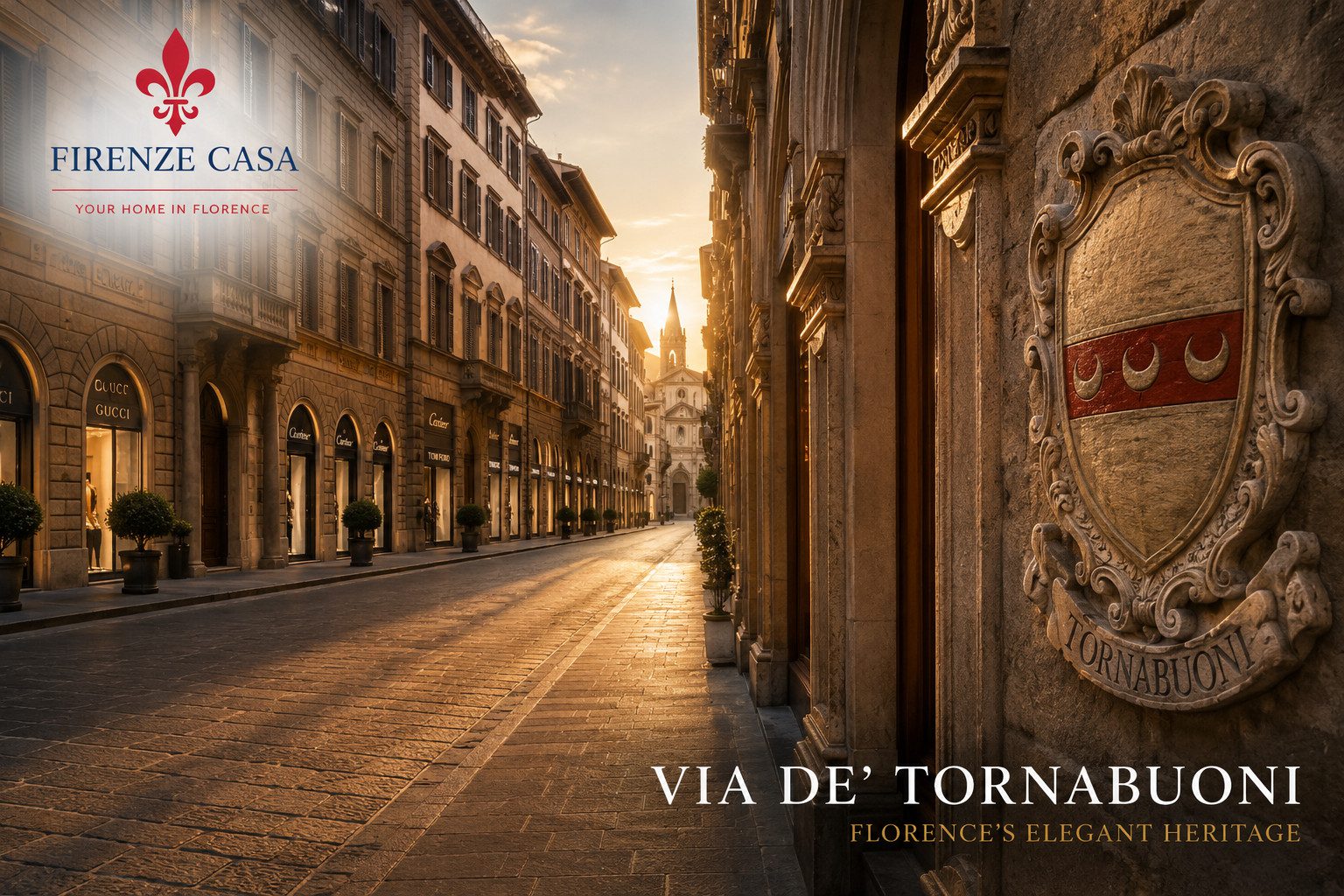
Today, international fashion houses occupy many of the historic buildings. However, the street’s elegance predates modern luxury retail by centuries.
Palazzo Strozzi, Palazzo Antinori and other historic residences nearby reveal why this part of Florence became associated with wealth and prestige long before designer boutiques arrived.
Walk slowly along Via de’ Tornabuoni and look above the shop windows. The façades, coats of arms and palace architecture reveal a much older history of Florentine wealth beneath the modern luxury brands.
The Tornabuoni and the Medici Bank
Giovanni Tornabuoni’s role in the Medici Bank demonstrates how closely the two families were connected economically. The Roman branch was particularly important because of its relationship with the papal court.
Banking at this level involved much more than lending money. It required currency exchange, transfers between cities, management of payments and relationships with powerful clients.
The Tornabuoni therefore participated directly in the international financial system that helped make Florence one of Europe’s most influential commercial centres.
The wider development of this system is explored in our Birth of Modern Banking in Florence guide.
Wealth as a Force for Culture
The Tornabuoni story demonstrates a fundamental characteristic of Renaissance Florence: private wealth frequently became public culture.
Successful bankers and merchants financed chapels, churches, paintings and charitable institutions. Although patronage reinforced family prestige, it also created works that became part of Florence’s shared cultural heritage.
Giovanni Tornabuoni’s chapel is perhaps the clearest example. His investment honoured his family and religious beliefs while providing work for one of the leading painters of the period.
Centuries later, visitors from around the world still benefit from that private act of patronage.
The Tornabuoni and Other Florentine Families
The Tornabuoni belonged to a dense network of relationships among Florence’s leading families. Their close alliance with the Medici contrasts with dynasties such as the Strozzi and Pazzi, whose names became associated with opposition to Medici dominance.
Other families developed different strategies. The Rucellai became famous for architectural patronage, while the Salviati combined marriage ties to the Medici with later political conflict.
The Gondi extended their influence internationally through banking and connections with France.
Together, these dynasties reveal that Florence was not shaped by one family alone. Instead, its history emerged from shifting alliances and competition among many powerful households.
Where to Discover the Tornabuoni Legacy
Tornabuoni Chapel
The most important artistic site connected with the family lies inside Santa Maria Novella. Allow time to examine Ghirlandaio’s frescoes closely because many of their most interesting historical details appear in the background figures and architecture.
Via de’ Tornabuoni
The street preserves the family name and passes through one of the most architecturally distinguished areas of central Florence.
Santa Maria Novella
The church provides the wider religious and artistic setting for the Tornabuoni Chapel and also connects the family story with other major Renaissance patrons, including the Rucellai.
Medici Florence
Because Lucrezia Tornabuoni married into the Medici family, sites such as Palazzo Medici Riccardi and San Lorenzo also form part of the wider Tornabuoni story.
A Tornabuoni Walk Through Florence
Begin at Santa Maria Novella and visit the Tornabuoni Chapel before walking towards Via de’ Tornabuoni.
Continue past Palazzo Antinori towards Palazzo Strozzi and Piazza Santa Trinita. From there, the street leads naturally towards Ponte Santa Trinita and the Arno.
This short route connects religious patronage with the commercial and architectural world in which the Tornabuoni prospered.
Santa Maria Novella → Tornabuoni Chapel → Via de’ Tornabuoni → Palazzo Strozzi → Piazza Santa Trinita → Ponte Santa Trinita creates an elegant walk through the world of Florence’s merchant elite.
The Tornabuoni Legacy
More than five centuries after their greatest period of influence, the Tornabuoni remain deeply embedded in the identity of Florence.
The family no longer exercises the political or financial power it possessed during the Renaissance, yet its name survives through architecture, paintings and the urban landscape.
The Tornabuoni Chapel preserves their commitment to artistic patronage, while Via de’ Tornabuoni keeps the family name at the centre of modern Florence.
Their story also demonstrates why the Renaissance cannot be attributed to the Medici alone. The cultural flowering of Florence depended on many merchants, bankers and patrons whose investments gave artists the opportunity to create extraordinary works.
The Tornabuoni show how alliances could be just as important as rivalry. Their close relationship with the Medici allowed two powerful families to reinforce one another through finance, marriage and cultural patronage.
Interesting Facts About the Tornabuoni Family
- The Tornabuoni were closely connected with the Medici through both banking and marriage.
- Lucrezia Tornabuoni married Piero de’ Medici and became the mother of Lorenzo the Magnificent.
- She was also a writer, estate manager and influential political adviser.
- Giovanni Tornabuoni directed the Roman branch of the Medici Bank.
- The Tornabuoni Chapel was decorated by Domenico Ghirlandaio between 1485 and 1490.
- The frescoes include portraits of contemporary members of Florentine society.
- Via de’ Tornabuoni remains one of the most prestigious streets in Florence.
Frequently Asked Questions About the Tornabuoni Family
Who were the Tornabuoni family?
The Tornabuoni were a wealthy Florentine merchant and banking family closely connected with the Medici. Their influence extended into politics, finance, diplomacy and artistic patronage.
How were the Tornabuoni connected to the Medici?
Lucrezia Tornabuoni married Piero de’ Medici and became the mother of Lorenzo the Magnificent. Giovanni Tornabuoni also held an important position within the Medici Bank.
Who was Lucrezia Tornabuoni?
Lucrezia Tornabuoni was a member of the family who married Piero de’ Medici. She became an influential writer, adviser and Medici matriarch and was the mother of Lorenzo the Magnificent.
Who was Giovanni Tornabuoni?
Giovanni Tornabuoni was a Florentine banker, diplomat and patron. He directed the Roman branch of the Medici Bank and commissioned the famous fresco cycle in the Tornabuoni Chapel.
Why is the Tornabuoni Chapel famous?
The chapel contains a major fresco cycle by Domenico Ghirlandaio depicting the lives of the Virgin Mary and Saint John the Baptist. Contemporary Florentines appear throughout the scenes, making the frescoes an exceptional visual record of Renaissance society.
What is Via de’ Tornabuoni?
Via de’ Tornabuoni is one of Florence’s most prestigious historic streets. Today, it is famous for luxury shopping, although its importance as an area of wealthy residences and commercial activity dates back centuries.
Why the Tornabuoni Family Is Worth Discovering
The Tornabuoni family is worth discovering because its history connects banking, politics, family alliances and Renaissance art. Few dynasties demonstrate so clearly how Florence’s merchant elite converted economic success into lasting cultural influence.
Lucrezia Tornabuoni connects the family directly with Lorenzo the Magnificent and the political world of the Medici. Giovanni Tornabuoni, meanwhile, represents the extraordinary intersection of international banking and artistic patronage.
The Tornabuoni Chapel and Via de’ Tornabuoni preserve these stories in two very different ways. One survives through Renaissance painting, while the other remains part of the everyday urban life of Florence.
Further Reading on Firenze Casa
Continue exploring Florence’s great families, banking networks and Renaissance culture:
- The Most Famous Florentine Families – Complete Guide
- The Medici Family: The Dynasty That Shaped Florence
- The Medici Bank: Europe’s Most Powerful Bank
- Lorenzo de’ Medici – The Magnificent Ruler of Renaissance Florence
- The Rucellai Family: Wealth, Art and Renaissance Architecture
- The Salviati Family: Wealth, Politics and Medici Connections
- The Gondi Family: Banking, Power and Renaissance Florence
- The Strozzi Family: Florence’s Greatest Rivals of the Medici
- History of Florence – Complete Guide
References
- Brucker, Gene – Florence: The Golden Age 1138–1737
- Kent, Dale – The Rise of the Medici
- Najemy, John M. – A History of Florence 1200–1575
- Hibbert, Christopher – The House of Medici: Its Rise and Fall
- Paoletti, John T.; Radke, Gary M. – Art in Renaissance Italy
- Santa Maria Novella – Historical Documentation on the Tornabuoni Chapel
- Treccani – Biographical and Historical Entries on Lucrezia and Giovanni Tornabuoni
- Comune di Firenze – Historical Documentation on Via de’ Tornabuoni

