
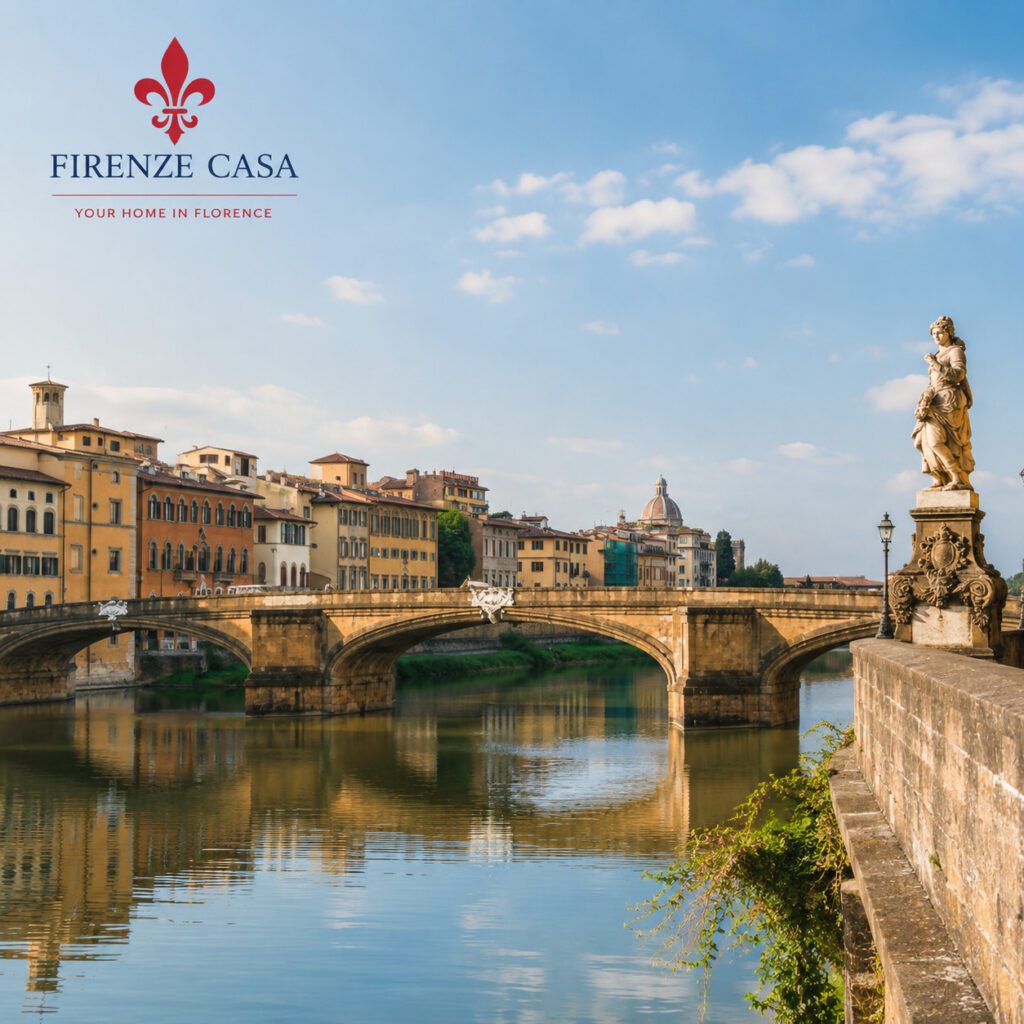
Ponte Santa Trinita is one of the most elegant bridges in Florence. Stretching across the Arno at the end of Via de’ Tornabuoni, its graceful arches connect the historic centre with the Oltrarno while offering one of the finest views of Ponte Vecchio.
Yet the beauty visitors see today hides a turbulent history. Floods repeatedly destroyed earlier bridges on this site, and German forces blew up Bartolomeo Ammannati’s Renaissance bridge during their retreat from Florence in August 1944. Afterwards, Florence reconstructed it with extraordinary care, recovering original stones from the Arno and consulting historical documentation throughout the rebuilding process.
When the bridge reopened in 1958, it became both a restored Renaissance masterpiece and a symbol of Florence’s determination to recover its architectural heritage after the Second World War.
Location: Between Via de’ Tornabuoni and the Oltrarno
Architect: Bartolomeo Ammannati
Renaissance bridge: 1567–1569
Destroyed: August 1944
Reopened: 16 March 1958
Known for: Three elegant arches and the Four Seasons statues
Best view: Ponte Vecchio looking east
Nearby: Basilica di Santa Trinita, Via de’ Tornabuoni, Santo Spirito and San Frediano
Why Ponte Santa Trinita Is Special
Florence has several historic bridges, but each has a very different character. Ponte Vecchio attracts attention through its shops, medieval structure and Vasari Corridor, while Ponte alle Grazie preserves the location of an important medieval crossing even though the present bridge is modern. Meanwhile, Ponte alla Carraia reflects centuries of commercial movement across the Arno.
Ponte Santa Trinita, however, stands apart because of its architectural refinement. Its three sweeping arches appear remarkably light and shallow, and instead of dominating the river, the bridge seems to stretch elegantly across it.
As a result, this combination of engineering and visual harmony makes the crossing one of the most accomplished bridges of Renaissance Florence.
For the wider story of the city’s crossings, see our Bridges of Florence – Complete Guide.
Ponte Santa Trinita is one of the best places in Florence to photograph Ponte Vecchio. Walk onto the bridge in the late afternoon and look east along the Arno as the historic bridge and riverside buildings catch the warmer light.
A Bridge at the End of Via de’ Tornabuoni
Location is essential to understanding Ponte Santa Trinita. On the northern bank, the bridge meets Via de’ Tornabuoni, historically one of Florence’s most prestigious streets.
This part of the city is dominated by monumental palaces, including Palazzo Strozzi, while Palazzo Spini Feroni stands close to the river. Moreover, the architecture reflects the wealth of families who shaped Florentine banking, politics and patronage.
Across the Arno, the bridge leads directly towards the Oltrarno and the neighbourhoods around Santo Spirito and San Frediano.
Therefore, Ponte Santa Trinita has never been an isolated architectural object. Instead, it forms part of an important urban route linking wealthy central Florence with neighbourhoods south of the Arno.
The First Ponte Santa Trinita
The history of the crossing began centuries before Ammannati created the bridge we recognise today. Florentines built a wooden bridge here during the thirteenth century, traditionally associated with the influential Frescobaldi family.
The crossing took its name from the nearby Basilica di Santa Trinita on the northern side of the Arno.
Like other early Florentine bridges, however, it faced a formidable enemy: the river itself. The Arno repeatedly flooded and damaged bridges throughout medieval Florence. Consequently, the city had to rebuild, strengthen or replace its crossings several times.
A River That Refused to Be Controlled
Modern Florence can make the Arno look surprisingly calm, but historically it was anything but predictable. During periods of heavy rainfall across the river basin, the water level could rise rapidly and place enormous pressure on medieval bridges.
In addition, rushing water and debris carried downstream could overwhelm structures within a short period. The history of Florence’s bridges is therefore also a history of destruction and reconstruction.
Several Florentine bridges occupy ancient crossing points but are much younger than their locations. Floods repeatedly destroyed earlier structures, forcing Florence to rebuild its connections across the river.
The Flood of 1557
A particularly destructive flood struck Florence in 1557. The existing bridge at Santa Trinita could not withstand the force of the Arno, and the river swept it away.
By this period, Florence had changed profoundly. Cosimo I de’ Medici had consolidated political power, and the city had become the centre of a territorial state. At the same time, architecture increasingly expressed ducal authority and ambition.
Therefore, the replacement bridge could become much more than simple infrastructure. It would also be a statement about the Florence of the Medici.
Bartolomeo Ammannati and the Renaissance Bridge
The task of creating the new bridge eventually went to Bartolomeo Ammannati, one of the important architects and sculptors working in sixteenth-century Florence.
Ammannati had already participated in major Medici projects, including work at Palazzo Pitti. At Santa Trinita, however, he faced a difficult challenge: the bridge had to withstand the Arno while remaining elegant enough for one of Florence’s most prominent urban locations.
Ultimately, his resulting structure solved both problems beautifully and became one of the most admired bridges of the Renaissance.
The Extraordinary Arches
The most distinctive feature of Ponte Santa Trinita is its three flattened arches. While the central arch spans the widest part of the river, the two outer arches connect it gracefully with the banks.
Their curves are unusually shallow compared with conventional semicircular arches, thereby reducing the visual mass of the structure and creating its characteristic horizontal elegance.
Consequently, viewed from Ponte Vecchio or the Lungarni, Ponte Santa Trinita appears almost to float above the water.
Engineering Becomes Architecture
This is what makes the bridge so important. A bridge must first function structurally, carrying people and goods while resisting the forces created by the river below.
Nevertheless, Ammannati transformed that engineering requirement into architecture through proportion, rhythm and carefully calculated curvature.
As a result, the design works so successfully that visitors rarely think first about structural engineering. Instead, they simply experience the bridge as beautiful.
Ponte Santa Trinita demonstrates an essential Renaissance idea: practical engineering and artistic beauty did not have to be separate. Ammannati turned a necessary river crossing into a carefully proportioned architectural composition.
Was Michelangelo Involved in Ponte Santa Trinita?
The question of Michelangelo’s influence often appears in discussions of the bridge. Tradition has long associated him with advice concerning the design of its unusually sophisticated curves, but Bartolomeo Ammannati remains the architect directly associated with Ponte Santa Trinita.
Therefore, describing Michelangelo as the bridge’s designer would go beyond the historical evidence.
Nevertheless, the broader connection is interesting. Ammannati belonged to the same remarkable Florentine architectural culture that included Michelangelo, Vasari and other artists working for the Medici.
In this context, Ponte Santa Trinita emerged from an environment of intense experimentation in architecture, sculpture and engineering.
The Four Seasons of Ponte Santa Trinita
The bridge gained another important feature in the early seventeenth century. In 1608, four allegorical sculptures representing the Four Seasons appeared at its entrances.
The figures represent:
- Spring – Primavera
- Summer – Estate
- Autumn – Autunno
- Winter – Inverno
However, the statues provide more than decoration. Their placement visually anchors the ends of the bridge and adds sculpture to Ammannati’s architectural design.
Look at the Statues Before Crossing
Many visitors walk directly onto Ponte Santa Trinita because they want to photograph Ponte Vecchio. Before doing so, however, stop at either end and look at the Four Seasons.
In a city filled with monumental sculpture, visitors can easily overlook these figures, yet they belong directly to the identity of the bridge.
Moreover, the statues play a central role in one of Ponte Santa Trinita’s most memorable twentieth-century stories.
The Night Ponte Santa Trinita Was Destroyed
During the final phase of the Second World War, Florence became caught between retreating German troops and advancing Allied forces.
Florentine memory knows the night between 3 and 4 August 1944 as the Night of the Bridges. German forces demolished the principal bridges across the Arno in an effort to hinder the Allied advance.
Although Ponte Vecchio remained standing, demolitions devastated buildings around its entrances. Ponte Santa Trinita, by contrast, did not share the same fate.
Instead, explosives shattered Ammannati’s Renaissance bridge and sent much of its masonry into the Arno.
A Renaissance Masterpiece Disappears
The destruction caused particular pain because Ponte Santa Trinita represented far more than useful infrastructure. For centuries, the bridge had formed part of Florence’s architectural identity.
After the explosions, therefore, residents encountered an altered cityscape where Ammannati’s graceful arches had once crossed the river.
The destruction of Florence’s bridges changed the city overnight. Ponte Santa Trinita became one of the most important architectural losses, while wartime demolitions forced thousands of residents near the Arno from their homes.
Rebuilding Ponte Santa Trinita
After the war, Florence faced difficult decisions about reconstruction. A temporary crossing could reconnect the two banks quickly, but recreating a Renaissance masterpiece required something entirely different.
Ultimately, Florentines decided to reconstruct Ponte Santa Trinita according to its historic form.
In 1947, a committee began coordinating the reconstruction. As a result, the project became an extraordinary exercise in architectural archaeology, engineering and craftsmanship.
Recovering Stones from the Arno
Material from the destroyed bridge remained in and around the river. Wherever possible, workers recovered original stones, while architects closely studied the proportions and construction of Ammannati’s design.
In addition, historical photographs, drawings and surviving evidence helped guide the work.
The aim was not to create a vaguely Renaissance-inspired replacement. Instead, Florence wanted its bridge back.
“Where It Was and As It Was”
The reconstruction followed the principle often summarised by the Italian expression dov’era e com’era – where it was and as it was.
Consequently, recreating the bridge required builders to reproduce the distinctive curves that gave Ponte Santa Trinita its identity. Rather than introducing a modern interpretation, the project revived Ammannati’s architectural form.
Finally, Florence inaugurated the restored bridge on 16 March 1958.
Rebuilding Ponte Santa Trinita became an act of cultural recovery. Florentines were not simply replacing a transport link; they were restoring a familiar part of the city’s Renaissance skyline.
The Missing Head of Primavera
One of the most memorable stories connected with the reconstruction concerns the statue of Spring, or Primavera.
Although the Four Seasons returned to the reconstructed bridge, Primavera was missing her head. Most of the sculpture had survived, yet searches initially failed to locate the missing fragment.
For several years, therefore, the lost head became something of a Florentine mystery.
Found in the Arno
The search continued even after the bridge reopened. Finally, in 1961, searchers recovered Primavera’s missing head from the bed of the Arno and reunited it with the sculpture.
Thus, the episode provides a wonderfully human detail within the much larger reconstruction project.
When Ponte Santa Trinita reopened in 1958, Primavera was still missing her head. Searchers finally discovered the lost fragment in the Arno in 1961 and returned it to the statue.
Ponte Santa Trinita and Ponte Vecchio
The relationship between the two neighbouring bridges creates one of Florence’s most beautiful urban compositions.
From Ponte Santa Trinita, Ponte Vecchio appears downstream with its shops projecting over the water and the Vasari Corridor crossing above them.
Meanwhile, looking back from Ponte Vecchio, visitors can appreciate Ammannati’s bridge as an architectural object in its own right.
| Ponte Santa Trinita | Ponte Vecchio |
|---|---|
| Renaissance elegance | Medieval character |
| Open stone bridge | Bridge lined with shops |
| Celebrated for graceful arches | Celebrated for its unique built environment |
| Destroyed in 1944 and reconstructed | Bridge structure survived 1944 |
| One of the best viewpoints for Ponte Vecchio | One of Florence’s most famous landmarks |
Walking from one bridge to the other takes only a few minutes. Nevertheless, the short distance spans very different periods of Florentine architectural history.
The Best View of Ponte Vecchio
For many travellers, the most practical reason to visit Ponte Santa Trinita is also the simplest: the view.
From near the centre of the bridge, look east. Ponte Vecchio sits across the Arno, framed by riverside façades, while reflections from buildings and sky create constantly changing colours on the water.
Best Time for Photography
Late afternoon is particularly attractive because warmer light can illuminate the historic riverside buildings. Around sunset, moreover, beautiful skies often complement the scene, although popular travel periods naturally bring larger crowds.
By contrast, early morning offers quieter streets, less activity along the Lungarni and often a more peaceful river.
Do not stand only in the exact centre of Ponte Santa Trinita. Move several metres north or south and compare the angle towards Ponte Vecchio. Small changes in position can produce very different compositions.
The View West Along the Arno
Most visitors instinctively turn towards Ponte Vecchio, but it is worth looking west as well.
In this direction, the Arno opens towards Ponte alla Carraia and the less monumental western stretches of Florence. Riversides, palaces and reflections create a quieter urban panorama.
Moreover, this perspective helps visitors understand how Ponte Santa Trinita forms part of a sequence of crossings rather than standing alone.
Continuing west brings you towards San Frediano, one of Florence’s historic artisan quarters and an area with a very different atmosphere from the streets surrounding Ponte Vecchio.
Santa Trinita Church and the Bridge
The bridge takes its name from the nearby Basilica di Santa Trinita.
Located just off Via de’ Tornabuoni near the northern approach to the bridge, the church has deep connections with important Florentine families.
Moreover, its chapels preserve major works of Renaissance art, while the building itself represents centuries of religious and architectural history.
Therefore, the name Ponte Santa Trinita reflects the religious geography of medieval and Renaissance Florence rather than simply serving as a convenient modern label.
From Church to Oltrarno
The bridge creates a natural walking axis. Begin around Santa Trinita and Via de’ Tornabuoni, cross the Arno and then continue into the Oltrarno.
Within a short distance, the character of Florence changes noticeably. Prestigious shopping streets give way to smaller streets, residential buildings and routes towards Santo Spirito.
Via de’ Tornabuoni and the World of Florentine Wealth
The northern entrance to Ponte Santa Trinita connects directly with one of Florence’s most prestigious urban environments.
Via de’ Tornabuoni has long been associated with powerful families and monumental palaces. During the Renaissance, moreover, this part of the city reflected the wealth of families who shaped Florentine banking, politics and patronage.
Only a short walk away, Palazzo Strozzi is one of the clearest expressions of that world. Its enormous rusticated façade demonstrates how family prestige could be translated into monumental urban architecture.
Palazzo Spini Feroni
Close to the bridge stands Palazzo Spini Feroni, one of the striking historic buildings overlooking this part of the Arno.
Its powerful façade demonstrates how elite residences helped shape the urban approaches to Florence’s bridges.
Consequently, Ponte Santa Trinita connects not only two riverbanks but also important architectural environments on both sides of the Arno.
Crossing into Santo Spirito
The southern end of Ponte Santa Trinita provides an excellent entrance into the wider Oltrarno.
From here, continue south and the streets gradually lead towards Santo Spirito, a neighbourhood shaped by Brunelleschi’s basilica, artisan traditions and one of Florence’s most characteristic piazzas.
This change of atmosphere is one of the pleasures of crossing the Arno. Within only a few minutes, visitors can therefore move from the monumental palaces and luxury shops of Via de’ Tornabuoni into a more residential part of Florence.
Ponte Santa Trinita as Part of a Florence Bridge Walk
The bridge works beautifully as part of a longer exploration of the Arno.
For example, one particularly rewarding route begins at Ponte alla Carraia and continues east, combining architecture, photography and neighbourhood exploration without requiring long distances.
- Ponte alla Carraia – Begin with views towards the historic centre.
- Ponte Santa Trinita – Stop for the classic Ponte Vecchio panorama.
- Ponte Vecchio – Explore the famous shops and Vasari Corridor.
- Ponte alle Grazie – Continue east and look back towards Ponte Vecchio.
- Ponte San Niccolò – Finish farther east near the quieter Oltrarno and southern hills.
Cross Ponte Santa Trinita into the Oltrarno, explore a few streets around Santo Spirito and return north across Ponte Vecchio. The small loop combines two extraordinary bridges with two very different sides of Florence.
Ponte Santa Trinita at Night
The bridge changes character after sunset. Artificial light reflects from the Lungarni and neighbouring buildings, while illumination transforms Ponte Vecchio downstream.
Meanwhile, most visitors concentrate around Ponte Vecchio, leaving parts of Ponte Santa Trinita comparatively calm outside peak periods.
For an evening walk after dinner, this stretch of the Arno is therefore particularly rewarding. River reflections, historic architecture and illuminated bridges combine to create one of central Florence’s most atmospheric nighttime scenes.
What to Notice on Ponte Santa Trinita
The bridge rewards closer observation. Before crossing, notice the Four Seasons standing at its corners, then look at the remarkably shallow profile of the arches from the Lungarno rather than only from the bridge itself.
Once on the crossing, compare the east and west views.
Finally, turn towards Via de’ Tornabuoni and then towards the Oltrarno. By seeing both directions, it becomes easier to understand the bridge as part of an urban axis rather than simply as a viewpoint.
Five Details Worth Looking For
- The unusually flattened Renaissance arches.
- The four allegorical statues representing the seasons.
- The perspective towards Ponte Vecchio.
- The architectural relationship with Via de’ Tornabuoni.
- The change in urban atmosphere as you cross towards the Oltrarno.
Ponte Santa Trinita and the Arno Floods
The history of the bridge cannot be separated from the history of the Arno.
Floods repeatedly destroyed earlier crossings and eventually created the circumstances in which Ammannati’s Renaissance bridge emerged. Its elegance is impressive, but it also represents a response to one of Florence’s persistent environmental challenges.
Nevertheless, the Arno continued to threaten the city after the Renaissance. During the catastrophic flood of 1966, the river once again demonstrated its destructive potential, while the reconstructed Ponte Santa Trinita endured the disaster.
Standing on the bridge today, visitors may find it difficult to imagine the calm-looking river rising dramatically through Florence. History, however, repeatedly proves otherwise.
From Destruction to Symbol of Resilience
Ponte Santa Trinita has survived in two different senses.
Although wartime explosives destroyed the physical Renaissance structure, its design, proportions and visual identity survived because Florence chose to reconstruct them.
This raises an interesting question about historic architecture: is a faithfully reconstructed monument still the same monument?
In Florence, the answer came through action. The city recovered the bridge’s form, reused surviving material and restored the crossing to its historical setting.
Consequently, Ponte Santa Trinita represents both Renaissance creativity and twentieth-century preservation.
What you see today combines Ammannati’s sixteenth-century architectural idea with Florence’s twentieth-century reconstruction. That double identity is one of the most fascinating things about Ponte Santa Trinita.
Ponte Santa Trinita at a Glance
| Feature | What to Know |
|---|---|
| Location | Between Via de’ Tornabuoni and the Oltrarno |
| Architect | Bartolomeo Ammannati |
| Renaissance bridge | 1567–1569 |
| Main architectural feature | Three unusually shallow arches |
| Sculptures | Four Seasons, installed in 1608 |
| Destroyed | August 1944 |
| Reconstructed | Post-war period |
| Reopened | 16 March 1958 |
| Best view | Ponte Vecchio looking east |
| Nearby | Santa Trinita, Via de’ Tornabuoni, Santo Spirito and San Frediano |
Frequently Asked Questions About Ponte Santa Trinita
Where is Ponte Santa Trinita in Florence?
Ponte Santa Trinita crosses the Arno immediately south of Via de’ Tornabuoni. In addition, it lies only one bridge west of Ponte Vecchio and connects the historic centre with the Oltrarno.
Who designed Ponte Santa Trinita?
Bartolomeo Ammannati designed the famous Renaissance bridge after flooding destroyed an earlier crossing in the sixteenth century.
Why is Ponte Santa Trinita famous?
Its elegant Renaissance arches, Four Seasons statues and exceptional view towards Ponte Vecchio make Ponte Santa Trinita one of Florence’s most distinctive bridges.
Is Ponte Santa Trinita original?
German forces destroyed the Renaissance bridge during the Second World War in 1944. Afterwards, Florence reconstructed it according to Ammannati’s historic design and reused recovered original material wherever possible.
When was Ponte Santa Trinita rebuilt?
Florence inaugurated the reconstructed bridge on 16 March 1958 after a major post-war recovery project.
What are the statues on Ponte Santa Trinita?
Four statues represent Spring, Summer, Autumn and Winter. They have decorated the bridge since the early seventeenth century.
What happened to the Primavera statue?
Primavera lost her head during the wartime destruction. Although the bridge reopened before the fragment was found, searchers eventually recovered it from the Arno in 1961.
Which bridge has the best view of Ponte Vecchio?
Ponte Santa Trinita generally offers the finest central Florence viewpoint for the classic photograph of Ponte Vecchio across the Arno.
What is the best time to visit Ponte Santa Trinita?
Early morning offers a quieter atmosphere, while late afternoon and sunset provide particularly attractive light towards Ponte Vecchio.
What can I visit near Ponte Santa Trinita?
On the northern side, you can visit the Basilica di Santa Trinita, Via de’ Tornabuoni and Palazzo Strozzi. After crossing into the Oltrarno, meanwhile, Santo Spirito and San Frediano are easy to explore on foot.
Why Ponte Santa Trinita Deserves More Than a Photograph
Many visitors arrive at Ponte Santa Trinita for one reason: to photograph Ponte Vecchio. The view certainly justifies the stop, yet concentrating only on the bridge downstream means overlooking the monument beneath your feet.
Its medieval predecessors reveal the city’s dependence on the Arno, while the flood of 1557 demonstrates the river’s destructive force. Moreover, Ammannati’s design represents Renaissance confidence in engineering and proportion, while the Four Seasons bring sculpture into the architectural composition.
Centuries later, the destruction of 1944 turned the bridge into a wartime casualty. Its reconstruction, however, demonstrated Florence’s determination to recover an essential part of its historic cityscape.
The bridge also forms an extraordinary urban connection. To the north lie Santa Trinita, Via de’ Tornabuoni and the monumental world of Florence’s great palaces. Once you cross south, however, within minutes you enter the streets of Santo Spirito and San Frediano.
So take the photograph of Ponte Vecchio, but then turn around and look at the bridge itself. Ponte Santa Trinita has one of the most remarkable stories of any crossing in Florence.
Further Reading on Firenze Casa
- Bridges of Florence – Complete Guide
- The History of Ponte Vecchio – Florence’s Most Famous Bridge
- Ponte alle Grazie – Florence’s Historic Arno Bridge
- Ponte alla Carraia – Florence’s Historic Arno Bridge
- Ponte San Niccolò – Florence’s Eastern Arno Bridge
- Basilica di Santa Trinita – Renaissance Art in Florence
- Palazzo Strozzi – Renaissance Palace of a Powerful Florentine Family
- Santo Spirito – Florence’s Historic Oltrarno Quarter
- San Frediano – Florence’s Historic Artisan Quarter
References
- Gallerie degli Uffizi – Historical resources on Ponte Santa Trinita and Florence’s wartime destruction.
- Comune di Firenze – Historical and cultural heritage resources on Florence and the Arno.
- Feel Florence – Historical information on the bridges of Florence.
- Historical studies on Bartolomeo Ammannati and Renaissance architecture in Florence.
- Architectural studies concerning the reconstruction of Ponte Santa Trinita after the Second World War.

