
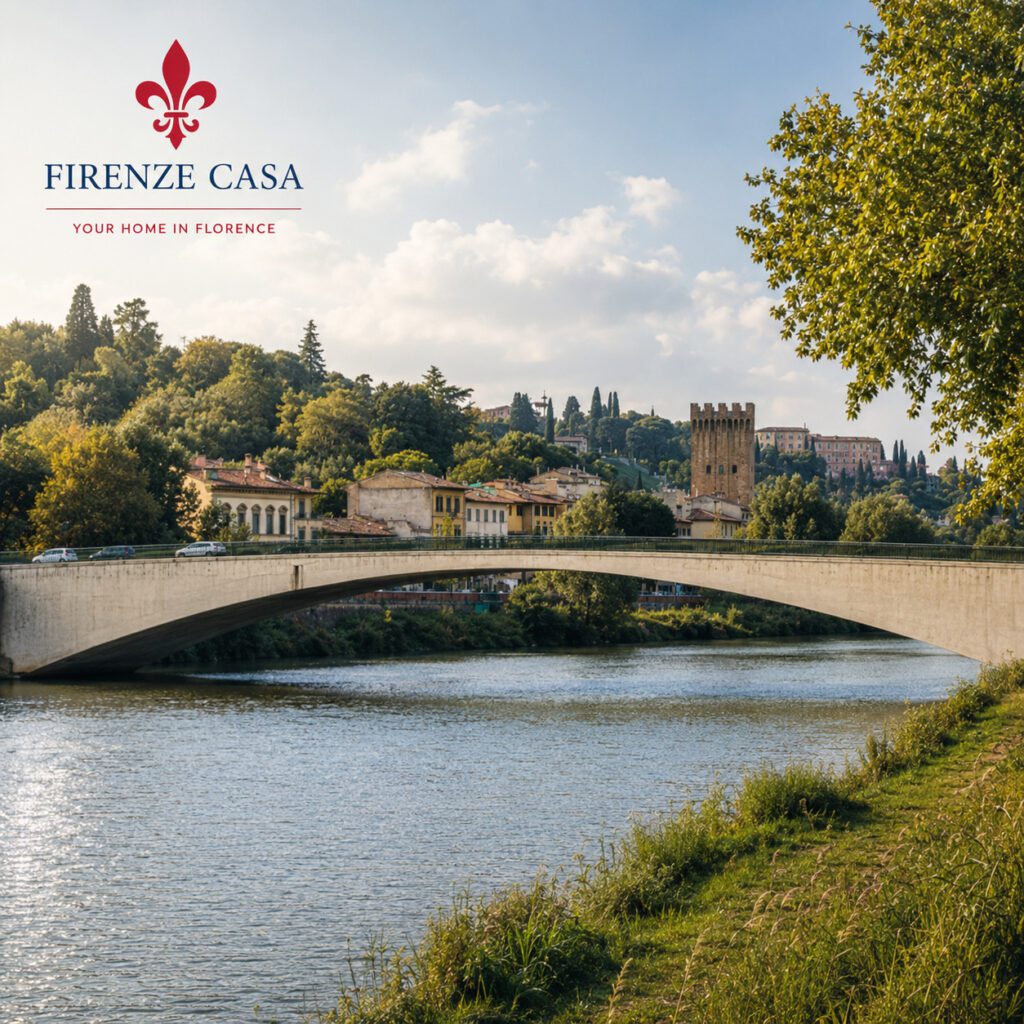
Ponte San Niccolò crosses the Arno at the eastern edge of central Florence. Connecting the city with the historic neighbourhood of San Niccolò, its story differs considerably from that of Ponte Vecchio or Ponte Santa Trinita. Rather than beginning in the Middle Ages, the crossing reflects the transformation of Florence during the nineteenth and twentieth centuries.
The first permanent bridge at this location was a nineteenth-century suspension bridge. Later structures replaced it as Florence expanded and traffic increased. Then, in August 1944, retreating German forces destroyed the bridge along with most other crossings over the Arno.
Today’s Ponte San Niccolò is therefore a modern bridge at a historic crossing point. Its location also makes it an excellent starting point for exploring San Niccolò, the eastern Arno and the route towards Piazzale Michelangelo.
Location: Eastern side of central Florence
Historic origin: 19th century
Earlier name: Ponte di San Ferdinando
Original design: Suspension bridge
Destroyed: August 1944
Present bridge: Post-war structure
Best for: Eastern Arno views, modern Florence and access to San Niccolò
Nearby: Porta San Niccolò, Piazzale Michelangelo and San Miniato al Monte
Where Is Ponte San Niccolò?
Ponte San Niccolò crosses the Arno east of Florence’s historic centre. On the northern bank, it connects with the avenues leading towards Piazza Beccaria. On the southern side, meanwhile, it reaches the area below the hills of San Miniato and the historic San Niccolò neighbourhood.
This position gives the bridge a distinctive character. The dense monumental centre lies to the west, while the landscape gradually opens towards the eastern outskirts of Florence.
For visitors, the location is particularly useful. From here, you can enter San Niccolò, walk towards the medieval Porta San Niccolò or begin the climb towards Piazzale Michelangelo and San Miniato al Monte.
For the wider story of the city’s historic crossings, see our Bridges of Florence – Complete Guide.
Ponte San Niccolò tells a different story from Florence’s Renaissance bridges. It belongs to the period when the city expanded beyond its old walls and began adapting to the demands of modern urban life.
A Bridge Outside Medieval Florence
For much of Florence’s history, there was no permanent bridge at the present location of Ponte San Niccolò. Medieval and Renaissance Florence concentrated its principal crossings farther west, where the urban centre developed around Ponte Vecchio and the bridges nearby.
The eastern part of the city had a different character. Medieval walls, gates, riverbanks and surrounding countryside shaped movement through this area. Porta San Niccolò still survives as an impressive reminder of that landscape.
By the nineteenth century, however, Florence was changing. Population growth, economic development and expanding road networks created a need for additional crossings of the Arno.
Ponte San Niccolò is much younger than Florence’s famous medieval bridges. Its history reflects the expansion of the modern city rather than the commercial world of medieval Florence.
The Ponte di San Ferdinando
The first major permanent bridge at this location was known as Ponte di San Ferdinando. It was constructed during the nineteenth century, when suspension bridges represented an innovative approach to bridge engineering.
The structure differed dramatically from Florence’s traditional masonry bridges. Instead of massive stone arches rising from the Arno, the new crossing used iron suspension technology.
This was a visible sign that Florence was entering a new technological era. Industrial materials and modern engineering increasingly appeared alongside the medieval and Renaissance architecture for which the city was famous.
Furthermore, the bridge improved connections between areas on opposite sides of the eastern Arno. As Florence continued to grow, such infrastructure became increasingly important.
A Suspension Bridge Across the Arno
The nineteenth-century suspension bridge must have looked striking to contemporary Florentines. The city’s older crossings relied on stone arches, while this structure used a lighter engineering system associated with the Industrial Revolution.
Suspension bridges could span waterways with fewer massive supports in the river. They also demonstrated the growing possibilities offered by iron construction.
However, Florence’s transportation needs continued to evolve. Increasing traffic eventually demanded a stronger and more practical crossing. Consequently, the original suspension bridge did not survive as the permanent solution for this part of the city.
The early bridge at San Niccolò represented something unusual in Florence: modern industrial engineering inserted into a city dominated by stone architecture. It was a visible symbol of nineteenth-century change.
Florence Becomes the Capital of Italy
The wider transformation of this area accelerated during the nineteenth century. Florence became capital of the Kingdom of Italy in 1865 and remained so until 1871.
Those few years brought enormous urban changes. Architect Giuseppe Poggi developed an ambitious programme to modernise Florence. Much of the old city wall on the northern side disappeared, while broad avenues replaced sections of the medieval fortifications.
South of the Arno, Poggi created the celebrated Viale dei Colli. This landscaped route climbed through the hills and included Piazzale Michelangelo, opening a new panoramic perspective over Florence.
Ponte San Niccolò stood close to this rapidly changing urban landscape. Therefore, the crossing became part of a broader network linking the expanding city with the hills south of the Arno.
This transformation forms part of the fascinating period explored in our guide to Florence as Capital of Italy – Firenze Capitale 1865–1871.
San Niccolò and the Medieval City
The bridge takes its present name from the San Niccolò area on the southern side of the river. Despite later urban development, this neighbourhood preserves a strong connection with medieval Florence.
The most visible landmark is Porta San Niccolò. Built in the fourteenth century, the tall defensive gate once formed part of Florence’s city walls. Unlike many other gates, much of its original height survives.
Nearby streets retain a more intimate character than many parts of the central tourist district. Small restaurants, workshops and residential buildings sit below the steep hills leading towards Piazzale Michelangelo.
Crossing Ponte San Niccolò therefore creates an interesting transition. Within a few minutes, visitors can move from nineteenth- and twentieth-century infrastructure into a neighbourhood with distinctly medieval roots.
After crossing the bridge towards the southern bank, look for the tall medieval tower of Porta San Niccolò. It is one of the most impressive surviving elements of Florence’s former defensive walls.
The Arno and the Changing City
Florence has always had a complicated relationship with the Arno. The river provided water, supported industry and helped shape commercial life. At the same time, severe floods repeatedly damaged buildings, streets and bridges.
By the nineteenth century, engineers and city planners increasingly sought to control the river and improve the infrastructure along its banks. New embankments and roads gradually changed the appearance of the Lungarni.
Ponte San Niccolò belongs to this period of transformation. Its development cannot be separated from Florence’s evolution from a compact historic city into a larger modern urban centre.
The Second World War Reaches the Arno
The most destructive moment in the history of Ponte San Niccolò came during the Second World War. In the summer of 1944, Allied troops advanced towards Florence while German forces prepared to withdraw northwards.
The bridges across the Arno had enormous strategic importance. Destroying them could slow the Allied advance and disrupt movement through the city.
During the night of 3–4 August 1944, retreating German forces demolished most of Florence’s bridges. Ponte San Niccolò was among the crossings destroyed.
Ponte Santa Trinita, Ponte alla Carraia and Ponte alle Grazie also disappeared. Ponte Vecchio survived, although surrounding streets and buildings suffered extensive destruction.
The destruction of Florence’s bridges severed connections that had shaped the city for generations. After liberation, restoring crossings over the Arno became one of the most urgent tasks of reconstruction.
Rebuilding Ponte San Niccolò
Post-war Florence faced a difficult challenge. The city needed functioning bridges quickly, but reconstruction also raised questions about architecture and historical identity.
Some bridges received meticulous historical reconstructions. Ponte Santa Trinita is the most famous example. Elsewhere, Florence chose modern designs rather than attempting to recreate earlier structures.
Ponte San Niccolò followed the modern approach. The present bridge was constructed after the war to meet contemporary transportation needs. Its appearance therefore differs fundamentally from the nineteenth-century suspension bridge that once crossed the river here.
This makes Ponte San Niccolò an interesting example of post-war Florence. The crossing remained historic, but its architecture acknowledged a new period.
The Ponte San Niccolò We See Today
Today’s bridge is functional and comparatively restrained. It carries vehicles, cyclists and pedestrians across the eastern Arno and remains an important part of Florence’s road network.
Visitors accustomed to Ponte Vecchio may initially find Ponte San Niccolò architecturally modest. Yet its value lies partly in this contrast. Florence is not a city frozen in the Renaissance.
Modern infrastructure exists beside medieval towers, Renaissance churches and nineteenth-century boulevards. Ponte San Niccolò makes that layering particularly easy to see.
Views from Ponte San Niccolò
One of the best reasons to cross Ponte San Niccolò is the changing perspective it offers along the Arno. Looking west brings the historic centre into view, while the eastern direction reveals a more open river landscape.
The surrounding hills also become increasingly prominent from this part of Florence. Consequently, the bridge creates a visual transition between the dense city and the Tuscan landscape beyond it.
Early morning can be especially attractive. Softer light, quieter streets and reflections on the Arno give the eastern riverfront a different atmosphere from the busier central bridges.
Do not photograph only the bridge itself. From this part of the Arno, the combination of river, medieval San Niccolò, the surrounding hills and the distant historic centre often creates the more interesting composition.
From Ponte San Niccolò to Piazzale Michelangelo
Ponte San Niccolò is an excellent starting point for a walk towards one of Florence’s most famous viewpoints. After crossing to the southern bank, continue towards Porta San Niccolò and the base of the hillside.
From there, paths and streets climb towards Piazzale Michelangelo. The ascent requires some effort, but the changing views make the walk worthwhile.
Piazzale Michelangelo offers one of the classic panoramas of Florence. The Duomo, Palazzo Vecchio, Santa Croce and the bridges of the Arno spread across the city below.
Those with additional time can continue uphill to San Miniato al Monte. The Romanesque basilica and its surroundings provide another remarkable perspective over Florence.
Combine Ponte San Niccolò with Porta San Niccolò, Piazzale Michelangelo and San Miniato al Monte. Together, they create one of the most rewarding walks on the eastern side of Florence.
Ponte San Niccolò and Florence’s Other Bridges
Florence’s bridges reveal different periods of the city’s development. Ponte San Niccolò becomes particularly interesting when compared with the older crossings farther west.
| Bridge | Historical Character | What Makes It Interesting |
|---|---|---|
| Ponte Vecchio | Medieval | Historic shops and survival during the destruction of 1944 |
| Ponte Santa Trinita | Renaissance | Elegant design associated with Bartolomeo Ammannati |
| Ponte alla Carraia | Medieval origins | Centuries of destruction and reconstruction |
| Ponte alle Grazie | Medieval crossing, modern bridge | Historic site with a twentieth-century structure |
| Ponte San Niccolò | 19th-century origins | Suspension-bridge history and modern urban expansion |
Together, these crossings form an architectural timeline along the Arno. Walking between them reveals how Florence continually adapted its river crossings to changing political, technological and economic circumstances.
Why Ponte San Niccolò Is Different
Most visitors come to Florence expecting medieval streets and Renaissance architecture. Ponte San Niccolò introduces another layer of the city’s history.
Its story begins with nineteenth-century engineering rather than medieval merchants. The bridge then became part of the expanding modern city before war destroyed it in 1944. Finally, post-war reconstruction created the crossing used today.
Few places illustrate Florence’s transition into the modern age quite so clearly. The bridge may not be a Renaissance masterpiece, but historically it helps complete the story of the city.
A Walk Along the Eastern Arno
Visitors who enjoy walking can use Ponte San Niccolò as part of a longer route along the river. Begin near Santa Croce and follow the Lungarno eastwards. As you leave the busiest part of the centre, the streets gradually become quieter.
Cross Ponte San Niccolò and enter the San Niccolò neighbourhood on the southern bank. From here, you can explore the streets around Porta San Niccolò before deciding whether to climb towards Piazzale Michelangelo.
Alternatively, turn west after crossing and follow the southern bank back towards central Florence. This route eventually leads towards Ponte alle Grazie and Ponte Vecchio.
The eastern Arno generally feels less crowded than the area around Ponte Vecchio. It is a good choice when you want to experience Florence at a slower pace while remaining within walking distance of the historic centre.
Ponte San Niccolò at a Glance
| Feature | What to Know |
|---|---|
| Location | Eastern side of central Florence |
| Historical origin | 19th century |
| Earlier name | Ponte di San Ferdinando |
| Original design | Suspension bridge |
| Historical importance | Modern engineering and the expansion of nineteenth-century Florence |
| Destroyed | August 1944 |
| Present bridge | Post-war structure |
| Best combined with | San Niccolò, Piazzale Michelangelo and San Miniato al Monte |
| Suggested time | About 10 minutes for the bridge itself or one to two hours as part of a longer walk |
Interesting Facts About Ponte San Niccolò
- The crossing is considerably younger than Florence’s medieval bridges.
- Its nineteenth-century predecessor was a suspension bridge.
- The earlier crossing was known as Ponte di San Ferdinando.
- Its development reflects the expansion of Florence during the modern era.
- The surrounding city changed dramatically when Florence became capital of Italy between 1865 and 1871.
- Porta San Niccolò stands close to the southern end of the bridge.
- The bridge was destroyed during the German retreat in August 1944.
- The present structure is a post-war bridge.
- Its location provides convenient access to the route towards Piazzale Michelangelo.
- It is an excellent starting point for exploring the quieter eastern section of the Arno.
Frequently Asked Questions
Where is Ponte San Niccolò?
Ponte San Niccolò crosses the Arno on the eastern side of central Florence. It connects the northern part of the city with the San Niccolò area below Piazzale Michelangelo.
Is Ponte San Niccolò a medieval bridge?
No. Unlike Ponte Vecchio and several other historic Florentine crossings, Ponte San Niccolò has nineteenth-century origins.
What was the original bridge called?
The nineteenth-century crossing was known as Ponte di San Ferdinando. It was notable for its suspension-bridge construction.
Was Ponte San Niccolò destroyed during the Second World War?
Yes. Retreating German forces destroyed the bridge in August 1944, together with most of Florence’s other bridges across the Arno.
Is the bridge standing today the original one?
No. The present Ponte San Niccolò is a post-war structure built after the destruction of the earlier crossing.
Can you walk from Ponte San Niccolò to Piazzale Michelangelo?
Yes. The bridge provides an excellent approach to San Niccolò and the routes climbing towards Piazzale Michelangelo. From there, you can continue to San Miniato al Monte.
Is Ponte San Niccolò worth visiting?
Yes, especially when combined with other sights in eastern Florence. Its history, views and proximity to Porta San Niccolò make it an interesting stop on a longer walk.
Why Ponte San Niccolò Is Worth Visiting
Ponte San Niccolò does not compete with Ponte Vecchio for fame or with Ponte Santa Trinita for Renaissance elegance. Its significance lies elsewhere. The bridge tells the story of Florence becoming a modern European city.
A nineteenth-century suspension bridge once demonstrated new engineering possibilities here. Later, expanding traffic and urban development changed the crossing. War then destroyed it, forcing Florence to rebuild once again.
The present bridge represents the latest chapter in that continuing story. Cross it and you move between several Florences at once: the modern avenues, medieval San Niccolò, the nineteenth-century landscape around Piazzale Michelangelo and the timeless hills surrounding the city.
Its location also makes the bridge particularly useful for visitors. Rather than treating it as an isolated sight, combine it with San Niccolò, Piazzale Michelangelo and San Miniato al Monte.
That combination makes Ponte San Niccolò more than a practical route across the Arno. It shows that Florence’s history did not end with the Renaissance.
Further Reading on Firenze Casa
- Bridges of Florence – Complete Guide
- The History of Ponte Vecchio – Florence’s Most Famous Bridge
- Ponte Santa Trinita – Florence’s Renaissance Bridge
- Ponte alle Grazie – Florence’s Historic Arno Bridge
- Ponte alla Carraia – Florence’s Historic Arno Bridge
- San Niccolò – Florence’s Historic Riverside Quarter
- Piazzale Michelangelo – The Best View of Florence
- San Miniato al Monte – Florence’s Romanesque Basilica
- Florence as Capital of Italy – Firenze Capitale 1865–1871
References
- Comune di Firenze – Historical resources on the bridges of Florence and the development of the city.
- Feel Florence – Official tourism information from the Municipality and Metropolitan City of Florence.
- UNESCO World Heritage Centre – Historic Centre of Florence.
- Historical studies on the bridges of the Arno and nineteenth-century Florence.
- Architectural studies on Giuseppe Poggi and the urban transformation of Florence during the nineteenth century.
- Historical studies on Florence during the Second World War and the destruction of the Arno bridges in August 1944.
- Architectural and urban studies concerning the post-war reconstruction of Florence.

