

Introduction
The bridges of Florence have connected neighbourhoods, merchants, pilgrims and travellers since ancient times. Over the centuries, they have witnessed devastating floods, political upheaval, Renaissance ambition, nineteenth-century expansion and the destruction of war.
Among them, the Ponte Vecchio is undoubtedly the most famous. Historic goldsmiths’ shops line the crossing, while the remarkable Vasari Corridor passes above it. As a result, the bridge has become one of the world’s most recognisable symbols of Florence.
Yet the city offers much more than this iconic landmark. Ponte Santa Trinita represents Renaissance elegance, while Ponte alle Grazie and Ponte alla Carraia preserve the memory of medieval crossings that changed repeatedly. Farther east, Ponte San Niccolò opens the city towards the hills. Meanwhile, Ponte Amerigo Vespucci and Ponte della Vittoria reveal the expansion of modern Florence towards the west.
Walking from bridge to bridge is therefore one of the best ways to experience the relationship between Florence and the Arno. Each crossing reveals a different panorama of the river, colourful Lungarni, historic palaces and the skyline beyond.
This complete guide explores the history, architecture and stories behind Florence’s most important bridges, from medieval engineering and Renaissance design to wartime destruction and modern reconstruction.

🔍 Click to view the infographic in full size.
Florence Bridges at a Glance
| Bridge | Main Character | Best Reason to Visit |
|---|---|---|
| Ponte Vecchio | Medieval landmark | Historic shops and Vasari Corridor |
| Ponte Santa Trinita | Renaissance elegance | Classic view of Ponte Vecchio |
| Ponte alle Grazie | Historic eastern crossing | Arno views and access to San Niccolò |
| Ponte alla Carraia | Medieval commercial route | Views towards Santa Trinita and the historic centre |
| Ponte San Niccolò | Eastern city bridge | Quieter Arno panoramas and nearby hills |
| Ponte Amerigo Vespucci | Modern central bridge | Western Lungarni and city walks |
| Ponte della Vittoria | Modern western crossing | Connection towards Cascine Park |
📅 Historical Timeline
| Year / Period | Development |
|---|---|
| Roman period | A bridge crosses the Arno in Roman Florentia near the site later occupied by Ponte Vecchio. |
| Early 13th century | Ponte alla Carraia develops as one of the earliest major crossings after Ponte Vecchio. |
| 1237 | The predecessor of Ponte alle Grazie is built and known as Ponte Rubaconte. |
| 1333 | A catastrophic flood destroys major bridges across the Arno. |
| 14th century | Ponte Vecchio takes the form that establishes it as Florence’s principal medieval crossing. |
| 1565 | Giorgio Vasari creates the Vasari Corridor above Ponte Vecchio for Cosimo I de’ Medici. |
| 1567–1569 | Bartolomeo Ammannati creates the celebrated Renaissance Ponte Santa Trinita. |
| 19th–20th centuries | New bridges and redesigned crossings respond to Florence’s expansion beyond its historic centre. |
| 3–4 August 1944 | Retreating German forces destroy Florence’s principal Arno bridges except Ponte Vecchio, while demolitions devastate buildings around both ends of the surviving bridge. |
| Post-war period | Florence undertakes extensive reconstruction of its destroyed bridges. |
| 1950s | Several major crossings return to the Arno, including the reconstructed Ponte Santa Trinita and Ponte alle Grazie. |
| Today | Florence’s historic and modern bridges remain essential transport links, walking routes and viewpoints across the city. |
Why Bridges Were Essential to Florence
Without reliable crossings over the Arno, Florence could never have developed into the prosperous trading city that dominated much of Tuscan economic life during the Middle Ages and Renaissance. The river created both opportunity and difficulty because it supported economic activity while also dividing the growing city.
Water from the Arno served workshops and mills, while the river formed part of the wider commercial landscape. At the same time, Florence needed dependable links between neighbourhoods on both banks. Bridges therefore became essential infrastructure.
Merchants used the crossings to move wool, textiles, leather, food and other goods. Moreover, the bridges connected the historic centre with the Oltrarno and linked important routes entering and leaving Florence.
As the city expanded, crossings also became increasingly important for ordinary urban movement. Churches, markets, workshops, palaces and residential districts developed on both sides of the river.
However, the Arno repeatedly demonstrated its destructive power. Floods damaged or swept away bridges over the centuries, forcing Florentines to rebuild and rethink their crossings. Today they may appear primarily picturesque, but historically they helped make Florence possible.
Ponte Vecchio – Florence’s Most Famous Bridge
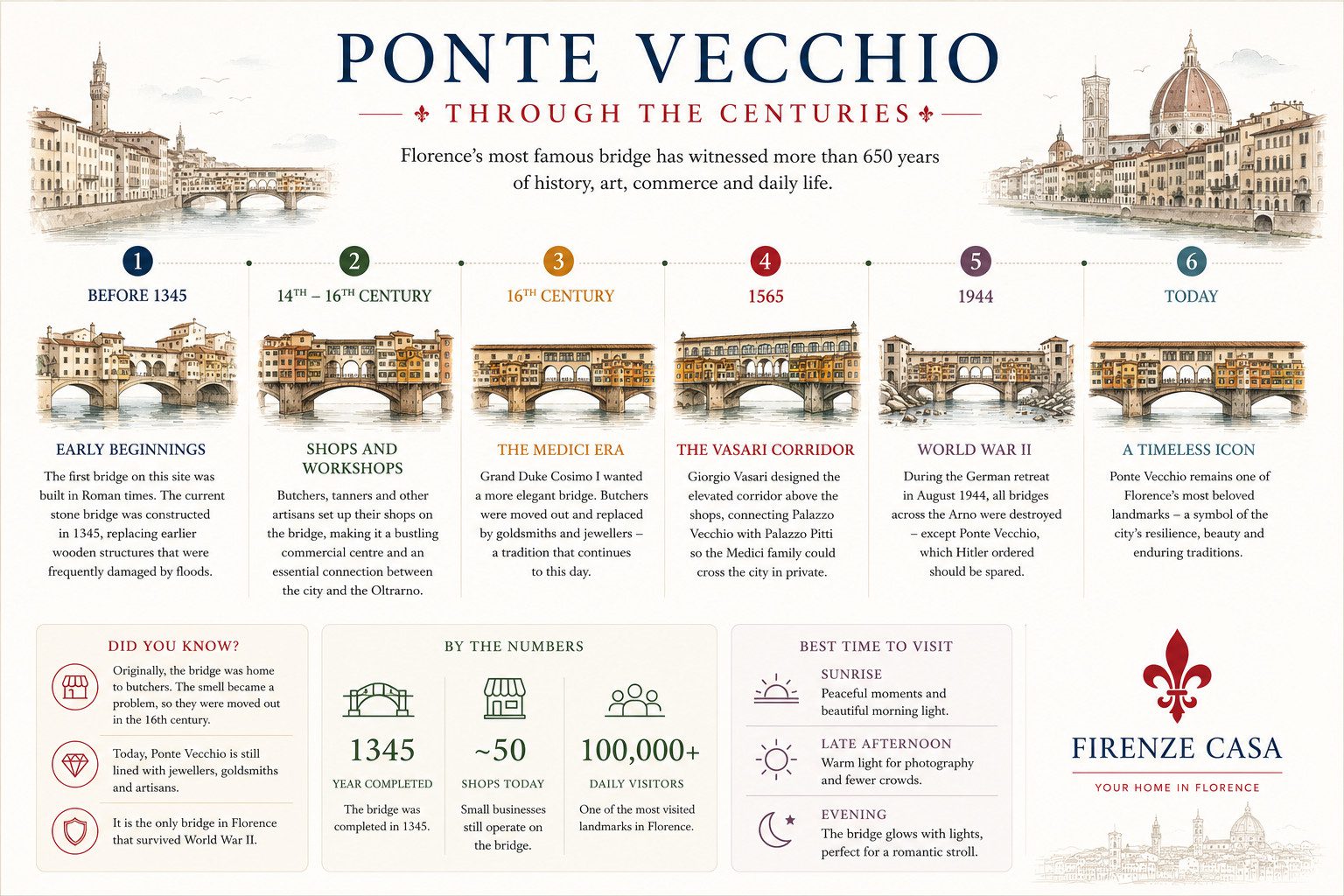
No bridge symbolises Florence more powerfully than the Ponte Vecchio. The crossing occupies an ancient location associated with the route across the Arno in Roman Florentia. Earlier structures suffered repeated damage or destruction before the great medieval rebuilding of the fourteenth century created the bridge form familiar today.
Unlike most historic bridges, Ponte Vecchio carries small shops that appear to hang above the river. Commerce has therefore shaped the crossing for centuries.
Butchers and other trades once occupied its shops. During the Medici period, however, the character of the bridge changed. Goldsmiths and jewellers eventually became closely associated with Ponte Vecchio, and that tradition continues today.
The Vasari Corridor Above the Bridge
High above the shops runs the extraordinary Vasari Corridor, which Cosimo I de’ Medici commissioned from Giorgio Vasari in 1565. The elevated route connected Palazzo Vecchio with Palazzo Pitti through the Uffizi and across the Arno.
Consequently, members of the ruling family could move between Florence’s political centre and their residence through a controlled passage above the streets. The corridor transformed Ponte Vecchio from a purely commercial bridge into part of an architectural route expressing Medici authority.
Ponte Vecchio During the Second World War
Ponte Vecchio occupies a unique place in Florence’s wartime history. During the German retreat in August 1944, troops destroyed the other principal bridges across the Arno. Ponte Vecchio itself survived, although demolitions devastated buildings and streets around both entrances.
A popular story attributes the bridge’s survival to a personal order from Adolf Hitler. However, historians cannot establish the precise reason with the same certainty as the destruction itself. Therefore, it is safer to distinguish the surviving fact from the later tradition.
🔍 Click to view the infographic in full size.
Ponte Santa Trinita – Florence’s Most Elegant Renaissance Bridge
If Ponte Vecchio is Florence’s most famous bridge, Ponte Santa Trinita is perhaps its most elegant. Bartolomeo Ammannati designed the celebrated Renaissance crossing during the sixteenth century, giving it graceful arches that create an impression of remarkable lightness across the Arno.
The bridge stands at the end of Via de’ Tornabuoni, historically one of Florence’s most prestigious streets. Therefore, it linked an important urban axis with the Oltrarno while also becoming an architectural statement in its own right.
The Four Seasons
Four sculptures representing the seasons stand at the bridge entrances. Besides enriching the crossing visually, they distinguish Ponte Santa Trinita from Florence’s other bridges. Architecture and sculpture therefore work together rather than treating the bridge merely as infrastructure.
The Classic View of Ponte Vecchio
For many visitors, Ponte Santa Trinita offers the finest view of Ponte Vecchio. Looking east, the historic bridge appears framed by the Arno and riverside buildings. Late afternoon and sunset can be particularly atmospheric, which makes Santa Trinita one of central Florence’s most popular photography locations.
Destroyed and Reconstructed
German forces destroyed the bridge during their retreat in August 1944. After the war, Florence undertook an unusually careful reconstruction. Surviving material, historical documentation and traditional craftsmanship helped restorers recover the bridge’s historic character.
As a result, Ponte Santa Trinita once again forms an essential part of the familiar Arno panorama.
Ponte alle Grazie – From Medieval Bridge to Modern Crossing
Ponte alle Grazie stands on the site of one of Florence’s most historically fascinating river crossings. Florentines built the medieval bridge in 1237 and originally called it Ponte Rubaconte, after the podestà of the period. It became the third major bridge across the Arno after Ponte Vecchio and Ponte alla Carraia.
A Medieval Bridge With Buildings and Chapels
The old Ponte alle Grazie looked very different from the modern bridge visitors see today. Small religious structures and other buildings occupied parts of the crossing, while chapels and spaces associated with religious life created the impression of a small extension of the medieval city over the river.
The name Ponte alle Grazie developed in connection with devotion to the Madonna delle Grazie. Over the centuries, however, floods and urban changes altered the crossing repeatedly.
Destruction in 1944
German forces destroyed the historic bridge during their retreat in August 1944. In the post-war period, Florence chose a much simpler modern replacement rather than recreating the medieval structure in detail.
Consequently, Ponte alle Grazie presents an intriguing contrast: its location is ancient, while its current appearance belongs to twentieth-century Florence.
A Gateway Towards San Niccolò
Today, the bridge connects the historic centre with the southern bank near San Niccolò. It is especially convenient for visitors heading towards the district below Piazzale Michelangelo or exploring the eastern Oltrarno.
Moreover, the crossing provides attractive views back towards Ponte Vecchio and along the Arno.
Ponte alla Carraia – Florence’s Historic Bridge of Carts and Commerce
Ponte alla Carraia represents one of the oldest routes across the Arno after Ponte Vecchio. Its early predecessor became known as a new bridge because it followed the older crossing near Ponte Vecchio. Later, the route became closely associated with carts carrying goods into and across Florence.
The name therefore reflects a practical commercial history. Ponte alla Carraia helped channel traffic towards western parts of the city and connected important routes on both sides of the Arno.
Commerce Across the River
The bridge’s history is closely connected with the commercial development of medieval Florence. Wool production, workshops and trade required constant movement of raw materials and finished goods. Consequently, reliable river crossings became essential parts of the city’s economic infrastructure.
Floods and other disasters repeatedly damaged or forced the rebuilding of Ponte alla Carraia. Its history therefore also reflects Florence’s difficult relationship with the Arno.
The Modern Bridge
Like the other major crossings, Ponte alla Carraia disappeared in the destruction of 1944. Florence rebuilt the bridge after the war, creating the structure visitors use today.
Although it is less architecturally famous than Ponte Santa Trinita, the crossing remains an important connection between central Florence and San Frediano. In addition, it offers attractive views eastward towards Ponte Santa Trinita and the historic centre.
Ponte Amerigo Vespucci – Florence’s Modern Central Bridge
Ponte Amerigo Vespucci lies west of Ponte alla Carraia and represents a different chapter in Florence’s relationship with the Arno. Unlike the medieval and Renaissance bridges farther east, this crossing belongs to the city’s modern development.
Its name honours Amerigo Vespucci, the Florentine navigator whose name ultimately became associated with the continents of the Americas.
A Bridge Beyond the Monumental Centre
Ponte Amerigo Vespucci does not attract crowds like Ponte Vecchio, and that is precisely part of its appeal. The bridge connects parts of the western historic centre with the Oltrarno and provides another perspective on the Lungarni.
Walking here reveals a more residential Florence with fewer monumental attractions. At the same time, the crossing marks the transition from the compact historic bridge sequence towards the wider modern city.
Ponte della Vittoria – Florence Expands West
Farther west stands Ponte della Vittoria, another bridge associated primarily with modern Florence rather than the medieval city. The crossing connects northern and southern districts beyond the dense historic centre and forms part of the wider transport network created as Florence expanded.
Most first-time visitors will not consider Ponte della Vittoria a sightseeing destination in itself. Nevertheless, it belongs in a complete guide because it shows how the city’s relationship with the Arno changed as Florence grew beyond its old walls.
Towards the Cascine
The bridge lies close to the western approach towards Parco delle Cascine, Florence’s largest historic public park. Therefore, walkers and cyclists can use this stretch of the Arno as a transition between monumental Florence and a greener, more spacious urban landscape.
Ponte della Vittoria also illustrates an important point: Florence’s bridges did not stop evolving after the Renaissance. New crossings continued to appear as the needs of the modern city changed.
Ponte San Niccolò – Florence’s Eastern Bridge
At the eastern edge of central Florence, Ponte San Niccolò offers yet another perspective on the city. The bridge belongs to the expansion and transformation of Florence beyond its medieval core, while the surrounding area developed strongly during the nineteenth-century redesign of the city.
Nearby, the medieval Torre di San Niccolò preserves a much older layer of history and creates an interesting contrast with the later bridge.
Between River and Hills
Ponte San Niccolò sits close to the point where the dense historic centre gives way to routes towards Florence’s southern hills. The famous Viale dei Colli, developed during Florence’s period as capital of the Kingdom of Italy, connects this wider area with Piazzale Michelangelo and other elevated viewpoints.
For walkers, the bridge therefore makes an excellent ending point for an Arno itinerary. From here, you can continue into the San Niccolò neighbourhood or begin climbing towards some of Florence’s finest panoramas.
Other Bridges Across the Arno in Florence
Florence’s metropolitan river landscape continues beyond the crossings most visitors encounter in the historic centre. Modern road and transport bridges farther east and west serve the needs of a much larger city.
Among them, crossings such as Ponte all’Indiano belong to a Florence shaped by twentieth-century mobility rather than medieval commerce or Renaissance architecture. Although these bridges remain important to modern transport, they offer less historical interest for most first-time visitors.
For exploring Florence’s relationship with the Arno on foot, the sequence from Ponte della Vittoria and Ponte Amerigo Vespucci through the historic bridges to Ponte San Niccolò provides a much more rewarding route.
The Lost Bridges of Florence
Florence’s bridges have never been permanent structures. Floods, reconstruction and warfare repeatedly changed the crossings over the Arno. Sometimes builders replaced an old bridge on essentially the same site; elsewhere, an entirely new design took its place.
The catastrophic flood of 1333 became one of the defining disasters in the medieval history of the Arno. Several bridges suffered destruction or severe damage, forcing Florence to undertake major rebuilding.
Later floods again demonstrated the vulnerability of structures spanning the river. However, the twentieth century brought destruction for an entirely different reason.
The Night of the Bridges – Florence in August 1944
One of the most dramatic nights in modern Florentine history occurred between 3 and 4 August 1944. As German forces withdrew ahead of the Allied advance, they prepared bridges across the Arno for demolition.
The resulting explosions destroyed the city’s principal crossings except Ponte Vecchio. Within hours, bridges that had connected Florentines for generations disappeared, while neighbourhoods near the Arno suffered severe damage.
Ponte Vecchio Survives – Its Surroundings Do Not
Although Ponte Vecchio remained standing, German forces demolished buildings around both ends of the bridge. The destruction blocked access and devastated medieval streets, including areas around Borgo San Jacopo and Via Guicciardini.
Therefore, describing Ponte Vecchio as surviving completely “intact” can be misleading. The bridge structure survived, but its immediate urban environment suffered enormous destruction.
Why Was Ponte Vecchio Spared?
The survival of Ponte Vecchio generated one of Florence’s most persistent wartime stories. Tradition often claims that Adolf Hitler personally ordered troops to spare the bridge because of its beauty or historical importance.
However, historians cannot establish the precise chain of command and reasoning securely enough to present that explanation as unquestioned fact. What remains certain is compelling enough: Ponte Vecchio stood while the other principal bridges disappeared.
Rebuilding Florence’s Bridges After the War
After liberation, Florence faced an enormous reconstruction challenge. Bridges were essential for reconnecting the two sides of the city, yet rebuilding also raised difficult questions. Should Florence recreate destroyed historic bridges, or should modern structures replace them?
Another issue concerned surviving material. Architects and engineers had to decide how much original stone they could recover and reuse. Ultimately, different bridges received different answers.
Ponte Santa Trinita – Reconstructing a Renaissance Masterpiece
Ponte Santa Trinita received particularly careful treatment because of its exceptional architectural importance. Historical documentation and surviving material guided the reconstruction, while workers recovered stones from the Arno to help restore its historic form.
Consequently, the rebuilt bridge became a powerful demonstration of Florence’s determination to recover an important part of its Renaissance cityscape.
Ponte alle Grazie – Choosing a Modern Design
Ponte alle Grazie followed another path. Instead of reconstructing the earlier bridge with all of its historical complexity, Florence created a simpler modern crossing.
The contrast between Santa Trinita and alle Grazie therefore makes the post-war rebuilding of Florence especially interesting. Reconstruction did not always mean reproducing the past exactly.
The Vasari Corridor
Running above Ponte Vecchio is one of Florence’s most extraordinary architectural structures: the Vasari Corridor. Cosimo I de’ Medici commissioned Giorgio Vasari to create the elevated route in 1565.
The passage linked Palazzo Vecchio, the seat of political authority, with Palazzo Pitti, the Medici residence across the Arno. After passing through the Uffizi complex, it crossed Ponte Vecchio above the historic shops and continued through the Oltrarno.
Its route demonstrates how architecture could serve political power. Rather than simply crossing a river, the Medici created a controlled pathway above the city itself.
War Damage to the Corridor
The destruction around both ends of Ponte Vecchio in 1944 also damaged parts of the Vasari Corridor. Therefore, the survival of the bridge did not protect the entire architectural system surrounding it.
Today, the corridor remains one of the clearest examples of the relationship between Florence’s bridges, urban design and Medici rule.
The Arno Floods and Florence’s Bridges
War was not the only threat to Florence’s bridges. The Arno flooded repeatedly throughout the city’s history, and medieval chronicles record several destructive events. Among them, the catastrophic flood of 1333 became especially important for the history of Florence’s crossings.
The river continued to threaten Florence in later centuries. In 1966, another devastating flood caused enormous damage across the city, although the twentieth-century bridge system faced the disaster in a very different context from the medieval structures.
Consequently, the history of almost every major Florentine bridge involves destruction, repair or reconstruction.
The Best Views from Florence’s Bridges
Every bridge across the central Arno offers a different perspective on Florence. Some crossings provide famous postcard views, while others reveal quieter scenes of riverside life. Exploring several bridges is therefore one of the easiest ways to understand how the city changes from east to west.
| Bridge | Best View or Experience | Best Time |
|---|---|---|
| Ponte Vecchio | Historic shops, Arno and neighbouring bridges | Early morning |
| Ponte Santa Trinita | Classic view of Ponte Vecchio | Late afternoon / sunset |
| Ponte alle Grazie | Ponte Vecchio and eastern historic centre | Morning |
| Ponte alla Carraia | Ponte Santa Trinita and riverside palaces | Late afternoon |
| Ponte Amerigo Vespucci | Quieter western Lungarni | Morning or evening |
| Ponte della Vittoria | Western Arno and route towards Cascine | Late afternoon |
| Ponte San Niccolò | Arno, eastern city and hills | Evening |
Photographers usually favour Ponte Santa Trinita for the classic Ponte Vecchio composition. However, visitors who want a less familiar Florence should also explore the river west of Ponte alla Carraia and east towards San Niccolò.
A Walking Tour Along Florence’s Bridges
One of the most enjoyable ways to explore the Arno is to follow the bridges from west to east. You can easily adapt the route according to your available time and interests.
Extended Bridge Walk
- Ponte della Vittoria – Begin near the western edge of central Florence and the route towards Parco delle Cascine.
- Ponte Amerigo Vespucci – Continue through a quieter stretch of the Lungarni.
- Ponte alla Carraia – Enter the historic sequence of medieval bridge sites.
- Ponte Santa Trinita – Stop for the classic view of Ponte Vecchio.
- Ponte Vecchio – Explore the shops and look up towards the Vasari Corridor.
- Ponte alle Grazie – Continue east and enjoy another view back towards Ponte Vecchio.
- Ponte San Niccolò – Finish near San Niccolò before continuing towards the hills.
Treat the full route as a leisurely riverside exploration rather than a race between bridges.
Short Historic-Centre Walk
If you have less time, concentrate on four crossings:
- Ponte alla Carraia
- Ponte Santa Trinita
- Ponte Vecchio
- Ponte alle Grazie
This shorter route contains the strongest concentration of medieval, Renaissance and wartime bridge history.
Which Florence Bridge Should You Visit?
| If You Want… | Best Bridge |
|---|---|
| The iconic Florence experience | Ponte Vecchio |
| The best view of Ponte Vecchio | Ponte Santa Trinita |
| Renaissance bridge architecture | Ponte Santa Trinita |
| Medieval bridge history | Ponte alle Grazie |
| Commercial Florence and San Frediano | Ponte alla Carraia |
| A quieter central crossing | Ponte Amerigo Vespucci |
| A walk towards Cascine Park | Ponte della Vittoria |
| San Niccolò and the hills | Ponte San Niccolò |
Florence Bridges at Sunrise and Sunset
The character of the Arno changes dramatically throughout the day. Early morning is particularly rewarding around Ponte Vecchio because the shops have not yet attracted the daytime crowds. Moreover, softer light often reflects beautifully from the river and historic façades.
Later in the day, photographers tend to gather on Ponte Santa Trinita. As the light warms, the view towards Ponte Vecchio becomes especially atmospheric. Evening works particularly well farther east and west, where the river feels more spacious and visitor numbers decrease.
After dark, illuminated buildings and reflections create another Florence altogether. For photography, however, remember that the best bridge is often not the famous bridge itself but the neighbouring crossing from which you can actually see it.
Visitor Information
Visitor Information
📍 Historic Core Bridges
Ponte alla Carraia
Ponte Santa Trinita
Ponte Vecchio
Ponte alle Grazie
Ponte San Niccolò
🌉 Additional Central Crossings
Ponte Amerigo Vespucci
Ponte della Vittoria
📌 Location
Across the Arno between Florence’s historic centre, Oltrarno and the modern districts extending east and west.
⏱ Suggested Visit
Allow two to three hours for the historic-centre bridge route. Add more time if you extend the walk west towards Ponte della Vittoria or continue from San Niccolò towards Piazzale Michelangelo.
🚶 Best Way to Explore
Walking is the easiest option because the historic bridges stand close together and connect naturally with the Lungarni and Oltrarno neighbourhoods.
Interesting Facts About the Bridges of Florence
- 🌉 Ponte Vecchio occupies the historic crossing associated with the ancient route over the Arno in Roman Florence.
- 🛍️ Shops have lined Ponte Vecchio for centuries, while jewellers and goldsmiths dominate the bridge today.
- 🏛️ Above Ponte Vecchio, the Vasari Corridor connects the Medici political and residential worlds.
- ✨ Elegant Renaissance design and graceful arches distinguish Ponte Santa Trinita.
- 📷 From Ponte Santa Trinita, visitors enjoy the classic downstream view towards Ponte Vecchio.
- 🏘️ Small religious structures once stood on the medieval predecessor of Ponte alle Grazie.
- 🛒 Ponte alla Carraia developed as an important route for carts and commercial traffic.
- 💥 German forces destroyed Florence’s other principal Arno bridges in August 1944, while Ponte Vecchio remained standing.
- 🏚️ Despite the bridge’s survival, demolitions destroyed buildings at both ends of Ponte Vecchio.
- 🪨 The reconstruction of Ponte Santa Trinita became one of Florence’s most celebrated post-war restoration projects.
- 🧭 Ponte Amerigo Vespucci reflects Florence’s expansion beyond the monumental historic centre.
- 🌳 Ponte della Vittoria lies along the western route towards the Cascine area.
- ⛰️ Ponte San Niccolò creates a natural connection between the Arno and routes leading towards Florence’s southern hills.
- 🌊 Throughout Florentine history, floods repeatedly damaged or destroyed bridges.
Frequently Asked Questions
Which is the most famous bridge in Florence?
Ponte Vecchio is Florence’s most famous bridge and one of the city’s internationally recognised landmarks. Its historic shops and the Vasari Corridor make it unique among the Arno crossings.
How many important bridges are there in central Florence?
Five bridges form the core historic and sightseeing sequence: Ponte alla Carraia, Ponte Santa Trinita, Ponte Vecchio, Ponte alle Grazie and Ponte San Niccolò. In addition, Ponte Amerigo Vespucci and Ponte della Vittoria extend the story westward into modern Florence.
Which is the oldest bridge in Florence?
Ponte Vecchio stands on the city’s oldest historic river-crossing site and preserves the most important surviving medieval bridge structure across the Arno.
Which Florence bridge offers the best view of Ponte Vecchio?
Ponte Santa Trinita offers the classic panoramic view of Ponte Vecchio and is particularly attractive during late afternoon and sunset.
Why was Ponte Vecchio not destroyed in 1944?
Ponte Vecchio was the only principal Florence crossing to survive the German demolitions of August 1944. A popular tradition attributes its survival to an order from Adolf Hitler, but historians cannot document the precise reason securely enough to present that story as certain fact.
Were the other Florence bridges destroyed during World War II?
Yes. Retreating German forces destroyed the city’s other principal bridges across the Arno during the night of 3–4 August 1944. Afterwards, Florence undertook extensive post-war reconstruction.
Was Ponte Vecchio completely untouched during the war?
No. Although the bridge structure survived, German demolitions devastated buildings and streets around both ends. The destruction also damaged parts of the surrounding historic neighbourhoods and the Vasari Corridor.
What is the Vasari Corridor?
The Vasari Corridor is an elevated passage that Cosimo I de’ Medici commissioned from Giorgio Vasari in 1565. It linked Palazzo Vecchio with Palazzo Pitti and crossed the Arno above Ponte Vecchio.
Which bridge is best for Renaissance architecture?
Ponte Santa Trinita is the outstanding choice. Its elegant design makes it one of Florence’s most important achievements in Renaissance engineering and architecture.
What happened to the old Ponte alle Grazie?
German forces destroyed the historic bridge during their retreat in 1944. Florence later replaced it with a modern structure rather than reproducing the earlier medieval bridge exactly.
Which bridge should I use for San Niccolò and Piazzale Michelangelo?
Ponte alle Grazie provides convenient access to the lower San Niccolò area from the historic centre. Farther east, Ponte San Niccolò connects naturally with routes towards the hills.
Is Ponte Amerigo Vespucci worth seeing?
It is not a major tourist attraction like Ponte Vecchio, but it is worthwhile for visitors who enjoy quieter river views and want to explore the western Lungarni beyond the most visited part of Florence.
Can you walk across Florence’s bridges?
Yes. The central bridges can all be incorporated into a walking route along the Arno. Ponte Vecchio is pedestrianised, while the other crossings generally combine pedestrian access with road traffic.
How long does a bridge walk through Florence take?
The historic-centre route can comfortably fill two to three hours when you allow time for photographs and short explorations along the river. An extended route including Ponte della Vittoria and Ponte San Niccolò takes considerably longer.
Further Reading on Firenze Casa
If you would like to discover more about Florence’s bridges and the stories behind them, you may also enjoy these Firenze Casa articles:
- The History of Ponte Vecchio: Florence’s Most Famous Bridge
- Ponte Santa Trinita – Florence’s Renaissance Bridge
- Ponte alle Grazie – Florence’s Historic Arno Bridge
- Ponte alla Carraia – Florence’s Historic Arno Bridge
- Ponte San Niccolò – Florence’s Eastern Arno Bridge
- The Medici Family: The Dynasty That Shaped Florence
- Parco delle Cascine Florence – The City’s Most Local Park
References
- Comune di Firenze – Official cultural heritage and historical resources.
- Feel Florence – Official tourism information from the Municipality and Metropolitan City of Florence.
- Uffizi Galleries – Historical resources on Ponte Vecchio, the Vasari Corridor and the destruction of the bridges in 1944.
- Uffizi Galleries – Photographic documentation of wartime destruction and post-war reconstruction in Florence.
- UNESCO World Heritage Centre – Historic Centre of Florence.
- Historical studies on Ponte Santa Trinita and Bartolomeo Ammannati.
- Historical studies on Ponte alle Grazie, Ponte alla Carraia and the medieval development of Florence.
- Academic literature on the Arno, Florentine urban history and post-war reconstruction.
Conclusion
The bridges of Florence are much more than practical crossings over the Arno. Together, they tell the story of a city that expanded through commerce, rebuilt itself after floods and recovered from the destruction of war.
Ponte Vecchio preserves Florence’s most iconic medieval river landscape, while Ponte Santa Trinita embodies Renaissance elegance. Meanwhile, Ponte alle Grazie and Ponte alla Carraia reveal how historic crossing points can survive even when the bridges themselves change completely.
Farther east, Ponte San Niccolò opens the historic city towards the hills. In contrast, Ponte Amerigo Vespucci and Ponte della Vittoria demonstrate Florence’s continuing growth westward beyond its medieval boundaries.
Together, the bridges reveal how different historical periods coexist along a single river. Roman routes, medieval trade, Medici architecture, nineteenth-century urban expansion, wartime destruction and twentieth-century reconstruction all meet along the Arno.
Whether you are interested in history, architecture, photography or simply a beautiful walk, exploring several crossings provides one of the best ways to understand Florence as a living city.

