
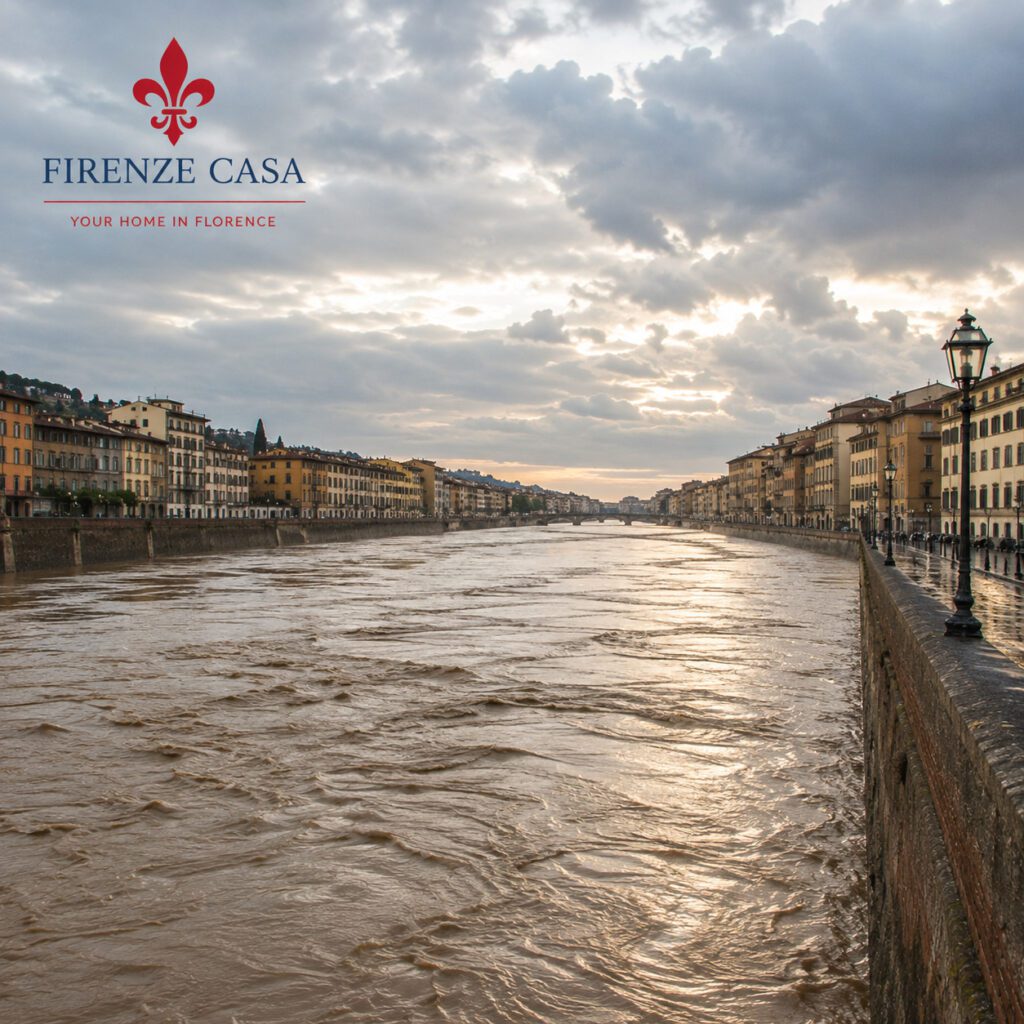
For more than two thousand years, the Arno River has been both Florence’s greatest blessing and its greatest threat. It transformed a small Roman settlement into one of Europe’s wealthiest cities, powered trade and industry, and inspired artists and writers. Yet the same river has repeatedly unleashed devastating floods that destroyed bridges, damaged priceless works of art and reshaped the city’s history forever.
Introduction
When visitors admire the peaceful waters of the Arno today, it is difficult to imagine the destructive force the river has unleashed throughout history. Flowing from the Apennine Mountains to the Tyrrhenian Sea, the Arno has always been unpredictable. Heavy rainfall upstream can rapidly transform the calm river into a torrent capable of overwhelming Florence’s streets within hours.
Over the centuries, the city has experienced numerous catastrophic floods. Some swept away medieval bridges, while others destroyed homes, workshops and churches. The most famous occurred on 4 November 1966, when muddy floodwaters invaded Florence’s historic centre, damaging thousands of priceless artworks, manuscripts and historic buildings. Images of volunteers rescuing paintings and books travelled around the world and turned the disaster into an international symbol of cultural preservation.
Yet the flood of 1966 was only the latest chapter in a much longer story. Medieval Florence repeatedly suffered similar catastrophes, forcing the city to rebuild stronger bridges, improve its riverbanks and rethink its relationship with the Arno. The famous Ponte Vecchio itself exists only because an earlier bridge was destroyed during one of the greatest floods in Florentine history.
This guide explores the most important floods that shaped Florence, explains why the Arno has overflowed so frequently and shows how the city repeatedly recovered from disasters that might have destroyed many other historic capitals.
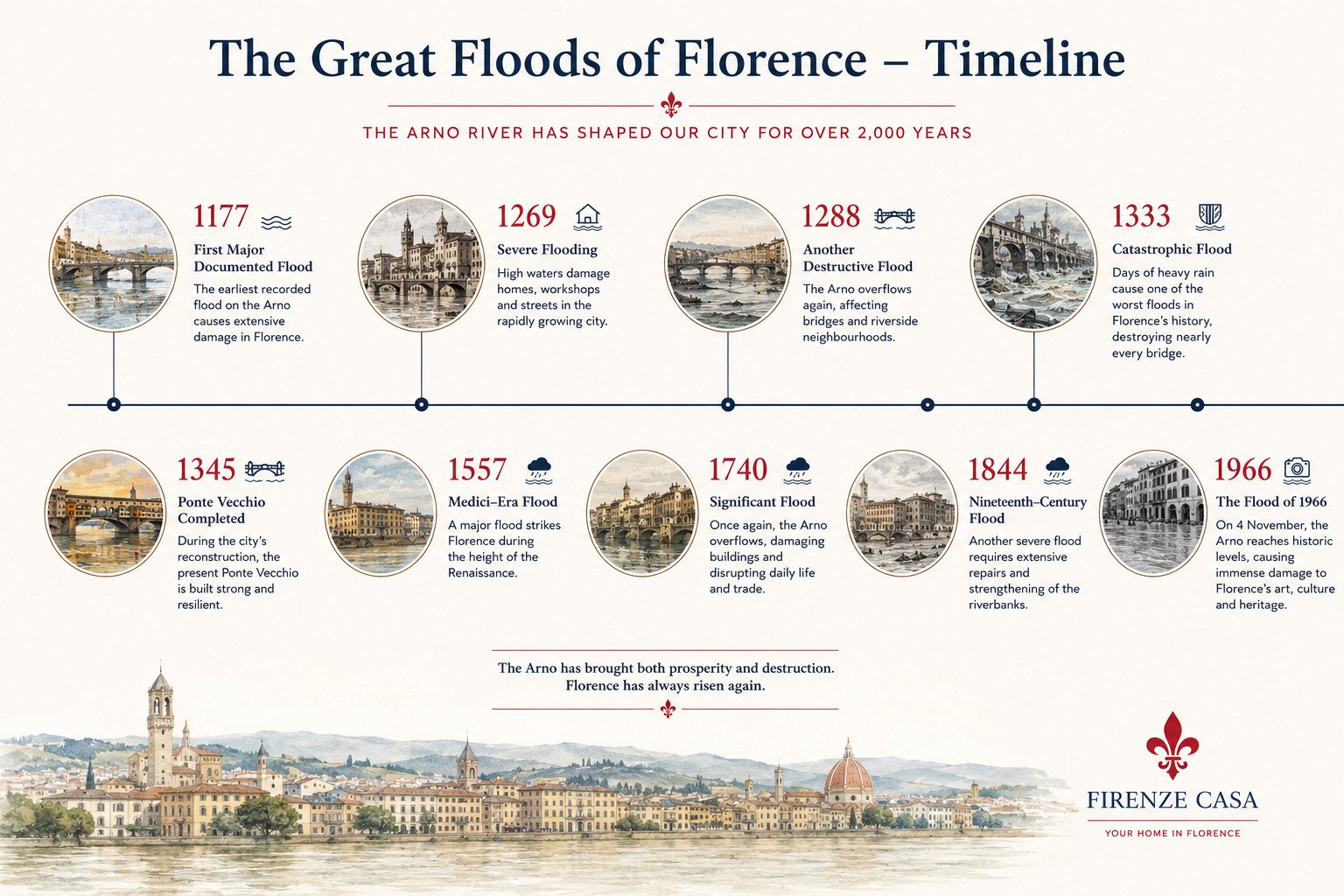
📅 Historical Timeline
| Year | Major Event |
|---|---|
| Roman period | Florence develops along the Arno, benefiting from trade and river transport. |
| 1177 | The first major documented flood causes widespread damage. |
| 1269 | Severe flooding affects the rapidly expanding medieval city. |
| 1288 | Another destructive flood damages bridges and riverside buildings. |
| 1333 | One of the worst floods in Florence’s history destroys nearly every bridge across the Arno. |
| 1345 | The present Ponte Vecchio is completed during the city’s reconstruction. |
| 1557 | A major flood strikes Florence during the Medici era. |
| 1740 | Significant flooding once again damages riverside districts. |
| 1844 | The nineteenth century brings another serious flood to the city. |
| 1966 | The most devastating modern flood damages thousands of artworks, libraries and churches. |
| Today | Modern flood monitoring and engineering help protect Florence against future disasters. |
🔍 Click to view the infographic in full size
The Arno – Florence’s Lifeline
The history of Florence cannot be understood without the Arno. Long before the city became the birthplace of the Renaissance, the river attracted settlers who recognised its strategic importance. It provided fresh water, fertile land and a natural transport route linking inland Tuscany with the coast.
During the Middle Ages, the Arno became the economic heart of Florence. Merchants transported wool, textiles and other valuable goods across its bridges, while mills along its banks powered important industries. Workshops, markets and noble residences gradually developed beside the river, transforming Florence into one of Europe’s richest commercial centres.
The river also shaped the city’s appearance. Magnificent palaces, elegant churches and the famous Ponte Vecchio all owe their existence to the Arno. Today, the river remains one of Florence’s defining features, offering some of the city’s most beautiful panoramic views.
Yet the Arno has always demanded respect. Unlike many larger European rivers, it reacts quickly to heavy rainfall in the surrounding mountains. What made Florence prosperous also exposed it to repeated natural disasters that would influence its architecture and urban planning for centuries.
Why the Arno Floods So Often
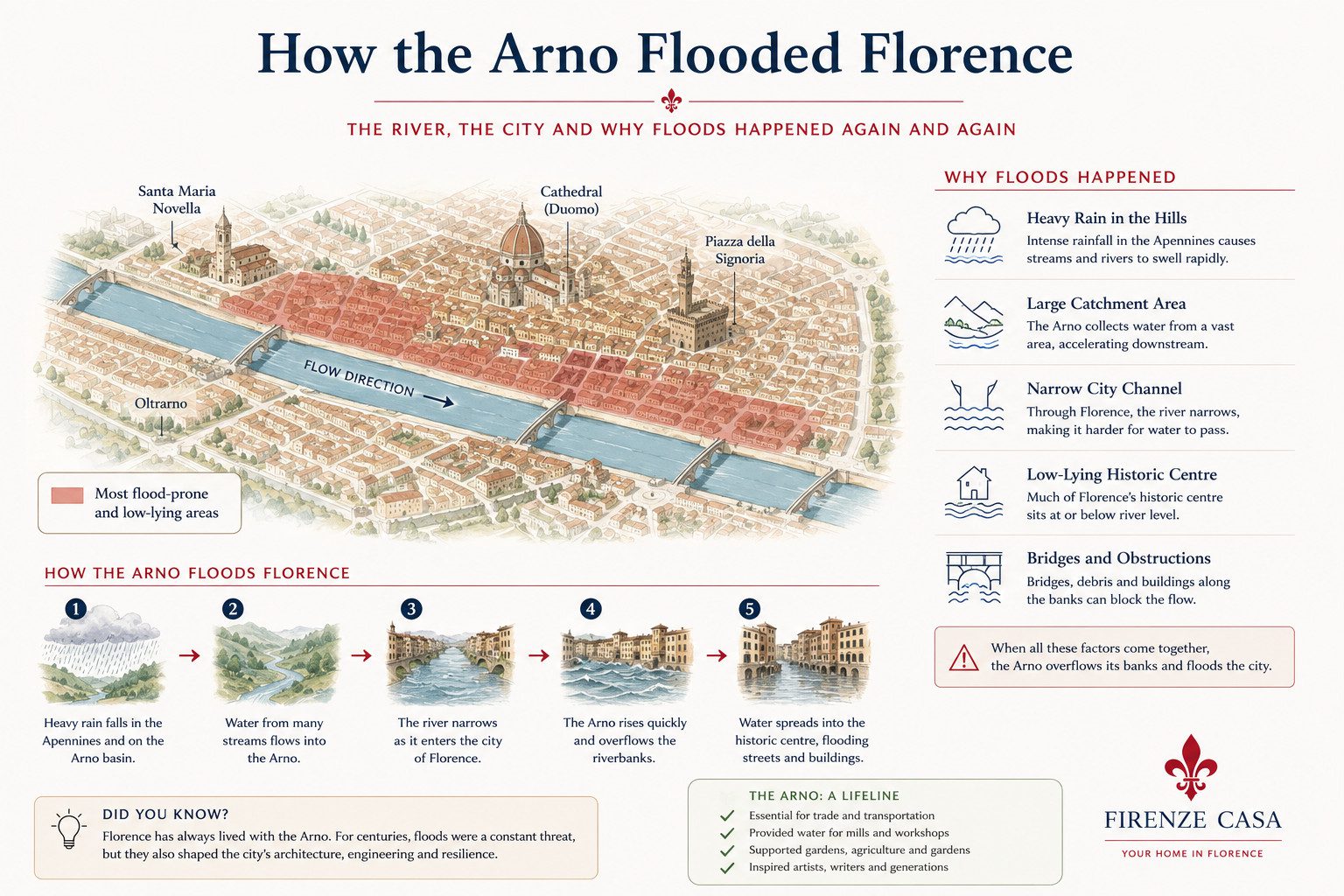
The Arno’s tendency to flood is largely the result of geography. Rising in the Apennine Mountains, the river drains a large catchment area where intense rainfall can rapidly increase water levels. As this water rushes downstream towards Florence, the relatively narrow river channel struggles to contain the sudden volume.
During the Middle Ages, the problem was made worse by limited engineering and the continuous expansion of buildings close to the riverbanks. Bridges, mills and defensive structures sometimes restricted the flow of water, increasing pressure during periods of heavy rainfall.
Seasonal storms in autumn have historically posed the greatest risk, particularly when prolonged rain falls across the mountains feeding the Arno. Before modern forecasting systems existed, Florentines often had little warning before floodwaters entered the city.
Although today’s flood-control systems are far more sophisticated, the Arno remains closely monitored, reminding residents that the river continues to be both Florence’s greatest natural asset and one of its greatest natural hazards.
🔍 Click to view the infographic in full size
The Great Flood of 1333
Among all the medieval floods that struck Florence, none proved more destructive than the catastrophe of 1333. After days of exceptionally heavy rainfall, the Arno burst its banks with extraordinary force, sweeping through the city and devastating large sections of medieval Florence.
The flood destroyed homes, workshops, defensive walls and, most dramatically, almost every bridge spanning the river. Only fragments remained standing, leaving both sides of the city isolated from one another. The disaster severely disrupted trade and daily life, forcing Florence to undertake one of the largest reconstruction projects in its history.
Out of this destruction came one of Florence’s greatest architectural achievements. In 1345, builders completed the present Ponte Vecchio, creating a stronger and more resilient bridge that has survived for nearly seven centuries. Today, millions of visitors admire the bridge without realising that its existence is directly linked to one of the city’s greatest natural disasters.
The flood of 1333 marked a turning point in Florence’s relationship with the Arno. It demonstrated both the river’s destructive power and the city’s extraordinary ability to rebuild, qualities that would define Florence throughout the centuries that followed.
Other Historic Floods
Although the flood of 1333 is often regarded as Florence’s greatest medieval disaster, it was by no means an isolated event. Throughout the centuries, the Arno repeatedly overflowed its banks, causing extensive damage to homes, churches, bridges and businesses. Each flood left its mark on the city’s development and encouraged improvements in construction techniques and river management.
| Year | Impact |
|---|---|
| 1177 | The earliest major documented flood causes widespread destruction in medieval Florence. |
| 1269 | Severe flooding damages homes and commercial districts along the Arno. |
| 1288 | Another major flood affects bridges and riverside neighbourhoods. |
| 1557 | The Medici-era city experiences one of its most serious Renaissance floods. |
| 1740 | Heavy flooding damages buildings and disrupts trade throughout Florence. |
| 1844 | The nineteenth century brings another destructive flood requiring extensive repairs. |
These repeated disasters shaped the city’s architecture and engineering. Bridges became stronger, embankments were reinforced and public awareness of flood risks steadily increased. Florence’s long history demonstrates that living beside the Arno has always required resilience and adaptation.
The Flood of 1966
On the morning of 4 November 1966, Florence experienced the most devastating flood in its modern history. Following days of exceptionally heavy rainfall across Tuscany, the Arno rose dramatically and burst through its embankments before dawn.
Within hours, enormous volumes of muddy water swept into the historic centre. In some areas, floodwaters reached more than four metres in height, filling streets, churches, museums, libraries and thousands of private homes. Cars were carried away, electricity failed and communication throughout the city collapsed.
Unlike previous centuries, however, the disaster threatened not only buildings but also one of the world’s greatest collections of cultural treasures. Priceless paintings, sculptures, manuscripts and archives suddenly found themselves submerged beneath water, mud and fuel oil released from damaged heating systems.
The Basilica of Santa Croce suffered severe damage. The Biblioteca Nazionale Centrale di Firenze lost or damaged millions of books and documents. Museums throughout the city faced an unprecedented conservation emergency as masterpieces by Cimabue, Vasari and countless other artists required immediate rescue.
The catastrophe quickly became international news. Television images showing Florence buried beneath mud shocked audiences around the world and prompted an extraordinary global response that forever changed the field of cultural heritage conservation.
The Mud Angels
In the days following the flood, thousands of volunteers travelled to Florence from across Italy and around the world. Many were students, artists, conservators and ordinary citizens who simply wanted to help save one of humanity’s greatest cultural treasures.
Working under extremely difficult conditions, these volunteers removed mud from churches, cleaned paintings, rescued sculptures and carefully separated waterlogged books page by page. Their dedication earned them the nickname “Mud Angels” (Angeli del Fango).
The Mud Angels became an international symbol of solidarity and cultural responsibility. Their work demonstrated that Florence’s artistic heritage belonged not only to Italy but to the entire world. Many of the restoration techniques developed after the flood continue to influence conservation practices today.
Without their remarkable efforts, countless masterpieces of Renaissance art and thousands of invaluable historical documents might have been lost forever.
Florence’s Cultural Heritage at Risk
The flood of 1966 highlighted just how vulnerable Florence’s cultural heritage remains. Because so many of the city’s most important monuments stand close to the Arno, rising water threatened not only individual buildings but entire chapters of European history.
Among the most severely affected sites were:
- Basilica of Santa Croce – Paintings, frescoes and monuments suffered extensive water and mud damage.
- Biblioteca Nazionale Centrale – Millions of books, manuscripts and historical documents required emergency conservation.
- Museo dell’Opera di Santa Croce – Numerous artworks had to undergo years of restoration.
- Churches throughout the historic centre – Altars, sculptures and decorative interiors were affected by floodwater.
- Historic workshops and artisan studios – Many traditional businesses lost equipment, materials and archives.
The disaster reminded the world that preserving cultural heritage involves far more than protecting buildings. Libraries, archives, paintings, sculptures and even traditional craftsmanship all require careful planning to survive natural disasters.
How Florence Recovered
Recovering from the flood of 1966 took years rather than months. The immediate priority was clearing the city of mud and debris, restoring essential services and preventing further deterioration of damaged artworks and historic buildings.
International museums, universities, conservation institutes and private donors provided financial assistance and specialist expertise. Restoration laboratories worked tirelessly to stabilise paintings, sculptures, manuscripts and furniture that had suffered severe water damage.
The flood also transformed the science of art conservation. New methods for drying books, cleaning paintings and treating water-damaged materials were developed in Florence and later adopted by museums and libraries throughout the world.
Today, visitors walking through Florence see a city that has fully recovered, yet much of what they admire has survived only because of one of the largest cultural restoration projects ever undertaken.
Flood Protection Today
Modern Florence is considerably better prepared than it was in 1966. Advanced weather forecasting, continuous river monitoring and coordinated emergency planning now provide authorities with valuable time to respond when heavy rainfall threatens the Arno basin.
River engineering projects have strengthened embankments and improved water management upstream, while civil protection authorities regularly monitor rainfall across the Apennine Mountains. Emergency procedures are in place to protect residents as well as Florence’s extraordinary artistic heritage.
Although no flood prevention system can completely eliminate the risk, today’s Florence is far better equipped to face the challenges posed by the Arno than at any previous time in its history.
Walking Through Florence’s Flood History
Although the devastating floods belong to the past, visitors can still discover many places that preserve their memory. Walking along the Arno and through Florence’s historic centre offers a unique opportunity to understand how the river shaped the city for centuries.
The following self-guided route combines some of the most important locations connected with Florence’s flood history.
- Ponte Vecchio
Begin at Florence’s most famous bridge, rebuilt in 1345 after the catastrophic flood of 1333. It remains one of the city’s greatest symbols of resilience. - Ponte Santa Trinita
Admire one of the world’s finest Renaissance bridges and learn how it was reconstructed after its destruction during the Second World War. - Santa Croce Basilica
One of the buildings most severely affected during the 1966 flood. Several artworks required years of restoration. - Biblioteca Nazionale Centrale di Firenze
The National Library became one of the flood’s greatest tragedies, with millions of books and manuscripts damaged by mud and water. - The Arno Riverbanks
Walking beside the river reveals how closely Florence has always lived with the Arno. In several locations, historical flood markers indicate the astonishing height reached by the water.
This walk requires approximately two to three hours and offers a fascinating perspective on Florence beyond its famous monuments.
Visitor Information
Visitor Information
📍 Main Locations
Ponte Vecchio, Ponte Santa Trinita, Basilica di Santa Croce, Biblioteca Nazionale Centrale di Firenze and the Arno riverbanks.
📌 Location
Historic Centre of Florence, UNESCO World Heritage Site.
⏱ Suggested Visit
Allow two to three hours for the self-guided walking route following Florence’s flood history.
🌐 Official Website
Visit Florence’s official tourism website for maps, museums and visitor information.
🗺 View on Google Maps
Start at Ponte Vecchio and follow the Arno eastwards towards Santa Croce and the National Library.
Interesting Facts
- The flood of 1333 destroyed almost every bridge across the Arno.
- The present Ponte Vecchio was completed only after this catastrophe.
- On 4 November 1966, floodwaters reached more than four metres in some parts of Florence.
- Millions of books and manuscripts were damaged at the National Library.
- Thousands of volunteers became known worldwide as the Mud Angels.
- The restoration work following the 1966 flood revolutionised modern art conservation.
- Some historic buildings in Florence still display flood level markers.
- The Arno remains one of Italy’s most closely monitored rivers during periods of heavy rainfall.
Frequently Asked Questions
Why does the Arno flood so frequently?
The Arno drains a large mountainous catchment area. Heavy rainfall in the Apennines can rapidly increase water levels, causing the river to overflow.
What was Florence’s worst flood?
The medieval flood of 1333 was one of the most destructive in the city’s history, while the flood of 1966 caused the greatest damage to Florence’s artistic and cultural heritage.
What happened during the flood of 1966?
Floodwaters inundated Florence’s historic centre, damaging churches, museums, libraries, homes and thousands of priceless works of art.
Who were the Mud Angels?
The Mud Angels were volunteers from around the world who helped rescue artworks, books and historical documents after the flood of 1966.
Can visitors still see evidence of the floods today?
Yes. Flood markers, restored artworks, historic buildings and several museums preserve the memory of Florence’s repeated encounters with the Arno.
Is Florence protected against future floods?
Modern monitoring systems, flood forecasting and improved river engineering have significantly reduced the risk, although the Arno remains under constant observation.
Further Reading from Firenze Casa
- Bridges of Florence: The Complete Guide
- The Renaissance in Florence: The Complete Guide
- Florence Museums: The Complete Guide
- The Most Beautiful Churches in Florence
- Ponte Vecchio: The Complete Guide (Coming Soon)
- The Arno River in Florence (Coming Soon)
- Santa Croce Basilica (Coming Soon)
- The Biblioteca Nazionale of Florence (Coming Soon)
References
- Comune di Firenze – Official historical and cultural resources.
- Protezione Civile Toscana – Flood monitoring and civil protection information.
- UNESCO World Heritage Centre – Historic Centre of Florence.
- Biblioteca Nazionale Centrale di Firenze – Documentation on the 1966 flood and restoration projects.
- Uffizi Galleries – Conservation and restoration resources.
- Academic publications on the history of the Arno River and the floods of Florence.
Conclusion
For centuries, the Arno has defined Florence’s identity. It brought prosperity, encouraged trade and inspired generations of artists, yet it also repeatedly reminded the city of nature’s extraordinary power. Every major flood left lasting scars, but each disaster also demonstrated Florence’s remarkable determination to rebuild and preserve its cultural heritage.
Today, visitors strolling along the river often see only its peaceful beauty. Beneath the calm surface, however, lies a history of resilience, innovation and international cooperation that helped save one of the world’s greatest artistic treasures.
Understanding the floods of Florence adds a new dimension to exploring the city. The bridges, churches, museums and riverside streets are not only architectural masterpieces—they are living witnesses to centuries of survival, recovery and renewal shaped by the ever-changing waters of the Arno.

