
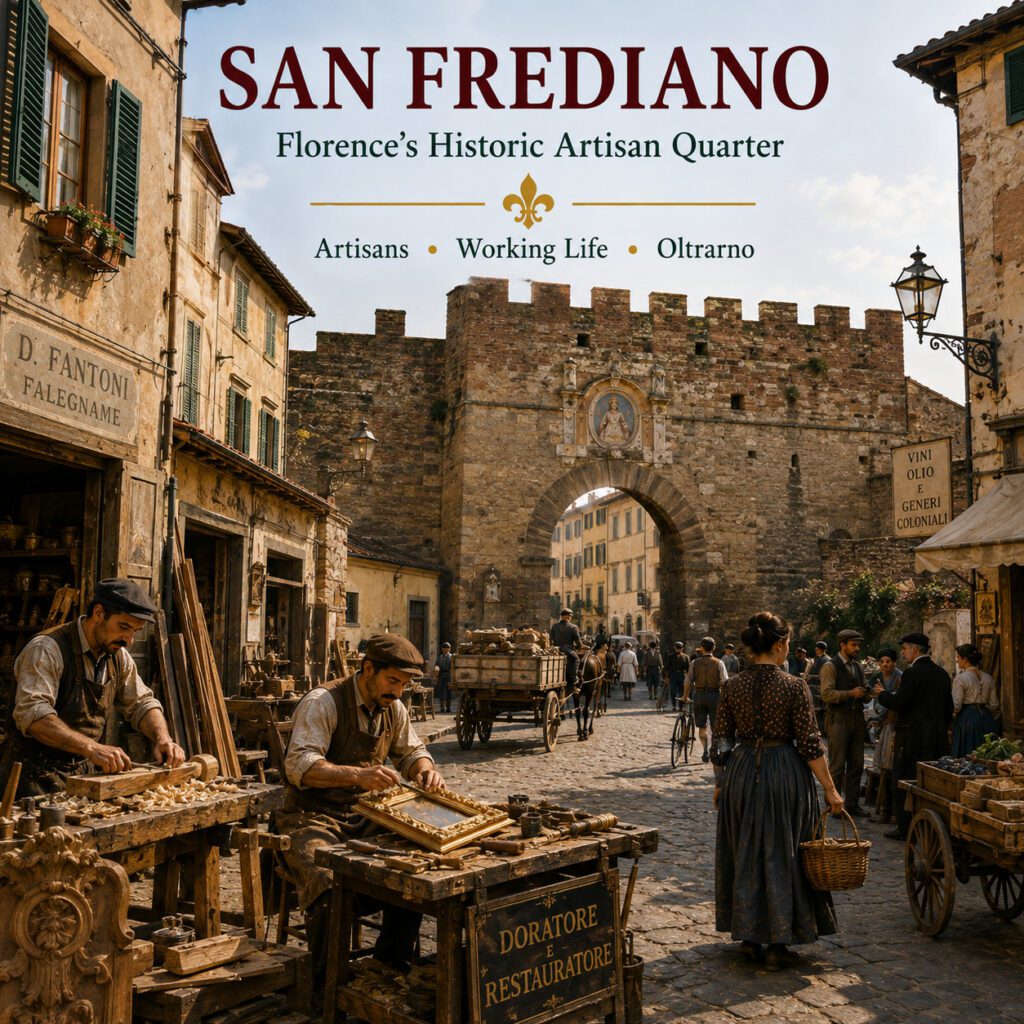
San Frediano in Florence is one of the most distinctive neighbourhoods of the Oltrarno. Stretching westwards from Santo Spirito towards Porta San Frediano, it developed a strong identity shaped by artisans, workers, religious communities and generations of ordinary Florentines. Its streets reveal a Florence that has always existed alongside the city’s palaces, churches and celebrated works of art.
Today, traditional workshops share the neighbourhood with cafés, restaurants and contemporary businesses. San Frediano has become increasingly fashionable, yet its historic character remains visible in its streets, churches and botteghe. Understanding the neighbourhood means looking beyond individual monuments and exploring the social history of the Oltrarno.
Location: Western Oltrarno
Historic axis: Borgo San Frediano
Landmark: Porta San Frediano
Major church: Santa Maria del Carmine
Art highlight: Brancacci Chapel
Historic character: Artisans, workers and neighbourhood life
Today: Traditional workshops alongside restaurants and contemporary businesses
Best explored: On foot
How San Frediano Became a Florentine Neighbourhood
The history of San Frediano is closely connected with the growth of Florence beyond the northern bank of the Arno. As the medieval population increased, settlement expanded into the Oltrarno along important routes leading away from the bridges and towards the countryside west and south of the city.
One of these routes became Borgo San Frediano. Houses, workshops, religious institutions and small businesses gradually lined the road, creating a populated district that extended towards the western edge of Florence. The construction of the final medieval city walls of Florence incorporated this growing community into the fortified city.
Unlike neighbourhoods whose identities centred on a great political dynasty or monumental civic building, San Frediano developed largely through everyday urban life. Craftspeople and workers became particularly important to its character, while churches and convents provided religious and social focal points. It is one of the distinctive districts explored in our Neighbourhoods of Florence – Complete Guide.
San Frediano forms part of the wider Oltrarno. Modern neighbourhood boundaries are not rigid, but the name generally describes the area west of Santo Spirito extending towards Porta San Frediano and the western edge of the historic centre.
Where Does the Name San Frediano Come From?
The neighbourhood takes its name from Saint Frediano, or Fridianus, an early medieval bishop of Lucca. A church dedicated to him existed in this part of Florence and gave its name to the borgo that developed along the road leading westwards.
The original Church of San Frediano stood closer to the Arno than the present Church of San Frediano in Cestello. Religious institutions changed considerably as the neighbourhood developed, but the saint’s name remained attached to the district. This pattern appears throughout Florence, where churches frequently gave their names to neighbourhoods even as the urban landscape around them changed.
Porta San Frediano – The Medieval Gateway
Porta San Frediano provides one of the clearest surviving reminders of the neighbourhood’s medieval geography. The gate formed part of the last great circuit of walls constructed around Florence at the end of the thirteenth and beginning of the fourteenth centuries.
Travellers passing through it followed an important route towards Pisa and western Tuscany. Goods, agricultural produce, animals and people entered Florence here, making the surrounding streets part of the constant exchange between city and countryside.
The gate is particularly striking today because much of Florence’s medieval wall system disappeared during nineteenth-century urban redevelopment. Porta San Frediano survived and still marks the transition between the historic neighbourhood and the city beyond.
Porta San Frediano once formed part of the continuous medieval fortifications surrounding Florence. Although large sections of the walls disappeared in the nineteenth century, the gate remains one of the most important landmarks of the western Oltrarno.
A Neighbourhood of Artisans and Workers
San Frediano became closely associated with Florence’s working population. Artisans established workshops in its streets, while labourers and their families lived in houses generally more modest than the palaces of the city’s wealthiest families.
Woodworking, furniture restoration, gilding, metalwork, leatherworking and decorative crafts all belonged to the wider artisan culture of the Oltrarno. Small botteghe often combined production, commerce and family life within the same building or street.
These workshops formed part of a much larger Florentine economy. Renaissance palaces, churches and artistic projects depended on skilled craftspeople who produced frames, furniture, metal fittings, textiles and countless decorative objects. Our guide to the Artisan Districts of Florence explores this network across San Frediano, Santo Spirito and the wider Oltrarno.
Florence’s famous artists depended on a vast network of less celebrated craftspeople. Carpenters, gilders, metalworkers, stonecutters and leatherworkers supplied the skills and objects required by churches, palaces and artistic workshops.
Why San Frediano Developed a Popular Identity
The social composition of San Frediano helped create its reputation as one of Florence’s more popular, or working-class, neighbourhoods. Its identity emerged largely from residents employed in workshops, small businesses and manual occupations rather than from the courtly world associated with Florence’s ruling families.
This distinction should not be exaggerated, because wealthy residences also existed in the Oltrarno and social groups mixed throughout the city. Nevertheless, San Frediano retained a particularly strong association with working people and neighbourhood traditions. That reputation survived well into the modern era and became part of the district’s distinctive local identity.
Santa Maria del Carmine and the Carmelite Presence
The Basilica di Santa Maria del Carmine became one of the principal religious centres of San Frediano. Carmelites established themselves in this part of Florence during the thirteenth century, when much of the surrounding Oltrarno was still developing.
The church underwent numerous alterations over the centuries, and a devastating fire in 1771 destroyed much of its interior. Reconstruction subsequently gave large parts of the building the appearance visitors see today. Despite these changes, one extraordinary artistic ensemble survived: the Brancacci Chapel.
The Brancacci Chapel – Renaissance Art in San Frediano
Masolino and the young Masaccio began decorating the Brancacci Chapel during the fifteenth century, while Filippino Lippi later completed the cycle. Masaccio’s revolutionary treatment of space, light and the human figure profoundly influenced generations of Renaissance artists.
The chapel demonstrates an important characteristic of San Frediano. A neighbourhood associated with artisans and ordinary urban life could simultaneously contain works that transformed European art. Extraordinary artistic achievements in Florence were rarely isolated from daily life; they existed inside churches and neighbourhoods used by local communities.
The Brancacci Chapel is sometimes described as a school of the Renaissance because later artists studied Masaccio’s frescoes there. Michelangelo was among those who admired and learned from the paintings.
San Frediano in Cestello
Another important landmark stands closer to the Arno. The Church of San Frediano in Cestello, with its distinctive dome, forms part of the riverside skyline of the neighbourhood. The present building largely reflects seventeenth-century development, although the site has a longer religious history.
Seen from the opposite bank of the Arno, the dome provides a useful visual marker for the western Oltrarno. Yet the church remains far less visited than Florence’s most famous religious monuments, making it one of the quieter historic landmarks of San Frediano.
Borgo San Frediano – The Neighbourhood’s Main Street
Borgo San Frediano forms the historic spine of the neighbourhood. Running towards the medieval gate, it developed as an important route lined with homes, workshops, shops and places serving travellers entering or leaving Florence.
The street still communicates something of this mixed character. Historic façades stand beside small businesses, restaurants and surviving artisan workshops, while side streets lead towards the Arno in one direction and deeper into the Oltrarno in the other.
Walking the entire borgo is one of the simplest ways to understand San Frediano. Rather than presenting a sequence of monumental attractions, it reveals how an urban neighbourhood developed along a working road.
Walk Borgo San Frediano rather than visiting only individual monuments. The façades, side streets, workshops and surviving medieval gate explain the neighbourhood’s character better than any single attraction.
San Frediano and Santo Spirito
San Frediano and Santo Spirito are neighbours, and their identities overlap. Both belong to the historic Oltrarno and share traditions of craftsmanship, residential life and small-scale commerce. There is no universally accepted modern boundary separating them street by street.
Nevertheless, their centres of gravity differ. Santo Spirito revolves around its basilica and large piazza, while San Frediano stretches westwards along Borgo San Frediano towards its medieval gate. Santa Maria del Carmine provides another important focal point within San Frediano.
Thinking of them as related but distinct neighbourhoods makes their history easier to understand. Together with San Niccolò, they demonstrate how several different local identities developed within the wider Oltrarno.
Life Inside the Walls
For centuries, Porta San Frediano marked a clear boundary between city and countryside. Inside the walls stood densely inhabited streets, churches and workshops; beyond them lay agricultural land, villas and routes towards neighbouring towns.
This proximity to the city edge influenced local life. Produce and materials arrived through the gate, while craftspeople could obtain supplies from the countryside and sell finished goods within Florence. The neighbourhood therefore occupied an important position between urban production and rural supply.
The Nineteenth Century Changes Florence
San Frediano experienced major changes when Florence became capital of the Kingdom of Italy in 1865. Giuseppe Poggi’s ambitious urban plans transformed large areas of the city and led to the demolition of much of the medieval wall circuit north of the Arno.
The Oltrarno followed a somewhat different course. Important stretches of fortifications survived on the hills, while Porta San Frediano remained standing. Urban expansion nevertheless altered the areas around the old boundaries and connected the neighbourhood more closely with newer districts outside the historic centre.
Industrialisation and changing patterns of employment also affected the population. Traditional craftsmanship continued, but the social and economic world in which many workshops had developed gradually changed.
Porta San Frediano helps us imagine Florence before the nineteenth-century demolition of much of its fortifications. The gate once formed part of a continuous defensive boundary separating the city from the surrounding countryside.
San Frediano in Florentine Literature
The neighbourhood’s strong social identity also entered Florentine literature and popular culture. San Frediano became associated with colourful characters, street life and a sense of belonging that distinguished it from more formal parts of the historic centre.
One of the best-known literary connections is Vasco Pratolini. His novel Le ragazze di Sanfrediano transformed the neighbourhood and its inhabitants into protagonists of Florentine storytelling. Pratolini’s Florence is not primarily a city of museums and Renaissance masterpieces, but a city of relationships, conversations, romances and neighbourhood loyalties.
This literary perspective fits naturally into the broader story explored in Florence in Literature, where the city itself becomes a setting and protagonist in works by writers from different periods.
Vasco Pratolini’s Le ragazze di Sanfrediano helped make the neighbourhood part of modern Italian literary culture. His writing captures a Florence defined by its inhabitants rather than by its monuments.
From Working-Class Quarter to Fashionable Neighbourhood
During recent decades, San Frediano has attracted increasing attention from visitors, restaurants, designers and creative businesses. New visibility has changed parts of an area once largely overlooked by tourists, while short-term accommodation and rising property values have created additional pressure.
Yet San Frediano has not completely lost its older identity. Long-established residents, artisans and local businesses continue to give parts of the neighbourhood a character that differs from Florence’s most heavily visited streets. The tension between change and continuity has itself become part of modern San Frediano.
Artisan Workshops Today
Traditional craftsmanship remains one of the most compelling reasons to explore San Frediano. Small workshops can still be found throughout the western Oltrarno, although their number has declined as economic conditions and property values have changed.
Some artisans continue long-established techniques, while others combine traditional skills with contemporary design. Restoration, woodworking, gilding and decorative arts remain particularly associated with the area and form part of the living culture described in our Traditional Florentine Workshops – Where Craftsmanship Survives.
These businesses should be understood as working places rather than museum exhibits. Their survival depends on customers and viable commercial conditions, making the preservation of craftsmanship an economic as well as a cultural issue.
What Is San Frediano Like Today?
Modern San Frediano combines several identities. It remains residential, retains artisan traditions and contains important historic monuments, while restaurants and bars have created a lively contemporary social scene.
The atmosphere varies considerably from street to street. Borgo San Frediano can feel animated, while quieter side streets preserve a more intimate residential character. Moving towards the old gate creates a sense of leaving Florence’s monumental centre behind.
This variety is precisely what makes the neighbourhood interesting. San Frediano does not offer a perfectly preserved version of historic Florence; instead, old and new uses coexist within streets that have been continuously inhabited for centuries.
How to Explore San Frediano
Begin around Piazza del Carmine and Santa Maria del Carmine, where the Brancacci Chapel provides an extraordinary introduction to the artistic history of the neighbourhood. From there, walk towards Borgo San Frediano and follow the historic route westwards.
Take time to explore the smaller streets branching from the borgo and look for workshops and modest historic buildings rather than concentrating only on major monuments. Continue towards Porta San Frediano, which provides a natural conclusion to a walk through the medieval district.
Another route leads towards the Arno and San Frediano in Cestello before returning through the neighbourhood. Together, these streets reveal the relationship between river, churches, workshops and the former city boundary.
Santa Maria del Carmine → Piazza del Carmine → Borgo San Frediano → artisan streets → Porta San Frediano → San Frediano in Cestello creates an excellent introduction to the western Oltrarno.
Why San Frediano Is Worth Exploring
San Frediano is worth exploring because it reveals the social history behind Florence’s artistic achievements. Craftspeople, workers, religious communities and ordinary families created a neighbourhood whose identity developed largely outside the city’s grand political spaces.
Its medieval gate, churches, workshops and residential streets preserve different chapters of that history. At the same time, contemporary businesses demonstrate that San Frediano continues to change rather than existing as a frozen historic district.
For visitors who want to understand Florence beyond its famous monuments, few neighbourhoods provide a better introduction to the traditional life of the Oltrarno.
Frequently Asked Questions About San Frediano
Is San Frediano a neighbourhood of Florence?
Yes. San Frediano is a historic neighbourhood in the western Oltrarno, particularly associated with Borgo San Frediano, Santa Maria del Carmine and Porta San Frediano.
Why is San Frediano famous?
San Frediano is known for its artisan traditions, strong neighbourhood identity and important historic sites, including the Brancacci Chapel and Porta San Frediano.
Is San Frediano part of the Oltrarno?
Yes. San Frediano forms part of the Oltrarno, the broad area of historic Florence south of the Arno.
Are San Frediano and Santo Spirito the same neighbourhood?
No. Their boundaries and traditions overlap, but Santo Spirito centres on its basilica and piazza, while San Frediano extends further west towards Porta San Frediano.
What is Porta San Frediano?
Porta San Frediano is a surviving gate from Florence’s last medieval circuit of walls. It marked the western entrance to the city and connected Florence with routes towards Pisa and western Tuscany.
What is the connection between San Frediano and the Brancacci Chapel?
The Brancacci Chapel is inside Santa Maria del Carmine in San Frediano. Its frescoes by Masolino, Masaccio and Filippino Lippi became one of the great achievements of early Renaissance painting.
Why is San Frediano associated with artisans?
The neighbourhood and wider Oltrarno historically contained numerous small workshops. Woodworking, restoration, gilding and other specialised crafts supported both everyday life and Florence’s artistic economy.
Is San Frediano still a local neighbourhood?
Yes, although tourism and new businesses have changed parts of the area. Residential streets, traditional workshops and long-established activities continue to coexist with restaurants and contemporary businesses.
Further Reading on Firenze Casa
- Neighbourhoods of Florence – Complete Guide
- Santo Spirito – Florence’s Historic Oltrarno Quarter
- San Niccolò – Florence’s Historic Riverside Quarter
- Artisan Districts – Oltrarno, San Frediano and Santo Spirito
- Traditional Florentine Workshops – Where Craftsmanship Survives
- Medieval City Walls of Florence
- Florence in Literature
- History of Florence – Complete Guide
References
- Comune di Firenze – historical information on the Oltrarno and Porta San Frediano
- FeelFlorence – San Frediano, Oltrarno and historic Florence
- Musei Civici Fiorentini – the historic quarters and urban development of Florence
- Museo della Cappella Brancacci – history and artworks of the Brancacci Chapel
- Comune di Firenze – Florence’s medieval walls and nineteenth-century urban transformation
- Vasco Pratolini – Le ragazze di Sanfrediano
- Robert Davidsohn – Storia di Firenze

