
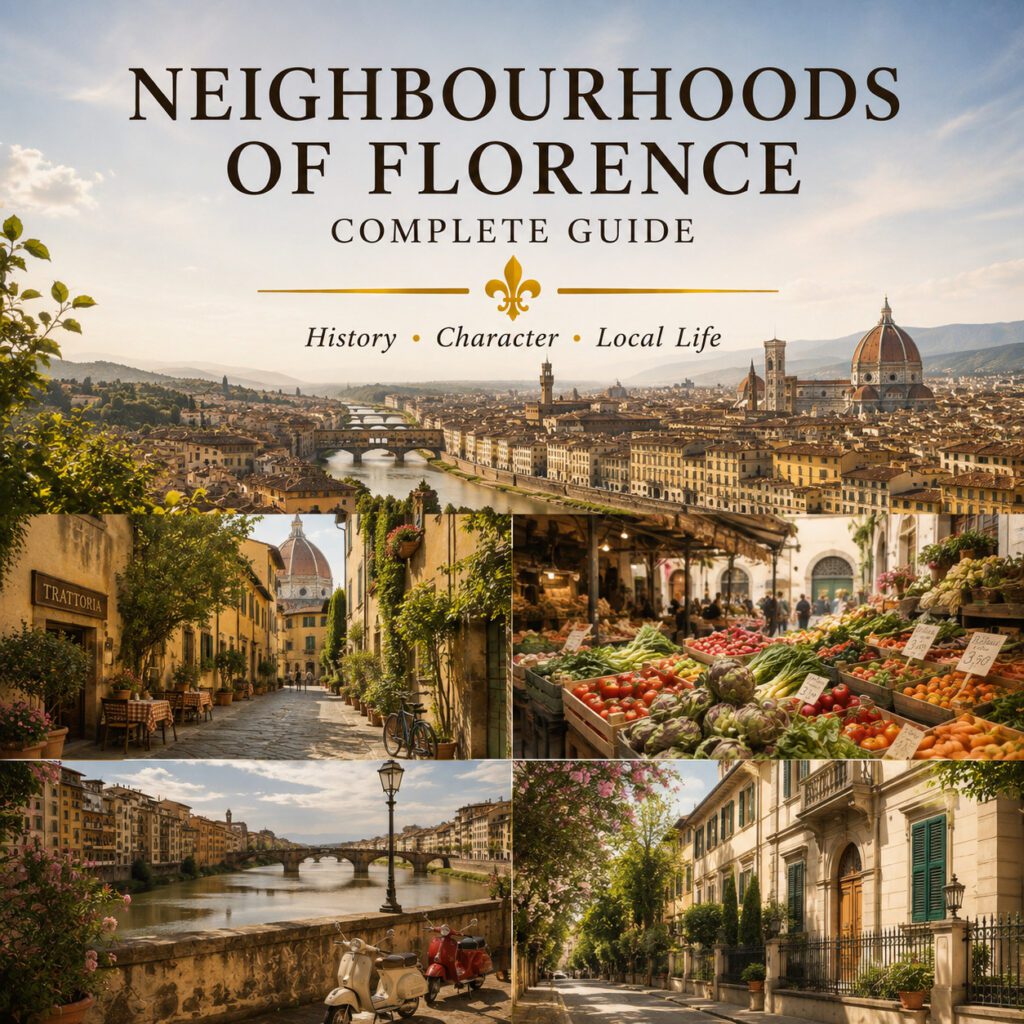
The neighbourhoods of Florence reveal a city with many different identities. Beyond the famous monuments, Florence consists of historic quarters, former working-class districts, market neighbourhoods and residential areas that developed as the city expanded beyond its medieval walls.
Santa Croce feels very different from San Lorenzo, while San Frediano has its own identity within the wider Oltrarno. Further from the historic centre, areas such as Le Cure, Gavinana and Coverciano reveal another Florence – residential, local and largely removed from the busiest Renaissance sights.
Historic centre: Santa Maria Novella, San Lorenzo, Santa Croce and Sant’Ambrogio
Oltrarno: Santo Spirito, San Frediano and San Niccolò
Residential Florence: Campo di Marte, Le Cure, Gavinana and Coverciano
Best for markets: San Lorenzo and Sant’Ambrogio
Best for artisan heritage: Santo Spirito and San Frediano
Best for local residential life: Le Cure, Gavinana and Coverciano
Important: Historic, administrative and locally used neighbourhood boundaries do not always coincide.
📑 Contents – Explore Florence by Neighbourhood
- Understanding the Neighbourhoods of Florence
- Santa Maria Novella
- San Lorenzo
- Santa Croce
- Sant’Ambrogio
- Santo Spirito
- San Frediano
- San Niccolò
- Campo di Marte
- Le Cure
- Gavinana
- Coverciano
- Neighbourhood Identities and Rivalries
- Historic Centre or Residential Florence?
- Which Florence Neighbourhood Should You Explore?
- Why Florence’s Neighbourhoods Are Worth Exploring
- Questions & Answers
Understanding the Neighbourhoods of Florence
Florence grew gradually around the Roman settlement of Florentia. Successive medieval city walls marked its expansion, while churches, monasteries, markets, workshops and powerful families gave different parts of the city their own identities.
The Arno created one of the most important natural divisions. Much of the historic centre developed north of the river, while the area known as the Oltrarno – literally “beyond the Arno” – grew on the southern bank.
Artisans, workshops and religious institutions became part of the Oltrarno’s character, alongside great aristocratic residences. Even today, crossing the Arno can feel like entering a subtly different part of Florence.
During the nineteenth and twentieth centuries, the city expanded far beyond its medieval boundaries. Campo di Marte, Le Cure, Gavinana and Coverciano became part of modern Florence and developed identities very different from the Renaissance centre.
The word quartiere can be confusing in Florence. It may describe a historic quarter, a modern administrative district or simply an area recognised locally as a neighbourhood. These geographical identities do not always have precise boundaries.
Santa Maria Novella – Florence’s Historic Gateway
Santa Maria Novella occupies the western side of the historic centre. Movement, commerce and travellers have shaped the area for centuries, while its historical identity developed around the Dominican Basilica of Santa Maria Novella.
The arrival of the railway transformed the neighbourhood into one of Florence’s principal gateways. Today, monumental architecture, hotels, restaurants, residential streets and transport connections coexist within a relatively compact area.
Move away from the station and the busiest routes, however, and quieter streets still reveal another side of Santa Maria Novella.
San Lorenzo – Markets, Medici and Everyday Florence
San Lorenzo is one of the oldest and historically most important neighbourhoods of Florence. The Basilica of San Lorenzo became closely associated with the Medici, whose patronage transformed the church and surrounding area.
Yet San Lorenzo is not only Medici Florence. Markets, workshops and commerce have shaped the neighbourhood for generations.
The Mercato Centrale remains one of its defining institutions, bringing together food, trade and everyday urban life only a short distance from some of the city’s greatest monuments.
The Medici connection with San Lorenzo began long before the family ruled Florence as dukes. Their patronage made the neighbourhood one of the best places to understand the family’s rise.
Santa Croce – Artisans and Monumental Florence
Santa Croce developed around the great Franciscan basilica on the eastern side of medieval Florence. Religious institutions existed alongside workshops, artisans and commercial activity.
Piazza Santa Croce provides the monumental centre, but the surrounding streets tell a broader story. Smaller squares, residential buildings, restaurants and local businesses make the district much more than the setting of its famous basilica.
This mixture of major monuments and everyday streets is one of Santa Croce’s defining characteristics.
Sant’Ambrogio – A Neighbourhood Built Around Its Market
Sant’Ambrogio lies east of the principal tourist axis and retains a particularly strong neighbourhood atmosphere. The Mercato di Sant’Ambrogio remains one of the area’s most important meeting points.
Residents shop here for vegetables, meat, cheese and other everyday products, while cafés, restaurants and small businesses animate the surrounding streets.
Students, long-term residents, artisans and visitors now share the neighbourhood. Despite its growing popularity, Sant’Ambrogio remains one of the easiest places close to the historic centre to observe ordinary Florentine life.
Visit Sant’Ambrogio in the morning rather than only in the evening. The market and surrounding shops reveal a different side of the neighbourhood before restaurants and bars become the main attraction.
Santo Spirito – The Heart of the Oltrarno
Across the Arno, Santo Spirito represents one of the best-known faces of the Oltrarno. Its broad piazza stands before Brunelleschi’s Basilica di Santo Spirito and functions as both a historic setting and a genuine neighbourhood meeting place.
Artisans and workshops have long shaped the surrounding streets. Restaurants, cafés and nightlife have added another layer, making Santo Spirito increasingly popular with visitors.
Tourism has undoubtedly changed the district, but traditional workshops, residential streets and lively public spaces continue to exist side by side.
San Frediano – Florence’s Historic Working-Class Neighbourhood
San Frediano lies west of Santo Spirito and traditionally maintained a particularly strong local identity. Artisans and working families shaped a neighbourhood historically regarded as more modest than the monumental streets north of the Arno.
Narrow streets, workshops and neighbourhood institutions still preserve traces of this heritage, although San Frediano has changed considerably.
Restaurants, independent shops and creative businesses have made the area increasingly fashionable. Rather than describing it as an untouched working-class district, it is more accurate to see San Frediano as a neighbourhood where older traditions and contemporary urban life now coexist.
Santo Spirito and San Frediano both belong to the Oltrarno, but they are not interchangeable. Each has its own streets, meeting places and sense of local identity.
San Niccolò – Between the Arno and the Hills
San Niccolò occupies a distinctive position between the Arno and the hills rising towards Piazzale Michelangelo. Narrow streets and the surviving Porta San Niccolò give the neighbourhood the feeling of a small enclave within Florence.
Restaurants and bars make the area lively in the evening, while stairways and streets climb towards the hills above the city.
This combination of river, medieval architecture and immediate access to panoramic walks gives San Niccolò a character unlike any other central Florentine neighbourhood.
Campo di Marte – Residential Florence and Football
Campo di Marte represents a very different Florence from the Renaissance centre. Much of the area developed outside the historic walls during the city’s modern expansion, and wide streets, sports facilities and residential buildings distinguish it from the dense medieval centre.
The Stadio Artemio Franchi gives Campo di Marte one of its strongest identities. On match days, the neighbourhood changes dramatically as Fiorentina supporters arrive from across Florence.
This sporting culture remains an important part of city life. Our guide to Football in Florence explores why Fiorentina means so much to the city.
Campo di Marte is a useful reminder that most Florentines do not live among Renaissance monuments. Residential districts and everyday routines are just as much part of contemporary Florence.
Le Cure – A Village Atmosphere Within Florence
Le Cure lies north of the historic centre and developed beyond Florence’s former city walls. It remains strongly residential, with a local market, neighbourhood shops and streets largely removed from intensive visitor traffic.
Its position between central Florence and the northern hills contributes to its distinctive atmosphere. At times, Le Cure can feel more like a small town than a neighbourhood of an internationally famous city.
The name is traditionally associated with the curandaie, women connected with washing and caring for linen in the area. Today, Le Cure remains interesting precisely because tourism has never become its principal purpose.
Gavinana – Everyday Life South of the Arno
Gavinana lies southeast of the historic centre and represents another predominantly residential side of Florence. Its development accelerated as the modern city expanded beyond its older boundaries.
Schools, shops, residential streets and local services define much of its character rather than monumental architecture.
For visitors interested in contemporary Florence, this apparent ordinariness is precisely the point. Gavinana shows how the city continued to grow long after the Renaissance period that dominates its international image.
Coverciano – Football and Residential Florence
Coverciano lies on the eastern side of Florence towards the foothills around Fiesole and Settignano. It is primarily residential, but one institution has made its name famous throughout Italy: the Centro Tecnico Federale.
The FIGC acquired the land in 1952 and inaugurated the centre in 1958. Since then, Coverciano has become synonymous with Italy’s national football teams and the education of coaches and other football professionals.
Beyond this national sporting role, the neighbourhood remains calm and residential. Its quiet streets provide a striking contrast to the crowded areas around Florence’s principal monuments.
In Italian football, “Coverciano” means much more than a geographical location. The name has become shorthand for the institutional home of the Italian national game.
Do Florence’s Neighbourhoods Have Rivalries?
Florence has a long tradition of strong local identities, although modern neighbourhood rivalries should not be exaggerated. Historically, residents often connected their loyalties with parishes, streets, trades and political factions.
These identities reinforced the idea of Florence as a collection of smaller communities rather than one culturally uniform city. The Arno also created a lasting distinction between areas north and south of the river.
Residents may still identify strongly with San Frediano, Santo Spirito or another part of Florence, but today these differences usually express neighbourhood pride rather than serious rivalry.
Football provides a more visible contemporary expression of collective identity. On match days, Campo di Marte fills with supporters, but the identity expressed there is overwhelmingly Florentine rather than a rivalry between individual neighbourhoods.
Historic Centre or Residential Florence?
For a first visit, the historic neighbourhoods provide extraordinary access to Florence’s architecture, museums, churches, markets and restaurants. Santa Maria Novella, San Lorenzo, Santa Croce and the Oltrarno place visitors within walking distance of many major sights.
Residential districts reveal something different. Le Cure, Campo di Marte, Gavinana and Coverciano show how Florence functions as a contemporary Italian city rather than simply as a Renaissance destination.
Neither experience is inherently more authentic. Together, they explain why Florence can feel simultaneously like an international cultural capital and a surprisingly intimate collection of local communities.
Avoid dividing Florence too simply into “tourist” and “authentic” areas. People live, work, shop and raise families even inside the historic centre, while residential districts are constantly changing too.
Which Florence Neighbourhood Should You Explore?
Visitors interested in markets and traditional commerce should explore San Lorenzo and Sant’Ambrogio. For artisan heritage and evening atmosphere, Santo Spirito and San Frediano are natural choices.
San Niccolò combines neighbourhood character with easy access to the hills above Florence, while Santa Croce offers an appealing mixture of monumental architecture and smaller residential streets.
If you want to understand residential Florence, venture towards Le Cure, Campo di Marte, Gavinana or Coverciano. These districts rarely dominate conventional guidebooks, but that is precisely why they provide such a useful counterpoint to the historic centre.
You do not need to explore all of them. Spending a few unhurried hours in even one neighbourhood can considerably broaden your impression of Florence.
Why Florence’s Neighbourhoods Are Worth Exploring
The neighbourhoods of Florence show how the city’s history became part of everyday life. Markets still occupy traditional meeting places, artisan workshops survive in streets associated with particular crafts, and residential districts preserve identities that developed as Florence expanded.
Looking beyond individual landmarks also changes the scale of the city. Florence becomes less a collection of masterpieces and more a network of communities connected by streets, markets, bridges and shared history.
This perspective does not diminish the importance of the Duomo, Uffizi or Palazzo Pitti. Instead, it places those monuments within the living city that surrounds them.
Do not try to “complete” Florence neighbourhood by neighbourhood. Choose one area and walk without a rigid itinerary. Visit its market, stop at a local café and notice how its streets differ from those you explored the day before.
Questions & Answers About the Neighbourhoods of Florence
What are the main neighbourhoods of Florence?
Among the best-known central areas are Santa Maria Novella, San Lorenzo, Santa Croce, Sant’Ambrogio, Santo Spirito, San Frediano and San Niccolò. Campo di Marte, Le Cure, Gavinana and Coverciano represent important parts of residential Florence beyond the historic centre.
Which neighbourhood is best for experiencing local life in Florence?
Sant’Ambrogio, San Frediano and Le Cure are particularly interesting for visitors looking for a strong neighbourhood atmosphere. Local life, however, exists throughout Florence once you move away from the busiest visitor routes.
What is the Oltrarno?
Oltrarno literally means “beyond the Arno” and broadly describes Florence south of the river. Santo Spirito and San Frediano are among its best-known neighbourhoods, while artisans and workshops have traditionally played an important role in the area.
Which Florence neighbourhood is known for artisans?
The Oltrarno has a particularly strong association with artisan workshops, especially around Santo Spirito and San Frediano. Woodworkers, restorers, metalworkers and other craftspeople have historically worked in this part of Florence.
Which Florence neighbourhoods are less touristy?
Le Cure, Gavinana, Coverciano and parts of Campo di Marte receive considerably fewer visitors than the historic centre. They provide a useful view of contemporary residential Florence.
Which neighbourhood is best for markets?
San Lorenzo is home to the Mercato Centrale, while Sant’Ambrogio has one of Florence’s most characteristic neighbourhood food markets. Both areas demonstrate the continuing importance of markets in Florentine daily life.
Are Florence neighbourhood boundaries clearly defined?
Not always. Historic neighbourhood names, traditional local identities and modern administrative boundaries frequently overlap. For visitors, the names are most useful as a way to understand the geography and character of different parts of Florence.
Further Reading on Firenze Casa
Continue exploring Florence through its neighbourhoods, markets, local traditions and everyday life beyond the city’s most famous monuments.
- Local Life in Florence – Complete Guide
- Mercato Centrale Florence
- Football in Florence – Why Fiorentina Means So Much to the City
- Porta San Niccolò – Florence’s Medieval Tower Gate
- Florence Before the Crowds – The City in the Early Morning
- Quiet Florence – The Best Places We Never Queued For
References
- Comune di Firenze – Quartieri and municipal information.
- Treccani – Historical and geographical entries on Florence.
- Encyclopaedia Britannica – Florence: history and urban development.
- Federazione Italiana Giuoco Calcio – Centro Tecnico Federale di Coverciano.
- Mercato Centrale Firenze – History of the San Lorenzo market area.

