
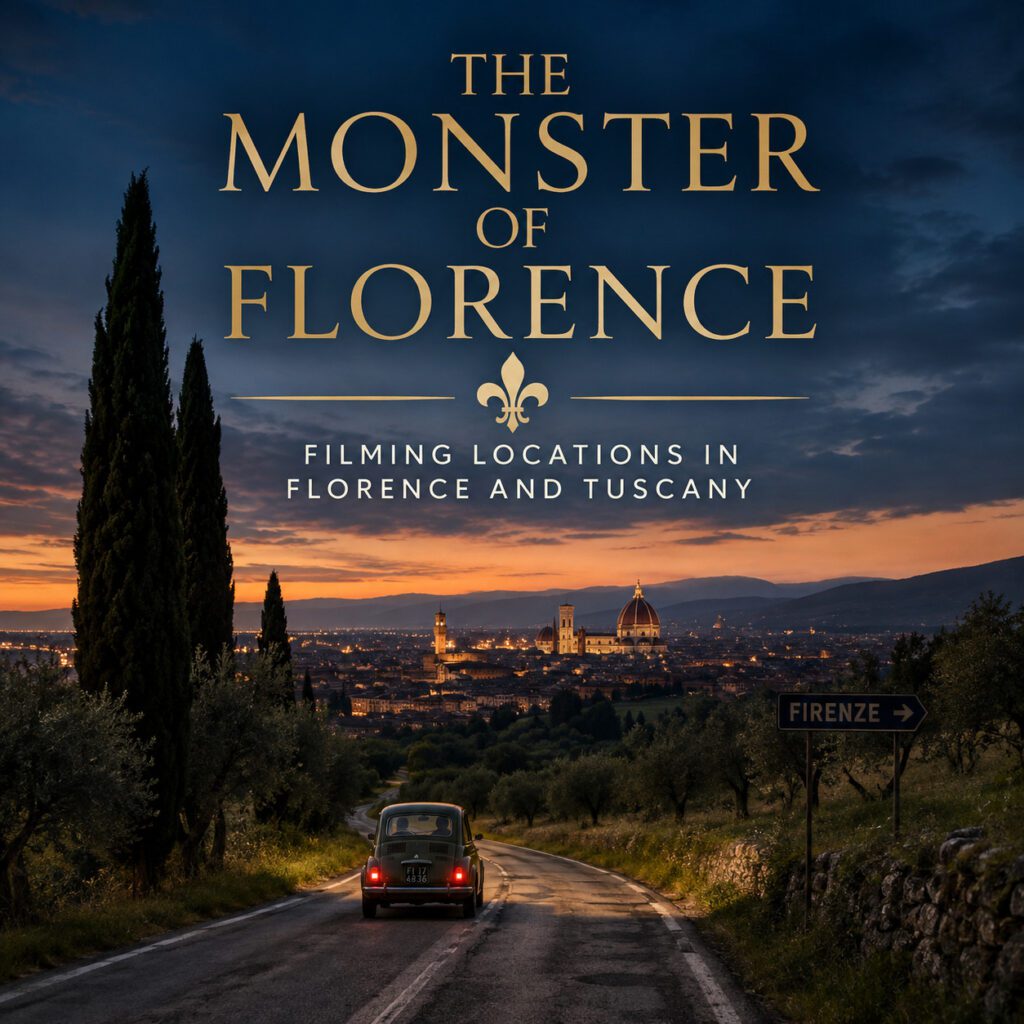
The Monster of Florence filming locations bring one of Italy’s darkest criminal cases back to the places where the story unfolded. Stefano Sollima’s four-part Netflix miniseries The Monster of Florence, released in 2025, was filmed partly in Florence and partly in the surrounding Tuscan towns and countryside.
Unlike productions that use Florence primarily for its Renaissance beauty, this series shows a very different side of the city. Piazza San Firenze, Via San Gallo, Trespiano and communities beyond the historic centre become settings for a story rooted in fear, investigation and uncertainty. The result is an unusual addition to our Movies Filmed in Florence – Famous Films and Locations.
Series: The Monster of Florence – Il Mostro
Director: Stefano Sollima
Creators: Leonardo Fasoli and Stefano Sollima
Release: 22 October 2025
Episodes: four
Platform: Netflix
Florence locations: Piazza San Firenze, Via San Gallo and Cimitero di Trespiano
Other Tuscan locations: Signa, Mercatale Val di Pesa, San Casciano in Val di Pesa and Campi Bisenzio
Filming in Tuscany: November 2023
A Different Florence on Screen
Florence has been represented on screen in countless ways. Filmmakers have used its palaces and piazzas for historical dramas, romantic stories, literary adaptations and international thrillers. The city often appears as one of the most beautiful backdrops in European cinema.
The Monster of Florence turns that familiar image almost upside down. Its Florence is connected with police investigations, courtrooms, cemeteries and the surrounding countryside. Instead of presenting Tuscany as an idyllic landscape, the series recalls a period when isolated roads and secluded places around the city acquired very different associations.
This contrast is precisely what makes The Monster of Florence filming locations interesting from a cinematic perspective. They demonstrate how the same city and landscape can communicate an entirely different atmosphere depending on the story being told.
This is not the postcard Florence of romantic cinema. The series deliberately explores another layer of the city and its surroundings – one connected with a criminal case deeply embedded in modern Italian memory.
What Was the Monster of Florence Case?
The name Mostro di Firenze, or Monster of Florence, became associated with a series of eight double murders committed in Florence and its surrounding area between 1968 and 1985. Sixteen people were killed, most of them couples in secluded locations outside the city.
The repeated use of the same .22 calibre ammunition linked the crimes and contributed to one of the longest and most controversial criminal investigations in modern Italian history.
Numerous suspects, investigative theories and judicial proceedings followed. The case developed into a complicated network of competing hypotheses, disputed evidence and unresolved questions. That uncertainty is central to understanding why it continues to attract attention decades later.
The Monster of Florence case remains complex and controversial. This article focuses primarily on the television production and its filming locations rather than attempting to identify the perpetrator or resolve disputed theories.
Florence and the Fear Surrounding the Case
For people who knew Florence during the 1970s and 1980s, the case was not an abstract crime story from another part of Italy. The murders occurred around the city and became part of newspaper coverage, everyday conversation and public anxiety.
The circumstances were particularly unsettling because several attacks involved couples who had sought privacy in secluded areas. Hills, country roads and wooded places normally belonging to the familiar geography of Tuscan life temporarily acquired darker associations.
This is a Florence far removed from the city of Renaissance masterpieces, yet it belongs just as much to its modern history. The series is particularly interesting for this reason: it explores Florence as a real twentieth-century city rather than an unchanging historical backdrop.
Stefano Sollima’s The Monster of Florence
The four-part Netflix miniseries was created by Leonardo Fasoli and Stefano Sollima, with Sollima directing all four episodes. Sollima was already known for crime dramas and thrillers including Romanzo Criminale, Gomorrah and Sicario: Day of the Soldado.
Rather than attempting to compress every investigative theory into four episodes, the first chapter concentrates particularly on what became known as the Sardinian trail. The story develops through suspects, relationships, testimony, procedural material and the investigations surrounding the crimes.
The Series Is Not Based on a Book
Because several important books have been written about the Monster of Florence, it is easy to assume that Sollima’s series adapts one of them. It does not. The production is a screen treatment of the real case rather than an adaptation of a particular book.
The distinction matters because the Monster of Florence has accumulated an enormous body of journalism, court material, books and competing interpretations over several decades.
The Netflix series should therefore not be confused either with Magdalen Nabb’s fictional novel or with the later nonfiction book by Douglas Preston and Mario Spezi.
Netflix’s The Monster of Florence is not an adaptation of a book. Several well-known books explore the same case, but they are separate works with very different approaches.
Where Was The Monster of Florence Filmed?
The Monster of Florence filming locations are concentrated in Florence and the surrounding area. According to the Toscana Film Commission, filming took place in the city and province of Florence for approximately ten days during November 2023.
Within Florence itself, confirmed locations include Piazza San Firenze, the former Court of Appeal in Via San Gallo and the Cimitero di Trespiano. The production also used locations in Signa, Mercatale Val di Pesa, San Casciano in Val di Pesa and Campi Bisenzio.
This geographical spread suits the story particularly well. The Monster of Florence case was never confined to Florence’s monumental centre. Its geography extends into towns, roads and countryside surrounding the city.
Piazza San Firenze
Piazza San Firenze is one of the most centrally located filming locations used for the series. Only a short walk from Piazza della Signoria, the square is dominated by the monumental complex of San Firenze and Palazzo Gondi.
Today, visitors cross the piazza while moving between some of Florence’s best-known attractions. Its appearance in The Monster of Florence demonstrates how effectively familiar parts of the historic centre can be transformed through period vehicles, costumes and careful framing.
Piazza San Firenze also belongs to Florence’s long literary geography. The surrounding medieval streets feature in our Florence in Literature – Complete Guide, providing an interesting bridge between the city on the page and Florence on screen.
Piazza San Firenze lies between Piazza della Signoria and Santa Croce. You do not need a special excursion to see this filming location – it fits naturally into a walk through the historic centre.
Via San Gallo and the Former Court of Appeal
Another important Florence location was the former Court of Appeal in Via San Gallo. This choice reflects the judicial and investigative dimensions of the story rather than the monumental Florence normally selected by international productions.
Via San Gallo runs north from the area around Piazza San Marco and has a different character from Florence’s grand ceremonial squares. Palaces, former religious institutions and ordinary urban buildings create a streetscape capable of representing different periods of the twentieth century.
For a production centred on police and judicial investigations, locations such as this are as important as the immediately recognisable landmarks of central Florence.
Cimitero di Trespiano
The Cimitero di Trespiano was another confirmed location used by the production. Situated north of central Florence, Trespiano is one of the city’s major cemeteries and lies outside the normal tourist geography.
Its inclusion reinforces an important characteristic of the series: much of the Florence it portrays exists beyond the Renaissance centre. This is the larger metropolitan landscape of institutions, suburbs, roads and surrounding hills in which the historical investigation unfolded.
Florence has several cemeteries with very different histories. Visitors interested in their cultural and historical significance can also explore the Cimitero degli Inglesi, which tells the story of the city’s nineteenth-century international community.
Signa and Campi Bisenzio
West of Florence, Signa was among the municipalities selected for filming. The town lies along the Arno and forms part of the wider Florentine metropolitan area. Campi Bisenzio, northwest of the city, provided another urban and suburban environment outside the highly protected historic centre.
Locations such as these allow filmmakers to reconstruct an earlier period without depending entirely on central Florence. Streets, buildings and surrounding landscapes can provide convincing settings for scenes representing everyday Tuscany during the decades covered by the story.
Together they broaden the visual geography of the series from famous Florence to the much larger territory surrounding it.
Mercatale and San Casciano in Val di Pesa
Mercatale Val di Pesa and San Casciano in Val di Pesa bring the production south of Florence into the Chianti landscape. Visitors normally associate this area with vineyards, olive groves, country roads and villages. In The Monster of Florence, however, the countryside carries a more uneasy atmosphere.
This reversal of expectations is one of the production’s most interesting visual choices. A landscape celebrated internationally for beauty becomes a setting in which isolation itself can feel threatening.
San Casciano also belongs to a much older chapter of Florentine history. Near the town lies Sant’Andrea in Percussina, where Niccolò Machiavelli lived after his removal from political office and worked on The Prince. The same countryside therefore connects remarkably different periods of Florence’s cultural history.
Chianti usually appears on screen as an idyllic landscape of vineyards, villas and sunsets. The Monster of Florence uses the countryside around Florence very differently, showing how narrative and atmosphere can completely change our perception of the same landscape.
Why the Real Locations Matter
Filming a story where it actually belongs geographically does not automatically make a drama historically accurate. Yet in this case, the use of Florence and its surrounding communities gives the series a strong sense of place.
The distinction between centre and periphery is particularly important. The investigation involved institutions in Florence, while the crimes became associated largely with secluded locations beyond the dense urban core.
The camera can therefore move between city streets, official buildings, small towns and open countryside without losing the geographical relationship between them. Florence is not merely a label attached to the title; the wider Florentine landscape becomes part of the visual narrative.
Florence in the 1970s and 1980s
Another fascinating aspect of the series is its reconstruction of relatively recent history. Renaissance Florence may appear timeless on screen, but recreating the city forty or fifty years ago presents a very different challenge.
Cars, street signs, clothing, interiors and everyday objects have changed enormously. Even streets whose architecture remains largely intact contain countless modern details that can reveal when a scene was actually filmed.
The production therefore had to create a Florence familiar enough to be recognisable while removing or disguising elements belonging to the twenty-first century. For viewers who remember Italy during those decades, such everyday details can be as evocative as the major locations themselves.
The Countryside Is Almost a Character
The landscape around Florence plays an unusual role in the story. Tuscany is one of the world’s most romanticised regions, and cinema has contributed enormously to that image.
Here, darkness, distance and isolation transform familiar countryside into something psychologically different. A quiet road through the hills can feel peaceful during the day and profoundly isolated at night.
This does not make the Tuscan landscape sinister. Rather, it demonstrates how cinema changes our perception of place through narrative, sound, lighting and context.
Why the Case Became Part of Florentine Memory
The long duration of the murders and investigation helps explain why the Monster of Florence became embedded in the collective memory of the region. Seventeen years separated the first and last crimes associated with the series.
For residents, the case unfolded gradually rather than appearing as a completed story. Newspaper reports, new suspects, investigative developments and rumours accumulated over years.
That experience is difficult for a modern viewer encountering the story through four episodes to reproduce. People living in Florence at the time did not know what would happen next, whether another attack would occur or whether an arrest would finally end the uncertainty.
The Monster of Florence in Literature
Long before Stefano Sollima’s Netflix series, the Monster of Florence had entered literature. Two books with almost identical English titles are particularly important, but they could hardly be more different in approach.
British crime writer Magdalen Nabb, who settled in Florence in 1975, published The Monster of Florence in 1996 as part of her acclaimed Marshal Guarnaccia series. The novel is fiction, although it was inspired by the real murders and incorporated details connected with the case.
Nabb did not attempt to write a definitive history of the investigation. Instead, the real case became the basis for a fictional police procedural featuring Marshal Salvatore Guarnaccia, the quiet Sicilian Carabiniere through whose investigations Nabb explored Florence and its inhabitants.
Her novel is particularly interesting because Nabb knew Florence as a resident rather than simply as a visitor. The Florence of the Guarnaccia novels is not merely a collection of Renaissance monuments; it is a working city of police stations, apartments, bars, families and neighbourhoods.
Magdalen Nabb’s The Monster of Florence is a fictional Marshal Guarnaccia novel inspired by the real murders. It should not be confused with either the Netflix series or the later true-crime book by Douglas Preston and Mario Spezi.
Douglas Preston and Mario Spezi – A True Story
A very different book appeared in 2008. American writer Douglas Preston and Italian journalist Mario Spezi published The Monster of Florence: A True Story, a nonfiction account of the case and their own involvement in investigating it.
Spezi had followed the investigation for years as a journalist. Preston became fascinated by the case after moving with his family to the Florence area and meeting Spezi. Their collaboration eventually became part of the story itself as their investigation brought them into conflict with authorities involved in the case.
The resulting book combines true crime, investigative journalism and personal experience. Unlike Nabb’s novel, it presents itself as an account of the actual investigation and the authors’ efforts to understand what had happened.
Magdalen Nabb, The Monster of Florence (1996): fictional Marshal Guarnaccia crime novel inspired by the real case.
Douglas Preston & Mario Spezi, The Monster of Florence: A True Story (2008): nonfiction account of the case and the authors’ investigation.
The Separate Antonio Banderas Project
The Preston and Spezi book also explains why Antonio Banderas sometimes appears in searches for The Monster of Florence. An English-language screen project based on The Monster of Florence: A True Story was developed separately, with Banderas associated with the role of Mario Spezi.
That project is not Stefano Sollima’s Netflix miniseries. Antonio Banderas does not appear in the 2025 Netflix production, and Sollima’s series is not an adaptation of Preston and Spezi’s book.
Keeping the different works separate makes the chronology much clearer: the real murders inspired Nabb’s fictional novel; Preston and Spezi later produced their nonfiction account; a screen adaptation of their book was developed separately; and Netflix eventually produced Sollima’s independent interpretation of the historical case.
The Netflix miniseries The Monster of Florence is not the earlier screen project associated with Antonio Banderas. That project was connected with the Preston and Spezi book; Sollima’s series is a separate production.
True Crime and the Risk of Turning Places into Attractions
Film-location tourism is usually harmless fun. Standing where a favourite romantic comedy or historical drama was filmed can add another layer to exploring a city.
True crime requires greater sensitivity. Locations connected with a dramatic production should not automatically be treated as attractions associated with the real victims.
There is an important distinction between visiting Piazza San Firenze because it appeared in the Netflix series and seeking out isolated places associated with actual murders. Firenze Casa strongly favours the first approach.
This guide identifies confirmed filming locations used by the television production. It is not intended as a guide to the actual crime scenes. Real people lost their lives in this case, and that distinction deserves to be respected.
From Piazza San Firenze to the Chianti Hills
For visitors interested specifically in the production, the confirmed filming locations reveal an unusually broad cross-section of the Florentine area.
Piazza San Firenze can be visited during an ordinary walk through the historic centre. Via San Gallo takes you towards San Marco and the northern part of central Florence. Trespiano lies beyond the centre, while Signa and Campi Bisenzio reveal the metropolitan landscape west and northwest of the city.
Travelling south towards Mercatale and San Casciano brings an entirely different Florence into view – the city opening into the hills and countryside of Chianti. For a very different perspective on this landscape, our Antinori nel Chianti Classico guide explores its wine culture and contemporary architecture.
Together, these places show why “Florence” on screen can mean much more than the Duomo and Ponte Vecchio.
A New Chapter of The Monster of Florence
The screen story is not finished. In June 2026, Netflix announced that production had begun on a new three-episode instalment directed by Stefano Sollima and again created by Sollima and Leonardo Fasoli.
The new chapter turns towards another major strand of the investigation, concentrating on Pietro Pacciani and the theory associated with the men popularly known as the Compagni di merende.
This allows the project to approach another investigative chapter rather than forcing decades of contradictory evidence and theories into a single linear explanation. Filming began in Rome, with further filming in Florence announced for the production.
The first four episodes are not the end of Sollima’s treatment of the case. A new three-episode chapter focusing on Pietro Pacciani and the Compagni di merende investigative lead entered production in 2026.
Why The Monster of Florence Is Different from Other Florence Productions
Many international productions come to Florence because the city is instantly recognisable. The Duomo establishes location within seconds, Ponte Vecchio provides romance and Piazza della Signoria provides grandeur.
The Monster of Florence does not need Florence in quite the same way. Its identity comes instead from the relationship between the city and the territory around it.
Via San Gallo, Trespiano, Signa and Mercatale may not provide the instant recognition of Brunelleschi’s dome, but they create something more appropriate for this story: geographical authenticity.
This makes the series especially interesting within Florence’s screen history. Compare it with the wartime city of Paisà, the expatriate memories of Tea with Mussolini or the romantic Florence of A Room with a View. Each production uses the same city to tell an entirely different story.
Is The Monster of Florence Worth Watching?
For viewers interested in Florence, Italian history and serious crime drama, The Monster of Florence offers a very different perspective on Tuscany. It is deliberately uncomfortable material and clearly not a conventional travel-inspired series.
Its strongest connection with Firenze Casa is the way it uses location. Florence appears not as a Renaissance fantasy but as a real twentieth-century city connected with suburbs, small towns and countryside.
The books by Magdalen Nabb and by Douglas Preston and Mario Spezi add another dimension. Together with Sollima’s series, they demonstrate how the same unresolved chapter of Florentine history has been approached through fiction, investigative nonfiction and television drama.
That broader cultural and geographical context is worth understanding even without a particular interest in true crime. Florence has always been more complex than the image presented on postcards, and cinema and literature can reveal aspects of the city that conventional travel stories leave untouched.
Frequently Asked Questions
Where was The Monster of Florence filmed?
Confirmed locations include Piazza San Firenze, the former Court of Appeal in Via San Gallo, Cimitero di Trespiano, Signa, Mercatale Val di Pesa, San Casciano in Val di Pesa and Campi Bisenzio.
Was The Monster of Florence really filmed in Florence?
Yes. Filming took place in the city and province of Florence during November 2023.
Where in central Florence was the series filmed?
Piazza San Firenze and the former Court of Appeal in Via San Gallo are among the confirmed central Florence locations.
Was The Monster of Florence filmed in Chianti?
Yes. Mercatale Val di Pesa and San Casciano in Val di Pesa, south of Florence in the Chianti area, were used by the production.
Who directed The Monster of Florence?
Stefano Sollima directed the four-part miniseries and created it together with Leonardo Fasoli.
When was The Monster of Florence released?
The four episodes were released on Netflix on 22 October 2025.
Is the Netflix series based on a book?
No. Sollima’s series is a treatment of the real Monster of Florence case rather than an adaptation of a particular book.
Does Antonio Banderas appear in The Monster of Florence?
No. Banderas was associated with a separate planned adaptation connected with the book by Douglas Preston and Mario Spezi.
Did Magdalen Nabb write a book called The Monster of Florence?
Yes. Nabb published The Monster of Florence in 1996 as part of her Marshal Guarnaccia series. It is a fictional crime novel inspired by the real murders.
What is the Douglas Preston and Mario Spezi book?
The Monster of Florence: A True Story, published in 2008, is a nonfiction account examining the case and the authors’ experiences investigating it.
Is The Monster of Florence based on a true story?
Yes. The drama is based on the investigation into eight double murders committed in the Florence area between 1968 and 1985.
Has the Monster of Florence case been solved?
The judicial history is extremely complex, involving suspects, trials and competing theories. Responsibility for the entire series of murders remains disputed.
Will there be more episodes?
Yes. A new three-episode chapter focusing particularly on Pietro Pacciani and the Compagni di merende investigative lead entered production in 2026.
Further Reading on Firenze Casa
- Movies Filmed in Florence – Famous Films and Locations
- Magdalen Nabb and Marshal Guarnaccia
- Florence in Literature – Complete Guide
- Paisà – Rossellini and Florence During the Second World War
- Tea with Mussolini – Florence and the Scorpioni on Screen
- A Room with a View – Florence Through the Locations of the Film
- Niccolò Machiavelli and The Prince
- Antinori nel Chianti Classico
References
- Netflix – The Monster of Florence. Official series information and production notes.
- Toscana Film Commission – The Monster of Florence: Stefano Sollima’s Netflix series filmed in Tuscany.
- Toscana Film Commission – Tuscany at the Venice Film Festival: authors and projects.
- Toscana Film Commission – The Monster: Pietro Pacciani, production information for the new chapter.
- Visit Tuscany – Florence and Cinema: films and television productions shot in the city.
- Nabb, Magdalen. The Monster of Florence. HarperCollins, 1996.
- Preston, Douglas and Mario Spezi. The Monster of Florence: A True Story. Grand Central Publishing, 2008.

