

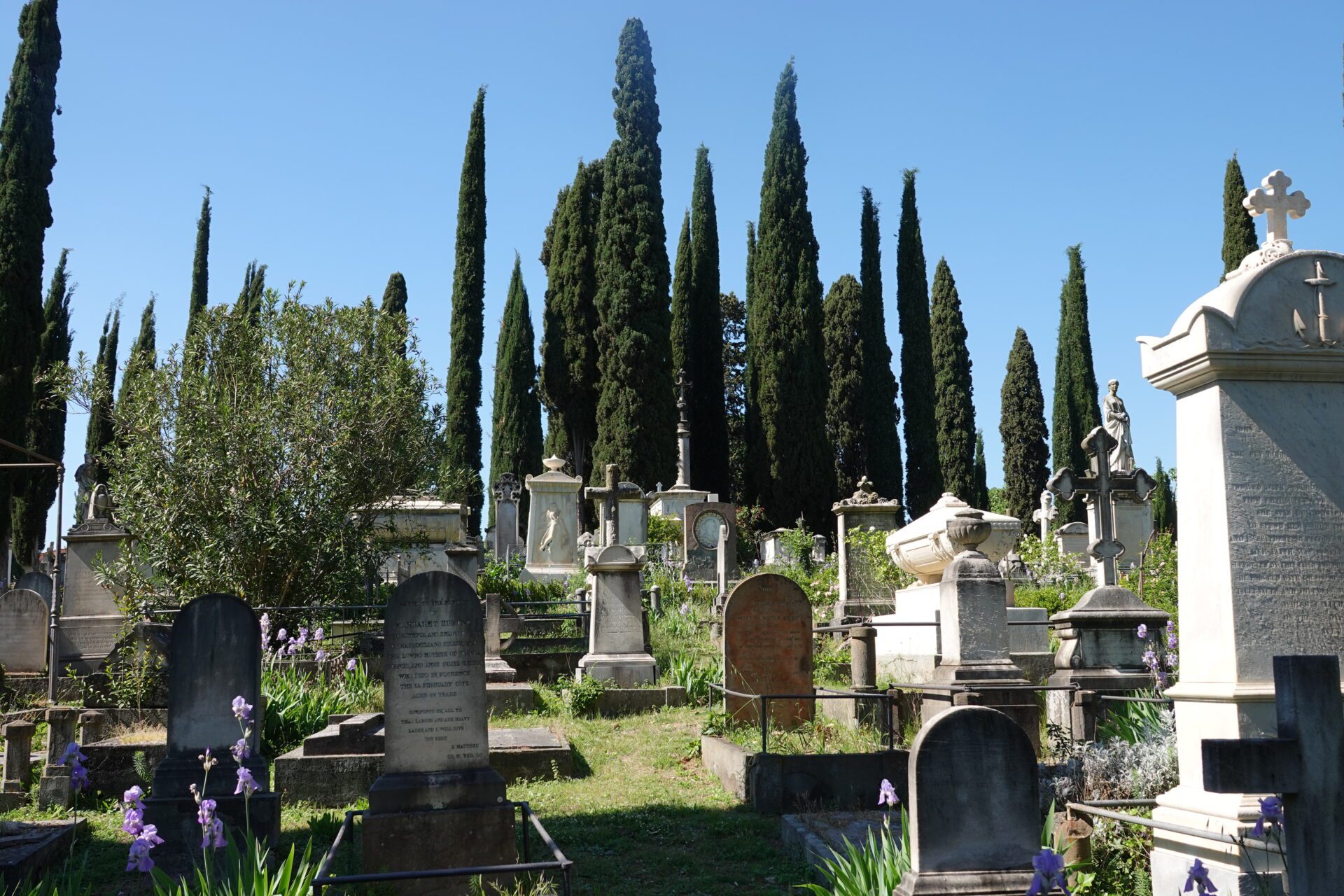
Cimitero degli Inglesi in Florence is one of the city’s most unusual historic cemeteries. At busy Piazzale Donatello, a small green hill rises quietly behind an iron fence. Traffic circles around it throughout the day, yet inside the gates cypress trees, historic gravestones and narrow paths create an atmosphere almost detached from modern Florence.
The cemetery tells a much broader story than its familiar English name suggests. British writers, American artists, Swiss families and other Protestant residents made nineteenth-century Florence their home, and many eventually found their final resting place here. Today, the cemetery is both a peaceful historic site and a remarkable record of Florence’s international past.
Established: 1827
Location: Piazzale Donatello, Florence
Historic community: International Protestant and non-Catholic residents
Most famous grave: Elizabeth Barrett Browning
Special feature: Strong Swiss historical connection
Character: Small, atmospheric and unusually peaceful
Suggested visit: 30–45 minutes
Access: Opening days and hours can vary
The cemetery forms part of the wider story explored in our Historic Cemeteries in Florence – Complete Guide.
More Than an “English” Cemetery
Despite its familiar name, the Cimitero degli Inglesi was never exclusively English. Florence’s Evangelical Reformed community established the cemetery in 1827, when the growing number of Protestant and other non-Catholic foreign residents required an appropriate burial place.
The cemetery was created outside the city walls near Porta a’ Pinti. British residents formed an important part of the community, but Americans, Swiss and people from several other countries were also buried here.
The graves therefore reveal the remarkable international character of nineteenth-century Florence, when the city attracted writers, artists, scholars, travellers and wealthy residents from across Europe and North America.
This cosmopolitan world is explored more broadly in our Foreigners Who Shaped Florence – Complete Guide.
The name “English Cemetery” can be misleading. The burial ground served an international Protestant and non-Catholic community and has particularly strong historical connections with Switzerland.
The Strong Swiss Connection
One of the most fascinating aspects of the cemetery often escapes visitors: its exceptionally strong connection with Switzerland.
Between 1827 and 1875, the cemetery received the remains of 433 Swiss citizens. This substantial number demonstrates the importance of the Swiss Protestant community in nineteenth-century Florence.
The cemetery also retains its historical association with the Swiss Evangelical Reformed community that founded and maintained it. Entrance plaques still draw attention to this heritage.

These details correct the common impression created by the name “English Cemetery”. English-speaking residents certainly played a prominent role, but the burial ground belonged to a much broader Protestant world.
Swiss merchants, professionals and families lived alongside British, American and other foreign residents, becoming part of the cosmopolitan society that flourished in Florence during the nineteenth century.
More than 400 Swiss citizens were buried here between 1827 and 1875. The cemetery therefore preserves an important chapter of Swiss history in Florence that many visitors never encounter elsewhere in the city.
Giovan Pietro Vieusseux and Florence’s Intellectual World
Among the important personalities buried here is Giovan Pietro Vieusseux. Born in Oneglia into a family of Genevan origin, he became one of the central figures in nineteenth-century Florentine intellectual life.
In 1819, Vieusseux founded the Gabinetto Scientifico Letterario G. P. Vieusseux. The institution offered newspapers, journals and books from across Europe, but it quickly became much more than a reading room.
Writers, scholars, politicians and travellers met there to exchange literary, political and scientific ideas. The Gabinetto Vieusseux became one of the institutions that helped make Florence an important international intellectual centre.
The institution still exists today, making Vieusseux’s grave a direct link between the cemetery and the cosmopolitan cultural world of nineteenth-century Florence.
Elizabeth Barrett Browning
The most famous person buried in the Cimitero degli Inglesi in Florence is undoubtedly Elizabeth Barrett Browning.
The English poet came to Italy with her husband Robert Browning after their marriage in 1846. Florence soon became central to their life together, and the couple settled at Casa Guidi near Palazzo Pitti.
Elizabeth continued her literary work in Florence and became deeply interested in Italian political developments. She followed the Risorgimento closely and sympathised with the movement towards Italian independence and national unification.
She died in Florence in 1861. Her distinctive tomb, designed by the artist Frederic Leighton, remains one of the cemetery’s most important monuments.

Elizabeth Barrett Browning’s story can still be followed through Florence. Visit Casa Guidi near Palazzo Pitti and then her grave at Piazzale Donatello to discover how deeply the poet’s life became connected with the city.
Other Famous Graves at the English Cemetery
Elizabeth Barrett Browning may attract the most attention, but she is far from the only important personality buried here. Writers, artists, intellectuals and reformers lie throughout this surprisingly small cemetery.
Frances Trollope
Frances Trollope, often known as Fanny Trollope, became a successful English novelist and travel writer and was the mother of novelist Anthony Trollope.
After travelling in the United States, she wrote extensively about American society. She later spent many years in Italy and died in Florence in 1863.
Walter Savage Landor
English writer and poet Walter Savage Landor spent important periods of his life in Florence. His long literary career connected him with many prominent writers of the nineteenth century, while his attachment to Tuscany made Florence central to his later years.
Arthur Hugh Clough
Victorian poet Arthur Hugh Clough died in Florence in 1861. Although less widely known today, he belonged to an influential generation of British writers and intellectuals and adds another important name to the cemetery’s remarkable literary community.
Hiram Powers
American sculptor Hiram Powers represents the artistic world of expatriate Florence. He moved to the city during the 1830s and established a successful studio.
His sculpture The Greek Slave became one of the best-known American sculptures of the nineteenth century. Powers spent much of his career in Florence and became a central figure within the city’s American artistic community.
Theodore Parker
American theologian and reformer Theodore Parker spent the final months of his life in Florence. He had gained prominence in the United States as a religious thinker, social reformer and outspoken abolitionist.
Parker died in Florence in 1860. His grave reminds visitors that the cemetery preserves political and social history as well as literature and art.
A Cemetery of Florence’s International Community
The famous names tell only part of the story. Hundreds of lesser-known graves may reveal even more about nineteenth-century Florence.
Merchants, children, diplomats, travellers, artists and entire families rest here, while inscriptions in different languages record origins across Europe and North America.
These graves document an important transformation in Florence. By the nineteenth century, the city had become much more than a destination for brief cultural visits. Foreign residents increasingly settled here for years or even decades.
Some came because of Florence’s artistic heritage, while others were attracted by Tuscany’s climate and landscape. Writers sought inspiration, painters and sculptors studied the city’s collections, and expatriate communities established churches, institutions and social networks.
The Cimitero degli Inglesi survives as one of the most tangible records of this international Florence.
Why the Cemetery Appears Elevated
The unusual physical position of the cemetery tells another fascinating story. When it opened in 1827, the burial ground stood outside Florence’s city walls near Porta a’ Pinti.
The surrounding landscape looked completely different from today’s busy Piazzale Donatello. The decisive transformation occurred after Florence became capital of the Kingdom of Italy in 1865.
Architect Giuseppe Poggi directed much of the city’s redevelopment. Large sections of the medieval walls disappeared, broad avenues were created and new residential districts spread outward.
The cemetery remained in place while the road system developed around it. Piazzale Donatello consequently encircles the burial ground, leaving it raised above street level like a small green island.
The cemetery therefore preserves not only nineteenth-century graves but also physical evidence of the transformation explored in Florence as Capital of Italy – Firenze Capitale 1865–1871.
The cemetery is also a small lesson in Florentine urban history. Its elevated position helps explain how radically Giuseppe Poggi transformed this part of Florence during the nineteenth century.
Why Burials Ended Here
Florence’s expansion eventually made the cemetery unsuitable for continued regular burial. As the city spread beyond its former walls, what had originally been a cemetery outside Florence became surrounded by the expanding urban area.
New regulations restricted further burials, and regular interments ended during the 1870s.
The Protestant community therefore required another burial ground. The Cimitero Evangelico agli Allori on Via Senese continued Florence’s international Protestant burial tradition.
The two cemeteries consequently form successive chapters of the same history: Piazzale Donatello represents the earlier nineteenth-century expatriate community, while Agli Allori carries that story into later generations.
A Place of Quiet Contrast
History explains the importance of the cemetery, but atmosphere explains much of its appeal.
Outside the gates, cars circulate continuously around Piazzale Donatello. Buses pass nearby, and modern Florence moves at its usual pace.
Inside, the atmosphere changes almost immediately. Cypress trees rise above weathered monuments, vegetation softens the outlines of the graves and narrow paths lead between stones marked with names from different countries.
The contrast gives the cemetery its special character. It feels neither monumental nor theatrical, but intimate, slightly melancholic and remarkably peaceful.
It is exactly the kind of place explored in our guide to Quiet Florence, beyond the city’s most visited monuments.
Few places demonstrate Florence’s layers as clearly as Piazzale Donatello: a nineteenth-century cemetery survives inside the road system of the modern city, while the people buried within it connect Florence with communities across Europe and North America.
What to Look For During Your Visit
It is tempting to walk directly towards Elizabeth Barrett Browning’s grave, but the smaller monuments deserve just as much attention.
Look closely at the languages and places of origin recorded on the gravestones. They reveal just how international this small burial ground became.
The monuments also document changing nineteenth-century attitudes towards death and remembrance. Classical forms appear beside Gothic-inspired memorials and simpler Protestant gravestones.
Trees and vegetation have meanwhile become part of the cemetery’s visual identity, creating a Romantic atmosphere that feels surprisingly distant from the traffic outside.
Visiting the Cimitero degli Inglesi in Florence
Location: Piazzale Donatello, Florence
Suggested visit: 30–45 minutes
Character: Small and peaceful historic cemetery
Most famous grave: Elizabeth Barrett Browning
Good to know: Opening days and hours can vary, so check current visitor information before making a special journey.
The cemetery lies northeast of Florence’s historic centre and can easily be reached on foot from Piazza della Santissima Annunziata and Piazza San Marco.
Because it occupies an island within a busy traffic circle, use the designated pedestrian crossings when approaching the entrance.
Visitors should also remember that this remains a burial ground and place of remembrance. Explore quietly and respectfully, especially if other visitors are attending for personal reasons.
Combine the Cemetery with Nearby Florence
A visit fits easily into a walk through the northeastern part of central Florence. From Piazzale Donatello, continue towards Piazza della Santissima Annunziata and the Basilica della Santissima Annunziata.
Piazza San Marco and the Museo di San Marco are also nearby, making the cemetery easy to combine with a broader cultural itinerary.
Alternatively, use Piazzale Donatello as a starting point for exploring nineteenth-century Florence. The broad surrounding avenues reveal a very different urban landscape from the medieval streets around the Duomo and provide visible evidence of the changes associated with Firenze Capitale.
Combine the English Cemetery with Santissima Annunziata and San Marco. The route moves from nineteenth-century international Florence into one of the most important religious and artistic areas of the historic centre.
Frequently Asked Questions About the Cimitero degli Inglesi
Why is it called the English Cemetery?
The familiar name reflects the prominence of Florence’s English-speaking Protestant community, but the cemetery was never exclusively English. People from Britain, Switzerland, the United States and several other countries were buried here.
Who is the most famous person buried here?
Elizabeth Barrett Browning is the cemetery’s best-known resident. The English poet lived in Florence with her husband Robert Browning and died in the city in 1861.
Why does the cemetery have such a strong Swiss connection?
The cemetery was associated with Florence’s Swiss Evangelical Reformed community, and 433 Swiss citizens were buried here between 1827 and 1875.
Why is the cemetery higher than the surrounding streets?
The cemetery originally stood outside Florence’s city walls. During the nineteenth-century transformation of the city, new avenues and Piazzale Donatello were constructed around the existing burial ground, leaving it elevated above the surrounding roads.
Is the Cimitero degli Inglesi worth visiting?
Yes, especially for visitors interested in literature, nineteenth-century Florence, international communities or quieter historic places. Its small size also makes it easy to include in a walk through this part of the city.
How long do you need?
About 30 to 45 minutes is usually sufficient. Taking time to read the inscriptions and explore the less famous graves makes the visit considerably more rewarding.
Where were Protestants buried after this cemetery closed?
The Cimitero Evangelico agli Allori on Via Senese continued Florence’s Protestant and international burial tradition after regular burials at Piazzale Donatello ended.
Why the Cimitero degli Inglesi Is Worth Visiting
The Cimitero degli Inglesi in Florence is worth visiting because it brings literature, migration, religion, Swiss history and nineteenth-century urban development together within a remarkably small space.
Elizabeth Barrett Browning, Frances Trollope, Walter Savage Landor, Hiram Powers and Theodore Parker reveal the extraordinary international community that made Florence its home. The hundreds of Swiss burials add another important chapter that the familiar name “English Cemetery” tends to obscure.
The cemetery’s unusual setting contributes just as much to its historical importance. Its elevated position in Piazzale Donatello preserves visible evidence of Giuseppe Poggi’s transformation of Florence after 1865.
Most importantly, the cemetery adds a human dimension to the city’s history. The people buried here did not simply pass through Florence. Many lived, worked and created here and became part of its intellectual and cultural life.
Their graves preserve the memory of a cosmopolitan Florence that existed alongside the better-known city of the Medici and the Renaissance masters.
Further Reading on Firenze Casa
Continue exploring Florence’s historic cemeteries, international communities and nineteenth-century cultural life:
- Historic Cemeteries in Florence – Complete Guide
- Elizabeth Barrett Browning in Florence – A Life of Poetry and Quiet Transformation
- Cimitero Evangelico agli Allori – Florence’s International Cemetery
- Cimitero delle Porte Sante – Florence’s Monumental Cemetery
- Historic Jewish Cemetery of Florence
- Foreigners Who Shaped Florence – Complete Guide
- Florence as Capital of Italy – Firenze Capitale 1865–1871
- Quiet Florence – The Best Places We Never Queued For
References
- Comune di Firenze / FeelFlorence – Historical and Visitor Information on the English Cemetery
- Swiss Evangelical Reformed Community in Florence – Historical Information on the Cemetery and Its Swiss Heritage
- Gabinetto Scientifico Letterario G. P. Vieusseux – Institutional History and Biographical Information on Giovan Pietro Vieusseux
- Holloway, Julia Bolton – Florence’s English Cemetery, 1827–1877: Thunders of White Silence
- Historical and Biographical Records on Elizabeth Barrett Browning, Frances Trollope, Walter Savage Landor, Arthur Hugh Clough, Hiram Powers and Theodore Parker

