
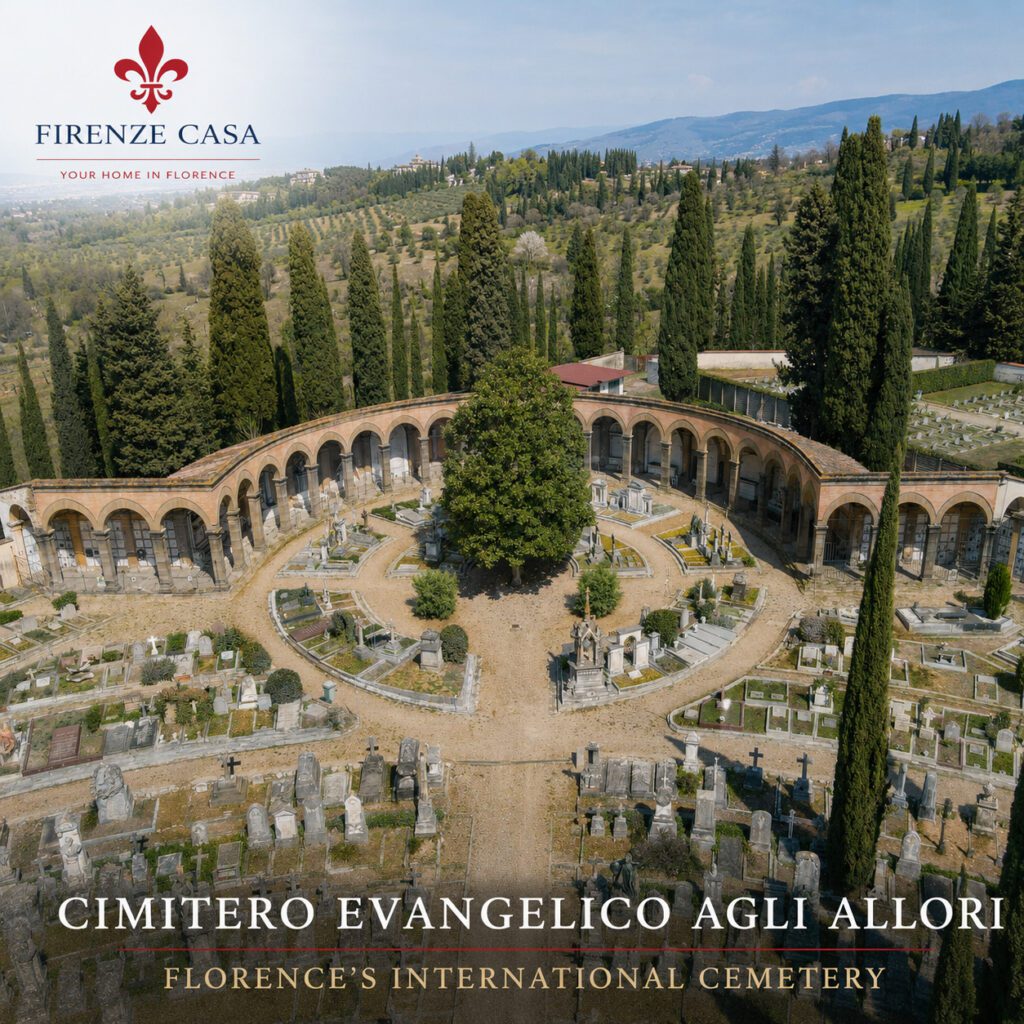
Cimitero Evangelico agli Allori is one of Florence’s most fascinating historic cemeteries. Located along Via Senese between Due Strade and Galluzzo, it preserves the memory of the international community that made Florence its home during the nineteenth and twentieth centuries.
Writers, artists, collectors, historians and travellers from across Europe and beyond found their final resting place here. Frederick Stibbert, Herbert Percy Horne, Harold Acton, Roberto Longhi, Arnold Böcklin, John Pope-Hennessy, Violet Trefusis and Oriana Fallaci are among the many figures whose lives connect the cemetery with museums, villas, literature and cultural institutions throughout Florence.
Opened: 1878
Location: Via Senese 184, Florence
Original purpose: Burial ground for Florence’s non-Catholic communities
Character: Historic, international and peaceful
Notable burials: Frederick Stibbert, Herbert Percy Horne, Harold Acton, Roberto Longhi, Arnold Böcklin, John Pope-Hennessy and Oriana Fallaci
Suggested visit: 45–60 minutes
Best for: Art history, literature, collectors and international Florence
Good to know: Opening hours vary during the year
Agli Allori forms part of the wider story explored in our Historic Cemeteries in Florence – Complete Guide.
Where Is the Cimitero Evangelico agli Allori?
The cemetery stands at Via Senese 184, south of Florence’s historic centre and close to Galluzzo.
Unlike the Cimitero degli Inglesi at Piazzale Donatello, Agli Allori lies outside the dense central districts. Its location gives it a quiet and almost secluded atmosphere.
The grounds contain trees, paths, historic gravestones and sculptural monuments. Although the cemetery has considerable artistic importance, it feels intimate rather than monumental.
This character distinguishes it clearly from Porte Sante. Visitors move gradually from one personal story to another rather than through a landscape dominated by large family chapels and panoramic views.
Agli Allori is much more than a cemetery. Many people buried here left collections, houses, books or institutions that still form part of Florence’s cultural landscape today.
Why Was Agli Allori Created?
The story of Cimitero Evangelico agli Allori begins with another historic Florentine burial ground: the Cimitero degli Inglesi.
During the nineteenth century, Florence attracted a substantial community of foreign residents. Many were Protestants or belonged to other non-Catholic traditions and therefore required an appropriate burial place outside Catholic cemeteries.
The cemetery near Porta a’ Pinti had served this international community since 1827. However, Florence expanded dramatically during the nineteenth century.
After the demolition of the city walls and the creation of new boulevards, the older cemetery became surrounded by the growing city. New regulations eventually prevented regular burials from continuing there.
Florence’s Protestant communities therefore needed a new cemetery beyond the expanding urban area.
The Opening of Agli Allori in 1878
In 1878, Florence’s Anglican, Baptist, Brethren, Lutheran, Swiss Reformed and Waldensian communities opened the new evangelical cemetery at Agli Allori.
The site provided a dignified burial place for non-Catholics who could no longer be buried at the older cemetery near Porta a’ Pinti.
This makes Agli Allori an important continuation of the story represented by the English Cemetery. The two burial grounds belong to different periods, but together they document the changing international community of Florence.
Over time, the character of Agli Allori broadened further. Today, it is associated with people from different religious traditions as well as those without religious affiliation.
The English Cemetery represents the earlier nineteenth-century foreign community of Florence. Agli Allori continues that history into the late nineteenth and twentieth centuries.
Why Florence Attracted an International Community
The graves at Agli Allori reflect a much larger phenomenon. During the nineteenth century, Florence became one of Europe’s great destinations for artists, writers, collectors and wealthy travellers.
Some came for only a few months, while others remained for decades or made Tuscany their permanent home.
Florence offered extraordinary art and architecture, but it also provided a cosmopolitan intellectual environment that attracted residents from Britain, Switzerland, Germany, the United States, Russia and many other countries.
Historic villas in the hills surrounding the city became centres of international cultural life. Writers found inspiration, collectors assembled important works of art and scholars studied Renaissance culture.
Agli Allori eventually became the final resting place of many members of this community. Its history therefore belongs naturally within our Foreigners Who Shaped Florence – Complete Guide.
An Open-Air Museum of Funerary Art
The cemetery also has significant artistic value. Sculptors and craftsmen created monuments reflecting changing tastes from the late nineteenth century into the twentieth.
Visitors encounter realism, Symbolism, Art Nouveau influences and later decorative styles among the graves.
Some memorials remain restrained, while others feature portraits, sculptural figures and carefully carved architectural details.
Foreign artists who lived in Florence also contributed to the cemetery’s artistic character. As a result, Agli Allori can feel like a small open-air museum, although the art never becomes detached from its commemorative purpose.
Look beyond the famous names. Portraits, lettering, carved flowers, crosses and symbolic figures reveal how ideas about death and remembrance changed between the nineteenth and twentieth centuries.
Famous People Buried at Cimitero Evangelico agli Allori
The extraordinary range of personalities buried at Agli Allori makes the cemetery particularly rewarding for a cultural visit.
Several have direct connections with museums, villas and institutions that visitors can still explore in Florence today.
Frederick Stibbert – Collector and Creator of the Stibbert Museum
Frederick Stibbert is one of the most important figures buried at Agli Allori.
Born in Florence in 1838 to a British father and Italian mother, he inherited considerable wealth and devoted much of his life to collecting art, armour, weapons, costumes and decorative objects.
His villa became home to an extraordinary collection containing European, Islamic and Japanese material. Stibbert eventually left the property and its collections to the city of Florence.
Today, the Museo Stibbert remains one of Florence’s most unusual cultural institutions and features naturally in our guide to small museums in Florence worth discovering.
Visiting Stibbert’s grave at Agli Allori therefore creates a direct connection with the museum he left behind.
Herbert Percy Horne – Collector and Renaissance Scholar
Herbert Percy Horne represents another remarkable connection between the cemetery and Florence’s museums.
The English architect, designer, art historian and collector developed a deep interest in Renaissance Florence. He acquired Palazzo Corsi in the historic centre and assembled an important collection of paintings, sculpture, furniture and decorative arts.
After his death, the collection became the Museo Horne.
His grave at Agli Allori therefore complements the museum in an unusually personal way: the collection reveals what Horne loved, while the cemetery preserves the memory of the person who created it.
Sir Harold Acton – Writer and Historian at Villa La Pietra
Sir Harold Acton was born at Villa La Pietra in Florence in 1904.
A writer, historian and cosmopolitan intellectual, he belonged to an Anglo-Florentine world that connected British culture with Tuscany across generations.
Villa La Pietra became famous for its art collection, gardens and international cultural life. Acton spent much of his long life between Britain and Florence, but Tuscany remained central to his identity.
His burial at Agli Allori reflects the deep roots of international families who considered Florence far more than a temporary residence.
Roberto Longhi – One of Italy’s Great Art Historians
Roberto Longhi was one of the most influential Italian art historians of the twentieth century.
His scholarship transformed the understanding of numerous painters, particularly Caravaggio and artists influenced by him.
Longhi lived with his wife, writer Anna Banti, at Villa Il Tasso in Florence. Their home later became the Fondazione di Studi di Storia dell’Arte Roberto Longhi.
His grave therefore connects Agli Allori with Florence’s continuing importance as a centre for art-historical scholarship.
Arnold Böcklin – The Painter of Isle of the Dead
The Swiss painter Arnold Böcklin gives Agli Allori one of its most evocative artistic connections.
Born in Basel in 1827, Böcklin spent important periods of his life in Italy and eventually settled near Florence.
He became one of the leading Symbolist painters of the nineteenth century. His best-known composition, Isle of the Dead, presents a mysterious island dominated by cypress trees and monumental architecture.
Finding Böcklin’s grave in a historic cemetery surrounded by the Tuscan landscape creates an almost uncanny connection with an artist whose work repeatedly explored mortality, memory and imagined landscapes.
Böcklin’s Isle of the Dead became one of the most haunting images of European Symbolism. Discovering that the painter himself rests at Agli Allori gives the cemetery a particularly memorable artistic resonance.
John Pope-Hennessy – Scholar of Renaissance Sculpture
Sir John Pope-Hennessy was one of the twentieth century’s leading historians of Italian Renaissance sculpture.
During his distinguished museum career, he worked at major institutions including the Victoria and Albert Museum and the British Museum.
Florence and Renaissance art remained central to his scholarship. His burial at Agli Allori places another internationally important art historian within this remarkable community of collectors and scholars.
Oriana Fallaci – Writer and Journalist
For many Italian visitors, Oriana Fallaci may be the most immediately recognisable person buried at Agli Allori.
Born in Florence in 1929, she became one of Italy’s best-known journalists and writers. Her career included war reporting and interviews with major international political figures.
Her books reached a worldwide readership, while her outspoken opinions also made her a highly controversial public figure.
Despite spending long periods abroad, particularly in New York, her connection with Florence remained profound. After her death in 2006, she was buried at Agli Allori alongside members of her family.
Violet Trefusis – Writer and Cosmopolitan Florentine
Violet Trefusis belonged to the international literary and social circles that flourished between Britain, France and Italy during the early twentieth century.
She became known as a writer and also for her relationship with Vita Sackville-West.
Trefusis eventually made the Villa dell’Ombrellino at Bellosguardo an important centre of her life. Her burial at Agli Allori reflects the cemetery’s close relationship with the cosmopolitan residents who settled in the Florentine hills.
Corrado Feroci – From Florence to Thailand
One of the cemetery’s most unexpected international stories belongs to Corrado Feroci.
The Florentine-born sculptor moved to Siam, now Thailand, where he became an enormously influential teacher and artist.
He later adopted the Thai name Silpa Bhirasri and is widely regarded as a central figure in the development of modern art education in Thailand.
His life demonstrates how far the international connections represented at Agli Allori could extend beyond Europe.
A Cemetery Connected with Florence’s Museums
Few cemeteries in Florence connect so naturally with the city’s museums and historic residences.
Frederick Stibbert leads directly to the Museo Stibbert, while Herbert Horne connects with the Museo Horne. Harold Acton leads visitors towards Villa La Pietra, and Roberto Longhi opens another route into Florence’s tradition of art-historical scholarship.
These connections make Agli Allori especially valuable for travellers who enjoy following stories across the city.
A collection becomes more personal when you know something about the person who assembled it. Likewise, a grave becomes more meaningful after visiting the house, museum or institution that person left behind.
Agli Allori works almost like a map of cultural Florence. Follow the names on the graves and they lead to museums, villas, libraries and foundations across the city.
Women in the International History of Agli Allori
The cemetery also preserves the stories of numerous women who participated in Florence’s international cultural life.
Writers, artists, intellectuals and travellers appear among the graves, including figures such as Vernon Lee, Elizabeth Boott Duveneck and Violet Trefusis.
Their lives evoke the remarkable network of women who chose Florence and its surrounding villas as places to live, write, paint and participate in cultural society.
Agli Allori therefore helps broaden the traditional history of international Florence beyond the better-known male collectors and scholars.
The Swiss Connection
Swiss history also forms an important part of the cemetery.
The Swiss Reformed Church participated in the creation of Agli Allori, continuing a connection already visible at the older Cimitero degli Inglesi.
Arnold Böcklin is the most famous Swiss personality buried here, but he represents only one part of a broader relationship.
Swiss merchants, professionals, artists and families formed part of Florence’s international community throughout the nineteenth century.
Seen together, the two Protestant cemeteries offer an unexpectedly tangible record of the historical connections between Florence and Switzerland.
What Is Agli Allori Like Today?
Agli Allori remains remarkably peaceful.
Trees and vegetation soften the monuments, while the absence of large tourist groups preserves an atmosphere of quiet reflection.
Unlike Porte Sante, the cemetery does not rely on spectacular panoramic views. Its appeal is more intimate.
Visitors move slowly from one personal story to another, discovering how people from very different backgrounds became connected through Florence.
This makes Agli Allori particularly suitable for travellers who already know the major sights and want to explore a less familiar layer of the city’s cultural history.
Agli Allori is not a cemetery to rush through. Give yourself time to read names and inscriptions. The mixture of languages, professions and nationalities is part of what makes the place so fascinating.
How Long Should You Spend at Agli Allori?
Allow approximately 45 to 60 minutes for a first visit.
This gives enough time to explore the historic sections and locate several of the most important graves.
Visitors interested in art history, literature or funerary sculpture can easily remain longer.
A map or information about the position of notable graves can make the visit considerably more rewarding.
Practical Information
Address: Via Senese 184, Florence
Suggested visit: 45–60 minutes
Character: Historic, peaceful and international
Access: Only partially barrier-free
Important: Opening hours vary during the year, so check current information before travelling.
The cemetery lies south of Florence’s historic centre between Due Strade and Galluzzo.
Because opening hours change by season and may be reduced during certain periods, it is sensible to verify current visitor information before making a special journey.
Respectful Visiting
Agli Allori is an important historical site, but it remains an active cemetery.
Visitors should speak quietly and respect families or mourners who may be present.
Photography should remain discreet, particularly around recent graves. Historic monuments can certainly be appreciated as works of art, but their commemorative purpose should always come first.
Cimitero Evangelico agli Allori at a Glance
| Category | Information |
|---|---|
| Type | Historic evangelical and international cemetery |
| Opened | 1878 |
| Location | Via Senese 184, between Due Strade and Galluzzo |
| Historical role | Successor to the Cimitero degli Inglesi for Florence’s non-Catholic communities |
| Notable burials | Frederick Stibbert, Herbert Percy Horne, Harold Acton, Roberto Longhi, Arnold Böcklin, John Pope-Hennessy and Oriana Fallaci |
| Main interest | International Florence, art history, literature and funerary sculpture |
| Suggested visit | 45–60 minutes |
| Best for | History, art, literature and lesser-known Florence |
Frequently Asked Questions About Cimitero Evangelico agli Allori
Is Cimitero Evangelico agli Allori worth visiting?
Yes, particularly for visitors interested in Florence’s international community, art history and literature. The cemetery contains the graves of numerous important artists, writers, collectors and scholars.
Why was the cemetery created?
Florence’s Protestant communities opened Agli Allori in 1878 after regular burials could no longer continue at the older Cimitero degli Inglesi near Porta a’ Pinti.
Who is buried at Agli Allori?
Notable burials include Frederick Stibbert, Herbert Percy Horne, Harold Acton, Roberto Longhi, Arnold Böcklin, John Pope-Hennessy and Oriana Fallaci, among many others.
Is Frederick Stibbert buried at Agli Allori?
Yes. Frederick Stibbert, whose extraordinary collection became the Museo Stibbert, is buried at Agli Allori.
Where is Oriana Fallaci buried?
Oriana Fallaci is buried at Cimitero Evangelico agli Allori together with members of her family.
Is Agli Allori only for Protestants?
No. Although Protestant communities founded the cemetery, its later history broadened to include people of different religions as well as those without religious affiliation.
How long should I allow for a visit?
Approximately 45 to 60 minutes is suitable for most visitors. Art and history enthusiasts may want to spend longer exploring the monuments and individual graves.
Why Cimitero Evangelico agli Allori Is Worth Visiting
Cimitero Evangelico agli Allori is worth visiting because it tells the story of Florence as an international city. Its graves reveal the writers, artists, collectors, scholars and modern Florentines who helped shape the city long after the Renaissance.
Collectors such as Frederick Stibbert and Herbert Horne left museums behind. Harold Acton preserved an extraordinary cultural world at Villa La Pietra, while Roberto Longhi and John Pope-Hennessy helped change the way later generations understood Italian art.
Arnold Böcklin, Violet Trefusis and Oriana Fallaci add very different literary and artistic perspectives, while Corrado Feroci demonstrates how connections originating in Florence could extend far beyond Europe.
Most importantly, Agli Allori is not simply a collection of famous graves. It is a quiet record of people from many countries who came to Florence, contributed to its cultural life and eventually chose the city as their final home.
Agli Allori reveals a Florence built not only by people born in the city, but also by those who arrived from elsewhere and chose to become part of its cultural history.
Further Reading on Firenze Casa
Continue exploring Florence’s historic cemeteries, international residents, museums and villas:
- Historic Cemeteries in Florence – Complete Guide
- Cimitero degli Inglesi Florence – Quiet Historic Site
- Cimitero delle Porte Sante – Florence’s Monumental Cemetery
- Historic Jewish Cemetery of Florence
- Foreigners Who Shaped Florence – Complete Guide
- Villa La Pietra – Florence’s Historic Acton Family Estate
- Small Museums in Florence Worth Discovering
- Galluzzo from Florence
References
- Cimitero Evangelico agli Allori – Official Historical Information and Cemetery Records
- Comune di Firenze / FeelFlorence – Cimitero Evangelico agli Allori
- Comune di Firenze – Historical Information on Florence’s Monumental and Non-Catholic Cemeteries
- Museo Stibbert – Biographical and Collection History of Frederick Stibbert
- Museo Horne – Biographical Information on Herbert Percy Horne and His Collection
- Fondazione di Studi di Storia dell’Arte Roberto Longhi – Biographical Information on Roberto Longhi
- Biographical and Historical Sources Concerning Arnold Böcklin, Harold Acton, John Pope-Hennessy, Violet Trefusis and Oriana Fallaci

