
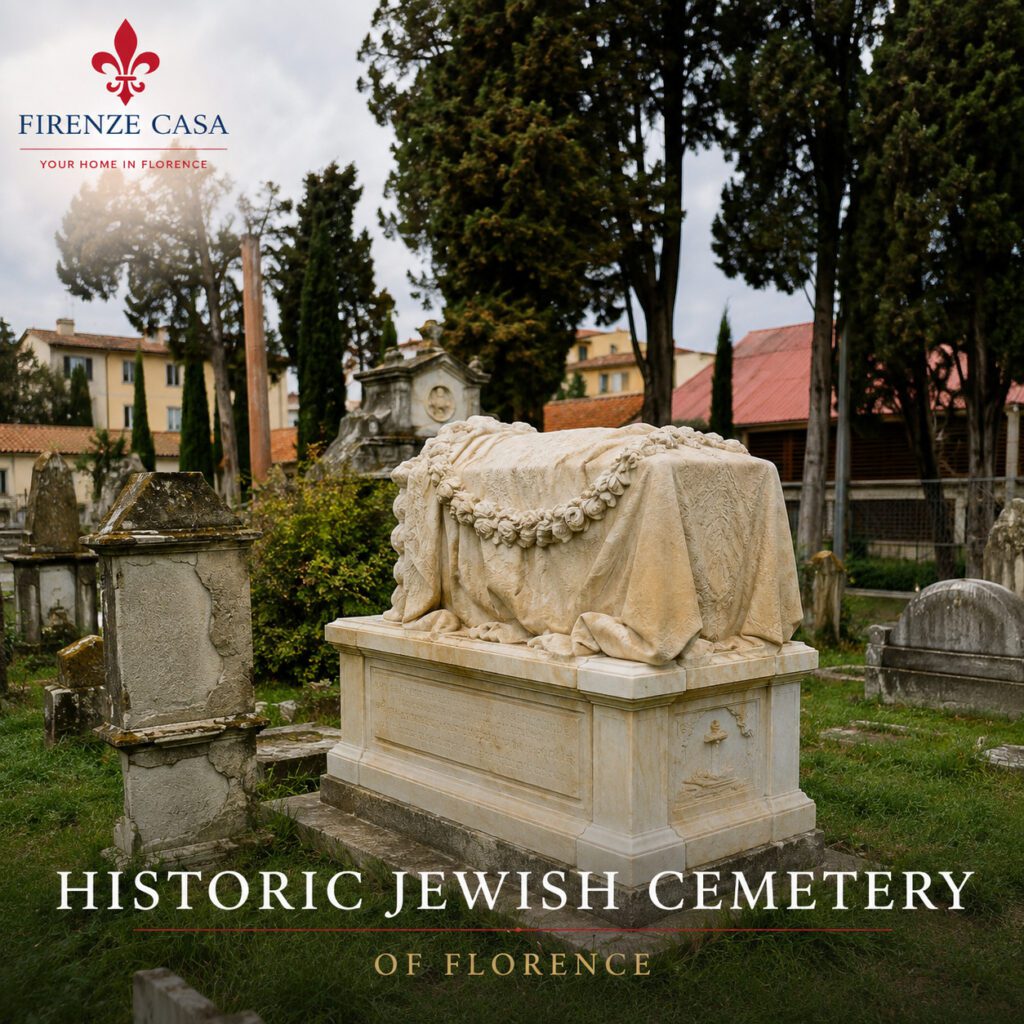
The Historic Jewish Cemetery of Florence is one of the city’s least-known historic sites. Hidden behind high walls near Porta San Frediano, the cemetery offers a quiet and unusually intimate insight into the history of Florence’s Jewish community.
Old tombstones, family monuments, Hebrew inscriptions and tree-lined paths preserve memories from an important period of Jewish life in the city. Unlike Florence’s monumental churches and better-known cemeteries, this is not a place of grand spectacle. Its significance lies instead in the stories of families, religious traditions and social change preserved behind its walls.
Location: Viale Ariosto, near Porta San Frediano
Origins: 18th century
Historic community: Jewish community of Florence
Main interest: Jewish history, funerary architecture and family monuments
Special features: Hebrew and Italian inscriptions, monumental tombs and eclectic architectural styles
Character: Quiet, enclosed and little known
Access: Limited; advance registration is normally required
Best combined with: San Frediano, the Oltrarno and Florence’s Great Synagogue
The cemetery forms part of the wider story explored in our Historic Cemeteries in Florence – Complete Guide. For the broader history of the community, see Jewish Florence – The Synagogue and the Ghetto.
A Hidden Cemetery Near Porta San Frediano
The cemetery lies on Viale Ariosto, just outside historic Porta San Frediano. High walls largely conceal it from the surrounding streets, and many people pass nearby without realising that one of Florence’s most unusual historic burial grounds lies behind them.
The Jewish community established the cemetery in the eighteenth century, when burial within the city walls was generally restricted. Its position outside the fortified perimeter therefore reflected both practical requirements and the legal conditions under which Jewish communities lived.
Today, the site feels remarkably separate from modern Florence. Once inside, the surrounding city quickly recedes, while trees, old stone monuments and narrow paths create an intimate atmosphere very different from the monumental scale of Porte Sante.
The cemetery is easy to miss because its high walls reveal almost nothing from the street. That sense of enclosure is part of its character and reflects the long history of a community whose presence in Florence was often both important and restricted.
Jewish Life in Florence Before the Cemetery
Jewish history in Florence reaches much further back than the cemetery itself. Jewish merchants, physicians and moneylenders lived in the city during the Middle Ages, although their legal position changed repeatedly according to political circumstances.
The Medici generally recognised the economic importance of Jewish residents, particularly in banking and commerce. Nevertheless, periods of relative tolerance alternated with increasing restrictions.
A decisive change came under Cosimo I de’ Medici. In 1571, a Jewish ghetto was established in the area around today’s Piazza della Repubblica.
Jewish residents were increasingly required to live within this designated quarter, and their economic and social activities were subject to regulation.
The ghetto remained an important part of Jewish life in Florence for centuries. During the nineteenth century, legal emancipation and political reforms gradually transformed the position of Jewish citizens within Florentine and Italian society.
Very little remains of Florence’s former Jewish ghetto today. Much of the old neighbourhood disappeared during the redevelopment of the city centre in the late nineteenth century.
The Origins of the Historic Jewish Cemetery
The Historic Jewish Cemetery of Florence dates from the eighteenth century. The Jewish community acquired land outside Porta San Frediano specifically for burial purposes.
This location carried particular religious significance. Jewish burial tradition places great emphasis on the permanent dignity of the dead and on leaving graves undisturbed whenever possible.
A dedicated cemetery therefore served both practical and spiritual needs. Over time, the burial ground developed into a landscape of individual graves, family monuments and increasingly elaborate architectural memorials.
Today, these monuments document not only religious life but also changes in Jewish society, wealth and artistic taste over several generations.
A Cemetery That Reflects Social Change
Walking through the cemetery reveals a gradual transformation in the social position of Florence’s Jewish community.
Some earlier graves are relatively restrained, while later monuments become much more elaborate. Visitors encounter classical architectural forms, sculptural decoration and family memorials comparable in ambition to funerary monuments elsewhere in Florence.
This development reflects broader changes during the nineteenth century. As legal restrictions diminished, Jewish Florentines participated more openly in the economic, intellectual and cultural life of the city.
The monuments increasingly express both Jewish identity and the artistic language of contemporary Florence.
The cemetery preserves social history in stone. Changes in the scale and style of the monuments reflect the gradual emancipation and growing public visibility of Jewish families in nineteenth-century Florence.
The Architecture and Art of the Tombs
The artistic variety of the cemetery makes it particularly rewarding for visitors interested in funerary architecture.
Tombstones range from relatively simple slabs to elaborate family monuments. Hebrew inscriptions appear alongside Italian texts, while Jewish symbols coexist with architectural forms influenced by nineteenth-century European historicism.
Classical motifs, Neo-Renaissance details and other eclectic elements demonstrate how strongly contemporary Florentine artistic traditions influenced cemetery design.
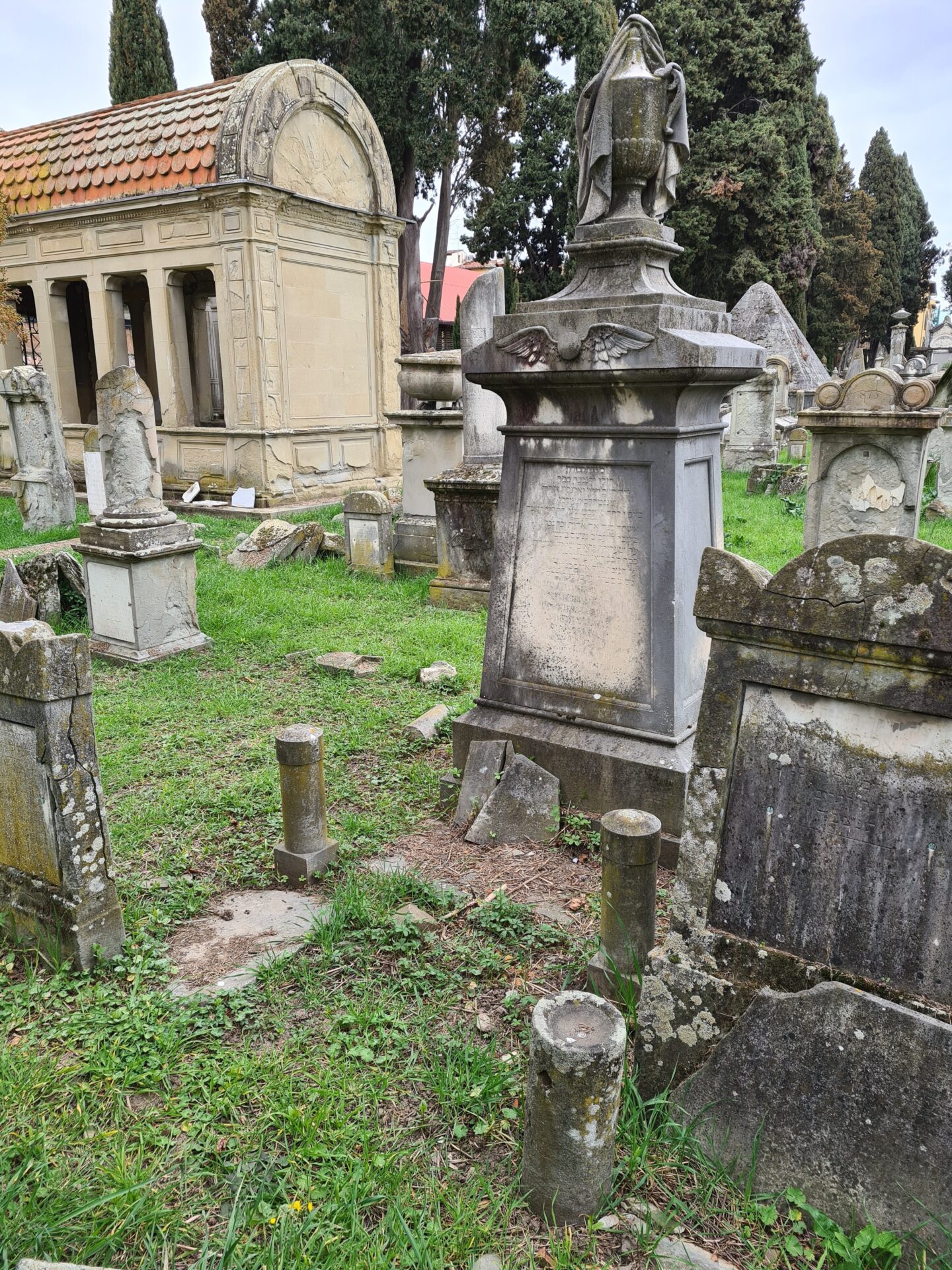
One of the most striking monuments is a large tomb inspired by ancient architectural forms. It immediately stands out from the surrounding graves and illustrates the eclectic taste characteristic of nineteenth-century funerary design.
Yet the smaller monuments are equally important. Names, dates and inscriptions transform the cemetery into a historical archive carved in stone.
Look closely at the mixture of Hebrew and Italian inscriptions. They reveal how Jewish religious identity existed alongside increasing participation in Italian civic and cultural life.
Monumental Family Tombs
Several larger monuments demonstrate the wealth and social position achieved by prominent Jewish families during the nineteenth century.
Among the most distinctive is the pyramid-shaped tomb associated with David Levi. Its unusual form reflects the fascination with Egyptian and ancient architectural motifs that appeared in European funerary design during the period.
The cemetery also contains important monuments associated with the Franchetti family, whose members became prominent in banking, politics, public life and culture.
These family tombs create a striking contrast with the cemetery’s more modest graves and demonstrate the considerable social diversity within Florence’s Jewish community.
The Franchetti Family and Jewish Florence
The Franchetti family provides one of the clearest examples of the transformation of Jewish life in modern Italy.
Members of the family became active in banking, politics and public service during the nineteenth century and participated in the broader cultural world of post-unification Italy.
Their presence in the cemetery demonstrates how dramatically the position of some Jewish families had changed since the centuries when residents were confined to the Florentine ghetto.
Other graves commemorate merchants, professionals, scholars and established Florentine families. Individually, many may be unfamiliar to modern visitors. Collectively, however, they tell the more important story of a community deeply connected with the city around it.
From the Old Cemetery to the New Jewish Cemetery
By the late nineteenth century, the historic burial ground could no longer meet the needs of Florence’s growing Jewish community.
A newer Jewish cemetery was therefore established elsewhere in the city, and regular burials at the older site largely came to an end.
This transition coincided with one of the most remarkable periods in modern Jewish Florentine history. The magnificent Great Synagogue of Florence opened in 1882.
Its monumental dome became a highly visible symbol of an increasingly confident and integrated Jewish community.
The contrast is striking. The historic cemetery remains hidden behind high walls near Porta San Frediano, while the synagogue rises prominently above the eastern cityscape.
Together, the two places represent very different chapters in the history of Jewish Florence.
The Cemetery and Florence’s Great Synagogue
Visitors interested in Jewish heritage should consider the cemetery and the Great Synagogue as complementary sites.
The cemetery preserves the memory of earlier generations and the gradual transformation of the community during the eighteenth and nineteenth centuries.
The synagogue, by contrast, represents the period after Jewish emancipation and Italian unification, when Florentine Jews could participate much more fully in public life.
Its monumental architecture gave the community a new visibility within Florence.
Seen together, the two places tell a story that extends far beyond religion. They reveal changing ideas about citizenship, identity, integration and belonging in modern Florence.
Do not look at the Great Synagogue in isolation. The historic cemetery near Porta San Frediano adds an earlier and much quieter chapter to the same story. Visiting both gives a far richer picture of Jewish Florence.
The Cemetery and Firenze Capitale
The nineteenth-century transformation of Jewish Florence occurred at the same time as enormous changes to the city itself.
After Florence became capital of the Kingdom of Italy in 1865, large sections of the medieval centre and surrounding districts were redeveloped.
The former Jewish ghetto around today’s Piazza della Repubblica was eventually demolished during later urban restructuring, erasing much of the physical environment associated with centuries of Jewish life.
This connection makes the cemetery particularly valuable. While much of the old ghetto vanished, the burial ground near Porta San Frediano survived.
The broader transformation is explored in Florence as Capital of Italy – Firenze Capitale 1865–1871.
A Different Kind of Florentine Monument
Florence usually presents its history through palaces, churches, sculpture and painting. Cemeteries offer a different perspective because they preserve the names of people who actually formed the city’s communities across generations.
The Historic Jewish Cemetery of Florence is particularly valuable in this respect.
Its monuments document a minority community that experienced periods of restriction and segregation before becoming increasingly integrated into Florentine society.
The cemetery is therefore not simply a religious site. It also preserves evidence of social change, emancipation, family history, architecture and the emergence of modern Italy.
Visiting the Historic Jewish Cemetery of Florence
The Historic Jewish Cemetery is not generally accessible through normal daily opening hours.
Visits are possible only on certain dates and typically require advance registration. Visitors should therefore contact the Jewish Community of Florence before planning a visit and confirm current access arrangements.
Because access is limited, this is one Florence site that requires some advance preparation. The restricted opening also helps preserve the cemetery’s exceptionally quiet and secluded atmosphere.
Do not simply arrive at the cemetery expecting it to be open. Access is limited and normally requires advance arrangements. Check the current visiting dates and registration procedure with the Jewish Community of Florence before making a special journey.
Because this remains a religious burial ground, visitors should explore it respectfully. Comfortable shoes are useful because some paths and surfaces can be uneven.
Combine the Cemetery with San Frediano and the Oltrarno
The location near Porta San Frediano makes the cemetery easy to combine with a broader exploration of the western Oltrarno.
Nearby San Frediano and Santo Spirito retain a strong neighbourhood character and offer a different atmosphere from the monumental streets around the Duomo.
The historic gates of Florence also provide useful context. Porta San Frediano once formed part of the medieval wall circuit that separated the city from the countryside beyond.
Walking through this area therefore brings together several layers of history: medieval fortifications, Jewish heritage, nineteenth-century urban change and the everyday life of the modern Oltrarno.
If you are able to arrange access to the cemetery, combine it with Porta San Frediano and a walk through the western Oltrarno. The area reveals a quieter side of Florence with strong connections to both medieval and modern history.
Why the Historic Jewish Cemetery Is Worth Discovering
The Historic Jewish Cemetery of Florence is worth discovering because it preserves an important part of the city’s history that is easy to overlook. Behind its walls lies a record of families, religious traditions, artistic tastes and changing social conditions spanning generations.
The monuments document the gradual transformation of Jewish life in Florence, from a period marked by restrictions and segregation to increasing civic participation and emancipation during the nineteenth century.
The cemetery also offers a distinctive collection of funerary art. Hebrew inscriptions, family chapels and monumental tombs give the burial ground an architectural character unlike Florence’s other historic cemeteries.
Most importantly, it reminds visitors that Renaissance Florence represents only one chapter in the history of the city. Jewish Florence has its own long and complex story, stretching across centuries and continuing into the present day.
The cemetery is valuable precisely because so much of historic Jewish Florence has disappeared from the urban landscape. Behind these walls, names, inscriptions and monuments preserve a history that nineteenth-century redevelopment erased elsewhere in the city.
Historic Cemeteries as Part of Florence’s Story
Florence’s historic cemeteries reveal sides of the city that churches and museums cannot show in quite the same way.
Porte Sante preserves the memory of prominent Florentines, while the Cimitero degli Inglesi tells the story of an international Protestant community. Agli Allori continues that cosmopolitan history into the late nineteenth and twentieth centuries.
The Historic Jewish Cemetery adds a different and essential perspective. It documents a community whose history in Florence includes commerce, restriction, segregation, emancipation and cultural integration.
Together, these burial grounds demonstrate that Florence has always been more diverse than its familiar Renaissance image suggests.
Frequently Asked Questions About the Historic Jewish Cemetery of Florence
Where is the Historic Jewish Cemetery of Florence?
The cemetery is located on Viale Ariosto near Porta San Frediano, on the western side of the Oltrarno.
When was the Historic Jewish Cemetery established?
The cemetery dates from the eighteenth century and served Florence’s Jewish community before a newer burial ground opened elsewhere in the city during the late nineteenth century.
Can tourists visit the Historic Jewish Cemetery?
Yes, but access is limited. Visits are generally available only on specific dates and require advance arrangements with the Jewish Community of Florence.
Why was the cemetery built outside the city walls?
Burial grounds were generally located outside the fortified city, and Jewish residents also lived under specific legal restrictions. The site near Porta San Frediano therefore reflects both broader burial practices and the historical circumstances of the Jewish community.
What can visitors see inside the cemetery?
Visitors can see historic tombstones, Hebrew and Italian inscriptions, family monuments and several elaborate examples of nineteenth-century funerary architecture.
What happened to Florence’s old Jewish ghetto?
The ghetto once occupied an area around today’s Piazza della Repubblica. Much of the historic neighbourhood disappeared during major urban redevelopment in the late nineteenth century.
How is the cemetery connected with the Great Synagogue?
The old cemetery preserves the history of earlier generations, while the Great Synagogue, opened in 1882, reflects the increasing emancipation, confidence and public visibility of Florence’s Jewish community.
Further Reading on Firenze Casa
Continue exploring Florence’s Jewish heritage and historic cemeteries:
- Historic Cemeteries in Florence – Complete Guide
- Cimitero degli Inglesi Florence – Quiet Historic Site
- Cimitero delle Porte Sante – Florence’s Monumental Cemetery
- Cimitero Evangelico agli Allori – Florence’s International Cemetery
- Jewish Florence – The Synagogue and the Ghetto
- Florence as Capital of Italy – Firenze Capitale 1865–1871
- The Historic Gates of Florence – From Porta Romana to San Niccolò
References
- Comunità Ebraica di Firenze – Historical Information on Jewish Florence and Its Cemeteries
- Museo Ebraico di Firenze – Historical Material on the Jewish Community of Florence
- Comune di Firenze – Historical and Cultural Information on Florence’s Jewish Heritage
- Regione Toscana – Resources on Jewish History and Heritage in Tuscany
- Davidsohn, Robert – Studies on the History of Medieval Florence and Its Communities

