
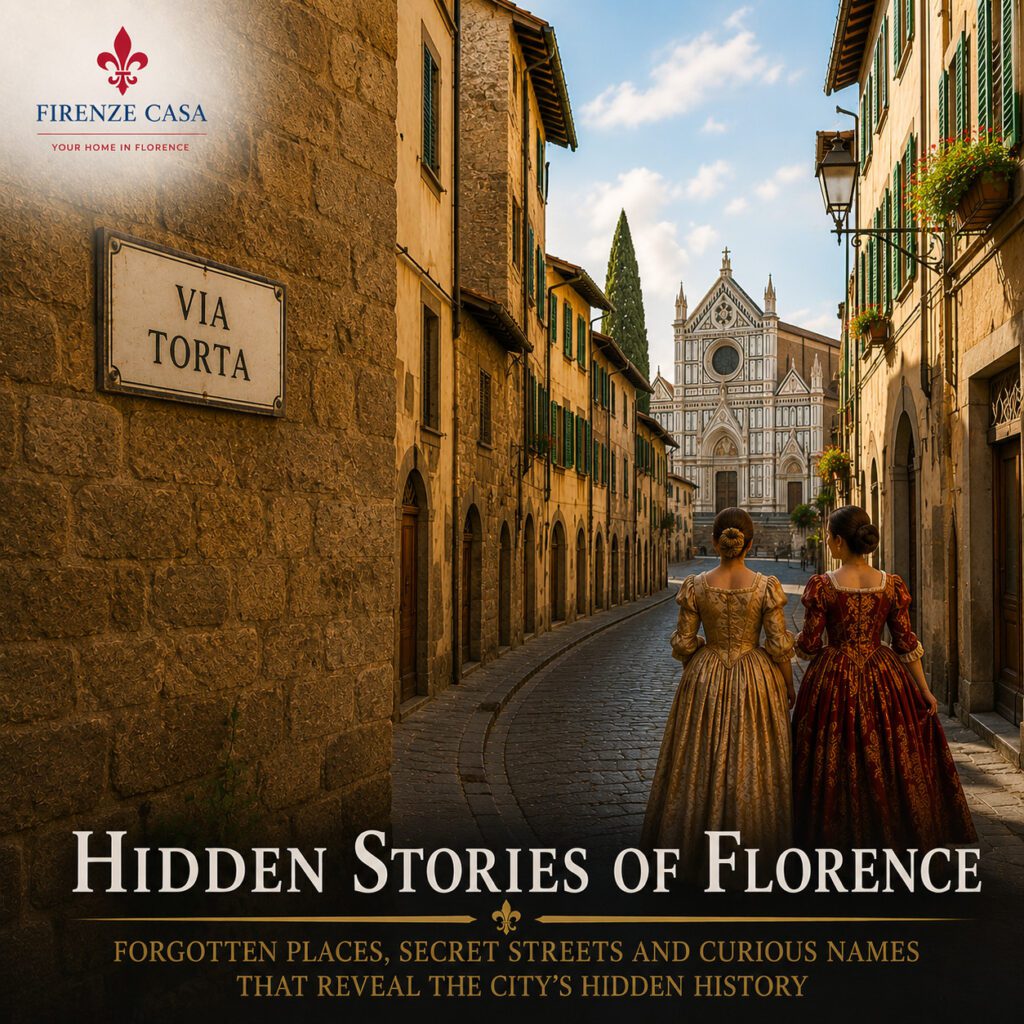
Hidden Stories of Florence are everywhere. They survive in unusual street names, curved rows of medieval houses, forgotten passages and places that disappeared centuries ago. Visitors often walk across them without ever knowing what happened there.
Florence is famous for its visible masterpieces: the Duomo, Palazzo Vecchio, Ponte Vecchio and the great Renaissance churches. Yet another Florence exists beneath and between these monuments. Roman structures determined later streets, medieval trades gave names to neighbourhoods, and executions, markets, convents and vanished buildings left traces that still form part of everyday Florence.
This guide explores some of those hidden stories. They offer a different way to discover the city: not simply by looking at monuments, but by learning how to read Florence itself.
Firenze Casa TipSome of the places in this guide look completely ordinary at first. When exploring Florence, pay attention to street names, changes in the direction of buildings and unusually curved streets. They often preserve a much older city underneath the one you see today.
Florence Is a City Built on Earlier Cities
Florence has continuously rebuilt itself for more than two thousand years. Roman Florentia developed into a medieval commercial centre, which later became one of the great cities of the Renaissance. Every period altered what came before it without completely erasing it.
This explains why hidden history often survives in unexpected forms. A Roman monument may disappear while its outline remains embedded in later buildings. A medieval occupation may vanish while the craftsmen who once worked there survive in a street name.
Even apparently strange names can function like historical documents. Once their meanings become clear, an ordinary walk through Florence becomes a journey through several different periods of the city’s past.
The Lost Roman Amphitheatre of Florence
One of the most remarkable Hidden Stories of Florence lies east of Piazza della Signoria. There is no great Roman amphitheatre standing here today. Nevertheless, part of its form can still be recognised in the modern city.
Roman Florentia had an amphitheatre used for public spectacles. Over the centuries, the structure lost its original function and later buildings occupied the site. Yet the enormous curved footprint did not disappear completely.
The clue is particularly visible around Via Torta. Its unusual curved course follows part of the ancient amphitheatre’s outline. Buildings constructed during later centuries adapted themselves to foundations and structures already present below and around them.
Did You Know?The name Via Torta can be understood as a reference to the street’s bent or crooked course. Its curve is not accidental: it helps reveal the shape of Roman Florence beneath the medieval and modern city.
This makes the area fascinating precisely because there is no reconstructed Roman attraction to visit. The city itself has become the archaeological evidence. Walking along the curve allows visitors to experience the dimensions of a monument that disappeared from view many centuries ago.
Discover the complete story in Florence’s Lost Roman Amphitheatre.
Via dei Malcontenti – A Name with a Dark Past
Some Florentine streets preserve history through their names rather than their architecture. Via dei Malcontenti is one of the most evocative examples.
The street lies in the Santa Croce area, close to the eastern edge of the historic centre. Its unusual name has traditionally been associated with condemned prisoners who were led towards the place of execution outside the old city.
The word malcontenti literally evokes those who were unhappy or discontented. In the historical tradition surrounding the street, the meaning takes on a much darker character. The people following this route were approaching the final moments of their lives.
Today the street forms part of an ordinary Florentine neighbourhood. Knowing its story changes the experience completely. What appears to be merely another picturesque street becomes connected with the city’s medieval and early modern system of justice and punishment.
A Florence Detail Worth NoticingStreet names are among the city’s smallest historical monuments. Unlike statues or palaces, we often pass them without thinking about why they exist.
Via delle Belle Donne – Beauty, Legend and a Curious Name
Florence contains many street names that immediately attract attention. Via delle Belle Donne – literally the Street of the Beautiful Women – is certainly among them.
Names of this kind often accumulated stories and popular explanations over the centuries. Some interpretations connect the street with women who lived or worked in the area, while later traditions gave the name more colourful associations.
For visitors, the important point is broader than one colourful anecdote. Florentine street names frequently preserve memories of the social life that once took place there. They can tell us about occupations, institutions, residents and activities that have otherwise vanished.
Florence’s Medieval Trades Hidden in Street Names
Today Via dei Calzaiuoli is one of the busiest pedestrian streets in Florence, connecting Piazza del Duomo with Piazza della Signoria. Its elegant shops and constant flow of visitors make it seem thoroughly modern.
Its name, however, points towards the world of Florentine craftsmen and trades. Medieval Florence was organised to a remarkable degree around professional activities and powerful guilds. Craftsmen often concentrated in particular streets or districts, and their occupations sometimes survived in the names long after the original workshops disappeared.
Via dei Calzaiuoli is only one example. Exploring Florence’s Medieval Trades Hidden in Its Street Names reveals how the modern map still preserves traces of the city’s economic life.
These names remind us that Renaissance Florence was not created only by famous artists and powerful families. It was also a working city filled with craftsmen, merchants, apprentices and specialised trades.
Via delle Terme – A Memory of Roman Florence
Another street name leads even further back in time. Via delle Terme, close to the historic heart of Florence, recalls the Roman city and the presence of ancient baths.
Bath complexes were important parts of Roman urban life. They served not only practical purposes but also social ones. The existence of such structures reminds us that Florence did not suddenly appear during the Middle Ages or Renaissance.
Long before Brunelleschi, Michelangelo and the Medici, Florentia was already an organised Roman settlement with streets, public buildings and infrastructure.
Look Beneath Renaissance FlorenceWhen exploring the historic centre, remember that parts of its medieval street network developed over Roman structures. Florence is not one historical city but several cities occupying the same ground.
Via dell’Inferno – Why Does Florence Have a Street of Hell?
Few street names stimulate curiosity as quickly as Via dell’Inferno. Translated literally, it means the Street of Hell.
Florence has accumulated various traditions explaining unusual names like this one. Their origins can be complicated because names changed, popular interpretations developed and stories were retold across generations.
What makes Via dell’Inferno particularly interesting is precisely this mixture of urban history and collective memory. A name that sounds almost theatrical today once belonged to the practical geography of the city.
It also demonstrates why street-name history should be approached carefully. Some explanations are well documented, while others belong partly to Florentine tradition and legend. Both can be fascinating, provided we distinguish between them.
When Professions Became Street Names
Many Hidden Stories of Florence become visible once you recognise the connection between streets and occupations.
The medieval city was filled with workshops. Wool workers, leather craftsmen, metalworkers, merchants, shoemakers and numerous specialised trades formed part of Florence’s economic machinery. The powerful guild system influenced politics as well as commerce.
Occupational geography also helped people navigate the city. Before modern street numbering and digital maps, identifying an area through the people who worked there made practical sense.
Some of these professions disappeared or moved elsewhere. Their names remained, turning the modern street map into an indirect record of medieval economic life. Our dedicated guide to Florence’s Medieval Trades explores these surviving names in greater detail.
Lost Markets and Changing Squares
Streets are not the only places that preserve hidden history. Florence’s squares have changed dramatically as well.
Markets moved, buildings disappeared and entire neighbourhoods were transformed. The Florence experienced by a medieval merchant would therefore differ substantially from the city we recognise today.
One of the most dramatic examples is the transformation of the area around today’s Piazza della Repubblica during the nineteenth century. Large parts of the old urban fabric were demolished when Florence underwent major redevelopment following its period as capital of the Kingdom of Italy.
The modern square consequently represents both creation and destruction. Its spacious appearance came at the cost of streets, buildings and layers of older Florentine life.
Then and NowPiazza della Repubblica can feel surprisingly different from Florence’s dense medieval streets. That contrast is not accidental. The area was extensively transformed during nineteenth-century urban redevelopment.
The Mercato Vecchio – Florence’s Lost Old Market
Before the redevelopment of the Piazza della Repubblica area, the Mercato Vecchio formed part of one of Florence’s oldest and most densely occupied districts.
For centuries, commercial activity filled the area. Shops, houses, narrow streets and market stalls created an urban environment very different from today’s open piazza.
Nineteenth-century planners regarded parts of the old quarter as overcrowded and unsuitable for the image of a modern city. Redevelopment swept much of it away.
The transformation remains one of the most striking examples of a lost Florence. Visitors standing in Piazza della Repubblica today are not simply looking at a historic square. They are standing where another piece of the city once existed.
The Jewish Quarter That Disappeared
The redevelopment around the former Mercato Vecchio also affected Florence’s lost Jewish quarter. For centuries, Jewish life had formed part of this area of the city.
Changes during the nineteenth century radically altered the district. Older buildings and streets disappeared as the centre was reshaped. Florence’s monumental synagogue, constructed elsewhere in the city during the same broad period of change, became a powerful new architectural expression of Jewish presence.
The vanished quarter reminds visitors that urban redevelopment does not merely change buildings. It can remove the physical setting in which communities lived for generations.
The Porcellino – A Small Monument with a Long Story
Not every hidden story has disappeared beneath later Florence. Some survive in plain sight but are so familiar that visitors rarely ask where they came from.
The Porcellino of Florence is a perfect example. The famous bronze wild boar beside the Mercato Nuovo has become associated with the tradition of rubbing its polished nose for good luck and dropping a coin through the grate below.
Behind the popular ritual lies a much longer artistic story connecting Florence with classical sculpture and the seventeenth-century sculptor Pietro Tacca. The Porcellino demonstrates how a work of art can acquire new legends and traditions as generations interact with it.
It also reminds us that Florence’s hidden stories are not necessarily hidden physically. Sometimes they are concealed behind customs that have become so familiar that nobody stops to ask how they began.
The Buchette del Vino – Florence’s Tiny Wine Windows
Another story can be found at eye level in the walls of historic palaces. The Buchette del Vino, or wine windows, are small openings once used to sell wine directly from private residences.
Many survived long after their original commercial purpose had disappeared. Some were sealed, others were almost forgotten, and visitors could easily walk past them without noticing anything unusual.
The renewed interest in Florence’s wine windows has made them much easier to recognise today. Yet they remain wonderful examples of how everyday economic life leaves physical traces in the city’s architecture.
Look at the WallsFlorence rewards visitors who look beyond façades as complete architectural compositions. Small openings, plaques, coats of arms and old signs can reveal stories that are easy to miss when walking quickly through the city.
Florence’s Lost City Gates
For much of its history, Florence was a walled city. Gates controlled movement between the urban centre and the surrounding countryside.
As the city expanded, large sections of the walls lost their defensive purpose. Nineteenth-century redevelopment removed substantial stretches, particularly on the northern side of Florence. Some gates survived as isolated monuments while the walls that once connected them vanished.
This can make their original function difficult to understand today. A historic gate surrounded by traffic may appear to be a decorative monument. Originally, however, it marked a physical boundary between Florence and the world outside.
Recognising those former boundaries helps explain why certain streets, avenues and neighbourhoods developed as they did.
Why Florence’s Street Plan Matters
A city map may look purely practical, but Florence’s street plan is a historical source in its own right.
Roman planning, medieval expansion, defensive walls, religious institutions and later redevelopment all influenced the routes people follow today. Some streets bend because they encountered older structures. Others widen where gates, markets or public spaces once shaped movement.
The result is an urban landscape created by accumulation rather than a single plan.
This is one reason Florence rewards walking. Moving slowly through the city allows you to notice details that disappear when attention is focused only on major monuments.
The same principle applies to the city’s civic emblems. Once you recognise the Florentine Lily and the Marzocco Lion, they suddenly appear on buildings, sculptures and public details throughout the centre. Our guide to The Two Symbols of Florence: The Lily and the Marzocco Lion explains the stories behind these familiar signs.
How to Discover the Hidden Stories of Florence
You do not need specialist archaeological knowledge to start reading the city. Curiosity is often enough.
Look at street signs and ask why a particular name was chosen. Notice sudden curves where neighbouring streets are straight. Compare broad nineteenth-century spaces with the narrow lanes surrounding them. Look for fragments of walls incorporated into later buildings.
Pay attention to the smaller details as well. Wine windows, coats of arms, old market structures, religious tabernacles and civic symbols often reveal connections that are invisible when Florence is experienced simply as a sequence of famous attractions.
Most importantly, occasionally leave the shortest route between famous monuments. Florence’s major sights deserve their reputation, but some of the city’s most memorable discoveries occur in the streets connecting them.
Firenze Casa TipTry walking through Florence without treating every street simply as a route from A to B. Via Torta, Via dei Malcontenti and the streets around Piazza della Repubblica are excellent places to begin looking for the city that has disappeared.
Frequently Asked Questions About Hidden Florence
Where can you see traces of Roman Florence?
Via Torta is one of the most fascinating places because its curved course preserves part of the outline of Florence’s lost Roman amphitheatre. Via delle Terme also recalls the Roman baths that once formed part of Florentia.
Why does Florence have so many unusual street names?
Many names developed from trades, residents, institutions, landmarks or activities once associated with a particular area. Others accumulated legends and popular explanations over the centuries.
What happened to Florence’s Mercato Vecchio?
The old market and much of the surrounding neighbourhood were demolished during major nineteenth-century redevelopment. Today’s Piazza della Repubblica occupies much of this transformed area.
Did Florence once have a Jewish quarter?
Yes. Florence’s historic Jewish quarter was located around the Mercato Vecchio area. Much of its physical fabric disappeared during the nineteenth-century transformation of the city centre.
What are Florence’s wine windows?
The Buchette del Vino are small openings in the walls of historic buildings that were traditionally used for the direct sale of wine. Many still survive around Florence today.
Why is the Porcellino famous?
The bronze wild boar at the Mercato Nuovo is associated with a popular good-luck tradition. Visitors rub its polished nose and drop a coin through the grate beneath the fountain.
Why the Hidden Stories of Florence Are Worth Discovering
The Hidden Stories of Florence reveal a city beyond the familiar Renaissance image. Roman entertainment buildings, medieval workshops, places of punishment, vanished markets and demolished neighbourhoods continue to influence the Florence we experience today.
Sometimes the evidence is monumental. More often, it consists of something much smaller: a curve in a street, an unusual name, a tiny wine window or a building line that does not quite make sense.
Once you begin noticing these traces, Florence changes. The historic centre no longer appears to belong to one celebrated period. Instead, Roman Florentia, medieval Florence, the Renaissance city and nineteenth-century Florence become visible together.
That may be one of the most rewarding ways to explore the city: not simply asking What should I see?, but also What used to be here?
Further Reading on Firenze Casa
Discover the individual streets, vanished places and traditions behind Florence’s hidden history:
- Via dei Malcontenti – Florence’s Dark Street
- Florence’s Lost Roman Amphitheatre
- The Lost Mercato Vecchio of Florence
- Florence’s Lost Jewish Quarter
- Via delle Terme – The Roman Baths Hidden Beneath Florence
- Via dell’Inferno – The Story Behind Florence’s Street of Hell
- Florence’s Medieval Trades Hidden in Its Street Names
- Via delle Belle Donne – The Story Behind One of Florence’s Most Curious Street Names
- The Porcellino of Florence – The Story Behind the Lucky Boar
- The Buchette del Vino in Florence – Historic Wine Windows
- The Two Symbols of Florence: The Lily and the Marzocco Lion
References
- Comune di Firenze – historical and cultural resources concerning the development of Florence and its urban landscape.
- Museo Archeologico Nazionale di Firenze – resources on Roman and archaeological Florence.
- Treccani – historical reference material on Florence, Florentia and the development of the city.
- Davidsohn, Robert – Storia di Firenze.
- Fanelli, Giovanni – studies on the architecture, urban development and historical topography of Florence.
- Historical maps and archival material relating to the nineteenth-century redevelopment of Florence and the Mercato Vecchio area.

