
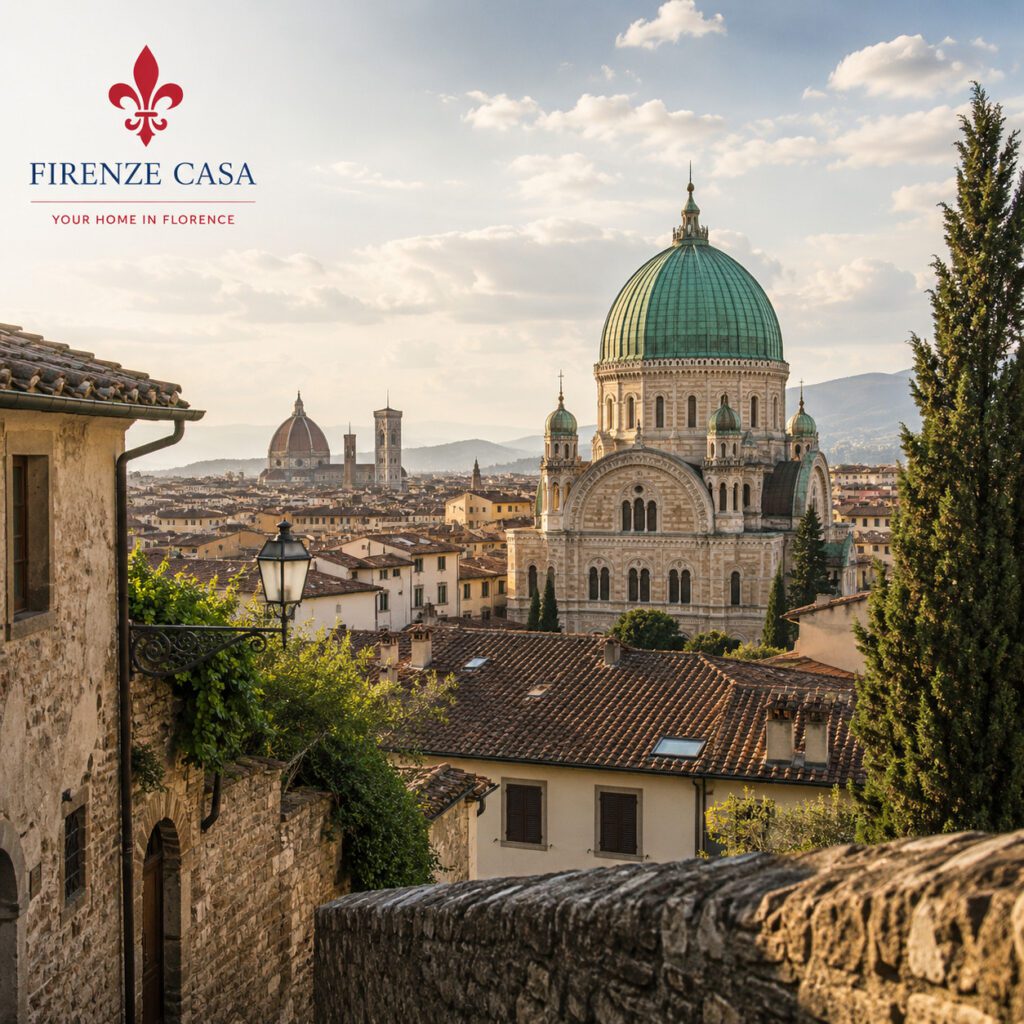
Jewish Florence tells a story that many visitors never discover. Behind the Renaissance palaces, churches and elegant squares lies the history of a Jewish community that lived, worked and worshipped in Florence for centuries.
Its traces lead from medieval commerce and the Medici period to the former Jewish ghetto in the heart of the city, the emancipation of the nineteenth century and the magnificent Great Synagogue. Yet part of this history has literally disappeared beneath modern Florence: much of the old ghetto was demolished during the transformation of the city centre in the late nineteenth century.
Jewish presence in Florence: Documented across many centuries
Historic ghetto: Established under Cosimo I de’ Medici around 1570–1571
Former location: Around today’s Piazza della Repubblica
Great Synagogue: Inaugurated in 1882
Architectural landmark: Large green copper dome
Jewish Museum: Inside the synagogue complex
Major nineteenth-century change: Demolition of the former ghetto during the Risanamento
20th-century history: Fascist racial laws, persecution and deportation
Historic cemetery: Viale Ariosto near Porta San Frediano
This article explores Jewish history across Florence. For the city’s broader historical development, see our History of Florence – Complete Guide.
The Origins of Jewish Florence
The history of Jews in Florence reaches back many centuries. Jewish individuals and families were present in Tuscany during the Middle Ages, although communities developed under changing political, religious and economic conditions.
By the fifteenth century, Jewish moneylenders had become particularly important. Christian restrictions concerning lending at interest created a complex financial environment in which Jewish lenders could provide forms of credit not always easily supplied through Christian institutions.
The relationship between Florence and its Jewish residents was never simple. Economic usefulness could bring protection, while political and religious pressure could produce restrictions. Policies changed repeatedly as rulers and governments changed.
Jewish history in Florence cannot be separated from the city’s wider commercial and financial development. Jewish lenders participated in the economy, but they operated under legal and religious conditions very different from those of Florence’s great Christian banking families.
Jewish Bankers and Renaissance Florence
Florence was already one of Europe’s major financial centres. Large Christian banking houses operated international networks, while smaller-scale credit remained essential to everyday economic life.
Jewish lenders occupied a particular position within this system. Their activities could include loans secured against objects and other forms of credit, but their right to live and work in Florence depended heavily on permissions granted by political authorities.
Economic participation therefore did not imply social equality.
The wider financial context is explored in our Birth of Modern Banking in Florence – Complete Guide.
The Medici and Florence’s Jewish Community
The rise of the Medici family changed Florence in countless ways, including the conditions under which Jewish residents lived.
Relations varied across generations. At certain moments, Medici rulers valued Jewish merchants, physicians, scholars and lenders. At others, political and religious pressure produced greater restrictions.
This contradiction became especially visible under Cosimo I de’ Medici, who transformed Florence from a republic into the centre of an increasingly centralised territorial state.
His government reshaped institutions, architecture and urban space. Eventually, it also reshaped Jewish life by concentrating Jewish residents within a designated quarter.
The Creation of the Jewish Ghetto
Around 1570–1571, under Cosimo I, the Jewish ghetto of Florence was established in the centre of the city.
The chosen area lay close to the Mercato Vecchio, the old market around today’s Piazza della Repubblica. Architect Bernardo Buontalenti was involved in adapting the quarter.
The location was extraordinarily central, close to major commercial, political and religious spaces.
Yet centrality did not mean equality. The ghetto imposed physical boundaries on Jewish life and formally separated residents from much of the surrounding population.
Stand in Piazza della Repubblica and look towards Via Roma and Via dei Brunelleschi. You are looking across an area that once formed part of Florence’s Jewish ghetto. Almost nothing in the modern square reveals how different this neighbourhood once looked.
Life Inside the Florence Jewish Ghetto
The ghetto developed into a densely inhabited urban world of its own. Its internal spaces included narrow passages, courtyards, homes, workshops and places of worship.
Two synagogues existed within the quarter. Shops and businesses served everyday needs, while religious traditions helped maintain communal identity across generations.
Life in the ghetto involved restriction, but the quarter should not be imagined only as a place of passive confinement. It was also a functioning community where families worked, worshipped and maintained social networks.
A Small City Within Florence
The physical structure of the ghetto reinforced separation from the surrounding city. Access was controlled through gates, while limited space produced a dense network of buildings, courtyards and adapted interiors.
At the same time, the quarter remained physically embedded in Florence’s commercial centre. Jewish residents were therefore simultaneously part of the city and legally separated from much of it.
The Synagogues of the Ghetto
The two synagogues within the old quarter were very different from the monumental Great Synagogue visitors see today.
They were integrated into the dense architecture of the ghetto rather than standing as prominent urban landmarks.
The contrast between these relatively concealed places of worship and the enormous nineteenth-century synagogue tells one of the most important stories of Jewish Florence: the transition from restriction towards emancipation and public visibility.
Where Was the Jewish Ghetto in Florence?
The former ghetto occupied an extremely central area around what is now Piazza della Repubblica.
Its approximate extent included parts of the area between today’s Piazza della Repubblica, Via Roma, Via dei Brunelleschi and neighbouring streets.
This can surprise visitors because the present square looks overwhelmingly nineteenth-century. Broad façades, cafés and open space replaced much of the dense medieval neighbourhood that once occupied the site.
Before Piazza della Repubblica
Before the modern square appeared, the area contained the Mercato Vecchio and a complicated network of medieval streets and buildings.
The Jewish ghetto formed part of that dense urban fabric. Understanding Jewish Florence therefore requires imagining a city centre very different from the one visible today.
The later transformation destroyed not only Jewish spaces but a substantial section of medieval Florence.
Piazza della Repubblica is one of the clearest examples of how dramatically Florence changed during the nineteenth century. The open square visitors see today replaced a dense historic neighbourhood that included the Mercato Vecchio and the former Jewish ghetto.
From Restriction to Emancipation
The position of Jews in Tuscany changed gradually during the eighteenth and nineteenth centuries.
Under the Lorraine rulers, some restrictions were relaxed, while political changes associated with the Napoleonic period and later nineteenth-century reforms further altered the legal position of Jewish residents.
Emancipation eventually opened a fundamentally different chapter.
The community no longer needed to define religious life within the physical confines of the old ghetto. A new generation could imagine a synagogue that was not hidden within a restricted neighbourhood but visibly present in the city.
The Great Synagogue of Florence
Few buildings express the transformation of Jewish Florence more powerfully than the Great Synagogue, the Tempio Maggiore Israelitico.
Completed and inaugurated in 1882, it stands in Via Luigi Carlo Farini east of the historic centre. Its enormous green copper dome rises above the surrounding buildings and makes it one of Florence’s most distinctive nineteenth-century landmarks.
The synagogue was designed by architects Mariano Falcini, Vincenzo Micheli and Marco Treves. Its architectural language deliberately differs from Florence’s medieval and Renaissance churches.
Moorish and other historicising influences give the building a highly individual character.
From several elevated viewpoints, the copper-green dome of the synagogue can be recognised among Florence’s terracotta roofs. It is a reminder that the city’s architectural history continued long after the Renaissance.
Why Is the Synagogue So Monumental?
The scale of the Great Synagogue makes an important historical statement.
For centuries, Jewish worship had often taken place within restricted or relatively inconspicuous spaces. The new synagogue emerged after emancipation, when Jewish citizens could participate more fully in public life.
Its monumental architecture therefore expressed confidence, visibility and belonging.
Rather than remaining hidden inside a ghetto, Jewish religious life now occupied one of the most impressive religious buildings in Florence.
Architecture of the Florence Synagogue
The synagogue immediately stands apart from most Florentine churches.
Its façade combines pale stone with coloured architectural details, while the central dome dominates the composition. Decorative arches and geometric ornament contribute to its distinctive nineteenth-century appearance.
Inside, rich decoration creates an equally impressive environment. Patterns, inscriptions and ornamental surfaces distinguish the interior from the restrained stone architecture associated with many Florentine Renaissance buildings.
A Building of a New Italy
The date of construction is significant. Italy had recently achieved national unification, and Florence itself had served as capital of the Kingdom of Italy from 1865 until 1871.
The synagogue therefore belongs to the same wider period of transformation explored in our Florence as Capital of Italy – Firenze Capitale 1865–1871.
For the Jewish community, monumental architecture offered a way to express participation in the new civic world while maintaining a distinct religious identity.
The Jewish Museum of Florence
The synagogue complex also houses the Jewish Museum of Florence.
The museum introduces visitors to Jewish religious traditions, ceremonial objects and the history of the Florentine community.
It provides valuable context for understanding both the synagogue and the much longer history of Jewish life in Tuscany.
For visitors interested in Jewish Florence, the museum is therefore more than an addition to the architectural visit. It connects the monumental nineteenth-century building with centuries of community history.
Combine the synagogue and Jewish Museum with Piazza della Repubblica. The two places tell opposite sides of the same story: one preserves the visible monument of Jewish emancipation, while the other conceals the vanished landscape of the former ghetto.
The Historic Jewish Cemetery of Florence
Another important part of Jewish Florence lies near Porta San Frediano.
The Historic Jewish Cemetery of Florence on Viale Ariosto dates from the eighteenth century and preserves graves, Hebrew inscriptions and monumental family tombs from generations of Florentine Jewish life.
Its enclosed and secluded character contrasts dramatically with the visibility of the Great Synagogue.
Together, cemetery and synagogue show two different stages in the history of the community: an older world shaped by restrictions and separation, and the more public Jewish life that emerged after emancipation.
The Destruction of the Old Ghetto
One of the most remarkable episodes in the history of Jewish Florence occurred after the community had gained greater freedom.
During the late nineteenth century, Florence undertook a vast programme of urban redevelopment generally associated with the Risanamento.
Much of the old centre around the Mercato Vecchio was considered overcrowded, unhealthy or incompatible with the image of a modern city.
Large sections of historic buildings were cleared, including the former Jewish ghetto.
Creating Piazza della Repubblica
The demolitions fundamentally changed the appearance of central Florence.
Narrow medieval streets, old houses, smaller religious buildings and the former market disappeared. In their place came broader streets, monumental façades and the open urban space that became Piazza della Repubblica.
The transformation created one of modern Florence’s most recognisable squares, but it also erased an extraordinary amount of historic urban fabric.
Among the histories lost from the physical landscape was the old Jewish quarter.
Nineteenth-century photographs preserve invaluable views of the old centre during the demolitions. They allow us to see streets and buildings that disappeared during the creation of modern Piazza della Repubblica.
What Remains of the Florence Ghetto?
Very little of the original ghetto survives in its former location.
This absence is precisely what makes its history so important. Unlike a preserved palace or church, the quarter cannot simply be entered and explored.
Visitors must reconstruct it through historical maps, photographs, surviving objects and the shape of the modern city.
Some architectural fragments and inscriptions associated with the vanished quarter survived demolition and entered collections elsewhere in Florence.
Reading Piazza della Repubblica Differently
Once you know the history, Piazza della Repubblica changes.
The square no longer represents only cafés, nineteenth-century façades and the monumental arch. It becomes a site of historical absence.
Beneath and around today’s open space lies the memory of Mercato Vecchio, medieval streets and generations of Jewish residents who lived within the ghetto.
Few places demonstrate more clearly how a city can preserve history through monuments while simultaneously hiding history through demolition.
Jewish Florence During Fascism
The twentieth century brought a far darker chapter.
The Fascist regime introduced racial laws in 1938 that systematically discriminated against Italian Jews.
Jewish citizens were excluded from schools, universities, professions and many areas of public life. Families that had participated in Italian society for generations suddenly lost fundamental rights.
For Florence’s Jewish community, conditions became dramatically worse after the German occupation of central and northern Italy in 1943.
Deportation and Persecution
Florentine Jews faced arrest, hiding and deportation during the German occupation and the Italian Social Republic.
Some escaped or survived with assistance from friends, religious institutions and clandestine networks. Others were captured and deported to Nazi concentration and extermination camps.
The Holocaust therefore forms an essential part of the history of Jewish Florence.
It also changes the meaning of the nineteenth-century synagogue. The building represents not only emancipation and confidence but also the survival of a community that later faced systematic persecution.
The history of Florence’s Jewish community cannot be separated from the Fascist racial laws of 1938 and the persecution that followed the German occupation in 1943. Remembering these events is essential to understanding Jewish Florence today.
Jewish Florence Today
Florence still has an active Jewish community, and the Great Synagogue remains its most visible landmark.
However, the community’s history extends far beyond one building. It includes medieval merchants and lenders, Renaissance politics, the Medici ghetto, emancipation, nineteenth-century civic life, Fascist persecution and post-war renewal.
That long history makes Jewish Florence an integral part of Florence itself rather than a separate historical footnote.
Why Visitors Often Miss This Story
Florence presents its Renaissance identity extraordinarily powerfully. The Duomo, Uffizi, Michelangelo, Botticelli and the Medici naturally dominate most first visits.
Other histories can therefore disappear behind that narrative.
In this case, the ghetto disappeared physically as well. Visitors can walk directly through its former location without knowing it ever existed.
The Great Synagogue restores some of that visibility. Its green dome announces a chapter of Florentine history that deserves far more attention.
A Short Jewish Florence Walk
You can connect two of the most important parts of this history on foot.
Begin in Piazza della Repubblica, where the former ghetto and Mercato Vecchio once stood. Pause for a moment and imagine the dense network of streets and buildings that existed before the nineteenth-century demolitions.
From there, walk east through the historic centre towards Via Luigi Carlo Farini and the Great Synagogue.
The contrast between the two locations is powerful. Piazza della Repubblica represents a Jewish place that has almost completely vanished, while the synagogue represents visibility, emancipation and continuity.
Walk from Piazza della Repubblica to the Great Synagogue as a journey from the lost ghetto to the public expression of an emancipated Jewish community. The route turns an abstract historical transformation into something visible within the city.
Interesting Facts About Jewish Florence
- Jewish residents have been part of Florentine history for centuries.
- Jewish lenders played a particular role in the economic life of Renaissance Florence.
- The Medici government established a Jewish ghetto around 1570–1571.
- The ghetto occupied part of the area around today’s Piazza della Repubblica.
- Two synagogues once existed within the old ghetto.
- Bernardo Buontalenti was involved in adapting the quarter.
- The Great Synagogue is famous for its large green copper dome.
- The synagogue was inaugurated in 1882.
- The former ghetto disappeared during the late nineteenth-century redevelopment of central Florence.
- Historic photographs preserve important evidence of the neighbourhood that was destroyed.
- Florence’s Jewish community suffered persecution after the Fascist racial laws of 1938 and during the German occupation.
- The synagogue complex includes the Jewish Museum of Florence.
Frequently Asked Questions About Jewish Florence
Was there a Jewish ghetto in Florence?
Yes. A Jewish ghetto was established under Cosimo I de’ Medici around 1570–1571. It occupied a central area around today’s Piazza della Repubblica and remained an important centre of Jewish life for centuries.
Where was the Jewish ghetto in Florence?
The ghetto stood around the former Mercato Vecchio in an area that now forms part of Piazza della Repubblica and the surrounding streets, including areas towards Via Roma and Via dei Brunelleschi.
Does the Florence Jewish ghetto still exist?
No. The former ghetto was demolished during the major redevelopment of Florence’s historic centre in the late nineteenth century. Very little survives in its original location.
Why was the Jewish ghetto demolished?
The demolition formed part of the large nineteenth-century urban redevelopment known as the Risanamento, which removed much of the old Mercato Vecchio district and created the modern city centre around Piazza della Repubblica.
When was the Great Synagogue of Florence built?
The Great Synagogue was completed and inaugurated in 1882, during the period following Jewish emancipation and Italian unification.
Why does the Florence Synagogue have a green dome?
The large copper-covered dome developed its characteristic green appearance through oxidation. Today, it makes the synagogue easy to recognise among Florence’s predominantly terracotta roofs.
Can you visit the Florence Synagogue?
The synagogue and Jewish Museum can be visited according to their current admission and security arrangements. Opening conditions may change, so visitors should check official information before planning a visit.
Is there still a Jewish community in Florence?
Yes. Florence continues to have an active Jewish community, with the Great Synagogue serving as its most prominent religious and cultural landmark.
What happened to Florence’s Jews during the Second World War?
Jewish Florentines suffered discrimination after the Fascist racial laws of 1938. Following the German occupation in 1943, members of the community faced arrest and deportation, while others survived in hiding or with assistance from rescue networks.
What is the best place to discover Jewish history in Florence?
The Great Synagogue and Jewish Museum provide the clearest introduction. The visit becomes even more meaningful when combined with Piazza della Repubblica and the Historic Jewish Cemetery near Porta San Frediano.
Why Jewish Florence Is Worth Discovering
Jewish Florence is worth discovering because it reveals a history of the city that is both deeply integrated and frequently hidden. Jewish residents participated in commerce, credit, intellectual life and the broader development of Florence while repeatedly living under legal and religious restrictions.
The Medici period produced the compulsory ghetto, while nineteenth-century emancipation allowed the community to build one of Florence’s most monumental religious buildings.
The destruction of the old quarter during the Risanamento then erased much of the physical landscape associated with centuries of Jewish life. The persecution of the twentieth century added an even darker chapter.
Yet the community survived. The synagogue, Jewish Museum, historic cemetery and surviving records preserve a history extending from medieval Florence to the present.
Understanding that history makes Florence itself more complete. The city was never only the world of Renaissance churches, Medici palaces and Christian institutions; it was also shaped by minorities whose stories belong fully to its past.
Jewish Florence shows how cities can preserve some histories in monumental architecture while allowing others to disappear almost completely from the streets. Discovering both the synagogue and the vanished ghetto helps restore that missing layer.
Further Reading on Firenze Casa
Continue exploring Jewish history, the Medici period and the transformation of modern Florence:
- History of Florence – Complete Guide
- Historic Jewish Cemetery of Florence
- Historic Cemeteries in Florence – Complete Guide
- The Medici Family: The Dynasty That Shaped Florence
- Cosimo I de’ Medici – The Duke Who Transformed Florence
- The Birth of Modern Banking in Florence – Complete Guide
- Florence as Capital of Italy – Firenze Capitale 1865–1871
- How Firenze Capitale Transformed Florence
References
- Gallerie degli Uffizi – The Jews, the Medici and the Ghetto of Florence
- Gallerie degli Uffizi – Historical Material on the Nineteenth-Century Renovation of Central Florence
- Comunità Ebraica di Firenze – Historical Resources on the Jewish Community of Florence
- Museo Ebraico di Firenze – Historical and Archival Resources on the Great Synagogue and Jewish Life in Florence
- Comune di Firenze – Historical Resources on the Former Jewish Ghetto and the Urban Transformation of Central Florence
- Medici Archive Project – Research on the Jews, the Medici and the Florentine Ghetto
- Milano, Attilio – Storia degli ebrei in Italia
- Stow, Kenneth R. – Studies on Jewish Life and Ghettos in Early Modern Italy

