

The birth of modern banking in Florence transformed commerce across medieval Europe. Long before the city became synonymous with Renaissance art, Florentine merchants and financiers were developing international banking networks, trusted currencies and sophisticated methods for transferring money across borders.
From the gold florin and the vast Bardi and Peruzzi companies to bills of exchange and the Medici Bank, Florence became one of Europe’s most innovative financial centres. The wealth created by this commercial revolution did not remain inside counting houses: it financed churches, palaces, libraries and works of art and ultimately helped create the economic foundations of the Renaissance.
Financial rise: 13th–15th centuries
Key currency: Gold florin, introduced in 1252
Early banking dynasties: Bardi, Peruzzi and Acciaiuoli
Major innovation: Bills of exchange and international cashless payments
Most famous institution: Medici Bank, founded in 1397
International network: London, Bruges, Paris, Avignon, Rome, Venice and other European centres
Cultural impact: Banking and commercial wealth helped finance the Renaissance
Legacy: International banking, credit, accounting, currency exchange and payment networks
Contents – The Birth of Modern Banking in Florence
- Timeline at a Glance
- Florence Before the Banks
- Why Florence Became a Financial Capital
- The Florin
- The First Great Banking Families
- How Medieval Banking Worked
- Bills of Exchange
- The Medici Bank
- How Banking Financed the Renaissance
- The Collapse of the Banking Giants
- Where to Discover Banking History in Florence
- The Legacy of Florentine Banking
- Frequently Asked Questions
Florence did not invent every financial technique discussed in this guide. However, its merchants and banking companies played a decisive role in developing, refining and spreading practices that made increasingly complex international commerce possible.
Timeline at a Glance
| Year | Event |
|---|---|
| 1252 | Florence introduces the gold florin, which becomes one of Europe’s most trusted trading currencies. |
| Late 13th century | Florentine companies such as the Bardi, Peruzzi and Acciaiuoli expand their commercial and financial networks across Europe. |
| Early 14th century | Florentine merchant-bankers finance international trade, rulers and the papal court. |
| 1340s | Major Florentine companies including the Peruzzi and Bardi fail during a wider financial crisis. |
| 1397 | Giovanni di Bicci de’ Medici establishes the Medici Bank. |
| 15th century | Florence reaches another peak of financial influence as banking wealth increasingly supports Renaissance culture and patronage. |

Florence Before the Banks
Long before Florence became a major European financial centre, it was developing into one of Italy’s most prosperous commercial cities. During the twelfth and thirteenth centuries, markets expanded, workshops multiplied and Florentine merchants established increasingly wide trading networks.
The textile industry provided a crucial foundation. Florentine wool and, later, silk became famous for their quality and reached customers across Europe and the Mediterranean. Successful merchants consequently accumulated substantial capital.
International commerce also created practical problems. Merchants had to purchase materials abroad, sell goods in distant markets and operate in regions where numerous currencies circulated simultaneously.
Money changers therefore became increasingly important. They understood the value and precious-metal content of different coins and could exchange currencies for merchants and travellers.
Over time, some of these financial activities became more sophisticated. Deposits, lending, transfers and commercial credit gradually formed part of a broader merchant-banking economy.
Medieval banking did not suddenly appear as a modern institution. It evolved gradually from commerce, currency exchange, credit and the practical need to move value between distant markets.
Why Florence Became a Financial Capital
Several factors allowed Florence to emerge as one of Europe’s leading centres of finance. Its merchants already participated in international trade, while the textile industry constantly required payments, credit and currency exchange across borders.
The city also developed a highly experienced commercial class. Florentine merchants understood mathematics, accounting, contracts and commercial law, while family and partnership networks provided trusted representatives in distant cities.
Reputation was essential. In a world without central banks or electronic transfers, merchants needed confidence that their partners would honour financial obligations hundreds of kilometres away.
Successful Florentine companies therefore turned trust into an economic asset. Their branches and correspondents gradually connected Florence with London, Bruges, Paris, Avignon, Rome, Venice, Naples and other major commercial centres.
As these networks expanded, money no longer needed to travel physically every time value moved between two places. Accounting relationships and financial instruments could increasingly perform that function instead.
Florence became financially powerful because manufacturing, international trade and banking evolved together. Textile merchants needed financial services, while bankers benefited from the commercial networks created by the textile industry.
The Florin: Europe’s Most Trusted Gold Coin
One of Florence’s greatest economic achievements was the introduction of the gold florin in 1252. The coin soon became one of the most widely trusted currencies in medieval European commerce.
The florin contained approximately 3.5 grams of high-purity gold and maintained remarkable consistency over long periods. At a time when some rulers altered the precious-metal content of their currencies, this stability encouraged confidence.
The coin carried the Florentine lily on one side and Saint John the Baptist, the city’s patron saint, on the other. Its recognisable design and reliable composition made it particularly useful for large transactions.
As Florentine merchants expanded throughout Europe, the florin travelled with them. It became accepted far beyond Tuscany and reinforced the city’s commercial reputation.
Other states later produced gold coins inspired by the Florentine model. The florin therefore became more than a local currency: it was one of the great international monetary symbols of the Middle Ages.

The First Great Banking Families
Florence’s rise depended on numerous merchant families, but several dynasties became particularly important in the evolution of international banking. Their careers also reveal that Florentine finance developed through several distinct generations rather than through the Medici alone.
The Bardi Family
By the early fourteenth century, the Bardi family was associated with one of Europe’s largest merchant-banking organisations. Its network reached major commercial centres in Italy, France, Flanders and England.
The company traded goods, exchanged currencies, extended credit and dealt with powerful political and ecclesiastical clients. Edward III of England became one of its most famous debtors.
The Bardi company failed during the financial upheavals of the 1340s. Although royal debts contributed to its difficulties, modern scholarship regards the collapse as the result of several interconnected commercial and financial pressures.
The Peruzzi Family
The Peruzzi family created another extraordinary international network. Its merchants operated across western Europe and the Mediterranean, combining trade with currency exchange, lending and other financial services.
Like the Bardi, the Peruzzi became involved with royal finance and accumulated substantial exposure to the English Crown. Their company also failed during the 1340s.
The dedicated article Bardi and Peruzzi: Florence’s Banking Giants examines these two medieval financial organisations in greater detail.
The Acciaiuoli Family
The Acciaiuoli family followed an especially international path. Their merchant and banking activities connected Florence with southern Italy and the Mediterranean.
Niccolò Acciaiuoli eventually transformed financial connections into political power at the Angevin court in Naples, while later members of the family acquired territories in Greece and even ruled medieval Athens.
The Acciaiuoli therefore demonstrate how Florentine commercial networks could open doors far beyond banking itself.
The Medici Family
The next great phase arrived with the Medici family. In 1397, Giovanni di Bicci de’ Medici established the institution generally known as the Medici Bank.
The company developed branches in major European centres and became closely involved with papal finance. Under Cosimo de’ Medici, commercial wealth increasingly supported the family’s political influence in Florence.
Its history therefore connected banking with something new: sustained political dominance and extraordinary cultural patronage.
The Bardi and Peruzzi represent the great medieval merchant-banking companies. The Acciaiuoli transformed financial networks into Mediterranean political power, while the Medici later combined banking with lasting political influence in Florence.
How Medieval Banking Worked
Many basic functions of medieval banking remain familiar today. Florentine financiers accepted deposits, provided credit, exchanged currencies, maintained accounts and transferred value between different commercial centres.
Merchants could deposit money with trusted financial companies instead of holding large quantities of valuable coin. Transactions could then be recorded through accounts rather than requiring a physical exchange of gold or silver every time a payment occurred.
Credit was equally important. Merchants needed financing to purchase goods and organise long-distance trade, while governments and rulers required enormous sums for diplomacy and warfare.
Currency exchange represented another specialised service because dozens of different coins circulated across Europe. Bankers therefore needed detailed knowledge of exchange rates, precious-metal values and conditions in individual markets.
As financial networks expanded, accurate bookkeeping became indispensable. Firms had to understand balances, obligations, profits and losses across several cities at once.
These practices created a financial infrastructure capable of supporting increasingly complex international commerce.
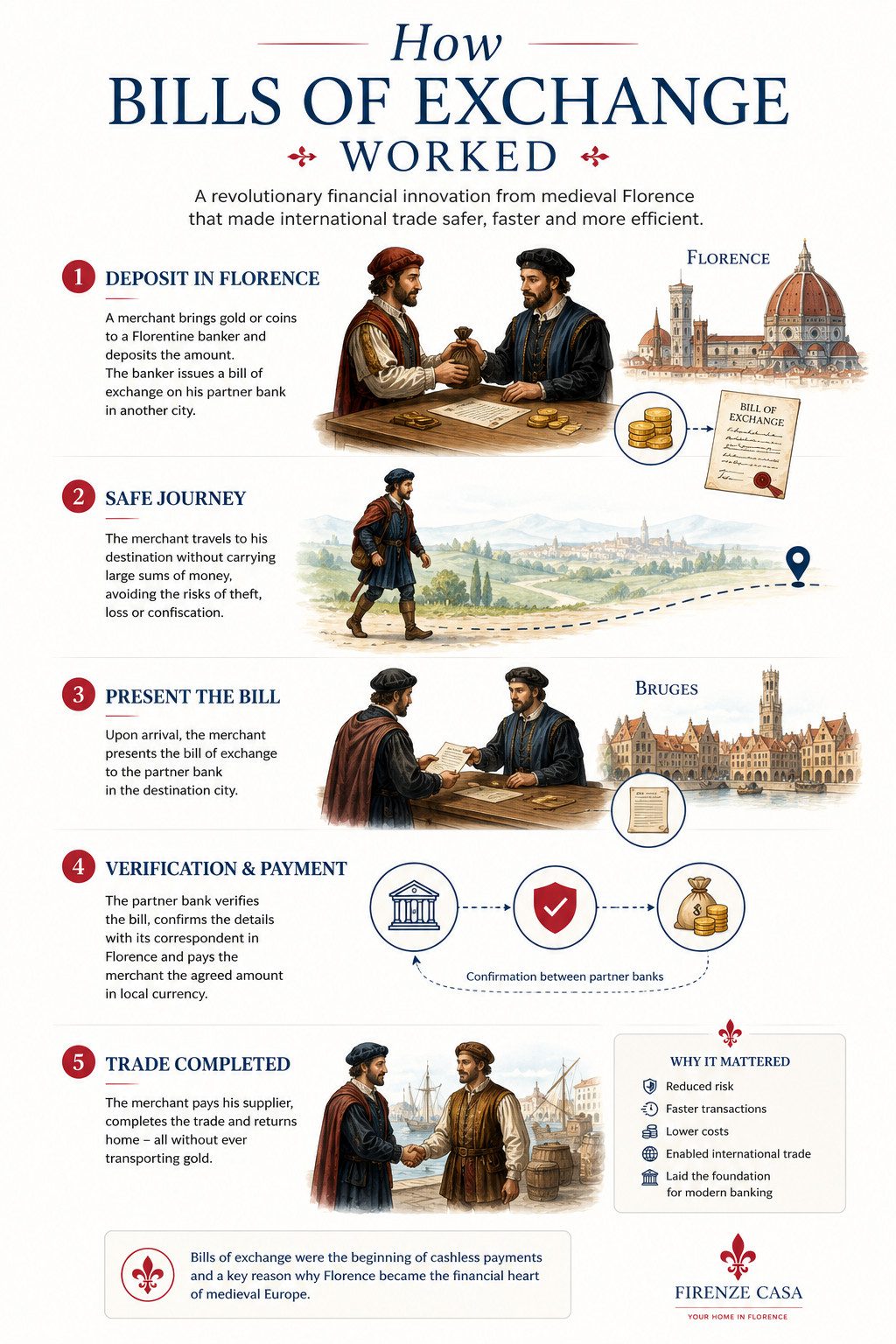
Bills of Exchange: The Origins of Cashless Payments
Transporting large quantities of gold and silver through medieval Europe was dangerous and expensive. Merchants faced robbery, shipwreck, war and rapidly changing political conditions.
One increasingly important solution was the bill of exchange. This financial instrument allowed payments to be arranged between different commercial centres without requiring an equivalent quantity of coins to make the same journey.
A merchant could enter an agreement in one city while payment was completed through a correspondent or associated company elsewhere. Currency exchange could be incorporated into the transaction.
The system reduced some of the risks of carrying precious metal and made international commerce more flexible. However, it depended heavily on reputation and reliable relationships.
In this sense, bills of exchange represent an important stage in the long development of cashless finance. Value increasingly moved through trusted financial networks rather than through the physical transportation of money.
The technology is completely different, but the underlying principle remains familiar: financial value can move between accounts and locations even when physical currency does not.
The Medici Bank
By the time Giovanni di Bicci founded the Medici Bank in 1397, Florence already possessed generations of international financial experience.
The Medici therefore did not invent Florentine banking. Instead, they entered an established commercial world and built one of its most influential fifteenth-century organisations.
Branches and associated businesses operated in cities including Rome, Venice, Milan, Geneva, Bruges and London. The structure allowed local operations to respond to individual markets while remaining connected to a broader financial network.
The relationship with the papal court proved particularly important. Church-related financial business brought both profits and valuable political connections.
Under Cosimo de’ Medici, the bank’s success increasingly reinforced the family’s political position in Florence. Financial wealth funded alliances and patronage while supporting a network that gradually made Cosimo the city’s dominant political figure.
The bank later declined as branches experienced management problems, political difficulties and unsuccessful lending. Nevertheless, its influence on the history of Florence remains extraordinary.
How Banking Financed the Renaissance
The connection between banking and Renaissance culture is one of the most important parts of the Florentine story. Wealth generated through commerce and finance did not remain locked inside merchant companies.
Families spent money on churches, chapels, monasteries, hospitals, libraries and palaces. They also commissioned paintings, sculpture and architecture from some of the most important artists of the period.
Patronage could express religious devotion, civic responsibility and family ambition simultaneously. A chapel honoured God while preserving the donor’s name; a palace provided a home while advertising social status.
The Bardi and Peruzzi had already commissioned Giotto in Santa Croce during the early fourteenth century. Later families continued this tradition on an even larger scale.
The Medici supported churches, libraries, scholars and artists, while other merchant dynasties such as the Rucellai, Strozzi, Tornabuoni and Pucci created their own remarkable cultural legacies.
Our dedicated guide to How Banking Financed the Renaissance explores these connections in greater detail.
Florence’s financial and artistic histories cannot really be separated. Merchant wealth paid architects, painters, sculptors and craftsmen, while great works of art transformed private fortunes into lasting public memory.
Banking, Politics and Family Power
Banking success also changed Florentine politics. Wealthy merchant families could finance political networks, acquire property and create alliances through marriage and patronage.
The relationship between money and political influence was particularly clear in the republic, where formal institutions continued to operate even as certain families became exceptionally powerful.
The Medici provide the most famous example, but they were part of a much broader world. Bardi, Peruzzi, Strozzi, Tornabuoni, Gondi, Frescobaldi and other families all combined economic resources with civic ambition in different ways.
Our Most Famous Florentine Families – Complete Guide explores how these dynasties interacted through commerce, politics, marriage and rivalry.
The Collapse of Florence’s Medieval Banking Giants
International banking created enormous opportunities but also serious risks. Companies could be exposed to wars, political instability, unreliable borrowers and sudden changes in commercial markets.
The failures of the Bardi and Peruzzi during the 1340s became the most famous examples. Giovanni Villani and later writers placed particular emphasis on unpaid loans to Edward III of England.
Modern scholarship presents a more complex picture. Royal debt mattered, but so did broader commercial losses, political instability, leverage and the interconnected structure of international finance.
The crisis did not end Florentine banking. Companies disappeared, but financial expertise survived, while new merchant families developed different organisations and strategies.
In this sense, failure itself became part of Florence’s financial evolution. Later bankers operated within a commercial culture that already understood both the opportunities and dangers of international credit.
Sovereign debt, concentration risk, political uncertainty and interconnected markets were already problems for medieval bankers. The institutions have changed, but many fundamental financial risks have not.
Where to Discover Florence’s Banking History
Palazzo Medici Riccardi
Palazzo Medici Riccardi is one of the clearest places to see how banking wealth became architecture and political prestige. Michelozzo designed the residence for Cosimo de’ Medici during the fifteenth century.
Piazza de’ Peruzzi
The curved Piazza de’ Peruzzi near Santa Croce preserves the name of one of Florence’s great medieval banking families. Its unusual shape also follows part of the footprint of the ancient Roman amphitheatre.
Via de’ Bardi
South of the Arno, Via de’ Bardi recalls another great merchant-banking dynasty. The street provides a tangible connection with the medieval neighbourhood where the family owned property.
Santa Croce
The Bardi and Peruzzi chapels inside Santa Croce demonstrate the cultural consequences of merchant wealth. Both families commissioned major fresco cycles associated with Giotto.
Via de’ Tornabuoni and the Historic Centre
Later merchant and banking families transformed the streets around Via de’ Tornabuoni with palaces and residences. Walking through this district reveals how financial wealth became part of Florence’s urban architecture.
Combine Piazza de’ Peruzzi and Santa Croce with Via de’ Bardi, then continue towards the great Renaissance palaces. The route allows you to follow Florentine finance from medieval banking families to the architectural world of the Renaissance.
The Legacy of Florentine Banking
The legacy of Florentine finance extends far beyond the institutions that once operated in the city. International banking networks, sophisticated bookkeeping, commercial credit, currency exchange and cashless payment mechanisms became increasingly important elements of European commerce.
Perhaps the most important achievement was the creation of trust across distance. Merchants could conduct transactions because they relied on established reputations, contractual relationships and networks of correspondents.
This financial infrastructure helped make long-distance trade safer and more efficient. It also connected markets separated by hundreds or thousands of kilometres.
Florence demonstrates equally clearly that finance can transform culture. Profits from trade and banking supported artists, architects, scholars and institutions whose achievements became central to European history.
Visitors still encounter these consequences throughout the city. Family palaces, chapels, churches and paintings preserve the memory of fortunes created through commerce and finance.
The birth of modern banking in Florence should therefore be understood as more than an economic story. It is one of the keys to understanding how medieval Florence became the city of the Renaissance.
Interesting Facts About Florentine Banking
- The gold florin was introduced in Florence in 1252 and became one of medieval Europe’s most trusted currencies.
- Florentine merchant-banking companies operated international networks centuries before modern multinational banks.
- The Bardi and Peruzzi reached extraordinary financial scale before the Medici Bank existed.
- Bills of exchange allowed value to move between European cities without equivalent quantities of coins travelling with it.
- The Medici Bank was founded by Giovanni di Bicci de’ Medici in 1397.
- Florentine bankers provided financial services to merchants, rulers and the papal court.
- Merchant and banking wealth helped finance important Renaissance art, architecture and scholarship.
Frequently Asked Questions
Why is Florence considered one of the birthplaces of modern banking?
Florence became a major centre for international merchant banking, currency exchange, commercial credit, accounting and payment networks during the Middle Ages and Renaissance. Florentine companies helped refine and spread practices that became important to later European finance.
Did Florence invent banking?
No. Banking and credit existed long before medieval Florence. However, Florentine merchants played an exceptionally important role in developing large international banking organisations and sophisticated financial practices.
What was the Florin?
The florin was a gold coin first minted by Florence in 1252. Its reliable weight and purity helped it become one of the most trusted currencies in medieval European commerce.
Who were Florence’s first great banking families?
The Bardi, Peruzzi and Acciaiuoli were among the major medieval merchant-banking dynasties. The Medici became especially important during the fifteenth century.
Who founded the Medici Bank?
Giovanni di Bicci de’ Medici founded the Medici Bank in 1397. It later developed into one of fifteenth-century Europe’s most influential financial organisations.
What was a bill of exchange?
A bill of exchange allowed merchants to arrange payments between different commercial centres without physically transporting the equivalent amount in coins. It could also incorporate credit and currency exchange.
Why did the Bardi and Peruzzi companies fail?
They failed during the financial crises of the 1340s. Large sovereign debts contributed to their problems, but historians also identify broader commercial losses, political instability and structural financial pressures.
How did banking help create the Renaissance?
Banking and international commerce generated wealth that Florentine families invested in churches, palaces, libraries, hospitals and works of art. These commissions supported artists, architects and scholars and helped shape Renaissance culture.
Can visitors still see Florence’s banking history today?
Yes. Palazzo Medici Riccardi, Piazza de’ Peruzzi, Via de’ Bardi, Santa Croce and numerous family palaces preserve direct connections with Florence’s merchant and banking dynasties.
Why Florence’s Banking History Is Worth Discovering
Florence’s banking history is worth discovering because it explains an essential part of the city’s transformation from medieval commercial centre to Renaissance capital. The florin, international merchant companies and increasingly sophisticated financial networks connected Florence with markets across Europe.
The Bardi, Peruzzi and Acciaiuoli reveal the extraordinary scale already reached by medieval Florentine finance, while the Medici demonstrate how banking wealth could become political and cultural power.
Understanding this financial world also changes the way visitors see Florence. Palaces, churches, chapels and masterpieces of Renaissance art become evidence of an economy that converted international commerce into one of Europe’s greatest cultural legacies.
Florence is usually introduced through art. Yet behind many of its masterpieces stood merchants, bankers and international financial networks. Understanding the money behind the Renaissance adds an entirely new layer to the city.
Further Reading on Firenze Casa
Continue through our Florence banking cluster and explore the families, financial innovations and cultural consequences behind the city’s economic rise:
- The Medici Bank: Europe’s Most Powerful Bank
- The Florin: The Gold Coin That Changed Europe
- Bills of Exchange: The Origins of Cashless Payments
- Bardi and Peruzzi: Florence’s Banking Giants
- How Banking Financed the Renaissance
- The Most Famous Florentine Families – Complete Guide
- The Bardi Family: Banking, Power and Medieval Florence
- The Peruzzi Family: Banking, Politics and Medieval Florence
- The Acciaiuoli Family: Banking, Power and Mediterranean Ambition
- The Medici Family: The Dynasty That Shaped Florence
References
- De Roover, Raymond – The Rise and Decline of the Medici Bank
- Goldthwaite, Richard A. – The Economy of Renaissance Florence
- Hunt, Edwin S. – The Medieval Super-Companies
- Hunt, Edwin S.; Murray, James M. – A History of Business in Medieval Europe, 1200–1550
- Spufford, Peter – Money and Its Use in Medieval Europe
- Parks, Tim – Medici Money
- Najemy, John M. – A History of Florence 1200–1575
- Historical and archival material on medieval Florentine commerce, coinage and banking

