
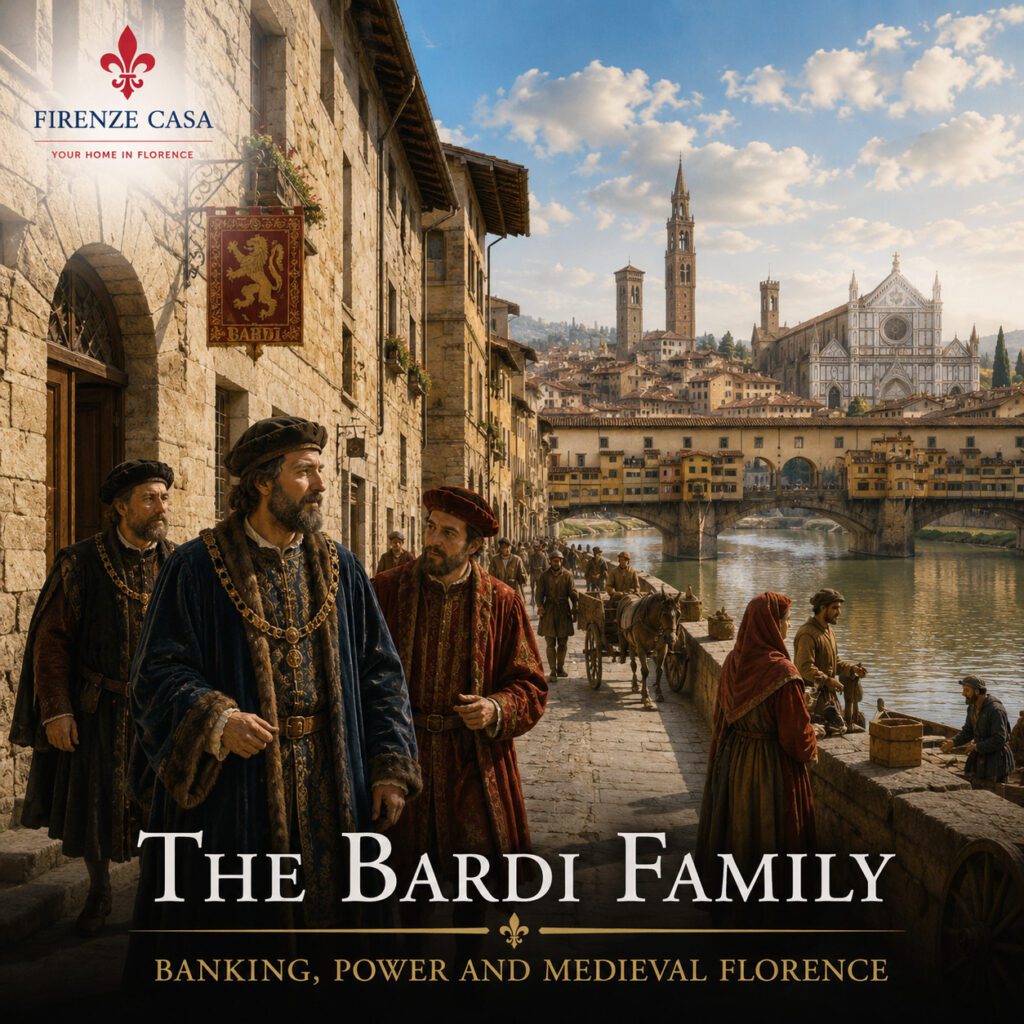
The Bardi family belonged to the most powerful merchant dynasties of medieval Florence. Centuries before the Medici came to dominate the city, the Bardi combined international commerce, banking, political influence and artistic patronage on an extraordinary scale.
Their merchant-banking company operated across Europe and dealt with rulers, merchants and the papal world. At home, members of the family participated in Florentine politics and established themselves in the Oltrarno, where Via de’ Bardi still preserves their name. Although the collapse of the company during the 1340s became famous, the family’s importance extends far beyond that financial crisis.
Origins: Medieval Florence
Period of greatest influence: Late 13th–early 14th centuries
Main activities: International trade, banking, currency exchange and credit
Key urban area: Via de’ Bardi in the Oltrarno
Major artistic legacy: Bardi Chapel in Santa Croce
Famous financial connection: Edward III of England
Major crisis: Collapse of the Bardi company in the 1340s
Historical importance: Early international banking before the Medici
The Bardi belong to the wider group explored in our Most Famous Florentine Families – Complete Guide. Their financial history also forms an essential chapter in The Birth of Modern Banking in Florence.
Who Were the Bardi Family?
The Bardi were an old Florentine family whose fortunes became closely connected with the commercial expansion of the city during the thirteenth and fourteenth centuries. They belonged to an urban elite that accumulated wealth through trade and finance while also participating actively in public life.
This combination was characteristic of medieval Florence. Leading merchants entered guilds, held public offices, formed political alliances and invested in religious and artistic patronage rather than limiting themselves to private business.
The Bardi followed precisely this path. Their international commercial activities generated enormous resources, while political connections strengthened their position within Florence.
The Bardi reached the height of their financial power generations before the Medici Bank was founded. Their story belongs to an earlier Florence dominated by merchant companies, guilds and powerful family networks.
The Bardi Family and Medieval Florence
Florence around 1300 was already one of Europe’s most dynamic cities. Its textile workshops produced valuable cloth, its merchants travelled across the continent and the gold florin had become a respected international currency.
Economic expansion created opportunities for families able to organise trade over long distances. Merchants needed capital, reliable representatives, detailed market information and methods for transferring value between distant cities.
The Bardi prospered in this environment. Their company became one of the exceptionally large Florentine enterprises that historians sometimes describe as medieval “super-companies”.
Calling them simply bankers therefore tells only part of the story. They were international merchant-financiers operating within a rapidly developing European economy.
The Rise of the Bardi Company
By the early fourteenth century, the Bardi company had developed into one of the largest commercial organisations in Europe. Its business extended far beyond Florence and depended on branches, agents and partnerships operating across several kingdoms.
The company traded commodities, exchanged currencies, extended credit and transferred money between commercial centres. These activities reinforced one another because international trade generated both profits and valuable information.
At the same time, financial services made large-scale commerce easier to organise. The company could therefore profit from both merchandise and finance.
Although the enterprise carried the Bardi name, it is important not to confuse the business with every member of the extended family. Medieval companies could include relatives and outside partners, while some family members had little involvement in the firm.
The “Bardi family” and the “Bardi company” were not exactly the same thing. This distinction becomes especially important when discussing political conflicts and the later collapse of the banking enterprise.
An International Merchant-Banking Network
The geographical reach of the great Florentine companies was remarkable. Their representatives operated in major centres of commerce in Italy, France, Flanders and England, while other connections extended throughout the Mediterranean.
England was particularly important because Florentine merchants required high-quality English wool for the textile industry. Northern European trading centres, meanwhile, connected Italian merchants with markets reaching towards the North Sea and beyond.
Southern Italy also played an important role, while relationships with the papal court offered profitable opportunities in finance and money transfers.
Through networks of this kind, the Bardi participated in an increasingly international economy even though Florence itself possessed neither a major seaport nor an overseas empire.
Why the Bardi Were More Than Bankers
The modern word “bank” can be misleading when applied to the Bardi. Their enterprise combined activities that today would belong to several different types of companies.
Trade remained fundamental. Florentine merchants purchased raw materials, sold finished products and participated in commodity markets, while also exchanging currencies and arranging credit between customers in different cities.
The company’s representatives gathered information about prices, political events and changing exchange rates. This ability to integrate commerce, information and financial services explains why the great Florentine companies became so influential across medieval Europe.
The Bardi Family and Florentine Politics
Commercial success naturally affected the family’s political position. Members of the Bardi repeatedly participated in Florentine government and civic institutions during the Middle Ages.
One example is Bartolo Bardi, who served several times among the Priors during the late thirteenth century and also held positions connected with powerful merchant guilds.
Such careers illustrate the close relationship between economic and political power in Florence. Wealthy merchants possessed extensive networks and administrative experience, while public office could strengthen family prestige and influence.
Politics also brought danger, however. The wider political background can be explored in The Medieval Republic of Florence – Guilds, Power and Civic Life.
Family Power and Political Conflict
The Bardi lived through a period of intense political instability. Guelphs and Ghibellines had struggled for control of Florence, while later divisions continued within the victorious Guelph camp.
Family alliances mattered enormously in this environment. Marriage, neighbourhood ties, business relationships and political loyalties could strengthen a dynasty but also draw it into dangerous conflicts.
A striking example came in 1340, when several members of the wider Bardi family became involved in a failed political conspiracy. Significantly, the company argued that those individuals were not active partners in the business.
In 1340, the Bardi company successfully distinguished itself from members of the wider family involved in a failed political coup. The episode shows why historians must separate the dynasty from the company that carried its name.
Via de’ Bardi: The Family’s Street in Florence
The Bardi name remains embedded in the geography of Florence. Via de’ Bardi runs through the Oltrarno close to the southern bank of the Arno, between the area of Ponte Vecchio and the neighbourhood towards San Niccolò.
This part of Florence became closely associated with the family. Houses, towers and other properties created an urban concentration of Bardi influence near one of the city’s most important river crossings.
The location made commercial sense because Ponte Vecchio connected the northern commercial centre with the Oltrarno, while roads south of the river led towards the countryside and routes beyond Florence.
Today, walking along Via de’ Bardi provides one of the most tangible connections with the dynasty.
Walk from Ponte Vecchio into Via de’ Bardi and imagine the neighbourhood before the great Renaissance palaces transformed Florence. Powerful medieval families often concentrated houses, towers and commercial property within particular streets and districts.
The Bardi and the Oltrarno
The association with the Oltrarno gives the Bardi a distinctive place among Florence’s great families. Their urban identity developed south of the Arno in an area that was becoming an increasingly important part of the expanding medieval city.
Bridges were vital to this growth because they allowed people, animals and merchandise to move between both sides of Florence. Property near these routes could therefore have considerable strategic and economic value.
The Bardi presence also reminds visitors that medieval Florence did not consist solely of the monumental centre around the Duomo and Palazzo Vecchio. Powerful families shaped neighbourhoods throughout the city.
The Bardi Family and Santa Croce
The family’s influence also survives on the opposite side of the Arno in the Basilica of Santa Croce. Like several wealthy Florentine dynasties, the Bardi invested in religious foundations and artistic patronage.
The Bardi Chapel became one of their most important cultural legacies. Giotto decorated the chapel with frescoes devoted to the life of Saint Francis during the early fourteenth century.
This commission placed the Bardi at the centre of one of the most important developments in Western art. Giotto’s approach to space, human emotion and narrative helped transform European painting.
The chapel therefore demonstrates something essential about Florentine merchant society: profits earned through international commerce could be transformed into religious prestige and artistic achievement.
Giotto and the Bardi Chapel
Inside Santa Croce, the Bardi Chapel offers a remarkable counterpoint to the nearby Peruzzi Chapel. Both families commissioned Giotto, revealing the extraordinary cultural ambitions of Florence’s merchant elite before the Renaissance traditionally began.
The Bardi cycle focuses on Saint Francis of Assisi. Its scenes combine architecture, groups of figures and carefully organised narratives to create a powerful visual account of the saint’s life.
For the family, such a chapel served several purposes. It expressed religious devotion, provided a place associated with dynastic memory and publicly demonstrated status.
For modern visitors, however, it offers something even more valuable: a direct connection between the financial world of medieval Florence and the artistic revolution taking place inside its churches.
The Bardi and Peruzzi chapels stand close to one another in Santa Croce. Together, they show how two of medieval Florence’s greatest banking families became patrons of Giotto.
The Bardi Family and the Florin
The international expansion of Florentine merchant companies coincided with the success of the Florin. Florence first minted the gold coin in 1252, and its reliable weight and fineness helped it gain acceptance across European markets.
For international companies, a trusted currency offered obvious advantages. Nevertheless, merchants could not rely exclusively on physical coins because transporting large quantities of gold across medieval Europe was expensive and dangerous.
Florentine financiers increasingly used account transfers, credit arrangements and Bills of Exchange. These methods allowed value to move between cities without requiring an equivalent physical movement of coin.
The Bardi belonged to the commercial culture that developed and expanded these sophisticated financial practices.
From Florence to the Courts of Europe
As Florentine financial networks expanded, merchant companies inevitably encountered kings and governments. Medieval rulers constantly needed money for administration, diplomacy and warfare.
Providing financial services to monarchs could be highly profitable and might also bring political advantages or valuable commercial privileges. However, lending to rulers involved risks that ordinary commercial transactions did not.
A merchant could pursue another merchant through established mechanisms, but collecting an enormous debt from a king was considerably more difficult.
This problem eventually became central to the most famous chapter in the history of the Bardi company.
Edward III and the Bardi
The Bardi maintained important business relationships with England during the reign of Edward III. English wool mattered greatly to Florence, while the king required financing as his conflict with France developed into the Hundred Years’ War.
According to the Florentine chronicler Giovanni Villani, Edward owed the Bardi an enormous sum when their company failed. His account helped create one of the most enduring stories in banking history: an English king borrowed so heavily from Florentine bankers that his failure to repay them destroyed their companies.
The story contains an important element of truth, but modern economic historians regard it as too simple. Royal debts placed severe pressure on the Bardi and Peruzzi family, yet other commercial, financial and political problems also contributed to their failures.
Edward III should therefore be seen as part of the explanation rather than as the single cause of the crisis.
The famous story that Edward III single-handedly bankrupted the Bardi makes excellent drama but poor financial history. Royal debt mattered greatly, although the collapse resulted from a much more complicated combination of risks.
The Collapse of the Bardi Company
The great Bardi company failed in the 1340s during a wider crisis affecting several of Florence’s largest merchant-banking organisations. The Peruzzi company had already collapsed, while the Acciaiuoli family also experienced serious financial difficulties during the same decade.
These events demonstrate how interconnected medieval finance had become. Large companies operated through networks of branches, investors, customers and creditors.
Consequently, difficulties in one market could create problems elsewhere. The collapse was undoubtedly a major blow to the economic standing associated with the Bardi name.
Nevertheless, it did not erase the family itself.
The Bank Failed, but the Bardi Survived
The extended Bardi family continued after the collapse of the great company. Property, marriages, political relationships and different branches of a dynasty could survive even when a particular commercial partnership failed.
Later members remained part of Florentine society, although the family no longer occupied the extraordinary financial position reached during the early fourteenth century.
Their name nevertheless remained visible in Florence. Via de’ Bardi preserved their geographical identity, while the chapel in Santa Croce maintained their association with one of the greatest artists of medieval Italy.
In this sense, the cultural and urban legacy of the family ultimately proved more durable than its banking empire.
The Bardi Before the Medici
The dominance of the Medici family in popular accounts can make earlier Florentine history seem like a prelude to the Renaissance. Yet the Bardi demonstrate that Florence had already developed an extraordinary financial culture long before Cosimo de’ Medici became the city’s dominant political figure.
By the early fourteenth century, Florentine companies operated across Europe. They financed rulers, traded internationally and developed sophisticated methods for transferring money between distant markets.
Furthermore, wealthy merchant families were already commissioning major works from artists such as Giotto. The familiar relationship between money, politics and art associated with Renaissance Florence therefore had deep medieval roots.
The Medici later became masters of this combination, but they entered a world that families such as the Bardi and Peruzzi had already helped create.
Bardi, Peruzzi and Medici: Different Generations of Florentine Banking
The Bardi and Peruzzi reached the height of their commercial power during the late thirteenth and early fourteenth centuries. Their enormous merchant-banking organisations belonged to the first great era of Florentine international finance.
The Medici Bank emerged later and became particularly powerful during the fifteenth century. Its structure and political environment differed from those of the earlier companies.
These families should therefore not simply be imagined as equivalent banks competing at the same moment. Instead, they represent different stages in the evolution of Florence as a financial centre.
Our dedicated guide to Bardi and Peruzzi: Florence’s Banking Giants compares the two medieval companies in greater detail.
What the Bardi Tell Us About Medieval Finance
The scale of the Bardi company challenges simplistic ideas about the medieval economy. Its representatives coordinated transactions across large geographical distances without modern communications or transport.
Success depended on correspondence, account keeping and trusted networks. Merchants had to understand currencies, prices, political risks and local markets.
At the same time, the company’s eventual collapse reveals the other side of this sophistication. International networks could spread risk, but they could also transmit financial problems from one region to another.
For this reason, the Bardi story feels unexpectedly contemporary. Questions about sovereign debt, credit concentration and interconnected financial markets remain familiar today.
Where to Discover the Bardi Family in Florence
Via de’ Bardi
Begin in the Oltrarno, where Via de’ Bardi still carries the family name. Walking along the street provides the most direct connection with the area in which the dynasty established much of its medieval presence.
Ponte Vecchio
The nearby bridge helps explain the strategic importance of the neighbourhood. River crossings connected the Oltrarno with Florence’s commercial centre and formed part of the routes used by people and merchandise entering the city.
The Bardi Chapel in Santa Croce
Cross the Arno and continue towards Santa Croce. Inside the basilica, Giotto’s frescoes in the Bardi Chapel provide the family’s most important surviving artistic legacy.
The Medieval Streets of the Oltrarno
Although much has changed over seven centuries, the narrow streets around Via de’ Bardi still help visitors appreciate the scale and density of medieval Florence.
Combine Via de’ Bardi, Ponte Vecchio and Santa Croce in one walk. The route connects the family’s medieval neighbourhood with its extraordinary artistic legacy on the opposite side of the Arno.
A Short Bardi Walk Through Florence
Start near Ponte Vecchio and enter Via de’ Bardi on the southern side of the Arno. From here, explore the surrounding Oltrarno streets and imagine the dense medieval neighbourhood that once contained properties associated with one of Florence’s most powerful families.
Next, cross the river and walk through the historic centre towards Piazza Santa Croce. The journey itself helps demonstrate how closely the different quarters of medieval Florence were connected.
Inside Santa Croce, visit the Bardi Chapel and compare it with the nearby Peruzzi Chapel. Two of Europe’s greatest merchant-banking families commissioned works from the same extraordinary artist.
Few walks illustrate the relationship between Florentine finance and art so clearly.
The Cultural Legacy of the Bardi Family
The Bardi company disappeared centuries ago, but the family’s cultural footprint remains surprisingly visible. Their name survives on the map of Florence, while their patronage helped preserve one of the most important fresco cycles in Giotto’s career.
This legacy also illustrates a larger Florentine phenomenon. Commercial fortunes were repeatedly converted into chapels, paintings, buildings and public prestige.
Such patronage was not merely decoration added to economic success. It formed part of the way elite families understood their place within the city, their faith and their dynastic identity.
Later Renaissance families continued this tradition on an even grander scale, but its foundations were already firmly established in medieval Florence.
Why the Bardi Family Still Matters
The Bardi family still matters because its history reveals Florence as a major international financial centre before the age of the Medici. Their world was one of guilds, merchant companies, political factions and rapidly expanding trade.
From Florence, the Bardi participated in networks reaching across Europe. Their financial activities connected them with rulers and distant markets, while their political influence placed them among the city’s powerful families.
At the same time, their patronage of Giotto demonstrates how commercial wealth contributed to Florence’s cultural transformation. Even the spectacular collapse of the company provides valuable insight into the opportunities and risks of early international finance.
The Bardi therefore belong to a crucial chapter in the history of Florence. Their story shows that the economic foundations of the Renaissance were being constructed long before the Renaissance itself reached its celebrated height.
The Bardi demonstrate how much of the Renaissance story begins in the Middle Ages. Banking networks, merchant wealth and private patronage were already reshaping Florence generations before the Medici reached power.
Frequently Asked Questions About the Bardi Family
Who were the Bardi family?
The Bardi were a powerful Florentine merchant and banking family. Their company became one of the largest international commercial organisations of the early fourteenth century.
Where did the Bardi family live in Florence?
The family was strongly associated with the Oltrarno. Via de’ Bardi, close to Ponte Vecchio, still preserves their name today.
What was the Bardi Bank?
The so-called Bardi Bank was actually a large merchant-banking company. It combined international trade, currency exchange, credit and other financial activities through an extensive European network.
Why did the Bardi company collapse?
The company failed during the financial crises of the 1340s. Large exposure to Edward III of England contributed to its difficulties, although historians emphasise that several financial, commercial and political factors were involved.
Did Edward III bankrupt the Bardi?
Not by himself. His debts were significant, but the traditional story that the English king alone caused the collapse oversimplifies a much more complicated financial crisis.
What is the Bardi Chapel?
The Bardi Chapel is located inside the Basilica of Santa Croce. Giotto decorated it with an important fresco cycle depicting episodes from the life of Saint Francis.
Were the Bardi more powerful than the Medici?
The two families reached their greatest influence during different periods, so direct comparisons are difficult. The Bardi company achieved extraordinary international scale in the early fourteenth century, while the Medici later combined banking wealth with far greater and more durable political control of Florence.
Did the Bardi family disappear after their bank failed?
No. The failure of the company did not mean the disappearance of the extended family. Later generations continued to live in Florence and participate in Florentine society.
Why the Bardi Family Is Worth Discovering
The Bardi family is worth discovering because it reveals the commercial and artistic foundations of medieval Florence. Their international merchant network shows how far Florentine influence already extended before the Medici age.
Via de’ Bardi provides a direct connection with the family’s urban world, while the Bardi Chapel in Santa Croce preserves their most important cultural legacy through Giotto’s frescoes.
Seen together with the Peruzzi, the Bardi also help explain how Florence developed the financial knowledge, commercial networks and culture of patronage that later supported the Renaissance.
Further Reading on Firenze Casa
Continue exploring Florence’s medieval banking families and the financial world that preceded the Medici:
- The Most Famous Florentine Families – Complete Guide
- The Peruzzi Family: Banking, Politics and Medieval Florence
- The Acciaiuoli Family: Banking, Power and Mediterranean Ambition
- The Frescobaldi Family: Florence’s Banking and Wine Dynasty
- The Medici Family: The Dynasty That Shaped Florence
- Bardi and Peruzzi: Florence’s Banking Giants
- The Birth of Modern Banking in Florence
- The Florin: The Gold Coin That Changed Europe
- Bills of Exchange: The Origins of Cashless Payments
- Guelphs and Ghibellines in Florence
References
- Hunt, Edwin S. – The Medieval Super-Companies: A Study of the Peruzzi Company of Florence
- Hunt, Edwin S.; Murray, James M. – A History of Business in Medieval Europe, 1200–1550
- Najemy, John M. – A History of Florence 1200–1575
- Goldthwaite, Richard A. – The Economy of Renaissance Florence
- Spufford, Peter – Money and Its Use in Medieval Europe
- Villani, Giovanni – Nuova Cronica
- Treccani – Historical and biographical material on the Bardi family and medieval Florence

