
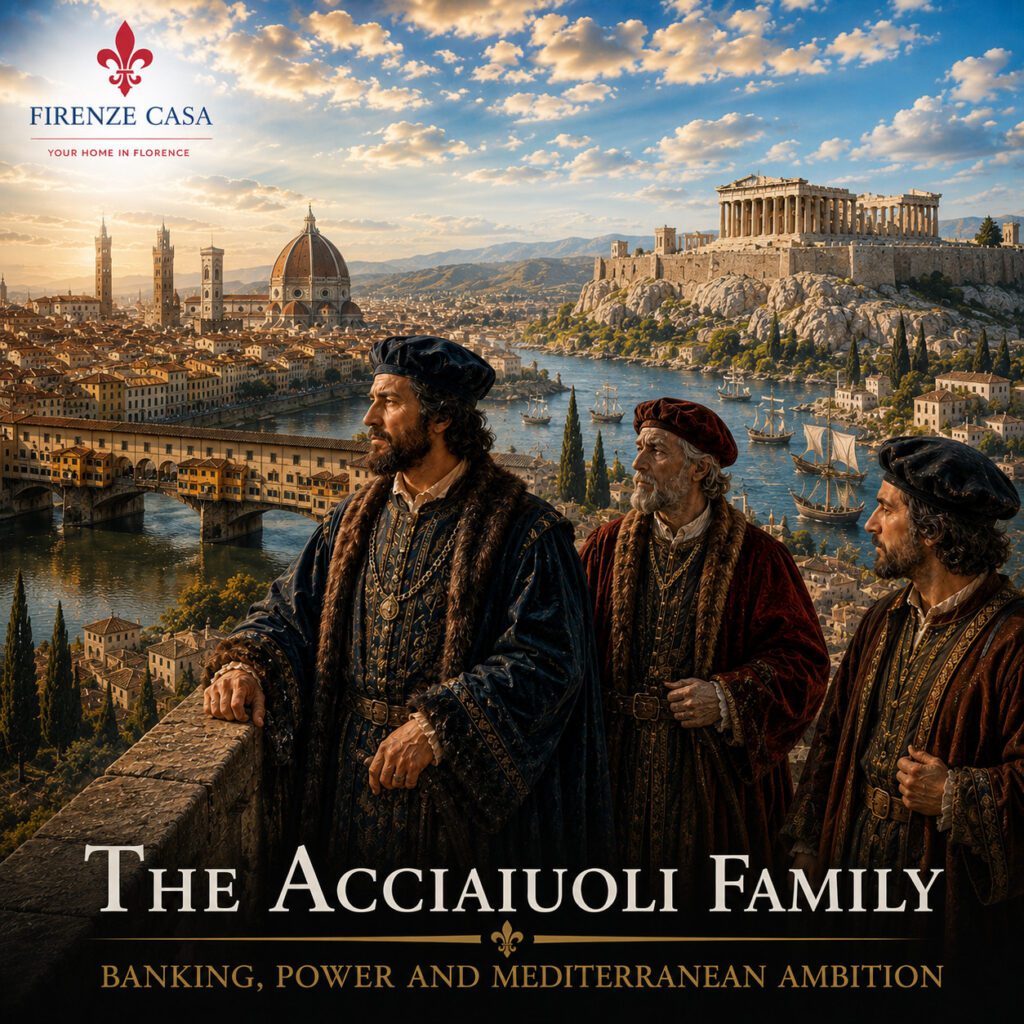
The Acciaiuoli family created one of the most remarkable international success stories of medieval Florence. Beginning with commerce and banking, the dynasty built networks that eventually stretched from Tuscany across southern Italy and into Greece.
Their history reaches far beyond the familiar streets of Florence. Niccolò Acciaiuoli became one of the most powerful figures at the Angevin court in Naples, while later members of the family established territorial power in Greece and ruled the Duchy of Athens. Yet the Florentine connection remained strong, most visibly through the magnificent Certosa del Galluzzo south of the city.
Origins: Medieval Florence
Main activities: Commerce, banking, diplomacy and politics
Key figure: Niccolò Acciaiuoli
Major political centre: Angevin Naples
Mediterranean expansion: Peloponnese and central Greece
Remarkable achievement: Acciaiuoli rule in the Duchy of Athens
Major Florentine monument: Certosa del Galluzzo
Founded: 1342 by Niccolò Acciaiuoli
Legacy today: Banking, diplomacy, monastic patronage and Mediterranean political power
The Acciaiuoli belong to the wider group explored in our Most Famous Florentine Families – Complete Guide. Their financial rise also belongs to the broader story told in The Birth of Modern Banking in Florence.
Who Were the Acciaiuoli Family?
The Acciaiuoli were a prominent Florentine family whose rise began during the commercial expansion of the Middle Ages. Historical traditions place their earlier origins outside Florence, but by the early twelfth century the family had established itself firmly in the city.
They became associated with Borgo Santi Apostoli, close to the Arno and the commercial heart of medieval Florence. Over time, members of the dynasty entered public affairs while expanding their interests in trade and finance.
Like other successful Florentine families, the Acciaiuoli combined several sources of influence. Commerce generated capital, banking extended their international reach and political alliances opened doors that business alone could not.
This combination eventually transformed prosperous merchants into influential participants in Mediterranean politics.
The Acciaiuoli story is unusually international even by Florentine standards. Their world eventually connected Florence with Naples, the Peloponnese and Athens.
The Acciaiuoli Family in Medieval Florence
By the late thirteenth century, Florence had become one of Europe’s great commercial centres. Textile production, international trade and increasingly sophisticated financial services generated enormous fortunes for successful merchant families.
The Acciaiuoli participated directly in this expansion. Leone di Riccomanno Acciaiuoli founded a merchant company towards the end of the thirteenth century, and the enterprise grew substantially during the following decades.
Its activities resembled those of other major Florentine companies. The firm traded internationally, exchanged currencies, extended credit and developed branches in important commercial centres.
Geography, however, would eventually distinguish the Acciaiuoli from many competitors. Their interests increasingly turned towards southern Italy and the eastern Mediterranean.
A Banking Network Across Europe and the Mediterranean
The Acciaiuoli company developed branches and commercial relationships far beyond Tuscany. Its representatives appeared in centres including Avignon, Paris, Bruges and London, while other operations connected the family with Mediterranean markets.
This geographical reach allowed goods, money and information to circulate through a network of trusted agents and partners. Such organisations were therefore much more than banks in the modern sense.
International commerce existed alongside lending, currency exchange and financial services for wealthy clients. The Acciaiuoli also dealt with exceptionally powerful customers, including the Angevin rulers of Naples and ecclesiastical institutions.
Florentine merchant companies succeeded because trade and banking reinforced each other. A branch handling merchandise could also transfer money, provide credit and gather valuable information about distant markets.
Why Naples Changed the Acciaiuoli Story
Southern Italy became particularly important for the family. The Kingdom of Naples offered access to a wealthy royal court, agricultural resources and strategic Mediterranean trading routes.
Acciaiuolo Acciaiuoli strengthened these connections during the early fourteenth century. His commercial and financial activities brought him into close contact with King Robert of Naples and the Angevin court.
The relationship created opportunities extending far beyond ordinary business. Florentine financiers could lend money to rulers, while royal favour could bring offices, privileges and political access.
For the Acciaiuoli, the Angevin connection became decisive. It created the environment in which the most famous member of the family would build an extraordinary career.
Niccolò Acciaiuoli: Banker, Courtier and Statesman
Niccolò Acciaiuoli (1310–1365) was born at Montegufoni in the Val di Pesa southwest of Florence and became the outstanding figure in the family’s medieval history.
In 1331, he travelled to Naples to direct the local branch of the family company. Rather than remaining solely a merchant or banker, however, Niccolò entered the political world of the Angevin court.
Financial resources, diplomatic ability and political judgement allowed him to advance rapidly. King Robert knighted him and entrusted him with responsibilities connected with the royal family.
Over the following decades, Niccolò became deeply involved in the turbulent politics of southern Italy and in Angevin interests across the eastern Mediterranean.
From Banking to Political Power
Niccolò’s career demonstrates how closely financial and political influence could overlap in medieval Europe. A wealthy Florentine financier with access to capital could become indispensable to rulers who constantly needed money and capable administrators.
Yet Niccolò offered considerably more than financial assistance. He became an adviser, diplomat and political strategist whose activities took him through Italy and into the complicated world of Angevin claims in Greece.
Eventually, he rose to the position of Grand Seneschal of the Kingdom of Naples. For a man whose family fortune originated in Florentine commerce, this represented an extraordinary social and political ascent.
Niccolò Acciaiuoli began his career in Naples by directing a branch of his family’s commercial company. He eventually became Grand Seneschal of the kingdom and one of the most influential figures at the Angevin court.
The Acciaiuoli Family and the Angevin Court
The Angevin rulers of Naples possessed interests extending far beyond southern Italy. Their dynastic claims connected the kingdom with territories across the Mediterranean, including parts of Greece.
Niccolò became deeply involved in these affairs. During the late 1330s and early 1340s, he helped secure Angevin interests in the Principality of Achaea in the Peloponnese.
Successful service brought substantial rewards. Titles, estates and feudal possessions increasingly connected the Acciaiuoli with territories lying hundreds of kilometres from Florence.
This marked a crucial transition in the family’s history. A commercial network created in Florence was beginning to produce a territorial and political dynasty in the Mediterranean.
From Florence to Greece
Greece during the fourteenth century was politically fragmented. Territories belonging to the former Byzantine and crusader worlds were divided among Byzantine rulers, Latin principalities, Venetian possessions and other regional powers.
For ambitious western families, this complicated landscape could create opportunities. Through their Angevin connections and involvement in the Principality of Achaea, the Acciaiuoli acquired estates and influence in Greece.
Later generations expanded these possessions, with Corinth becoming particularly important as a strategic family base.
From there, the Acciaiuoli entered the politics of central Greece and eventually reached one of the most famous cities in European history: Athens.
The Acciaiuoli and the Duchy of Athens
The medieval history of Athens is unfamiliar to many modern visitors. Long after classical antiquity, the city became the centre of a Latin duchy created in the political world that followed the Fourth Crusade.
By the late fourteenth century, the balance of power changed again. Nerio I Acciaiuoli expanded the family’s position in Greece and eventually gained control of Athens.
Members of the dynasty subsequently ruled the Duchy of Athens through parts of the late fourteenth and fifteenth centuries. Succession disputes and regional rivalries repeatedly complicated their rule, while Ottoman expansion ultimately ended this remarkable Florentine chapter.
Few dynasties illustrate the international reach of Florence so dramatically. Merchants whose ancestors had built their fortune beside the Arno eventually became rulers in the land of the Acropolis.
For part of the late Middle Ages, Athens was ruled by members of a Florentine family. The Acciaiuoli story is therefore one of the most unexpected links between Florence and Greece.
Florentines on the Acropolis
The idea of Florentines ruling Athens creates one of the most striking images in Acciaiuoli history. Yet medieval Athens looked very different from the archaeological landscape visitors know today.
The Acropolis functioned as a fortified centre rather than an isolated group of ancient monuments. The Parthenon had already experienced centuries of transformation and had served as a Christian church.
For the Acciaiuoli rulers, Athens represented strategic territory rather than an archaeological treasure. Nevertheless, their presence added another remarkable layer to the city’s complex history.
Diplomacy also required relationships with neighbouring rulers, Venice, the papacy and the growing Ottoman power. The Greek branch therefore remained embedded within wider Mediterranean politics.
Banking and the Acciaiuoli Collapse
The political success of individual family members should not obscure the difficulties experienced by the original Florentine company. Like several other great banking enterprises, the Acciaiuoli firm faced a severe crisis during the 1340s.
The collapse occurred during the same wider period of financial instability that affected the Bardi family and Peruzzi family. Large loans, international commitments and political risks had made Florence’s great companies vulnerable.
The Acciaiuoli enterprise was also weakened by its involvement in financing Florence’s unsuccessful struggle for Lucca. Financial disputes with ecclesiastical creditors further complicated the situation.
Eventually, the company was liquidated. Once again, however, the failure of a commercial organisation did not mean the disappearance of the dynasty behind it.
Why the Family Survived Its Banking Crisis
Medieval Florentine dynasties were larger and more resilient than individual companies. Different branches owned property, held political offices, arranged marriages and pursued independent careers.
The Acciaiuoli provide an exceptional example. Their Florentine commercial enterprise could collapse while Niccolò simultaneously increased his political influence in Naples and other family members established territorial power in Greece.
This distinction between company and dynasty explains why the Acciaiuoli story continued long after the financial crisis of the 1340s.
Indeed, their most spectacular political achievement – control of Athens – came decades after the great merchant company had ceased to dominate Florentine finance.
The Acciaiuoli Family and Florence
Despite their international careers, the Acciaiuoli remained closely connected with Florence. Property, family relationships and patronage ensured that the dynasty retained a visible place in Florentine society.
The family had long been associated with Borgo Santi Apostoli, close to the Arno, Ponte Vecchio and important commercial streets of medieval Florence.
Later generations continued to participate in the political and cultural life of the city. As Florence changed, the Acciaiuoli adapted to new circumstances and eventually developed relationships with the Medici family.
One monument, however, preserves their Florentine identity more powerfully than any other.
The Certosa del Galluzzo
On a hill a few kilometres south of central Florence stands the Certosa del Galluzzo, also known as the Certosa di Firenze. Niccolò Acciaiuoli founded the monastery in 1342.
The large complex rises above the surrounding landscape near the southern approaches to Florence and remains one of the most impressive monastic ensembles around the city.
Niccolò intended the foundation to serve both religious and dynastic purposes. It reflected personal devotion while creating a permanent monument associated with the Acciaiuoli name.
He was eventually buried there, reconnecting the statesman of Naples and the Mediterranean with his Tuscan homeland.
Our guide to Galluzzo from Florence provides additional context for exploring the area south of the historic centre.
The Certosa del Galluzzo is one of the best places around Florence to encounter the Acciaiuoli legacy directly. Its hilltop setting also makes the experience very different from visiting a palace or chapel in the crowded historic centre.
What to See at the Certosa
The monastery visible today developed over several centuries, so not every part belongs to Niccolò’s original foundation. Later generations enlarged and transformed the complex.
Important spaces include the Church of San Lorenzo, the chapter house, refectory and Great Cloister. Monastic cells open onto the cloister, reflecting the Carthusian ideal of contemplative and largely solitary religious life.
The Certosa also preserves an important artistic legacy. Pontormo stayed there during an outbreak of plague in sixteenth-century Florence and produced works associated with the complex.
A visit therefore tells several stories at once: medieval patronage, monastic life, Renaissance art and the legacy of one of Florence’s most internationally connected families.
Niccolò Acciaiuoli and Florence’s Intellectual World
Niccolò’s connections extended beyond banking and politics. He moved within the sophisticated intellectual culture of fourteenth-century Italy and maintained relationships with important literary figures.
Petrarch corresponded with him, while Giovanni Boccaccio also had personal connections with the Acciaiuoli circle. These relationships demonstrate the cultural ambitions increasingly associated with wealthy political and commercial elites.
Prestige did not depend exclusively on money or military power. Patronage, education, architecture and association with respected intellectuals also contributed to reputation.
This aspect of the dynasty creates a natural connection with our Florence in Literature – Complete Guide.
Donato Acciaiuoli and Renaissance Florence
The family continued to produce notable figures during the Renaissance. Donato Acciaiuoli (1429–1478) became a statesman, humanist and writer.
His career belonged to a very different Florence from the world of Niccolò. By the fifteenth century, Medici influence had reshaped the political landscape, while humanist scholarship had become an important element of elite culture.
Donato participated in this environment through both political service and intellectual activity. His career illustrates the ability of old Florentine families to adapt to changing cultural and political conditions.
The Acciaiuoli story therefore stretches from medieval banking into the intellectual world of Renaissance Florence.
Acciaiuoli, Bardi and Peruzzi
The Acciaiuoli belonged to the same broad generation of international Florentine finance as the Bardi and Peruzzi. All three families developed large commercial organisations during the city’s extraordinary economic expansion.
Their histories nevertheless followed different paths. The Bardi and Peruzzi became especially famous for vast European merchant-banking networks and their dramatic failures during the 1340s.
The Acciaiuoli also experienced financial collapse, but individual family members had already transformed commercial relationships into political careers and territorial interests in the Mediterranean.
That difference gives the dynasty its distinctive place in Florentine history. Its story continued beyond the counting house into royal courts, castles and Mediterranean principalities.
Acciaiuoli and Medici: Two Different Paths to Power
The Acciaiuoli and Medici demonstrate two very different ways in which banking wealth could become political influence.
The Medici concentrated increasingly on Florence. Their financial network remained international, but the family gradually became the dominant political dynasty of its home city.
The Acciaiuoli followed a more outward-looking path. Many of their greatest opportunities appeared outside Tuscany, particularly at the Angevin court and in Greece.
One dynasty eventually ruled Florence; branches of the other ruled Athens. Together, their histories demonstrate the extraordinary geographical reach that Florentine wealth could create.
Mediterranean Ambition
The phrase Mediterranean ambition captures something fundamental about the Acciaiuoli. Their history cannot be understood within the boundaries of Florence alone.
Commercial opportunities first carried family members south. Political service then transformed financial relationships into offices, estates and titles, while territorial expansion eventually carried the dynasty into Greece.
Few medieval families moved so convincingly between the worlds of merchant, banker, diplomat, courtier and territorial ruler.
The Mediterranean was therefore not simply a distant market for the Acciaiuoli. It became the arena in which members of the family achieved their greatest political ambitions.
The Acciaiuoli demonstrate why medieval Florence should never be viewed as an isolated Tuscan city. Its merchants belonged to networks connecting northern Europe, Italy, the Mediterranean and the eastern territories of the former crusader world.
Where to Discover the Acciaiuoli Family Today
Borgo Santi Apostoli
The historic centre around Borgo Santi Apostoli provides a connection with the family’s early Florentine world. Its narrow streets lie close to the Arno and some of the most important commercial routes of medieval Florence.
The Certosa del Galluzzo
The Certosa is the most impressive surviving monument associated with Niccolò Acciaiuoli. Its architecture and hilltop setting make it particularly rewarding for visitors interested in discovering Florence beyond the historic centre.
Montegufoni and the Val di Pesa
The countryside southwest of Florence formed another important setting in the family story. Niccolò was born at Montegufoni, linking the dynasty with the Tuscan landscape as well as the city.
Athens
The final destination lies much farther away. Anyone standing on the Acropolis today is looking at a place that once formed the political centre of a duchy ruled by members of a Florentine family.
A Florence Excursion to the Certosa del Galluzzo
For travellers staying in Florence, the Certosa offers an opportunity to combine family history with a quieter excursion beyond the city centre. The monastery stands only a few kilometres south of Florence but feels distinctly removed from its busiest streets.
Its elevated position and monumental architecture immediately convey the scale of Niccolò Acciaiuoli’s ambitions. At the same time, the cloisters and monastic spaces create an atmosphere very different from the palaces of Florence’s merchant elite.
A visit therefore complements places such as Palazzo Strozzi or the Medici residences. Those buildings demonstrate urban family power, whereas the Certosa expresses patronage through religion, landscape and monastic architecture.
It is perhaps the most fitting Florentine monument to a man whose life constantly moved between different worlds.
Access arrangements and opening times at the Certosa can change. Check current visitor information before making a special journey from central Florence.
The Legacy of the Acciaiuoli Family
The Acciaiuoli demonstrate the extraordinary possibilities created by Florence’s medieval commercial revolution. Banking and trade gave the dynasty resources, connections and mobility, but individual family members transformed those advantages into something much larger.
Niccolò Acciaiuoli moved from managing a banking branch to the highest levels of the Neapolitan court. His relatives and successors established power in Greece, while the Florentine connection survived through property, politics and patronage.
The Certosa del Galluzzo provides the magnificent physical reminder of this story near Florence. Meanwhile, the family’s rule in Athens reveals just how far Florentine influence could travel.
Among Florence’s great dynasties, the Acciaiuoli therefore occupy a unique position. Their history connects banking with diplomacy, Tuscany with the Mediterranean and medieval Florence with one of the most famous cities of the ancient world.
Frequently Asked Questions About the Acciaiuoli Family
Who were the Acciaiuoli family?
The Acciaiuoli were a prominent Florentine merchant, banking and political family. Their influence eventually extended from Florence and Naples into Greece.
What did the Acciaiuoli family do?
The family built its early fortune through commerce and banking. Later members became diplomats, royal advisers, landholders and rulers in parts of Greece.
Who was Niccolò Acciaiuoli?
Niccolò Acciaiuoli was the most famous medieval member of the dynasty. After beginning his career with the family company in Naples, he became a powerful statesman and Grand Seneschal of the Kingdom of Naples.
What is the Acciaiuoli connection with Athens?
Members of the family acquired territories in Greece during the fourteenth century. A branch of the dynasty eventually gained control of Athens and ruled the duchy during parts of the late fourteenth and fifteenth centuries.
Did a Florentine family really rule Athens?
Yes. Members of the Acciaiuoli dynasty ruled the medieval Duchy of Athens before Ottoman expansion ended their rule there during the fifteenth century.
What is the Certosa del Galluzzo?
The Certosa del Galluzzo is a large Carthusian monastic complex south of Florence. Niccolò Acciaiuoli founded it in 1342 and was later buried there.
Can you visit the Certosa del Galluzzo?
The complex can be visited when access is available, although arrangements and opening times may change. Visitors should therefore check current information before travelling.
Were the Acciaiuoli connected with the Medici?
Yes. Both families belonged to Florence’s elite, although the Acciaiuoli achieved international prominence much earlier. Later generations adapted to the political world increasingly dominated by the Medici.
Why the Acciaiuoli Family Is Worth Discovering
The Acciaiuoli family is worth discovering because its history reveals how far Florentine influence could extend beyond Tuscany. Banking and commerce created the networks that carried members of the dynasty to Naples and into the political world of the Mediterranean.
Niccolò Acciaiuoli embodies this remarkable mobility, rising from the world of merchant finance to become one of the most powerful officials of the Kingdom of Naples. Later family members went even further and established Florentine rule in medieval Athens.
The Certosa del Galluzzo brings the story back to Tuscany. Its architecture, landscape and dynastic purpose provide a lasting reminder that one of medieval Florence’s most outward-looking families never completely lost its connection with home.
The Acciaiuoli show that the history of Florence cannot be confined to Tuscany. Merchant capital created networks through which Florentines became bankers, diplomats, royal advisers and even rulers far beyond their native city.
Further Reading on Firenze Casa
Continue exploring Florence’s medieval banking families and their international networks:
- The Most Famous Florentine Families – Complete Guide
- The Bardi Family: Banking, Power and Medieval Florence
- The Peruzzi Family: Banking, Politics and Medieval Florence
- The Gondi Family: Banking, Power and Renaissance Florence
- The Frescobaldi Family: Florence’s Banking and Wine Dynasty
- The Medici Family: The Dynasty That Shaped Florence
- The Birth of Modern Banking in Florence
- Bardi and Peruzzi: Florence’s Banking Giants
- Galluzzo from Florence
- Florence in Literature – Complete Guide
References
- Treccani – Historical and biographical entries on the Acciaiuoli family, Niccolò Acciaiuoli and Nerio Acciaiuoli
- Najemy, John M. – A History of Florence 1200–1575
- Goldthwaite, Richard A. – The Economy of Renaissance Florence
- Hunt, Edwin S.; Murray, James M. – A History of Business in Medieval Europe, 1200–1550
- Setton, Kenneth M. – Catalan Domination of Athens 1311–1388
- Historical material on the Certosa del Galluzzo and Niccolò Acciaiuoli
- Historical studies on the Angevin Kingdom of Naples and Latin Greece

