
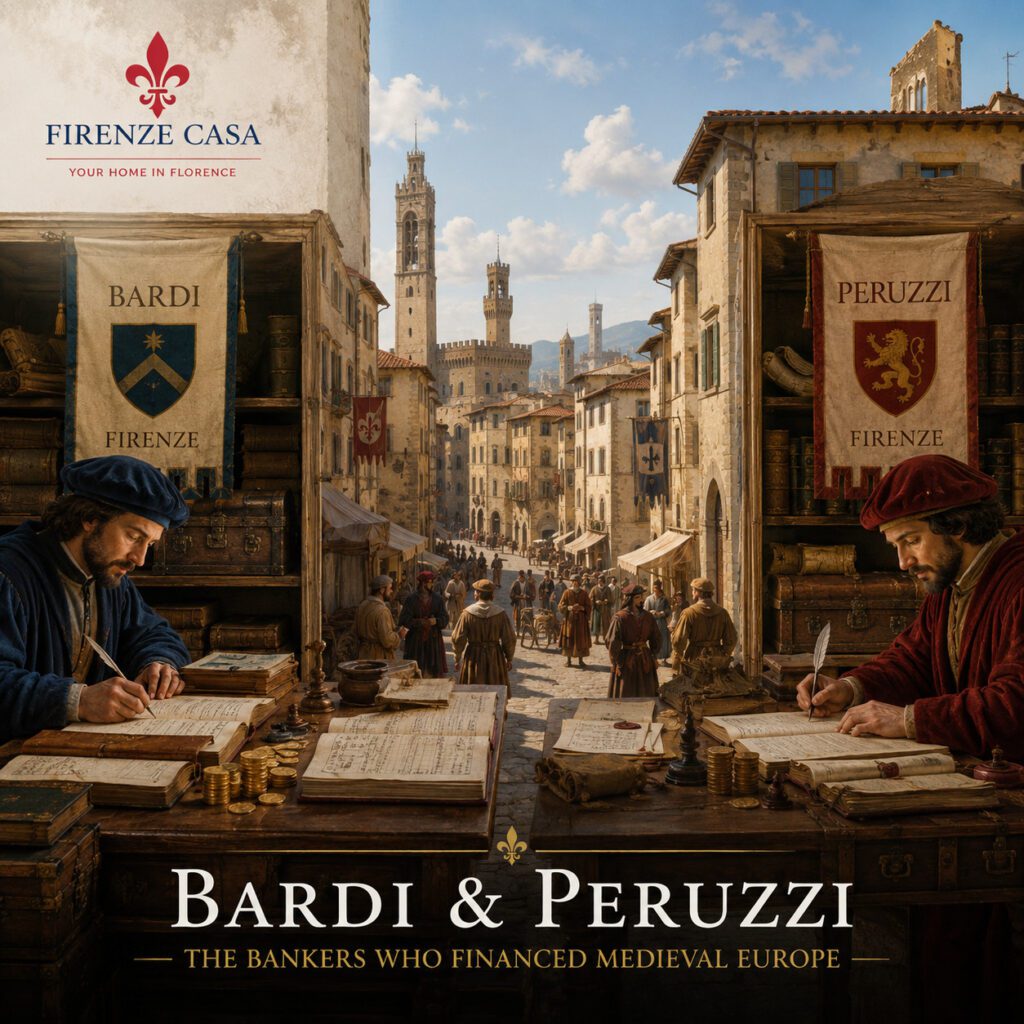
The Bardi and Peruzzi banks were among the most powerful financial organisations of medieval Florence. Long before the Medici became Europe’s most famous Florentine banking dynasty, these two merchant companies created international networks linking Tuscany with England, Flanders, France, the papal court and Mediterranean markets.
Their representatives traded goods, exchanged currencies, transferred money and extended credit on an extraordinary scale. Both companies eventually collapsed during the financial crises of the 1340s, but their rise and fall reveal how sophisticated Florentine banking had already become generations before the Renaissance reached its celebrated height.
Period of greatest influence: Late 13th–early 14th centuries
Home city: Florence
Main activities: International trade, banking, currency exchange and credit
Important markets: England, Flanders, France, Italy and the Mediterranean
Major royal connection: Edward III of England
Financial crisis: 1340s
Peruzzi collapse: Earlier in the 1340s
Bardi collapse: Mid-1340s
Artistic legacy: Bardi and Peruzzi Chapels in Santa Croce
Historical importance: International banking before the Medici
The Bardi and Peruzzi form a central chapter in our Birth of Modern Banking in Florence – Complete Guide. Their individual family histories are explored in The Bardi Family: Banking, Power and Medieval Florence and The Peruzzi Family: Banking, Politics and Medieval Florence.
Florence Before the Medici Bank
The Medici dominate modern perceptions of Florentine finance. Yet Florence had already produced enormous international banking organisations generations before Giovanni di Bicci de’ Medici founded the Medici Bank in 1397.
During the thirteenth century, the city’s textile industry expanded rapidly. Florentine merchants imported wool and other raw materials, transformed them into valuable finished products and sold them across European markets.
This international commerce required increasingly sophisticated financial services. Merchants needed credit, currency exchange and reliable ways to transfer value between distant cities.
Florentine companies responded by creating networks of representatives, branches and trusted commercial partners. Among the most important were the Bardi and Peruzzi.
The great age of Florentine international banking began before the Renaissance. By the early fourteenth century, the Bardi and Peruzzi were already conducting business across much of Europe.
Who Were the Bardi?
The Bardi were one of medieval Florence’s most prominent merchant families. Their wealth came from international commerce and finance, and their company developed into one of the largest commercial organisations of its age.
Calling the enterprise simply a bank can be misleading. The Bardi traded commodities, provided credit, exchanged currencies and handled financial transactions for merchants, rulers and ecclesiastical institutions.
Their network extended far beyond Tuscany. Representatives operated in major European commercial centres and gathered information about markets, currencies and political developments.
At the height of their influence, the Bardi belonged to an international financial elite whose decisions connected Florence with economies hundreds or even thousands of kilometres away.
For the wider family history, see our dedicated guide to the Bardi family of Florence.
Who Were the Peruzzi?
The Peruzzi developed another vast Florentine merchant-banking company. Their activities likewise combined commerce, finance, currency exchange and international trade.
The family had deep roots in Florence and became increasingly wealthy as the city’s economy expanded. Through agents and partnerships, the Peruzzi established connections across western Europe and the Mediterranean.
The scale of their operations becomes especially striking when we remember the world in which they functioned. Instructions travelled by letter, while detailed account books recorded obligations between people separated by enormous distances.
The Peruzzi therefore demonstrate that international finance was already remarkably sophisticated during the Middle Ages.
The family itself is explored in greater depth in The Peruzzi Family: Banking, Politics and Medieval Florence.
Calling the Bardi and Peruzzi simply “banks” does not capture their full role. They were international merchant-financial companies combining trade, credit, currency exchange and payment services.
Bardi and Peruzzi Compared
| Feature | Bardi | Peruzzi |
|---|---|---|
| Peak influence | Late 13th–early 14th centuries | Late 13th–early 14th centuries |
| Main activities | Trade, banking, currency exchange and credit | Trade, banking, currency exchange and credit |
| International reach | England, Flanders, France, Italy and Mediterranean markets | England, Flanders, France, Italy and Mediterranean markets |
| English connection | Major financial exposure to Edward III | Major financial exposure to Edward III |
| Collapse | Mid-1340s | Earlier in the 1340s |
| Florentine artistic legacy | Bardi Chapel in Santa Croce | Peruzzi Chapel in Santa Croce |
The similarities are striking, but the two companies were separate organisations with their own partners, strategies and financial circumstances. Their shared fate reflects the pressures affecting Florence’s wider commercial system rather than one identical business model.
How Large Were Their Banking Networks?
The international reach of the great Florentine companies was extraordinary. Bardi and Peruzzi representatives maintained business connections across many of Europe’s most important economic centres.
London was particularly significant because England supplied high-quality wool to the Florentine textile industry. Bruges, meanwhile, connected Florentine merchants with the prosperous markets of northern Europe.
Avignon became another major financial centre after the papal court moved there in the early fourteenth century. Rome, Naples and other Italian cities also belonged to the wider commercial landscape.
These networks allowed the companies to move goods, information and financial value across political borders.
Florence at the Centre of an International Economy
The headquarters remained in Florence, but international banking depended on representatives working throughout Europe.
Letters carried information about commodity prices, exchange rates, political developments and outstanding debts. Meanwhile, account books allowed partners to monitor transactions taking place in distant cities.
This flow of information gave large companies a significant advantage. A merchant with reliable contacts in London, Bruges and Avignon understood European markets far better than someone operating only locally.
Banking power therefore depended on knowledge and communication as much as on capital.
Letters were the data network of medieval finance. Market information, exchange rates, political news and instructions moved constantly between Florence and commercial centres across Europe.
The Textile Trade Behind Florentine Banking
The rise of the Bardi and Peruzzi cannot be separated from Florence’s textile industry. Wool was one of the foundations of the city’s medieval economy.
Raw wool arrived from abroad, particularly from England, before skilled Florentine workers transformed it into valuable finished cloth. This international production chain required substantial capital.
Merchants had to purchase raw materials, finance transport and production and then wait for goods to be sold. Credit helped bridge the time between expenditure and eventual payment.
Banking and trade therefore developed together. The same companies could finance commercial transactions while participating directly in international commerce.
Florence’s banking success was closely connected with its workshops. The textile industry created international trade flows that required credit, currency exchange and sophisticated financial networks.
The Florin and International Commerce
The rise of Florence’s merchant companies coincided with another major economic development: the introduction of the Florin gold coin in 1252.
Its reliable weight and high gold purity helped the Florin become widely trusted in European commerce. For merchant companies operating across borders, a respected currency offered obvious advantages.
Yet physical coins alone could not support an increasingly complex international economy. Transporting large quantities of precious metal remained expensive and dangerous.
Florentine bankers therefore combined trusted currency with sophisticated accounting, credit arrangements and financial instruments.
Bankers to Kings and Courts
Successful Florentine companies did not serve merchants alone. European rulers also needed large amounts of money.
Wars, diplomacy, courts and administration all required funds, while tax revenues did not necessarily arrive at the moment rulers needed them.
Large merchant-banking companies could provide credit and arrange international payments. A relationship with a king could therefore generate prestigious and potentially profitable business.
However, royal clients also created exceptional risks. Recovering an unpaid debt from an ordinary merchant was difficult enough; recovering one from a sovereign ruler was considerably more complicated.
Edward III and the English Crown
The most famous royal client associated with both companies was Edward III of England.
During the fourteenth century, Edward required substantial resources as England entered the conflict with France that became known as the Hundred Years’ War.
Florentine financiers participated in funding the English Crown and consequently became heavily exposed to royal finances.
For generations, the traditional version of the story was simple: Edward borrowed enormous sums from the Bardi and Peruzzi, failed to repay them and caused both companies to collapse.
The actual history is considerably more complicated.
Did Edward III Really Bankrupt the Bardi and Peruzzi?
Edward III’s debts undoubtedly placed substantial pressure on Florentine financiers. However, historians no longer regard English royal debt as a complete explanation for the collapse of either company.
The Bardi and Peruzzi operated complex international businesses exposed to many different risks. Commercial losses, political instability, credit problems and declining confidence also affected their fortunes.
Moreover, both companies had extensive interests outside England. Their difficulties therefore cannot be reduced to one king and one unpaid obligation.
The popular version remains memorable because it provides a dramatic villain and a simple cause. Medieval finance, however, was already too interconnected for such a neat explanation.
Edward III’s debts contributed significantly to the crisis, but modern scholarship points to a broader combination of commercial, political and financial pressures behind the failures of the Bardi and Peruzzi.
The Risks of Lending to Kings
The experience of both companies illustrates a problem that remains familiar in financial history: sovereign risk.
Rulers could be valuable clients because they borrowed large amounts and controlled important privileges. Yet they also possessed political power unavailable to ordinary borrowers.
If a monarch delayed payment, renegotiated obligations or lacked the resources to repay, creditors had limited options.
International banking therefore required a difficult balance. Prestigious borrowers could generate substantial business, but excessive exposure to politically powerful clients could threaten the stability of an entire company.
Bills of Exchange and International Payments
The Bardi and Peruzzi operated within the commercial world in which bills of exchange became increasingly important.
These instruments helped merchants arrange payments between distant cities without transporting equivalent quantities of gold and silver along the same route.
They also incorporated currency exchange and delayed settlement, making them especially useful within networks spanning several monetary systems.
Written instruments, accounts and trusted correspondents therefore allowed financial value to move more efficiently across Europe.
This was one of the foundations on which later Florentine banking continued to develop.
How the Peruzzi Company Failed
The Peruzzi company encountered severe financial difficulties during the 1340s and failed before the Bardi.
Its problems reflected the vulnerability of a large international organisation operating in unstable economic and political conditions. Losses and unpaid obligations weakened the company while confidence became increasingly difficult to maintain.
Liquidity also mattered. A company could hold valuable claims and commercial assets yet still face serious problems if immediate obligations exceeded available funds.
The Peruzzi collapse demonstrated that international scale could magnify losses just as effectively as it magnified profits.
The Fall of the Bardi
The Bardi survived somewhat longer but ultimately suffered a similar fate during the middle of the 1340s.
Their enormous international network could not protect the company from accumulating financial pressures. When such a large organisation failed, the consequences extended beyond the partners who controlled it.
Creditors, investors and commercial partners could all suffer losses, while confidence within Florence’s wider business community was affected.
Nevertheless, the Bardi family itself did not disappear. Different branches continued to own property and participate in Florentine society long after the great company had failed.
A Medieval Financial Crisis?
It is tempting to compare the collapse of the Bardi and Peruzzi with a modern banking crisis. There are certainly intriguing similarities.
Large financial organisations became heavily exposed to risky borrowers, confidence weakened and failures affected other participants within an interconnected economy.
However, medieval finance operated without central banks, deposit insurance or modern financial regulation. Merchant companies were also organised very differently from contemporary banks.
The comparison is therefore useful only if we recognise the enormous institutional differences between the two periods.
Diversification, liquidity, concentration risk and confidence mattered centuries before modern financial regulation. The institutions were different, but several fundamental financial risks remain recognisable.
What Happened to Florence After the Collapse?
The failure of two great companies did not end Florentine banking. This is one of the most important lessons of the entire episode.
Florence possessed a broad commercial culture rather than depending on a single banking house. Other merchants, financiers and companies continued to operate after the crisis.
Knowledge accumulated over generations also survived. Accountants, merchants and bankers continued using sophisticated techniques for international trade, currency exchange and finance.
Eventually, new financial dynasties emerged. More than half a century after the crisis, another Florentine banking name began its rise: Medici.
From the Bardi and Peruzzi to the Medici
Giovanni di Bicci de’ Medici founded the Medici Bank in 1397, decades after the collapse of the Bardi and Peruzzi companies.
The Medici therefore entered a financial world already shaped by generations of Florentine experience.
International networks, currency exchange, commercial credit, bills of exchange and detailed accounting were not Medici inventions. Earlier merchant companies had already developed and refined many of these practices.
The Medici built on that tradition and created the most famous Florentine banking institution of the Renaissance.
Understanding the Bardi and Peruzzi therefore changes the familiar story. The Medici were not the beginning of Florentine banking; they represented a later phase in a much older financial tradition.
The Bardi Chapel in Santa Croce
The history of these banking families is not confined to account books. Visitors can still encounter their presence in Florence today.
The Bardi Chapel inside the Basilica of Santa Croce contains Giotto’s celebrated fresco cycle depicting scenes from the life of Saint Francis.
The chapel demonstrates how wealthy merchant families transformed commercial success into religious patronage and cultural prestige.
For modern visitors, this creates a fascinating connection: one of Europe’s great medieval banking families also helped support works of art admired more than six centuries later.
When visiting Santa Croce, look for the Bardi Chapel and Giotto’s frescoes. It is one of the best places in Florence to connect medieval banking history with the art financed by merchant wealth.
The Peruzzi Chapel in Santa Croce
The connection becomes even more remarkable because the Peruzzi also left an important artistic legacy inside the same church.
The Peruzzi Chapel contains another major Giotto cycle, with scenes from the lives of Saint John the Baptist and Saint John the Evangelist.
The presence of chapels associated with both banking dynasties within Santa Croce offers an exceptional glimpse into medieval Florentine society.
These were not anonymous financiers working behind closed doors. They were prominent families whose commerce, politics, religious devotion and patronage shaped the city around them.
The banking companies disappeared. Their cultural footprint survived.
Banking Wealth and Medieval Florence
The Bardi and Peruzzi lived before the period usually associated with the full flowering of the Renaissance. Yet their history already reveals the relationship between commercial prosperity and cultural patronage.
Successful families financed chapels, commissioned artists and supported religious institutions. These projects expressed faith while also establishing a visible dynastic presence within Florence.
The city’s later Renaissance culture therefore developed within an urban society that had already accumulated substantial wealth through manufacturing, trade and finance.
The financial foundations of Renaissance Florence were laid considerably earlier than many visitors realise.
This relationship is explored further in How Banking Financed the Renaissance.
What Made the Bardi and Peruzzi So Important?
The importance of the two companies extends far beyond the amount of money they controlled.
They demonstrated that Florentine businesses could operate internationally. Their networks connected distant markets and allowed information, goods and financial obligations to circulate across political borders.
They also refined many of the commercial practices required for such operations. Accurate accounts, reliable correspondence, currency expertise and trusted representatives became essential components of international business.
Their failures were equally instructive. Large networks created extraordinary opportunities but also exposed companies to political events and financial problems originating far beyond Florence.
Were They Really Banks?
Modern visitors should use the word “bank” carefully when discussing the Bardi and Peruzzi.
The companies did not resemble modern retail banks offering savings accounts, credit cards and regulated deposits. Instead, they combined international trade with financial services.
They bought and sold goods, transferred money, exchanged currencies, extended credit and maintained accounts for clients and partners.
Calling them banks is useful because finance formed a major part of their activities. However, merchant-banking companies provides a more accurate sense of their broad commercial role.
Where to Discover the Bardi and Peruzzi in Florence
Santa Croce
The Basilica of Santa Croce is the essential starting point because it contains chapels associated with both families and major works by Giotto.
Via de’ Bardi
South of the Arno, Via de’ Bardi preserves the name of one of Florence’s great medieval banking dynasties and recalls the family’s strong association with the Oltrarno.
Piazza de’ Peruzzi
Near Santa Croce, Piazza de’ Peruzzi preserves the name of the other dynasty. Its unusual curved layout also follows part of the footprint of Florence’s ancient Roman amphitheatre.
The Medieval Historic Centre
Walking between these locations helps reveal how compact the home city of these extraordinary international networks actually was.
Combine Piazza de’ Peruzzi and Santa Croce with Via de’ Bardi across the Arno. The route connects both medieval banking dynasties with the neighbourhoods and artistic commissions that still preserve their names.
The Legacy of Florence’s Banking Giants
The Bardi and Peruzzi companies vanished as great financial institutions, but their history remained part of Florence’s economic inheritance.
They helped establish the city as one of Europe’s principal centres of international finance. Their representatives connected Florence with royal courts, commercial cities and distant markets.
Their failures also revealed the dangers of sovereign lending, liquidity pressure and excessive exposure to politically powerful borrowers.
Most importantly, their story proves that Florence’s financial revolution did not begin with the Medici.
By the time the Medici Bank appeared at the end of the fourteenth century, Florentine merchants had already spent generations creating some of Europe’s most sophisticated international commercial networks.
The Bardi and Peruzzi banks were among the greatest pioneers of that world.
The Bardi and Peruzzi move the story of Florence’s financial greatness back into the Middle Ages. Their international networks show that the economic foundations of the Renaissance were already developing generations before the Medici rose to power.
Interesting Facts About the Bardi and Peruzzi
- The Bardi and Peruzzi created major international merchant-banking networks before the rise of the Medici Bank.
- Their business connections reached important markets across western Europe and the Mediterranean.
- English wool linked Florence’s textile industry closely with northern European trade.
- Both companies became financially involved with Edward III of England.
- Edward III’s debts contributed to their problems but do not fully explain their collapse.
- Both families are associated with chapels decorated by Giotto in Santa Croce.
- Their history demonstrates how sophisticated Florentine international finance had already become during the Middle Ages.
Frequently Asked Questions About the Bardi and Peruzzi
Who were the Bardi and Peruzzi?
The Bardi and Peruzzi were wealthy Florentine families whose merchant-banking companies became two of the most important international financial organisations of the late thirteenth and early fourteenth centuries.
Were the Bardi and Peruzzi more powerful than the Medici?
They reached their peaks during an earlier period, so direct comparisons are difficult. However, both operated extraordinarily large international networks and demonstrate that Florence had already become a major financial centre long before the Medici Bank was founded.
Why did the Bardi and Peruzzi banks collapse?
Their collapse resulted from a combination of commercial, financial and political pressures. Exposure to the English Crown was important, but historians generally reject the simple explanation that Edward III alone caused both failures.
When did the Bardi and Peruzzi banks fail?
Both companies encountered severe difficulties during the 1340s. The Peruzzi failed first, followed by the Bardi during the middle of the decade.
What did Edward III have to do with their collapse?
Edward III owed substantial sums to Florentine financiers. Problems surrounding English royal debts contributed to the companies’ difficulties but represented only part of a wider financial crisis.
Did the Bardi and Peruzzi invent banking?
No. Banking and commercial finance had much older origins. However, both companies became exceptionally important examples of large-scale international merchant banking in medieval Europe.
Were the Bardi and Peruzzi really banks?
They performed many banking functions but also traded goods directly. Describing them as merchant-banking companies is therefore more accurate than comparing them with modern retail banks.
Can visitors still see places connected with them in Florence?
Yes. Santa Croce contains chapels associated with both families, while Via de’ Bardi and Piazza de’ Peruzzi preserve their names within the historic city.
Why the Bardi and Peruzzi Are Worth Discovering
The Bardi and Peruzzi are worth discovering because they reveal an international Florence that existed long before the Medici. Their merchants and bankers connected the city with England, Flanders, France, Italy and the Mediterranean through sophisticated commercial and financial networks.
Their failures during the 1340s are equally important because they demonstrate how vulnerable international finance could become when sovereign debt, commercial losses and declining confidence converged.
Yet their legacy is not confined to banking history. The Bardi and Peruzzi Chapels in Santa Croce show how merchant wealth was already supporting extraordinary art during the early fourteenth century.
Together, the two dynasties help explain the economic foundations on which later Renaissance Florence was built.
Further Reading on Firenze Casa
Continue exploring Florence’s medieval banking families and the financial system that preceded the Medici:
- The Birth of Modern Banking in Florence – Complete Guide
- The Bardi Family: Banking, Power and Medieval Florence
- The Peruzzi Family: Banking, Politics and Medieval Florence
- The Medici Bank: Europe’s Most Powerful Bank
- The Florin: The Gold Coin That Changed Europe
- Bills of Exchange: The Origins of Cashless Payments
- How Banking Financed the Renaissance
- The Acciaiuoli Family: Banking, Power and Mediterranean Ambition
References
- Hunt, Edwin S. – The Medieval Super-Companies: A Study of the Peruzzi Company of Florence
- Goldthwaite, Richard A. – The Economy of Renaissance Florence
- Spufford, Peter – Money and Its Use in Medieval Europe
- De Roover, Raymond – Studies on Medieval and Renaissance Banking and Commerce
- Villani, Giovanni – Nuova Cronica

