
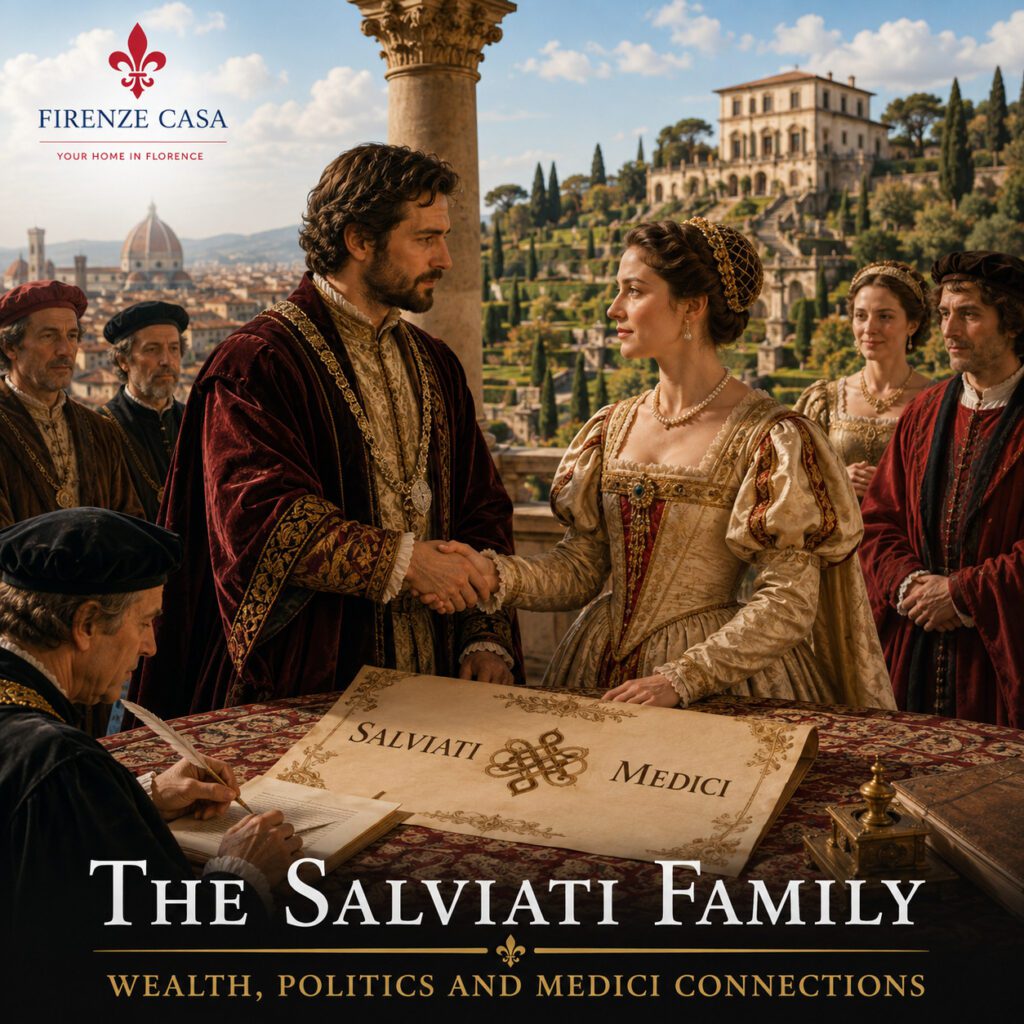
The Salviati family belonged to Florence’s wealthy merchant and political elite. Their history is especially fascinating because their relationship with the Medici changed dramatically over time, moving from open political conflict to one of the closest dynastic connections in Renaissance Florence.
In 1478, Archbishop Francesco Salviati participated in the Pazzi Conspiracy against Lorenzo and Giuliano de’ Medici. Only a generation later, however, Jacopo Salviati married Lucrezia de’ Medici, daughter of Lorenzo the Magnificent. Their daughter Maria Salviati eventually became the mother of Cosimo I de’ Medici, linking the Salviati directly with the future ruling dynasty of Tuscany.
Origins: Medieval Florence
Main activities: Commerce, banking, politics and diplomacy
Major conflict: Pazzi Conspiracy of 1478
Key figures: Francesco Salviati, Jacopo Salviati and Maria Salviati
Medici connection: Jacopo married Lucrezia de’ Medici
Most important descendant: Cosimo I de’ Medici
Major residence: Villa Salviati
Legacy today: Family alliances, Medici genealogy, politics and Renaissance architecture
The Salviati belong to the wider network explored in our Most Famous Florentine Families – Complete Guide. Their history also connects directly with the Medici family and the Pazzi family.
Who Were the Salviati Family?
The Salviati were an old Florentine family whose rise developed through commerce and participation in civic government. Their economic interests included banking as well as the wool and silk trades, both central to Florence’s extraordinary expansion during the late Middle Ages.
As their wealth increased, members of the family entered public office and diplomacy. This path was typical of Florence, where successful merchants often became politicians, ambassadors and administrators.
Commercial ability, public reputation and family alliances therefore reinforced one another. Over several generations, the Salviati became deeply embedded in the governing elite of the republic.
Florentine families cannot always be divided neatly into “Medici allies” and “Medici enemies”. Relationships changed constantly, and the Salviati provide one of the clearest examples of rivalry turning into close dynastic alliance.
The Salviati Family in Medieval and Renaissance Florence
By the fourteenth century, Florence had developed a political culture dominated by merchant families rather than hereditary kings. Wealthy citizens competed for elected offices, controlled guilds and built networks through marriage, business partnerships and diplomatic service.
The Salviati prospered within this environment. Some members remained closely involved in commerce, while others devoted increasing attention to politics.
One earlier Jacopo Salviati, active around the turn of the fifteenth century, moved from the wool business into government and diplomacy. He served as a prior and undertook diplomatic assignments for Florence.
Political involvement had therefore become part of Salviati identity well before the better-known events of the later Renaissance.
Commerce, Banking and Family Influence
Like many leading Florentine dynasties, the Salviati did not depend on a single economic activity. Wool and silk connected them with the city’s manufacturing economy, while banking and finance provided opportunities beyond Florence.
International commerce also created valuable information networks. Merchants learned about political developments, currency movements and commercial opportunities long before such information reached ordinary citizens.
As a result, successful businessmen often possessed skills that translated naturally into diplomacy and administration. Economic success also financed property, villas and artistic patronage.
The Salviati therefore followed the familiar Florentine progression from business to political influence and, eventually, to dynastic importance. The wider financial context is explored in The Birth of Modern Banking in Florence.
The Salviati Family and the Pazzi Conspiracy
The darkest episode associated with the family came in 1478. Francesco Salviati, Archbishop of Pisa, became one of the principal participants in the conspiracy directed against Lorenzo and Giuliano de’ Medici.
The plot culminated on 26 April 1478, when Giuliano was murdered during Mass inside Florence Cathedral while Lorenzo survived the attack. At the same time, Francesco Salviati attempted to seize control of the Florentine government at Palazzo della Signoria.
The coup failed almost immediately. Medici supporters retained control of the city, and Francesco Salviati was captured and executed during the violent aftermath.
His role placed the Salviati name on the opposing side of one of the most dramatic conflicts in Renaissance Florence. Yet that hostility would not define the dynasty permanently.
Francesco Salviati’s role in the Pazzi Conspiracy did not mean that every branch of the extended Salviati family followed the same political path. Large Florentine dynasties could contain several branches with different alliances and interests.
From Medici Enemies to Medici Relations
The transformation that followed is one of the most interesting chapters in Salviati history. Political reconciliation eventually replaced the hostility associated with 1478.
Jacopo Salviati married Lucrezia de’ Medici, daughter of Lorenzo the Magnificent. The marriage joined two important Florentine households and helped restore relations damaged by the conspiracy.
This was more than a private union. Among Florence’s elite, marriage could stabilise political relationships, connect commercial networks and create alliances that lasted for generations.
In the case of the Salviati and Medici, the consequences became historically extraordinary.
Jacopo Salviati and Lucrezia de’ Medici
Jacopo Salviati became one of the most important members of the family during the early sixteenth century. He was a banker and politician who held major offices in Florence and developed significant connections in Rome.
His marriage to Lucrezia de’ Medici placed him within the immediate family circle of Lorenzo the Magnificent. Lucrezia was also the sister of Giovanni de’ Medici, who later became Pope Leo X.
Marriage therefore connected Jacopo simultaneously with Florentine political power and the papal court.
Yet he was not simply a passive beneficiary of Medici influence. Jacopo developed an independent political career and sometimes disagreed with members of the dynasty, demonstrating that kinship did not eliminate political judgement or competing interests.
A Marriage That Changed Florentine History
Jacopo and Lucrezia had a large family, and through their children the Salviati became increasingly integrated into the dynastic world surrounding the Medici.
The most historically important of their daughters was Maria Salviati, born in Florence in 1499. Through her mother, she was a granddaughter of Lorenzo the Magnificent.
Her own marriage would unite that Medici lineage with another branch of the family. Consequently, the Salviati became a crucial bridge between different branches of the future ruling dynasty.
Only a few decades after Francesco Salviati participated in the Pazzi Conspiracy against Lorenzo de’ Medici, another branch of the same family became closely related to Lorenzo’s descendants.
Maria Salviati and Giovanni delle Bande Nere
Maria Salviati married Giovanni de’ Medici, better known as Giovanni delle Bande Nere. He belonged to the Popolano branch of the Medici and became one of the most celebrated military commanders of his generation.
The marriage joined different strands of Medici ancestry through Maria and Giovanni. Although Giovanni spent much of his married life campaigning, the couple had one child whose future would completely transform Florence.
Their son was Cosimo I de’ Medici, born in 1519. After Duke Alessandro de’ Medici was assassinated in 1537, the young Cosimo unexpectedly emerged as Florence’s new ruler.
Through Maria Salviati, the Salviati bloodline therefore entered the dynasty that would rule Tuscany for generations.
The Salviati Family and Cosimo I de’ Medici
Cosimo I became one of the most important rulers in Florentine history. He transformed a politically fragile duchy into a stronger territorial state and eventually became Grand Duke of Tuscany.
His maternal ancestry is particularly important for understanding the Salviati connection. Maria Salviati was both a Medici granddaughter through her mother and a member of the Salviati dynasty through her father.
The family therefore occupied an unusual place within the genealogy of the ruling house. A dynasty once associated with a conspiracy against Medici power became part of the ancestry of the ruler who consolidated that power more effectively than almost anyone before him.
The Salviati story moves from the Pazzi Conspiracy of 1478 to the birth of Cosimo I only forty-one years later. Within two generations, opposition had become dynastic kinship.
The Salviati and Pope Leo X
The marriage connection also linked Jacopo Salviati directly with Giovanni de’ Medici, Lucrezia’s brother. When Giovanni became Pope Leo X in 1513, the extended Salviati network gained greater importance in Rome.
Jacopo held offices connected with papal administration and participated in diplomacy. Later generations also entered ecclesiastical careers.
Rome therefore became another arena in which the family could exercise influence. This pattern was common among Florentine elites because papal service provided prestige, political opportunity and access to powerful networks.
Nevertheless, the Salviati remained fundamentally connected with Florence and Tuscany.
Villa Salviati: The Family’s Great Florentine Residence
One of the finest surviving monuments associated with the family stands north of Florence’s historic centre. Villa Salviati occupies a commanding position in the hills along Via Bolognese.
The family acquired the property during the fifteenth century, when Alamanno Salviati purchased a medieval fortified residence and surrounding agricultural land.
After his death in 1490, the property passed to Jacopo Salviati. Under his ownership, the residence underwent substantial renovation and expansion, reflecting the family’s growing wealth and prestige.
Successive generations remained connected with the villa for centuries, making it one of the most enduring architectural expressions of the dynasty.
The villa belongs naturally within our Historic Villas of Florence and Fiesole – Complete Guide.
A Renaissance Villa Outside the City Walls
Florentine villas performed a different function from urban palaces. They offered elite families space, gardens and agricultural estates beyond the densely built centre while remaining close enough to Florence for political and commercial life.
Villa Salviati developed into precisely this type of residence. Its architecture and gardens reflected the transition from fortified medieval property to cultivated Renaissance retreat.
The villa also became a setting for family representation. Architectural expansion, distinguished visitors and decorative programmes demonstrated that the Salviati had achieved a social position extending far beyond their mercantile origins.
Villa Salviati offers a different perspective on Florentine family history from the palaces of the historic centre. It shows how wealthy dynasties also expressed identity through villas, gardens and agricultural estates.
Villa Salviati and the Medici Connection
The villa also preserves reminders of the relationship between the Salviati and Medici. Its history became closely intertwined with both families after the marriage of Jacopo Salviati and Lucrezia de’ Medici.
A sixteenth-century chapel within the complex commemorates this union. That is particularly fitting because the marriage became one of the most consequential family alliances in Florentine history.
The building therefore provides more than architectural interest. It transforms an abstract genealogical connection into a physical place associated with the dynastic relationship between the two families.
Villa Salviati Today
Villa Salviati experienced many transformations after the family era. In the modern period, the restored complex acquired an entirely different historical role.
Today, it houses the Historical Archives of the European Union and facilities connected with the European University Institute. Documents relating to European integration are preserved within a residence once occupied by one of Renaissance Florence’s great dynasties.
The contrast is remarkable. A villa shaped by merchant wealth, dynastic politics and Renaissance patronage now safeguards part of the institutional memory of modern Europe.
Public access varies because the site functions primarily as an institutional complex rather than as a conventional museum.
Palazzo Portinari Salviati
The Salviati name also survives in central Florence at Palazzo Portinari Salviati on Via del Corso.
The building originated from properties associated with the Portinari family, famous above all because Beatrice Portinari became Dante’s celebrated muse. Over the centuries, the residence developed substantially and later became associated with the Salviati.
Its history therefore connects several different chapters of Florentine culture: Dante and the Portinari, Renaissance family politics and the later Salviati presence.
Today, the restored building functions as a historic residence and hospitality property, while its location still provides another tangible Salviati connection in the historic centre.
The Salviati Family and the Church
Several later members of the family pursued ecclesiastical careers. This development was unsurprising because the Salviati had acquired strong connections with Rome through commerce, marriage and Medici relationships.
Cardinals and church officials extended the dynasty’s influence beyond the political world of Florence. Ecclesiastical office could provide education, diplomacy and access to courts throughout Catholic Europe.
Once again, the family demonstrates how Florentine elite networks crossed institutional boundaries. Banking, politics, marriage and the Church were separate activities, yet they continually interacted.
Why the Salviati Family Was Different
Each of Florence’s great families developed a distinctive historical identity. The Bardi and Peruzzi represent the international banking world of medieval Florence, while the Rucellai stand out through architecture and humanist patronage.
The Pazzi remain associated with conspiracy, whereas the Guicciardini are remembered particularly for politics and historical writing.
The Salviati are different because their history is fundamentally about connection and transformation. They moved from merchant wealth into politics, from political conflict into reconciliation and from Medici opponents into close relatives.
The family ultimately became part of the genealogy of Cosimo I. Its significance therefore cannot be measured simply by a bank, palace or single political event.
Family Alliances as Political Strategy
The history of the Salviati demonstrates why marriage was so important in Renaissance Florence. Families used marriage to connect fortunes, strengthen political relationships and sometimes overcome earlier conflicts.
The union of Jacopo Salviati and Lucrezia de’ Medici provides an excellent example. Their marriage helped rebuild relations after the trauma surrounding the Pazzi Conspiracy.
Its consequences extended far beyond the couple themselves. Their children linked several prominent households, while Maria’s marriage eventually produced Cosimo I.
What began as a family alliance therefore became part of the political future of Tuscany.
A marriage alliance could matter almost as much as an election result. Among Florence’s leading dynasties, kinship often shaped politics across generations and outlasted temporary political conflicts.
Where to Discover the Salviati Family in Florence
Villa Salviati
The villa is the most distinctive surviving place associated with the family. Its architecture and landscape illustrate the wealth and social standing the Salviati achieved during the Renaissance.
Palazzo Portinari Salviati
In the historic centre, the palace on Via del Corso preserves the Salviati name while also connecting the site with the older history of the Portinari family and Dante’s Florence.
Florence Cathedral
The Duomo provides the setting for the violent episode that initially divided the Salviati and Medici stories. The Pazzi Conspiracy cannot be understood without Francesco Salviati’s role in the attempted coup.
Palazzo Vecchio
Francesco Salviati attempted to seize the Florentine government at the Palazzo della Signoria, today’s Palazzo Vecchio. The building therefore forms an important part of the family’s political history.
A Salviati Route Through Florence
A Salviati itinerary works best as a combination of central Florence and the northern outskirts. Begin at Florence Cathedral, where the Pazzi Conspiracy provides the dramatic opening chapter.
From there, continue to Palazzo Vecchio and consider how the conspirators attempted to overthrow the city’s political order. Next, walk towards Via del Corso and Palazzo Portinari Salviati.
Villa Salviati then provides a completely different final destination. Away from the crowded historic centre, its architecture and gardens reveal the private world of a wealthy Florentine dynasty.
Explore the Duomo, Palazzo Vecchio and Via del Corso on foot, then treat Villa Salviati as a separate excursion. The contrast between political Florence and the family’s country residence makes the story especially clear.
The Legacy of the Salviati Family
The Salviati never ruled Florence under their own name, nor did they create a banking empire remembered like that of the Medici or Peruzzi. Their historical importance developed through something more complex.
Commerce gave them wealth, public service gave them influence and marriage connected them with the most powerful dynasty in Tuscany. At the same time, figures such as Francesco Salviati remind us that the relationship was not always peaceful.
The transition from the Pazzi Conspiracy to the marriage alliance with Lorenzo the Magnificent’s descendants captures the extraordinary flexibility of Florentine politics. Within only a few decades, enemies could become relatives.
Through Maria Salviati and her son Cosimo I, the family became woven directly into the future of Medici Tuscany. Meanwhile, Villa Salviati still provides a magnificent physical reminder of the dynasty near Florence.
The Salviati story therefore reveals Renaissance Florence not as a city ruled by isolated families, but as a constantly changing network of wealth, politics, rivalry and kinship.
Frequently Asked Questions About the Salviati Family
Who were the Salviati family?
The Salviati were a wealthy Florentine family involved in commerce, banking, politics and diplomacy. Over time, they became closely connected with the Medici through marriage.
Were the Salviati enemies of the Medici?
Some members were. Archbishop Francesco Salviati participated in the Pazzi Conspiracy of 1478 against Lorenzo and Giuliano de’ Medici. However, later branches developed much closer relationships with the dynasty.
Who was Jacopo Salviati?
Jacopo Salviati was a Florentine banker and politician who married Lucrezia de’ Medici, daughter of Lorenzo the Magnificent. Through this marriage, the Salviati became closely integrated into the Medici family network.
Who was Maria Salviati?
Maria Salviati was the daughter of Jacopo Salviati and Lucrezia de’ Medici. She married Giovanni delle Bande Nere and became the mother of Cosimo I de’ Medici.
How were the Salviati related to Cosimo I?
Cosimo I was the son of Maria Salviati. The future Grand Duke of Tuscany therefore belonged to the Salviati family through his maternal grandfather Jacopo.
What is Villa Salviati?
Villa Salviati is a historic residence north of central Florence that belonged to generations of the family. Today, the complex houses the Historical Archives of the European Union and facilities connected with the European University Institute.
Can visitors see Villa Salviati?
The site is primarily an institutional complex rather than a conventional tourist attraction, so public access varies. Special open days or organised visits may occasionally provide access.
Why is the Salviati family important?
Their history illustrates how commerce, politics and marriage alliances shaped Renaissance Florence. Their Medici connection eventually placed the Salviati within the ancestry of Cosimo I and Tuscany’s ruling dynasty.
Why the Salviati Family Is Worth Discovering
The Salviati family is worth discovering because its history shows how quickly alliances could change in Renaissance Florence. A dynasty associated with the Pazzi Conspiracy in 1478 became, within a few decades, closely linked with Lorenzo the Magnificent’s descendants.
Jacopo Salviati’s marriage to Lucrezia de’ Medici created the decisive bridge, while Maria Salviati carried that connection into the next generation. Through her son Cosimo I, the family became part of the ancestry of Tuscany’s ruling house.
Villa Salviati adds an architectural dimension to this political story. Together, the family’s genealogy, political conflicts and surviving residences provide an unusually clear example of how wealth, kinship and power interacted in Florence.
The Salviati remind us that Florentine politics was rarely permanent. Rivalry could become alliance, and a marriage between two families could influence the political future of Tuscany for generations.
Further Reading on Firenze Casa
Continue exploring the families, alliances and political conflicts surrounding the Salviati:
- The Most Famous Florentine Families – Complete Guide
- The Medici Family: The Dynasty That Shaped Florence
- The Pazzi Family: Florence’s Most Famous Conspiracy
- The Tornabuoni Family: Wealth, Art and Influence in Florence
- The Pucci Family: Art, Power and Medici Connections
- The Guicciardini Family: Politics, Diplomacy and History
- Cosimo I de’ Medici – The Duke Who Transformed Florence
- Palazzo Vecchio – Florence’s Historic Seat of Government
- Historic Villas of Florence and Fiesole – Complete Guide
- The Birth of Modern Banking in Florence
References
- Treccani – Biographical entries on Maria Salviati
- Treccani – Biographical entries on Jacopo Salviati
- Treccani – Biographical entries on Francesco Salviati
- Treccani – Biographical entries on Lucrezia de’ Medici
- Historical Archives of the European Union – Historical material on Villa Salviati
- European University Institute – History of Villa Salviati and the Salviati Family
- Najemy, John M. – A History of Florence 1200–1575
- Hibbert, Christopher – The House of Medici: Its Rise and Fall

