
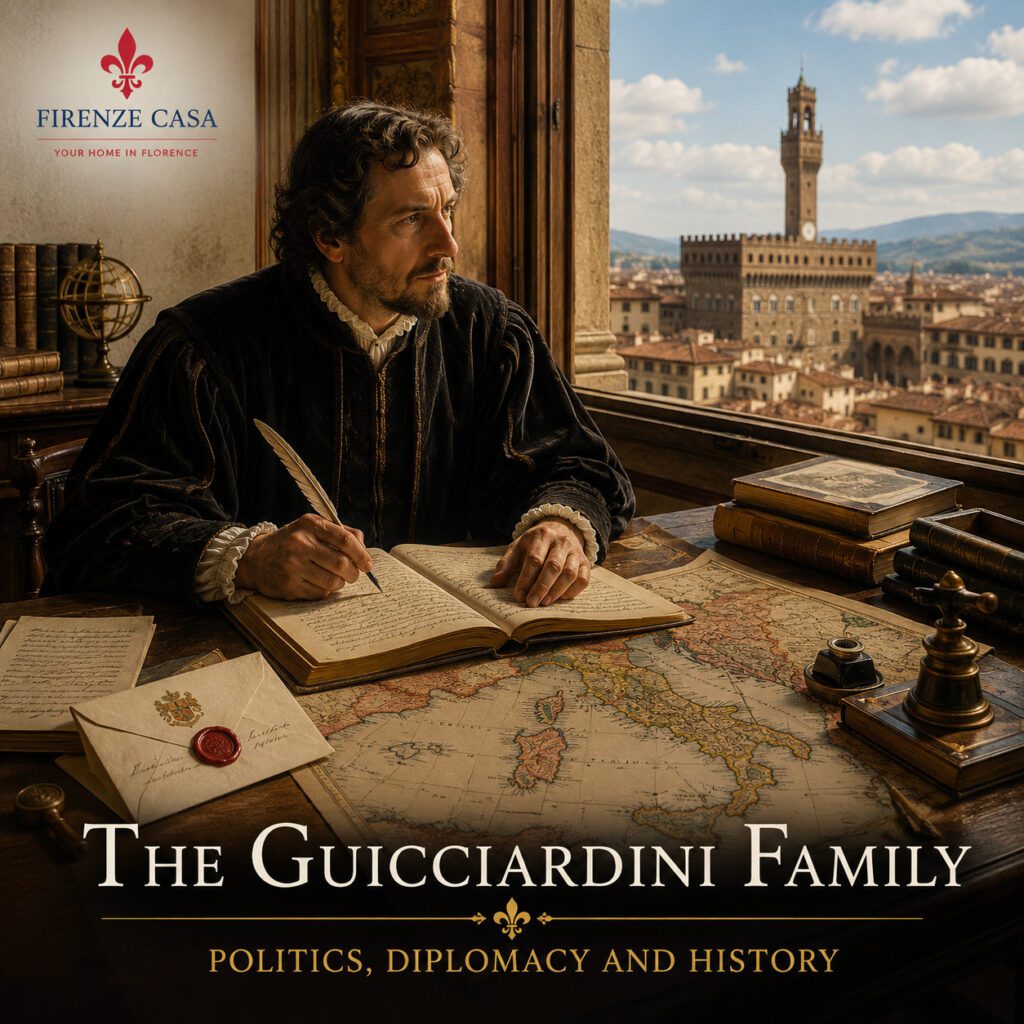
The Guicciardini family belonged to Florence’s political elite for generations. Unlike dynasties remembered primarily for banking fortunes or spectacular commercial empires, the Guicciardini became closely associated with public service, law, diplomacy and political thought.
Their most famous member, Francesco Guicciardini, was born in Florence in 1483 and became one of the outstanding historians and political observers of Renaissance Italy. His career placed him close to popes, princes, wars and the dramatic transition from the Florentine Republic to increasingly concentrated Medici rule.
Origins: Medieval Florence
Main areas of influence: Politics, law, diplomacy and public service
Most famous member: Francesco Guicciardini
Born: Florence, 1483
Major works: Storia d’Italia and Ricordi
Medici connection: Service under Medici popes and involvement in Medici-era politics
Florentine residence: Palazzo Guicciardini in the Oltrarno
Legacy today: Political thought, historiography and Florentine family history
The Guicciardini belong to the wider network explored in our Most Famous Florentine Families – Complete Guide. Their historic residence also forms part of our Historic Palaces of Florence – Complete Guide.
Who Were the Guicciardini Family?
The Guicciardini were an established Florentine family with deep roots in the civic and political life of the republic. Their importance developed through public office, law, diplomacy, property and participation in Florence’s governing elite rather than through one spectacular banking enterprise.
Generations of the family held positions within republican institutions and maintained connections with other prominent Florentine households. Consequently, the Guicciardini became part of the dense network of families whose alliances shaped politics long before Florence became a hereditary Medici state.
Public service also formed part of family identity. Holding office increased prestige, while legal education and political experience allowed members of the family to participate effectively in the complicated institutions of the Florentine Republic.
Not every important Florentine family built its reputation through banking. The Guicciardini represent another side of Renaissance Florence: lawyers, officials, diplomats and political thinkers who helped govern the city and interpret its history.
The Guicciardini Family and Florentine Politics
Florence described itself proudly as a republic, yet elections alone did not determine political influence. Wealth, family alliances, public reputation and personal networks all affected who could participate effectively in government.
Established families such as the Guicciardini therefore played an important role within the political system. Marriage strengthened relationships between households, while repeated service in public office created experience and prestige across generations.
Political fortunes, however, could change rapidly. Republican government, Medici influence, foreign intervention and papal politics repeatedly altered the balance of power.
This unstable political environment later became the intellectual laboratory for Francesco Guicciardini’s unusually analytical understanding of government.
The institutional background is explored more fully in The Medieval Republic of Florence – Guilds, Power and Civic Life.
Francesco Guicciardini: The Family’s Greatest Figure
Francesco Guicciardini (1483–1540) became the most celebrated member of the dynasty and one of the most important political historians of the Italian Renaissance.
Born in Florence on 6 March 1483, he grew up within an educated and politically connected household. The philosopher Marsilio Ficino served as one of his godfathers, reflecting the cultivated environment surrounding the family.
Francesco studied law and initially pursued a legal career. However, public service soon drew him into diplomacy and government.
Rather than observing political life from a distance, he spent decades participating directly in it. That experience would eventually distinguish his historical writing from more abstract political theory.
A Florentine Diplomat in Spain
In 1511, the Florentine Republic appointed Guicciardini ambassador to the court of Ferdinand of Aragon in Spain. For a relatively young Florentine statesman, the mission offered an exceptional introduction to European power politics.
Spain was emerging as one of the continent’s strongest monarchies, while Italy remained divided among republics, duchies, kingdoms and papal territories. Guicciardini therefore observed at first hand the contrast between a powerful monarchy and the fragmented political world of the Italian peninsula.
The experience influenced his later thinking because he saw how resources, circumstance and political judgement could matter more than elegant constitutional theories.
Guicciardini did not learn international politics only from books. His diplomatic mission allowed him to observe a major European monarchy directly, which contributed to his highly practical understanding of political power.
The Medici Return to Florence
While Guicciardini was serving abroad, Florence underwent another profound political transformation. In 1512, the Medici family returned after nearly two decades of republican government.
For members of Florence’s political elite, the restoration created difficult questions about loyalty, public office and political survival. Guicciardini eventually entered the service of the Medici papacy.
This did not make him an unquestioning supporter of dynastic power. Instead, his career illustrates one of the recurring realities of Renaissance politics: capable statesmen often had to work within political systems they regarded critically.
For Guicciardini, government rarely involved choosing between perfect alternatives. Political actors usually confronted incomplete information, competing interests and imperfect solutions.
Serving Pope Leo X
In 1516, Pope Leo X appointed Guicciardini governor of Modena. Leo X was Giovanni de’ Medici, the son of Lorenzo the Magnificent, and his pontificate created important opportunities for Florentines connected with Medici networks.
Guicciardini proved an effective administrator. Modena occupied a strategically sensitive position, and his responsibilities required him to manage local tensions while defending papal interests.
Later appointments brought him even more deeply into the political and military affairs of the Papal States. Consequently, his understanding of politics developed through practical administration as much as through reading and reflection.
Politics Across Renaissance Italy
Guicciardini’s career unfolded during the Italian Wars, when France, Spain, the Holy Roman Empire, the papacy and numerous Italian states competed for influence across the peninsula.
Alliances shifted repeatedly, while armies crossed territorial borders with devastating consequences. Diplomatic agreements could become irrelevant within months, and yesterday’s ally might soon become an enemy.
Moreover, decisions taken in Rome, Madrid or Paris could dramatically alter the political position of Florence.
Guicciardini experienced these changes from unusually close range. As an administrator and adviser, he saw how military resources, personal ambition and changing circumstances shaped events.
Francesco Guicciardini and Niccolò Machiavelli
Francesco Guicciardini and Niccolò Machiavelli belonged to the same remarkable generation of Florentine political thinkers. Both had direct experience of diplomacy, government and political failure, yet their intellectual approaches differed.
Machiavelli often searched for broader patterns and lessons that rulers or republics might apply. Guicciardini was generally more suspicious of universal political rules because he believed circumstances varied too greatly from one situation to another.
The two men corresponded and engaged with many of the same political problems. Read together, they offer two complementary Florentine attempts to understand power.
This intellectual connection also places Guicciardini within the wider cultural world explored in our Florence in Literature – Complete Guide.
Machiavelli and Guicciardini both studied politics through experience rather than idealised theory. However, Guicciardini was generally more sceptical that history could provide simple rules for future political decisions.
The Ricordi: Lessons From a Life in Politics
Among Guicciardini’s most fascinating writings are the Ricordi, a collection of reflections on politics, behaviour, ambition and practical judgement.
He revised these observations repeatedly over many years, drawing on experience accumulated through diplomacy and government. Instead of presenting one systematic political theory, the work consists of concentrated reflections on particular problems.
This fragmented form fits Guicciardini’s intellectual outlook. Political circumstances rarely repeat themselves exactly, and therefore sound judgement depends on understanding the specific situation rather than applying a rigid universal rule.
The Ricordi reveal a thinker fascinated by reputation, self-interest, uncertainty and the limits of political prediction.
The History of Italy
Guicciardini’s greatest historical work is the Storia d’Italia, or History of Italy. Written during the later part of his life, it examines the conflicts that transformed Italy from the end of the fifteenth century into the early sixteenth century.
The work stands out because its author had personally participated in high-level politics. He understood diplomatic negotiations, military decisions and rivalries not only as a scholar but also as a former administrator.
Rather than presenting history as a sequence of heroic acts, Guicciardini examined competing interests, mistakes and unintended consequences. His focus on causes and political motivations gave the work an unusually analytical character.
For this reason, the History of Italy became one of the defining works of Renaissance historiography.
Guicciardini did not merely record what happened. He repeatedly asked why decisions produced particular consequences, giving his historical writing an analytical quality that can feel strikingly modern.
The Guicciardini Family and the Medici
The relationship between the Guicciardini and Medici was neither simple friendship nor permanent opposition. Like many elite Florentine families, the Guicciardini had to navigate a political landscape increasingly shaped by Medici influence.
Francesco served Medici popes and held major offices under their patronage. Nevertheless, his writings reveal an independent and often critical understanding of political power.
This complexity is important because Florentine family politics rarely followed fixed categories. A dynasty could cooperate with the Medici in one generation or context while disagreeing with them in another.
Office, personal interest, marriage alliances and wider Italian politics could all reshape relationships.
From Republic to Medici Duchy
During Francesco’s lifetime, Florence changed profoundly. Republican institutions survived repeated crises, while Medici political influence gradually developed into hereditary authority.
In 1530, republican Florence fell after an imperial siege, and Medici rule returned. Alessandro de’ Medici subsequently governed the city as duke.
After Alessandro’s assassination in 1537, Cosimo I de’ Medici emerged as the new ruler. Guicciardini initially supported his elevation, but Cosimo soon consolidated authority in a way that left experienced republican politicians with far less room for independent influence.
The transformation effectively ended the political environment in which families such as the Guicciardini had traditionally exercised power through republican institutions.
The End of Francesco Guicciardini’s Political Career
As Cosimo I strengthened his position, Guicciardini withdrew increasingly from active politics. His final years became more focused on writing, reflection and the revision of his historical works.
Distance from daily government gave him an opportunity to reconsider events he had witnessed and decisions in which he had participated.
Guicciardini died in 1540. By then, Florence had entered a political era very different from the republic into which he had been born.
His writings therefore became both an analysis of Renaissance politics and a record of a disappearing Florentine political culture.
Palazzo Guicciardini in the Oltrarno
The family left a physical presence in Florence as well as an intellectual one. Palazzo Guicciardini stands in Via Santo Spirito in the Oltrarno, close to the Basilica of Santo Spirito and within walking distance of Ponte Vecchio.
The property developed from buildings associated with the family during earlier periods, although much of the appearance seen today reflects later architectural changes. During the seventeenth century, Gherardo Silvani contributed to the unification and transformation of parts of the complex.
Today, the building does not function as a conventional public museum. Nevertheless, its façade and location preserve an important connection between the Guicciardini and the Oltrarno.
Via Santo Spirito is one of the most rewarding streets in the Oltrarno for visitors interested in Florentine family history. Palazzo Guicciardini belongs to a neighbourhood where aristocratic residences, churches and artisan traditions still coexist.
The Guicciardini and the Oltrarno
The family’s association with the Oltrarno gives their history a particularly strong geographical identity. South of the Arno, wealthy Florentine households occupied palaces alongside churches, workshops and smaller residences.
The district developed differently from the dense civic centre around Palazzo Vecchio, yet it remained closely connected with Florence’s ruling elite.
The Guicciardini residence stood not far from Palazzo Pitti. Once the Medici established their court there, the neighbourhood contained both the residences of older republican families and the monumental seat of Tuscany’s rulers.
This contrast makes the Oltrarno particularly interesting for understanding the political transformation of Florence.
A Family of Political Writers
Francesco was not the only member of the wider Guicciardini family interested in law, political thought and history. The family tradition of education and public service continued through later generations.
This continuity matters because it places Francesco within a broader culture rather than treating him as an isolated genius. The Guicciardini did not merely participate in government; they also reflected on institutions and the behaviour of political actors.
In this respect, the dynasty occupies a distinctive position among Florence’s great families. Its most important inheritance lies as much in manuscripts and political ideas as in stone palaces or financial fortunes.
Why the Guicciardini Family Was Different
Comparing the Guicciardini with other famous Florentine families makes their distinctive character especially clear.
The Medici combined banking with political rule, while the Strozzi became famous for wealth and opposition to Medici dominance. The Pazzi are remembered particularly for conspiracy, whereas the Rucellai became closely associated with architecture and humanist patronage.
The Guicciardini, by contrast, lead us directly into the machinery of politics itself: diplomacy, law, administration and historical analysis.
Their story therefore helps reveal Florence as more than an artistic centre. Renaissance Florence was also a sophisticated political society whose citizens continually debated government, liberty, alliances and the practical exercise of power.
The Guicciardini offer a different form of Florentine legacy. Their greatest contribution is not a banking empire or monumental palace but an unusually sophisticated record of how Renaissance politics actually worked.
Florence Through the Eyes of Guicciardini
Visitors often experience Renaissance Florence through paintings and architecture. Guicciardini offers another perspective: Florence as a political laboratory.
The city repeatedly experimented with republican institutions, factional alliances and constitutional reform. Meanwhile, wealthy families competed for influence, foreign powers intervened in Italian affairs and the Medici gradually transformed informal dominance into hereditary rule.
Francesco witnessed much of this transformation. His writings therefore allow modern readers to look behind the façades of Renaissance palaces and consider the ambitions, calculations and uncertainties that shaped political life inside them.
When walking between Palazzo Vecchio, Via Santo Spirito and the Medici residences, imagine Florence not simply as an artistic capital but as a city constantly debating who should govern it. Guicciardini spent his life observing precisely that struggle.
Where to Discover the Guicciardini Family in Florence
Palazzo Guicciardini
Via Santo Spirito provides the most direct physical connection with the family. The historic palace preserves the Guicciardini presence in the Oltrarno and places the dynasty within one of Florence’s most atmospheric neighbourhoods.
Palazzo Vecchio
Although not a Guicciardini residence, Palazzo Vecchio is essential for understanding their political world. It stood at the centre of the republican government in which generations of Florentine families competed for office and influence.
Piazza della Signoria
The square surrounding Palazzo Vecchio remains the best place to imagine Florence as a functioning republic rather than simply an open-air Renaissance museum.
The Oltrarno
Walk along Via Santo Spirito and neighbouring streets before continuing towards Palazzo Pitti. This route connects the traditional residential world of elite Florentine families with the later Medici court that eventually replaced republican family politics.
A Guicciardini Walk Through Florence
A short thematic walk can connect the family’s residential world with the political Florence that shaped Francesco’s career.
Begin at Palazzo Guicciardini on Via Santo Spirito and explore the surrounding Oltrarno. Afterwards, cross Ponte Santa Trinita or Ponte Vecchio towards the historic centre.
Continue to Piazza della Signoria and Palazzo Vecchio, the heart of Florentine republican government. Although Francesco’s career eventually took him across Italy and beyond, this political landscape remained fundamental to his identity.
The route is therefore less about visiting a sequence of family monuments than about experiencing two sides of Renaissance Florence: the private world of an elite household and the public world of republican politics.
Combine Via Santo Spirito with Piazza della Signoria rather than treating Palazzo Guicciardini as an isolated sight. The walk connects the family’s Oltrarno residence with the political institutions that defined generations of Guicciardini public life.
The Legacy of the Guicciardini Family
The Guicciardini did not leave Florence a monument as immediately recognisable as Palazzo Pitti or Palazzo Strozzi, nor did they become hereditary rulers like the Medici.
Their most important contribution lies elsewhere. Through generations of public service, the family participated in the civic culture of Florence, while Francesco transformed personal experience of diplomacy, war and administration into some of the most important historical and political writing of the Renaissance.
His works preserve a world in which Florence struggled between republican traditions and increasingly concentrated Medici power. At the same time, they reveal the uncertainty behind political decisions that can appear inevitable when viewed centuries later.
The Guicciardini legacy therefore combines family history with something larger: an extraordinary attempt to understand how political power actually works.
Frequently Asked Questions About the Guicciardini Family
Who were the Guicciardini family?
The Guicciardini were an established Florentine family closely involved in politics, law and public service. Their most famous member was the Renaissance statesman and historian Francesco Guicciardini.
Who was Francesco Guicciardini?
Francesco Guicciardini was born in Florence in 1483. He became a lawyer, diplomat, papal administrator, political adviser and historian and is regarded as one of the major political writers of the Italian Renaissance.
Was Francesco Guicciardini a diplomat?
Yes. In 1511, the Florentine Republic sent him as ambassador to Spain. Later, he held major administrative and political positions in papal service.
What did Guicciardini write?
His best-known works include the Storia d’Italia and the Ricordi. Together, they explore political events, human behaviour, judgement and the instability of power.
Did Guicciardini know Machiavelli?
Yes. Francesco Guicciardini and Niccolò Machiavelli were contemporaries who corresponded and confronted many of the same political questions, although they often reached different conclusions.
Where is Palazzo Guicciardini?
Palazzo Guicciardini stands on Via Santo Spirito in Florence’s Oltrarno, within walking distance of Ponte Vecchio and Palazzo Pitti.
Can visitors see the Guicciardini family legacy in Florence?
Yes. Palazzo Guicciardini and Via Santo Spirito provide the most direct physical connection. Palazzo Vecchio and Piazza della Signoria, meanwhile, help visitors understand the republican political world in which the family operated.
Why the Guicciardini Family Is Worth Discovering
The Guicciardini family is worth discovering because it reveals the political intelligence behind Renaissance Florence. Their story moves beyond banking fortunes and artistic patronage into law, diplomacy, republican institutions and the practical exercise of power.
Francesco Guicciardini is particularly important because he experienced Renaissance politics from the inside. His diplomatic missions, papal offices and involvement in Florentine affairs gave him a perspective few historians possessed.
Palazzo Guicciardini provides the physical connection with the family, while the Ricordi and Storia d’Italia preserve its most important intellectual legacy. Together, they reveal Florence not simply as the cradle of Renaissance art but as one of Europe’s most fascinating political laboratories.
For visitors who already know the Medici, Palazzo Pitti and Florence’s great museums, Guicciardini offers another way into the Renaissance: through diplomacy, political judgement and the difficult question of how a republic should govern itself.
Further Reading on Firenze Casa
Continue exploring Florence’s great families, political thinkers and historic palaces:
- The Most Famous Florentine Families – Complete Guide
- The Medici Family: The Dynasty That Shaped Florence
- The Strozzi Family: Florence’s Greatest Rivals of the Medici
- The Pitti Family: Ambition, Power and Palazzo Pitti
- The Salviati Family: Wealth, Politics and Medici Connections
- The Corsini Family: Wealth, Politics and Papal Power
- Palazzo Guicciardini – Historic Palace in Florence
- Historic Palaces of Florence – Complete Guide
- Palazzo Vecchio – Florence’s Historic Seat of Government
- Florence in Literature – Complete Guide
- Cosimo I de’ Medici – The Duke Who Transformed Florence
References
- Guicciardini, Francesco – Storia d’Italia
- Guicciardini, Francesco – Ricordi
- Treccani – Dizionario Biografico degli Italiani: Francesco Guicciardini
- Najemy, John M. – A History of Florence 1200–1575
- Hibbert, Christopher – Florence: The Biography of a City
- Historical Studies on Francesco Guicciardini and Renaissance Florentine Politics
- Historical Documentation on Palazzo Guicciardini and the Guicciardini Family Residence in the Oltrarno

