
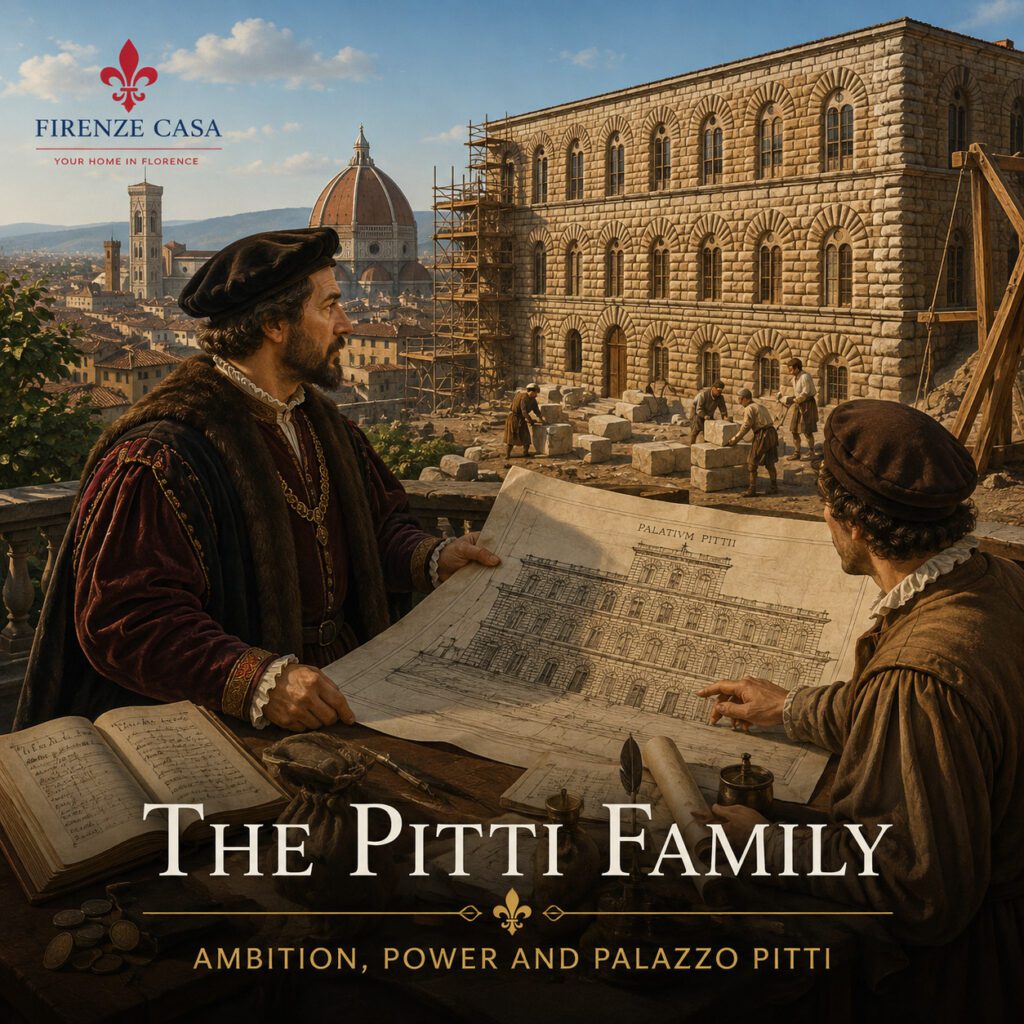
The Pitti family was one of the most ambitious dynasties of Renaissance Florence. Through commerce, banking and politics, the family rose into the city’s governing elite, while Luca Pitti became one of the most influential citizens of the fifteenth century.
Their name survives above all through Palazzo Pitti, the enormous residence that still dominates the Oltrarno. Yet the family’s story is more complex than the history of a palace: Luca Pitti rose through the Florentine Republic, became closely associated with Cosimo de’ Medici, later opposed the Medici political network and began an architectural project so ambitious that his descendants eventually sold it to the dynasty he had once challenged.
Origins: Medieval Florence
Main activities: Commerce, banking and politics
Key figure: Luca Pitti
Political peak: Mid-15th century
Greatest monument: Palazzo Pitti
Major connection: Cosimo de’ Medici and later Medici rule
Turning point: Political crisis of 1466
Palace sold to the Medici: 1549
Legacy today: Palazzo Pitti, Piazza de’ Pitti and the transformation of the Oltrarno
The Pitti belong to the wider network explored in our Most Famous Florentine Families – Complete Guide. Their palace also forms a major chapter in our Historic Palaces of Florence – Complete Guide.
Who Were the Pitti Family?
The Pitti were an old Florentine family whose history reaches back into the Middle Ages. Historical traditions connect their origins with Semifonte, a fortified settlement southwest of Florence that was destroyed by Florentine forces in the early thirteenth century.
Over subsequent generations, members of the family established themselves firmly in Florence and participated in commerce, banking and republican politics. Like many successful Florentine dynasties, they combined economic wealth with public office.
Business generated financial resources, while civic service increased influence and strengthened family networks. By the fifteenth century, the Pitti belonged securely to Florence’s prosperous governing elite.
The great families of Renaissance Florence rarely separated business from politics. Commercial wealth created social influence, while public office strengthened family networks. The rise of the Pitti followed this distinctly Florentine pattern.
The Rise of the Pitti Family in Florence
Medieval and Renaissance Florence offered extraordinary opportunities to successful merchants. The wool and textile industries connected Tuscany with markets across Europe, while Florentine bankers developed increasingly sophisticated international financial networks.
The Pitti prospered within this environment and entered the political institutions of the republic. Several family members served as Priori and Gonfalonieri, placing them among the citizens eligible for Florence’s highest civic offices.
This political culture is explored more fully in The Medieval Republic of Florence – Guilds, Power and Civic Life.
One member eventually overshadowed all the others: Luca Pitti.
Luca Pitti: Banker, Politician and Ambitious Florentine
Luca Pitti (1398–1472) became the defining figure of the family. A successful banker, merchant and politician, his career unfolded during the period when Cosimo de’ Medici was becoming the dominant political figure in Florence.
Luca initially belonged to Cosimo’s political circle and benefited from the relative stability created by the Medici network. He held important public offices and became one of the most influential citizens in the republic.
Economic success and political prestige eventually encouraged him to undertake an extraordinary architectural project. Luca intended to build a residence whose scale would make his position unmistakable.
Luca Pitti and Cosimo de’ Medici
The relationship between Luca Pitti and the Medici family demonstrates how fluid Florentine politics could be. Powerful houses were not permanently divided into simple groups of friends and enemies.
Luca initially supported Cosimo de’ Medici and became an important figure within the political system surrounding him. During the final years of Cosimo’s life, Luca’s influence grew particularly strong.
After Cosimo died in 1464, however, the political balance changed. Piero de’ Medici inherited leadership of the Medici faction, but several influential Florentines questioned whether one family should simply continue exercising the same informal authority.
Luca became associated with opposition to Piero and played a role in the political crisis that followed.
The Pitti were not hereditary enemies of the Medici. Luca Pitti initially worked closely with Cosimo. His later opposition developed from changing political circumstances rather than from an ancient family feud.
The Political Crisis of 1466
Cosimo’s death created uncertainty among Florence’s ruling elite. Several prominent citizens resisted the idea that Piero de’ Medici should automatically inherit his father’s political position.
Luca Pitti became one of the leading figures associated with this opposition. The confrontation developed into a serious political crisis in 1466.
Piero nevertheless retained control, while the opposition fragmented. Luca’s political position never fully recovered.
For a man who had reached the highest levels of public life, the reversal was substantial. His declining influence also affected the monumental building project that had become the most visible expression of his ambition.
The Birth of Palazzo Pitti
The greatest monument associated with the Pitti began as Luca’s private residence. Construction started during the fifteenth century on the southern side of the Arno, in the Oltrarno.
The location itself was significant. Florence’s principal political and commercial institutions stood north of the river, while Luca chose a large site across the Arno for his extraordinary new home.
The palace was monumental from the beginning. Massive rusticated stone blocks, broad arches and an imposing façade created an impression of strength and permanence.
Palazzo Pitti was therefore more than a comfortable residence. It was architecture used as a language of status and ambition.
Stand in Piazza de’ Pitti and look at the central section of the palace. Massive rustication, repetition and scale – rather than delicate decoration – give the building its extraordinary visual authority.
Who Designed Palazzo Pitti?
The architectural authorship of Palazzo Pitti has long been debated. Traditional accounts attributed the design to Filippo Brunelleschi, but modern scholarship treats this attribution with considerable caution.
Luca Fancelli has also been associated with the original project, and the precise authorship remains uncertain.
Visitors should remember another important point: the palace visible today is vastly larger than the residence commissioned by Luca Pitti. Successive rulers expanded the complex over several centuries.
The original Renaissance residence therefore forms only the historical core of the enormous Palazzo Pitti seen today.
Was Palazzo Pitti Built to Rival the Medici?
Florentine tradition has long portrayed Palazzo Pitti as Luca’s attempt to surpass the Medici residence in scale and magnificence. The comparison is understandable because Palazzo Medici Riccardi had already established an influential model for the Renaissance urban palace.
Later stories claimed that Luca wanted windows larger than the entrance of Palazzo Medici or a courtyard large enough to contain the entire Medici residence.
Such colourful anecdotes should be treated cautiously. They reveal how later generations understood the rivalry but cannot be accepted automatically as literal architectural instructions.
What cannot be doubted is the extraordinary ambition behind the scale of Palazzo Pitti.
When Ambition Became a Financial Burden
Building a monumental Renaissance palace required enormous resources. Stone had to be quarried and transported, while architects, masons, carpenters and other craftsmen required payment over many years.
Luca’s changing political fortunes reduced the momentum behind the project. Construction slowed, leaving the residence incomplete.
The unfinished building became an unusually visible reminder that political prestige in Florence could disappear more quickly than a monumental palace could be completed.
Palazzo Pitti demonstrates both the possibilities and risks of private prestige. Luca possessed enough wealth and influence to begin an extraordinary residence, but political power proved less durable than his architectural ambitions.
The Decline of Luca Pitti
Luca never returned to the commanding political position he had enjoyed earlier in his career. He remained in Florence but gradually moved away from the centre of public power.
When he died in 1472, his enormous residence was still unfinished.
The family continued to own the property, but maintaining and completing a palace of this scale required considerable resources. Over time, the gap between the ambitions embodied by the building and the family’s financial position became increasingly difficult to sustain.
Nearly eight decades after Luca’s death, his descendants made the decision that would completely change the history of Palazzo Pitti.
How Palazzo Pitti Passed to the Medici
In 1549, Eleonora di Toledo purchased Palazzo Pitti. She was the wife of Cosimo I de’ Medici, Duke of Florence and later Grand Duke of Tuscany.
Eleonora came from a powerful Spanish aristocratic family and possessed substantial resources of her own. The purchase gave the Medici access to a vast residence and extensive land south of the Arno.
The historical irony is difficult to miss. A palace begun by one of Florence’s most ambitious republican citizens eventually became the residence of the dynasty whose political dominance had eclipsed his own.
The Medici did not build Palazzo Pitti. Eleonora di Toledo acquired the existing residence in 1549, after which the dynasty enlarged it dramatically and transformed it into a grand-ducal court.
How the Medici Transformed Palazzo Pitti
After acquiring the property, the Medici began adapting Palazzo Pitti to the requirements of a ruling court. Bartolomeo Ammannati played an important role in enlarging the complex and increasing its ceremonial character.
The surrounding landscape changed as well. Behind the palace, the Medici developed what became the Boboli Gardens.
The transformation was extraordinary. Luca Pitti’s private monument to family ambition evolved into one of the principal residences of the Medici state.
The move also reflected the political transformation of Florence itself. The city was no longer simply a merchant republic dominated informally by powerful families; under Cosimo I, it was becoming the capital of a hereditary territorial state.
The Boboli Gardens and the Pitti Legacy
The Boboli Gardens are now inseparable from Palazzo Pitti, although their major development belongs to the period after the Pitti family sold the property.
Work began for Eleonora di Toledo around the time of the palace purchase, with Niccolò Tribolo playing an important role in the early design.
Later generations added avenues, fountains, sculpture, terraces and grottoes, transforming the hillside into an extraordinary court landscape.
For the Pitti, there is another historical irony. Their decision to build on a large Oltrarno property ultimately provided the Medici with the space needed to create one of Florence’s great palace-and-garden complexes.
Palazzo Pitti After the Medici
The palace continued to evolve long after the Medici dynasty ended. When Gian Gastone de’ Medici died in 1737, Tuscany passed to the Habsburg-Lorraine dynasty.
Palazzo Pitti remained one of the principal residences of Tuscany’s rulers and continued to accumulate new interiors, collections and ceremonial functions.
During the nineteenth century, Florence briefly became the capital of the Kingdom of Italy. The House of Savoy also used Palazzo Pitti as a royal residence during the years of Firenze Capitale.
What began as the ambitious home of a Florentine banker had become a palace for grand dukes and kings.
What Happened to the Pitti Family?
The sale of the palace did not immediately end the history of the Pitti family. Different branches continued to participate in Florentine society, although no later member achieved the prominence of Luca.
Over time, the building overshadowed the people who created it.
Today, millions of visitors recognise the name “Pitti”, even though many know little about the family behind it. The survival of that name is itself an extraordinary form of historical legacy.
The Pitti Family and the Oltrarno
The location of Palazzo Pitti makes the family particularly important to the history of the Oltrarno. This district developed differently from the dense political and commercial centre north of the Arno.
Large properties, gardens, religious institutions and aristocratic residences became increasingly important south of the river.
Once the Medici established their court at Palazzo Pitti, the surrounding neighbourhood acquired even greater political and social significance.
The Pitti family therefore influenced not only one building but also the later development and identity of an entire part of Florence.
Do not visit Palazzo Pitti in isolation. Walk through the surrounding Oltrarno before or after your visit. Its churches, workshops, streets and historic residences reveal a very different Florence from the area around the Duomo.
What the Pitti Story Reveals About Renaissance Florence
The history of the Pitti illustrates several defining characteristics of Renaissance Florence. Financial success could translate rapidly into political influence, while banking and commerce allowed ambitious citizens to compete for the highest offices of the republic.
Architecture became another language of power. A monumental palace communicated wealth and status to every passer-by.
At the same time, alliances changed quickly. Luca moved from close cooperation with Cosimo de’ Medici to involvement in opposition against Piero.
His career demonstrates how unstable elite power could be, even for one of the wealthiest citizens in Florence.
The Pitti Family and Florence’s Culture of Rivalry
Florentine history repeatedly shows powerful families competing through politics, business, marriage, patronage and architecture.
The Strozzi built one of Florence’s greatest private palaces while repeatedly opposing Medici dominance. The Rucellai transformed commercial success into sophisticated architectural patronage, while the Pazzi became associated with the violent conspiracy of 1478.
The Pitti belonged to the same competitive world, although their relationship with the Medici developed differently.
Florence’s great families did not compete only for money. They competed for reputation, visibility and political influence within an extraordinarily compact urban environment.
Renaissance Florence becomes easier to understand when its palaces are read as part of a competition between families. Architecture made wealth and ambition permanently visible in the streets.
Where to Discover the Pitti Family in Florence
Palazzo Pitti
The palace is naturally the essential starting point. Although later rulers transformed it enormously, its central structure preserves the origins of Luca Pitti’s ambitious residence.
Piazza de’ Pitti
Spend a few minutes in the square before entering the palace. From here, the extraordinary width of the façade and the scale of the rusticated stonework are particularly easy to appreciate.
The Boboli Gardens
The gardens belong primarily to the Medici chapter of the property, but they demonstrate what became possible after the Pitti residence passed into ducal hands.
The Oltrarno
A walk through the surrounding district places the palace within the urban landscape chosen by Luca Pitti and provides useful context for the development of the south bank of Florence.
Visiting Palazzo Pitti Today
Today, Palazzo Pitti forms part of the Uffizi Galleries and contains several important museum collections. The enormous complex allows visitors to experience different periods of Florentine history within a single building.
Grand rooms, paintings, decorative arts and royal interiors reveal how successive rulers transformed the residence over centuries.
The original Pitti story can easily disappear beneath this later splendour. Before entering, spend a moment looking at the façade and remembering that the palace began not as a royal residence but as the extraordinarily ambitious home of a Florentine citizen.
Palazzo Pitti makes more sense when you view it as a building that evolved over centuries: Luca Pitti’s Renaissance residence first, then Medici court, Habsburg-Lorraine palace and finally Savoy royal residence.
The Legacy of the Pitti Family
The Pitti never achieved the lasting political dominance of the Medici. Luca’s influence declined, his palace remained unfinished during his lifetime and the family’s greatest property eventually passed to another dynasty.
Yet their legacy is extraordinary.
By beginning Palazzo Pitti, the family created the architectural foundation for one of Florence’s greatest complexes. The palace later became home to Medici grand dukes, Habsburg-Lorraine rulers and the kings of Italy.
Through every transformation, the Pitti name remained attached to the building.
In that sense, Luca achieved something more durable than the political influence he pursued. His family’s name became permanently embedded in the geography and history of Florence.
Frequently Asked Questions About the Pitti Family
Who were the Pitti family?
The Pitti were a wealthy Florentine family involved in commerce, banking and politics. Their most famous member was Luca Pitti, one of the leading political figures of fifteenth-century Florence.
Who was Luca Pitti?
Luca Pitti was a Florentine banker, merchant and politician born in 1398. He became an influential supporter of Cosimo de’ Medici before later participating in opposition to Medici political dominance.
Did the Pitti family build Palazzo Pitti?
Yes. Luca Pitti began the palace as a private family residence during the fifteenth century. Later rulers expanded it substantially, so the building visible today is much larger than the original Pitti residence.
Did Brunelleschi design Palazzo Pitti?
The palace was traditionally attributed to Filippo Brunelleschi, but the attribution is uncertain. Luca Fancelli has also been associated with the original project.
Did the Medici build Palazzo Pitti?
No. The Pitti family began the palace. Eleonora di Toledo purchased it in 1549, after which the Medici transformed it into a much larger ducal and later grand-ducal residence.
Why is the palace still called Palazzo Pitti?
The building retained the name of the family that originally commissioned it. Even after centuries of Medici, Habsburg-Lorraine and Savoy ownership, the original Pitti name survived.
Where can visitors discover the Pitti family today?
Palazzo Pitti is the most important surviving monument connected with the family. Piazza de’ Pitti and the surrounding Oltrarno also help explain the urban setting chosen for Luca Pitti’s residence.
Why the Pitti Family Is Worth Discovering
The Pitti family is worth discovering because its story captures the ambition, instability and competition of Renaissance Florence. Luca Pitti converted financial success into political influence and then attempted to make that status permanent through architecture.
His political fortunes faded, but his palace survived. In a remarkable reversal, the Medici later acquired the residence and transformed it into the monumental court complex that still dominates the Oltrarno.
The Pitti therefore demonstrate how buildings can outlive the political ambitions that created them. Their family never ruled Tuscany, yet their name remains attached to one of the most important palaces in Florence.
Further Reading on Firenze Casa
Continue exploring Florence’s great families, political rivalries and historic palaces:
- The Most Famous Florentine Families – Complete Guide
- The Medici Family: The Dynasty That Shaped Florence
- The Strozzi Family: Florence’s Greatest Rivals of the Medici
- The Rucellai Family: Wealth, Art and Renaissance Architecture
- The Tornabuoni Family: Wealth, Art and Influence in Florence
- The Guicciardini Family: Politics, Diplomacy and History
- Palazzo Pitti – Grand Ducal Palace of Florence
- Historic Palaces of Florence – Complete Guide
- Cosimo I de’ Medici – The Duke Who Transformed Florence
- Florence as Capital of Italy – Firenze Capitale 1865–1871
References
- Gallerie degli Uffizi – Palazzo Pitti: History
- Gallerie degli Uffizi – Boboli Gardens: History
- Treccani – Pitti and Luca Pitti
- Najemy, John M. – A History of Florence 1200–1575
- Hibbert, Christopher – Florence: The Biography of a City
- Goldthwaite, Richard A. – The Economy of Renaissance Florence
- Historical Studies on Florentine Palace Architecture and Republican Politics

