Palazzo Pitti in Florence is the monumental former residence of the Grand Dukes of Tuscany. Standing on Piazza de’ Pitti in the Oltrarno, the enormous palace began as the ambitious home of banker Luca Pitti before Eleonora di Toledo and Cosimo I de’ Medici transformed it into the principal residence of the Medici court.
Today, Palazzo Pitti forms one of Florence’s most important museum complexes, while the Boboli Gardens rise directly behind it. Yet the building is far more than a collection of galleries. Its architecture, ceremonial rooms and gardens reveal how Florence changed from a city dominated by republican traditions and powerful banking families into the capital of a dynastic state.
Address: Piazza de’ Pitti 1, Florence
Area: Oltrarno
Original patron: Luca Pitti
Medici acquisition: 1549, by Eleonora di Toledo
Important architect: Bartolomeo Ammannati
Historic role: Grand-ducal and later royal residence
Known for: Monumental façade, historic apartments and Boboli Gardens
Current use: Major museum complex
Public access: Yes
Worth visiting? Absolutely – especially together with the Boboli Gardens
Palazzo Pitti forms one of the essential landmarks in our Historic Palaces of Florence – Complete Guide.
Where Is Palazzo Pitti?
Palazzo Pitti dominates Piazza de’ Pitti in the Oltrarno, on the southern side of the Arno. From Ponte Vecchio, visitors can reach the palace within only a few minutes along Via de’ Guicciardini.
Its position is important to understanding the history of the residence. Most of Florence’s great civic and political buildings developed north of the river, whereas Palazzo Pitti created a new centre of dynastic life in the Oltrarno.
Behind the palace rises the hillside occupied by the Boboli Gardens. Palace and landscape eventually developed into a single grand-ducal complex.
Approach Palazzo Pitti from Ponte Vecchio. The short walk from the old political centre across the Arno recreates part of the historical route between civic Florence and the later Medici court.
Why Is It Called Palazzo Pitti?
The palace takes its name from Luca Pitti, a wealthy Florentine banker and politician who became one of the prominent figures of fifteenth-century Florence.
Pitti commissioned an imposing residence that reflected his wealth and social ambitions. Construction began around the middle of the fifteenth century, although historians continue to debate aspects of the earliest architectural history.
For a long time, tradition attributed the original design to Filippo Brunelleschi. Modern scholarship, however, generally gives greater importance to Luca Fancelli in the palace’s early development.
Remarkably, the Pitti name survived even after the family lost possession of the building. The Medici made the palace famous, yet Florence continued to remember the dynasty that began it.
Palazzo Pitti kept the name of its original family even after it became one of the principal residences of the Medici and later rulers of Tuscany.
From the Pitti Family to the Medici
Luca Pitti’s political and financial fortunes eventually declined, while the ambitious residence remained incomplete. Almost a century later, a transaction changed the future of both the palace and the Oltrarno.
In 1549, Eleonora di Toledo, wife of Cosimo I de’ Medici, purchased Palazzo Pitti from the Pitti family. Eleonora possessed considerable personal wealth and played an important role in the development of the new Medici residence.
The palace offered something the family’s central residence could not provide: substantially more space and direct access to extensive land on the hillside behind it.
As a result, the acquisition laid the foundations for an entirely new courtly landscape on the southern side of the Arno.
Eleonora di Toledo and the New Medici Residence
Eleonora di Toledo deserves particular attention in the history of Palazzo Pitti. Her purchase of the residence was not simply a secondary event in the career of Cosimo I.
As Duchess of Florence, Eleonora brought considerable wealth and connections to the Medici court. Palazzo Pitti allowed her family to enjoy a larger residential environment while creating direct access to gardens and open space.
The move also shifted the geography of Medici life. The dynasty increasingly occupied both sides of the Arno, while government, residence and court functions became connected through a wider architectural system.
Eleonora di Toledo was central to the transformation of Palazzo Pitti. Her purchase of the palace in 1549 created the foundation for the grand-ducal residence and the development of the Boboli Gardens.
The Grand Ducal Palace of Florence
Under Cosimo I and Eleonora di Toledo, Palazzo Pitti gradually developed into a magnificent court residence. The Medici expanded the original building and reshaped the surrounding landscape.
Bartolomeo Ammannati played an important role in this transformation. His monumental courtyard behind the main façade remains one of the most distinctive architectural spaces within the complex.
Meanwhile, the developing Boboli Gardens gave the residence an entirely new dimension. Palazzo Pitti was no longer simply an enormous urban house. Instead, it became the centre of a grand-ducal environment designed for residence, representation, entertainment and court ceremony.
A Palace Built to Impress
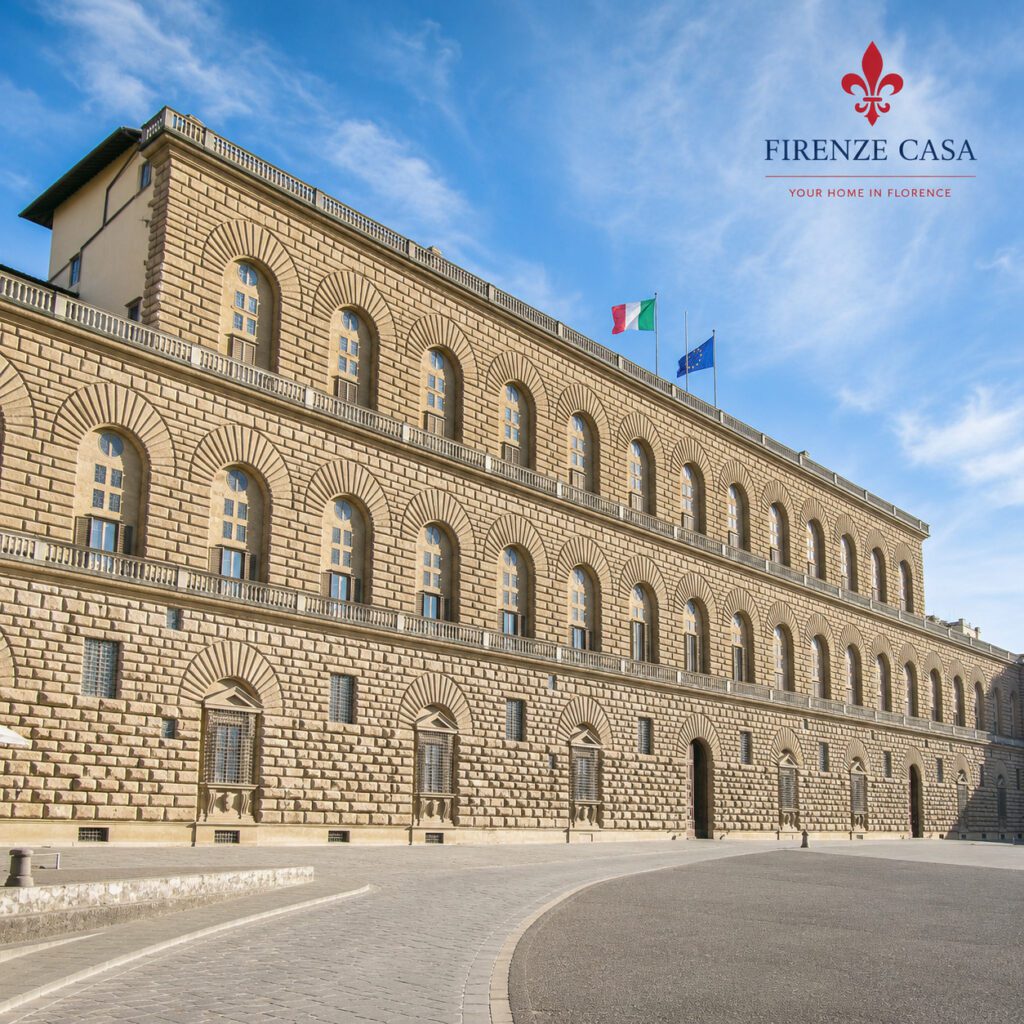
The façade of Palazzo Pitti differs strikingly from the richly decorated exteriors of many later European royal residences. Its power comes primarily from scale, repetition and stone.
Huge rusticated blocks cover the monumental elevation, while large arched openings repeat across each level. Later extensions increased the width of the building considerably, yet architects preserved the visual language of the original Renaissance structure.
The result is one of Florence’s most imposing secular buildings. Palazzo Pitti requires little exterior ornament because its massive proportions already communicate authority.
Step back into Piazza de’ Pitti and look at the façade as a whole. Its enormous rusticated blocks, repeated arches and extraordinary horizontal scale create monumentality without relying on elaborate sculptural decoration.
The Boboli Gardens and the Palace
The Boboli Gardens became inseparable from life at Palazzo Pitti. Beginning in the sixteenth century, designers transformed the hillside behind the residence into one of Europe’s most influential historic gardens.
Terraces, avenues, fountains, sculptures and architectural features created a carefully organised landscape. The Medici used these spaces for private recreation as well as ceremonies and elaborate court festivities.
Consequently, the gardens extended the architecture of the palace into the landscape. Buildings, sculpture, water and vegetation formed one unified grand-ducal environment.
Do not treat the Boboli Gardens as a completely separate attraction. Palace and garden belonged to the same grand-ducal world, and seeing both makes the history of Palazzo Pitti much easier to understand.
Palazzo Pitti and Palazzo Vecchio
The move towards Palazzo Pitti created a fascinating contrast with Palazzo Vecchio.
Palazzo Vecchio originated as a fortified seat of republican government and later became Cosimo I’s ducal residence. Palazzo Pitti, by contrast, provided the space required for a more elaborate court culture and an increasingly dynastic style of government.
The two buildings therefore represent different sides of Medici power. Palazzo Vecchio remained closely associated with government, whereas Palazzo Pitti increasingly symbolised residence, ceremony and grand-ducal splendour.
Palazzo Vecchio grew from a fortified medieval government building. Palazzo Pitti developed into a monumental court residence. Together, they illustrate the transformation of Medici power in Florence.
The Vasari Corridor and the Medici Court
In 1565, Giorgio Vasari created one of Florence’s most ingenious architectural connections. The elevated Vasari Corridor linked the Palazzo Vecchio and Uffizi area with Palazzo Pitti.
Its route crossed the Arno above Ponte Vecchio and allowed members of the ruling family to travel between government and residence without moving through the crowded streets below.
More importantly, the corridor physically connected different centres of Medici power. Government, administration and dynastic residence now formed part of one architectural system stretching across central Florence.
Our article on Casa Vasari in Florence explores the architect behind this extraordinary intervention.
Life at the Grand Ducal Court
Palazzo Pitti was not simply a private home on an enormous scale. It functioned as the centre of a sophisticated court.
Grand dukes, family members, officials, servants, artists and visiting dignitaries all moved through the palace according to highly organised social hierarchies. Ceremonial rooms provided stages for diplomacy and representation, while private apartments supported everyday dynastic life.
The scale of the building reflects this complexity. A ruling court required far more than bedrooms and reception rooms: administration, kitchens, service areas, ceremonial spaces and accommodations for numerous members of the household all had to function together.
Think of Palazzo Pitti as a working political and social organism rather than simply as a luxurious residence. Hundreds of people supported the ceremonial and practical life of the grand-ducal court.
After the Medici
The Medici dynasty ended with the death of Gian Gastone de’ Medici in 1737. The Grand Duchy of Tuscany then passed to the House of Habsburg-Lorraine.
The new rulers continued to use Palazzo Pitti and adapted parts of the residence to changing tastes and court requirements. Thus, the palace remained at the centre of Tuscan dynastic life long after the Medici disappeared.
During the Napoleonic period, the complex also served rulers connected with French control of Tuscany. Political systems changed repeatedly, yet Palazzo Pitti retained its association with sovereign power.
Palazzo Pitti and the Kings of Italy
Another important chapter began during the nineteenth century. From 1865 to 1871, Florence served as capital of the newly unified Kingdom of Italy.
During this period, the House of Savoy used Palazzo Pitti as a royal residence. A building created for a Florentine banker and transformed by the Medici now became connected with the monarchy of unified Italy.
Its history therefore spans several political worlds: Renaissance Florence, the Medici Grand Duchy, Habsburg-Lorraine Tuscany and the Kingdom of Italy.
For more on this period, see our guide to Florence as Capital of Italy.
Few Florentine buildings housed so many successive ruling dynasties. Palazzo Pitti connects the Medici, Habsburg-Lorraine and Savoy periods within one extraordinary residence.
From Royal Residence to Museum
During the twentieth century, Palazzo Pitti underwent another fundamental change. Instead of serving a ruling dynasty, the palace and its collections increasingly became part of Italy’s public cultural heritage.
Today, the enormous complex contains several museums and collections. Among them are the Palatine Gallery, the Royal Apartments, the Gallery of Modern Art, the Treasury of the Grand Dukes and the Museum of Costume and Fashion.
Visitors therefore experience Palazzo Pitti on two levels. The artworks deserve attention, but the rooms themselves also preserve the scale and ceremonial structure of a former dynastic residence.
Do not focus exclusively on individual paintings. Look at ceilings, doors, room sequences and the scale of the apartments. The palace itself is one of the most important exhibits.
Palazzo Pitti as a Historic Palace
Within our historic-palace cluster, the most interesting question is not simply which artworks hang inside Palazzo Pitti. The larger story concerns the building’s transformation from an ambitious private residence into the home of Florence’s rulers.
This evolution mirrors a fundamental change in Florentine history. Republican traditions and the influence of merchant families gradually gave way to the formal court culture of the Medici Grand Duchy.
Palazzo Pitti provides the architectural setting for that transformation. Its enormous façade, ceremonial apartments, gardens and physical connection with Palazzo Vecchio all reveal how the political geography of Florence changed.
Can You Visit Palazzo Pitti?
Yes. Palazzo Pitti is one of Florence’s major public museum complexes. Visitors can enter the palace and explore several collections housed within its historic rooms.
The Boboli Gardens form a separate visitor area, and ticket arrangements can vary. Temporary closures, museum schedules and combined-ticket options may also change.
Therefore, check current official information before visiting, especially if you want to combine several museums with the gardens on the same day.
Address: Piazza de’ Pitti 1, Florence
Area: Oltrarno
Nearest landmark: Ponte Vecchio
Current use: Public museum complex
Admission: Ticket required for museum areas
Boboli Gardens: Separate access and ticket arrangements may apply
Best advice: Check current official opening and ticket information before visiting
What to See near Palazzo Pitti
The Oltrarno offers many opportunities to continue exploring after Palazzo Pitti. Via de’ Guicciardini leads directly back towards Ponte Vecchio, while the streets around Santo Spirito reveal another side of historic Florence.
Palazzo Guicciardini provides an excellent comparison with a more discreet aristocratic residence integrated into the neighbourhood.
The Boboli Gardens, meanwhile, can occupy several hours on their own. For visitors interested in architecture and landscape, they form the most natural continuation of the palace visit.
After Palazzo Pitti, continue through the Oltrarno rather than immediately crossing back towards the Duomo. Santo Spirito, Via Santo Spirito and the surrounding streets reveal a quieter layer of Florentine palace and neighbourhood history.
Why Palazzo Pitti Is Worth Visiting
Palazzo Pitti is worth visiting because it reveals Florence as the capital of a ruling dynasty rather than only as a Renaissance republic. Here, the Medici were no longer simply an influential banking family. They lived as sovereign rulers surrounded by a sophisticated court.
The palace also rewards visitors architecturally. Its vast rusticated façade, monumental courtyard and ceremonial interiors differ significantly from the compact family palaces of central Florence.
Most importantly, the relationship with Boboli and Palazzo Vecchio creates a larger historical landscape. Walking from Piazza della Signoria across Ponte Vecchio towards Palazzo Pitti traces the changing geography of political power through Florence.
Palazzo Pitti is not simply a museum filled with art. It is the architectural expression of Florence becoming a grand-ducal capital, complete with court apartments, gardens and a physical connection to the old centre of government.
Frequently Asked Questions
Where is Palazzo Pitti?
Palazzo Pitti stands on Piazza de’ Pitti in the Oltrarno, only a few minutes’ walk from Ponte Vecchio.
Who built Palazzo Pitti?
Luca Pitti commissioned the original fifteenth-century residence. The precise attribution of the earliest design remains debated, although modern scholarship gives an important role to Luca Fancelli.
Did Brunelleschi design Palazzo Pitti?
Older tradition attributed the palace to Filippo Brunelleschi. However, modern scholarship has questioned that attribution and generally gives greater importance to Luca Fancelli in the early construction history.
When did the Medici acquire Palazzo Pitti?
Eleonora di Toledo purchased Palazzo Pitti from the Pitti family in 1549.
Why did the Medici move to Palazzo Pitti?
The palace offered substantially more space than Palazzo Vecchio and provided direct access to extensive land behind the residence. This allowed the Medici to develop a more elaborate grand-ducal court and the Boboli Gardens.
What is inside Palazzo Pitti today?
The complex contains several museums and collections, including the Palatine Gallery, Royal Apartments, Gallery of Modern Art, Treasury of the Grand Dukes and Museum of Costume and Fashion.
Are the Boboli Gardens part of Palazzo Pitti?
Historically, yes. Palace and gardens developed as parts of the same grand-ducal complex. For modern visitors, however, separate access or ticket arrangements may apply.
Did Italian kings live in Palazzo Pitti?
Yes. The House of Savoy used Palazzo Pitti as a royal residence when Florence served as capital of the Kingdom of Italy from 1865 to 1871.
Can you visit Palazzo Pitti?
Yes. Palazzo Pitti is a major public museum complex, although opening hours, individual museum access and ticket arrangements can change.
How much time should you allow for Palazzo Pitti?
Allow several hours if you want to explore the palace collections properly. If you also plan to visit the Boboli Gardens, the combined experience can easily occupy most of a day.
Further Reading on Firenze Casa
Continue exploring Florence’s historic palaces and discover how civic authority, wealthy families and grand-ducal power transformed the city:
- Historic Palaces of Florence – Complete Guide
- Palazzo Vecchio – Florence’s Historic Seat of Government
- Palazzo Medici Riccardi – Renaissance Palace
- Palazzo Corsini al Parione in Florence
- Palazzo Strozzi – Renaissance Palace of a Powerful Florentine Family
- Palazzo Guicciardini – Historic Palace in Florence
- Casa Vasari in Florence – Giorgio Vasari’s Home and Studio
References
- Gallerie degli Uffizi – Palazzo Pitti, Historical and Visitor Information
- Comune di Firenze – Historical and Architectural Information on Florence and the Oltrarno
- Treccani – Pitti and Medici Family History
- UNESCO World Heritage Centre – Historic Centre of Florence
- Hibbert, Christopher. The House of Medici: Its Rise and Fall.
- Acton, Harold. The Last Medici.