
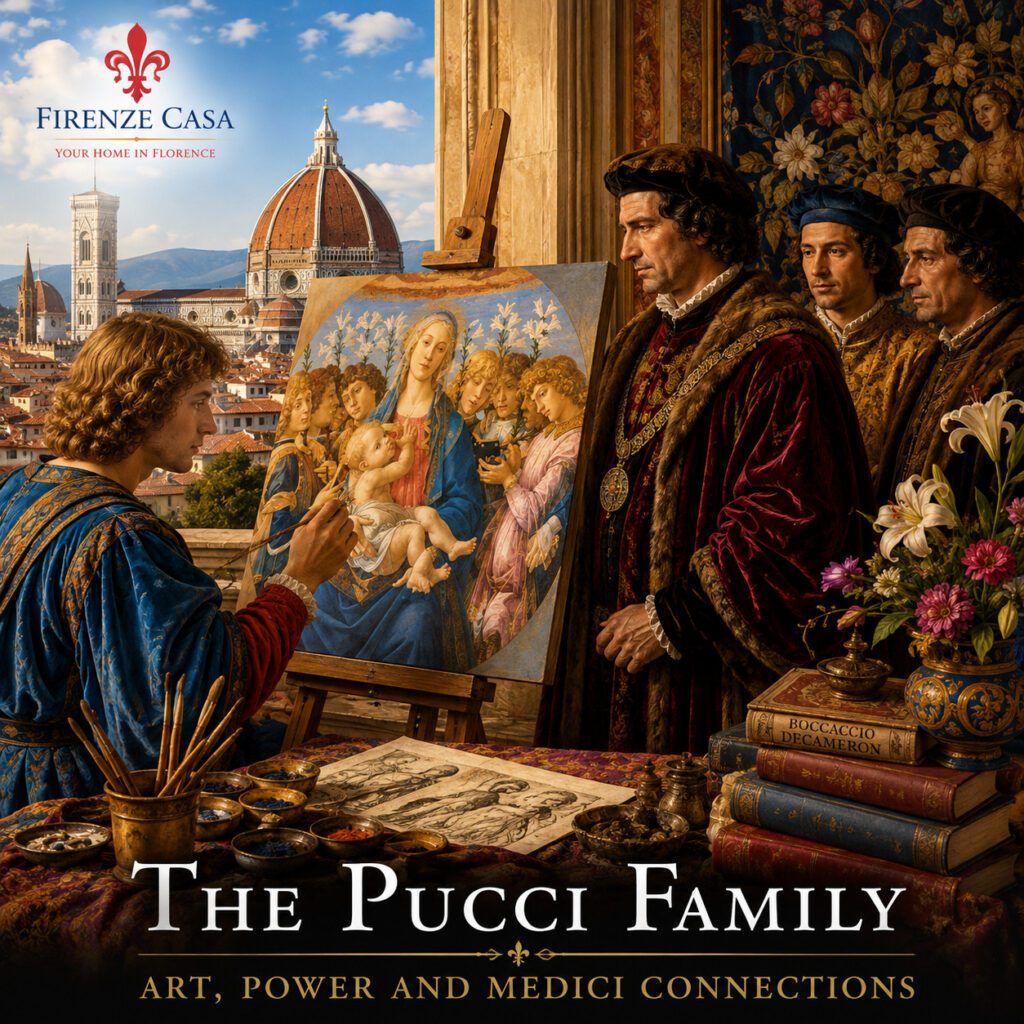
The Pucci family belonged to the influential elite of Renaissance Florence. Their history combines politics, artistic patronage and a remarkably complicated relationship with the Medici, whom they supported for generations before one branch eventually turned against Medici rule.
The family’s legacy remains visible in Palazzo Pucci near Florence Cathedral, in important artistic commissions associated with Botticelli and in the famous conspiracy of Pandolfo Pucci against Cosimo I. Centuries later, the Pucci name acquired another international identity through fashion designer Emilio Pucci.
Origins: Medieval Florence
Main areas of influence: Politics, public office, property and artistic patronage
Medici relationship: Long-standing alliance followed by later opposition
Important Renaissance figure: Antonio Pucci
Major artistic connection: Sandro Botticelli
Political crisis: Pandolfo Pucci’s conspiracy against Cosimo I in 1559
Major residence: Palazzo Pucci
Modern legacy: Emilio Pucci and international fashion
The Pucci belong to the wider network explored in our Most Famous Florentine Families – Complete Guide. Their historic residence also forms part of our Historic Palaces of Florence – Complete Guide.
Who Were the Pucci Family?
The Pucci were an old Florentine family whose prominence developed during the Middle Ages and Renaissance. Like many successful families in the republic, they combined economic activity with participation in civic government.
Members of the family repeatedly held important public positions and established relationships with other powerful Florentine households. Most importantly, they became closely associated with the Medici family.
This alliance placed the Pucci near the centre of Florentine political life during the fifteenth century. At the same time, growing wealth allowed them to invest in property, religious foundations and works of art.
Florence was rarely shaped by one dynasty acting alone. Powerful families depended on networks of allies, relatives and supporters, and families such as the Pucci played an important role within the political world surrounding the Medici.
The Pucci Family and Florentine Politics
Florence’s republican government offered wealthy citizens many opportunities to participate in public life. Offices rotated frequently, while guild membership, wealth and family reputation strongly influenced political careers.
The Pucci became part of this governing class. Several family members served in public positions, represented Florence diplomatically or participated in institutions connected with the republic.
Political success depended heavily on alliances. Consequently, the Pucci relationship with the Medici became increasingly important as Medici influence expanded during the fifteenth century.
The connection brought advantages, but it also placed the family inside a political system in which loyalty, ambition and personal interests could become difficult to separate.
The Pucci Family and the Medici
The relationship between the Pucci and Medici became particularly significant during the Renaissance. Members of the Pucci family belonged to the circle of supporters who helped sustain Medici influence within Florence’s republican institutions.
Antonio Pucci was among the prominent figures associated with this political world during the fifteenth century. The family’s position allowed it to benefit from the stability and opportunities created by Medici dominance.
Yet Florentine alliances were never simply personal friendships. They connected political interests, marriages, business relationships and patronage.
That closeness makes the later conflict between the two families especially interesting.
Antonio Pucci and Lorenzo the Magnificent
Antonio Pucci emerged as one of the notable members of the family during the age of Lorenzo the Magnificent. He participated actively in Florentine political life and maintained close connections with the Medici circle.
His career illustrates how Florence functioned during Lorenzo’s period of influence. The city remained formally republican, yet political power increasingly depended on networks surrounding the Medici family.
Supporters such as the Pucci could hold office and participate in government while contributing to the broader political system sustaining Lorenzo’s authority.
Antonio’s importance, however, was not limited to politics. His generation also helped establish the Pucci reputation as significant patrons of Renaissance art.
Art Patronage and the Pucci Family
Renaissance Florence offered wealthy families several ways to display status. Architecture was one, political office another, while artistic patronage provided an equally powerful form of representation.
The Pucci commissioned works for churches, family chapels and private settings. These projects expressed religious devotion while also demonstrating wealth and cultural sophistication.
Moreover, patronage connected the family with some of Florence’s most important artists. Through these commissions, the Pucci became part of the extraordinary artistic environment that made fifteenth-century Florence one of Europe’s great cultural centres.
Renaissance art was rarely created in isolation. Families financed chapels, altarpieces, frescoes and private works, so many masterpieces visible today also tell the story of the patrons who commissioned them.
The Pucci and Sandro Botticelli
One of the family’s most famous artistic connections involves Sandro Botticelli. Antonio Pucci commissioned works from the artist during the period when Botticelli had become one of Florence’s leading painters.
The best-known connection is the celebrated series illustrating the story of Nastagio degli Onesti from Boccaccio’s Decameron. The paintings were commissioned in connection with the 1483 marriage of Giannozzo Pucci and Lucrezia Bini.
Botticelli and his workshop transformed Boccaccio’s dramatic tale into a sequence of richly detailed scenes combining narrative, landscape, fashionable clothing and the visual sophistication expected from an elite wedding commission.
Today, most of the surviving panels are held by the Museo del Prado in Madrid, while another remains in a private collection.
A Renaissance Wedding and a Botticelli Masterpiece
The Nastagio degli Onesti panels reveal much about elite marriage culture in Renaissance Florence. Weddings between prominent families were not merely private celebrations; they created political and economic alliances between entire households.
Art could reinforce these connections. A prestigious commission demonstrated the status of both families and transformed a marriage into a public expression of wealth and culture.
The Pucci commission is particularly fascinating because it connects one dynasty directly with Botticelli and Boccaccio, bringing painting, literature and family politics together.
This literary dimension also creates a natural connection with our Florence in Literature – Complete Guide.
The Botticelli panels depicting Nastagio degli Onesti were associated with the 1483 marriage of Giannozzo Pucci and Lucrezia Bini, offering an extraordinary connection between Renaissance art, literature and elite marriage.
The Pucci Chapel at Santissima Annunziata
Another important place associated with the family is the Basilica della Santissima Annunziata. The church became one of Florence’s most important religious centres and contains chapels connected with several prominent dynasties.
The Pucci maintained a strong relationship with the basilica and supported artistic decoration there. Family chapels served several purposes at once: they provided spaces for worship and burial while also preserving dynastic identity across generations.
For visitors, Santissima Annunziata therefore offers an opportunity to understand the Pucci beyond political history and places the family within the broader devotional culture of Renaissance Florence.
Palazzo Pucci in the Heart of Florence
The most visible architectural reminder of the family stands close to the Duomo. Palazzo Pucci occupies a prominent position along Via de’ Pucci, a street whose name itself preserves the family’s presence in the city.
The palace developed from properties owned by the family and evolved over time into an imposing noble residence. Its location was especially prestigious because Florence Cathedral stands only a short distance away.
Living here placed the Pucci at the physical centre of Florentine religious, political and social life. The palace therefore represented more than comfortable accommodation: it made family status permanently visible in the urban landscape.
Via de’ Pucci is only a few minutes from Piazza del Duomo. Look beyond the cathedral itself: many surrounding streets and buildings preserve the names of families that once shaped Florentine society.
A Palace with a Political Secret
Palazzo Pucci is also connected with the most dramatic chapter in the family’s relationship with the Medici. By the middle of the sixteenth century, Florence’s political environment had changed fundamentally.
The Florence of Cosimo I de’ Medici was no longer the relatively open republican world experienced by earlier generations. Cosimo steadily strengthened ducal authority and created a more centralised territorial state.
Not every member of Florence’s traditional elite welcomed this transformation. Among those who eventually opposed Medici rule was Pandolfo Pucci.
Pandolfo Pucci and the Conspiracy Against Cosimo I
In 1559, Pandolfo Pucci became involved in a conspiracy against Duke Cosimo I de’ Medici. According to the traditional account, the plan involved assassinating the duke as he passed near Palazzo Pucci.
The conspiracy was discovered before it could succeed, and Pandolfo was arrested. The consequences for those involved were severe.
The episode represented an extraordinary reversal. A family that had once belonged to the circle of Medici supporters now produced a conspirator against the ruler who had transformed Medici influence into hereditary ducal power.
The conflict demonstrates how dramatically Florence had changed between the age of Lorenzo the Magnificent and the government of Cosimo I.
The Famous Window of Palazzo Pucci
A particularly intriguing Florentine tradition links the failed conspiracy with one of the palace windows. According to the story, Cosimo I ordered an opening facing a route he regularly travelled to be permanently sealed after the plot was discovered.
The blocked window became a physical reminder of political distrust. Whether every detail of the tradition can be documented or not, it remains one of the most memorable stories associated with Palazzo Pucci.
It also illustrates why looking carefully at Florentine buildings can be rewarding. Seemingly minor architectural details sometimes preserve stories that remain invisible at first glance.
When passing Palazzo Pucci, look for the famous bricked-up window traditionally associated with Pandolfo Pucci’s conspiracy against Cosimo I. It is one of those small details that makes Florence’s political history tangible.
From Republican Florence to Medici Rule
The conflict between Pandolfo Pucci and Cosimo I reflects a much larger political transformation. During the fifteenth century, the Medici exercised enormous influence while Florence formally remained a republic.
By the middle of the sixteenth century, that political system had disappeared. Cosimo governed as duke and built institutions capable of controlling a territorial state extending far beyond Florence.
Families accustomed to participating in republican government therefore faced a very different political reality. Some adapted successfully, whereas others resisted.
The Pucci experience spans both worlds. Their history begins within Florence’s merchant republic and continues into the age of Medici dynastic rule.
The Pucci Family Beyond Politics
Despite the dramatic conspiracy, the dynasty cannot be reduced to political opposition. Different branches continued to participate in Florentine society, while the family name remained associated with property, culture and public life.
Over the centuries, Pucci descendants entered ecclesiastical, administrative and diplomatic careers. Their long history therefore extends far beyond the Renaissance period most visitors associate with Florence.
Nevertheless, art and architecture remain the most accessible elements of their legacy today. Palazzo Pucci, Santissima Annunziata and the Botticelli commissions allow visitors to connect the family with specific places and works.
The Pucci Name in Modern Florence
Unlike some medieval dynasties whose names largely disappeared from everyday life, Pucci remains immediately recognisable. Via de’ Pucci still runs through the historic centre near the cathedral, while Palazzo Pucci preserves the architectural presence of the family.
The name acquired an entirely different international identity during the twentieth century through fashion designer Emilio Pucci. Born into the aristocratic Pucci di Barsento family in 1914, he became famous for colourful geometric designs and created one of Italy’s internationally recognised fashion houses.
This modern chapter belongs to a very different Florence from the world of Renaissance politics. Nevertheless, it demonstrates the remarkable longevity of a family name deeply rooted in Florentine history.
Few historic Florentine family names moved into modern popular culture as successfully as Pucci. Centuries after the Renaissance patrons and politicians, Emilio Pucci transformed the name into an international symbol of Italian design.
What Made the Pucci Family Different?
Florence’s great families often shared similar origins in commerce, banking and civic government. Nevertheless, each dynasty developed a distinctive historical identity.
The Bardi and Peruzzi became symbols of medieval international banking. The Rucellai combined merchant wealth with extraordinary architectural patronage, while the Guicciardini became closely associated with politics and historical writing. The Pazzi remain inseparable from their famous conspiracy.
The Pucci stand somewhere between these worlds. They participated in politics, supported important artists and maintained a long relationship with the Medici. Later, however, that alliance fractured dramatically.
Their history therefore captures both sides of Medici Florence: the networks of cooperation that helped the dynasty rise and the resistance that developed once Medici influence became princely rule.
Where to Discover the Pucci Family in Florence
Palazzo Pucci
The palace and surrounding Via de’ Pucci provide the most direct connection with the family in the historic centre. Its location near the Duomo makes it easy to include on almost any walking route through Florence.
Santissima Annunziata
The basilica offers another perspective through the family’s religious and artistic patronage. Its architecture and chapels also provide a broader introduction to the devotional culture of Renaissance Florence.
Florence Cathedral
The Duomo is not primarily a Pucci monument, yet its immediate proximity to Palazzo Pucci helps visitors appreciate the exceptional position occupied by the family residence.
Via de’ Pucci
Simply walking along the street reveals how strongly family geography survives in Florence. Street names frequently preserve dynasties whose palaces and properties once shaped entire neighbourhoods.
A Pucci Walk Through Renaissance Florence
A short Pucci itinerary can begin at Piazza del Duomo. From the cathedral, walk northwest towards Via de’ Pucci and Palazzo Pucci.
After examining the palace exterior and the architectural details associated with the family, continue towards Piazza della Santissima Annunziata. The walk takes only a few minutes and leads to one of Florence’s most harmonious Renaissance squares.
Inside the basilica, the Pucci story becomes part of a much broader world of Florentine religious patronage. The nearby Ospedale degli Innocenti adds another major Renaissance landmark to the route.
Combine Palazzo Pucci with Santissima Annunziata and the Ospedale degli Innocenti. This compact route links family history, Renaissance architecture, religious patronage and one of Florence’s most beautiful squares.
Art, Power and Medici Connections
The three themes in the title of the Pucci family story are closely connected. Political influence created opportunities, while wealth made artistic patronage possible. Meanwhile, the Medici relationship placed the family inside Florence’s most important political network.
Yet those same connections could become dangerous. When the political system changed under Cosimo I, an alliance that had benefited earlier Pucci generations no longer guaranteed harmony.
The Botticelli commissions and Pandolfo Pucci’s conspiracy may appear to belong to completely different histories. In reality, they illustrate two sides of the same elite culture: powerful families expressed ambition through both art and politics.
Florence became extraordinary partly because these ambitions left behind paintings, churches, palaces and stories that remain visible centuries later.
The Legacy of the Pucci Family
The legacy of the Pucci stretches across several distinct periods of Florentine history. During the Renaissance, members participated in government and belonged to the political world surrounding the Medici, while their patronage connected them with artists such as Botticelli.
Later, the conspiracy against Cosimo I revealed how fragile old political alliances could become. Florence had changed, and members of the traditional elite had to adapt to a new balance of power.
Nevertheless, the family name endured. Palazzo Pucci and Via de’ Pucci still anchor it firmly within the historic centre, while works commissioned by the dynasty survive in major art collections.
The modern association with Emilio Pucci adds an unexpected final chapter. Few Florentine dynasties connect Renaissance patronage, Medici politics and twentieth-century Italian design so naturally.
Frequently Asked Questions About the Pucci Family
Who were the Pucci family?
The Pucci were a prominent Florentine family involved in politics, public life and artistic patronage. They maintained important connections with the Medici during the Renaissance.
Were the Pucci allies of the Medici?
For much of the fifteenth century, members of the Pucci belonged to the political network surrounding the Medici. However, the relationship later deteriorated, most dramatically with Pandolfo Pucci’s conspiracy against Cosimo I.
Where is Palazzo Pucci?
Palazzo Pucci stands on Via de’ Pucci in the historic centre of Florence, only a short walk from the Cathedral of Santa Maria del Fiore.
What was the Pucci conspiracy?
In 1559, Pandolfo Pucci became involved in a plot against Duke Cosimo I de’ Medici. The authorities discovered the conspiracy before the planned attack could succeed.
Why is there a bricked-up window at Palazzo Pucci?
Florentine tradition associates the sealed window with Pandolfo Pucci’s conspiracy against Cosimo I. According to the story, it faced a route regularly used by the duke and was blocked after discovery of the plot.
Did the Pucci family commission Botticelli?
Yes. The family is famously associated with Botticelli’s Nastagio degli Onesti series, commissioned in connection with the 1483 marriage of Giannozzo Pucci and Lucrezia Bini.
Is Emilio Pucci related to the historic Florentine family?
Yes. Fashion designer Emilio Pucci was born into the aristocratic Pucci di Barsento family and created a modern international chapter in the long history of the Pucci name.
Why is the Pucci family important to Florence?
Their history connects Renaissance politics, Medici power, artistic patronage, architecture and later Florentine culture. Several places in central Florence still preserve their name and legacy.
Why the Pucci Family Is Worth Discovering
The Pucci family is worth discovering because its history connects art, political power and the changing relationship between Florence’s elite and the Medici. Their early alliance with the dynasty placed them close to the political centre of Renaissance Florence, while their artistic commissions linked them with Botticelli and Boccaccio.
Pandolfo Pucci’s later conspiracy against Cosimo I reveals the other side of the story. As the republic evolved into a hereditary Medici state, old alliances could turn into resistance.
Palazzo Pucci and Via de’ Pucci still preserve the dynasty within Florence’s urban landscape, while Emilio Pucci adds an unusually modern continuation to a family name stretching back centuries.
The Pucci demonstrate how one Florentine family could move through very different worlds: republican politics, Renaissance art, Medici opposition and finally modern Italian fashion.
Further Reading on Firenze Casa
Continue exploring the families, palaces and political networks surrounding the Pucci:
- The Most Famous Florentine Families – Complete Guide
- The Medici Family: The Dynasty That Shaped Florence
- The Salviati Family: Wealth, Politics and Medici Connections
- The Rucellai Family: Wealth, Art and Renaissance Architecture
- The Tornabuoni Family: Wealth, Art and Influence in Florence
- The Pazzi Family: Florence’s Most Famous Conspiracy
- Cosimo I de’ Medici – The Duke Who Transformed Florence
- Palazzo Pucci – Historic Noble Palace in Florence
- Historic Palaces of Florence – Complete Guide
- Florence in Literature – Complete Guide
References
- Treccani – Biographical and historical material on the Pucci family and its principal members
- Archivio di Stato di Firenze – Archival material on Florentine families and political institutions
- Museo Nacional del Prado – The Story of Nastagio degli Onesti, Sandro Botticelli and workshop
- Basilica della Santissima Annunziata – Historical material concerning Pucci patronage
- Najemy, John M. – A History of Florence 1200–1575
- Kent, F. W. – Lorenzo de’ Medici and the Art of Magnificence
- Hibbert, Christopher – The House of Medici: Its Rise and Fall

