
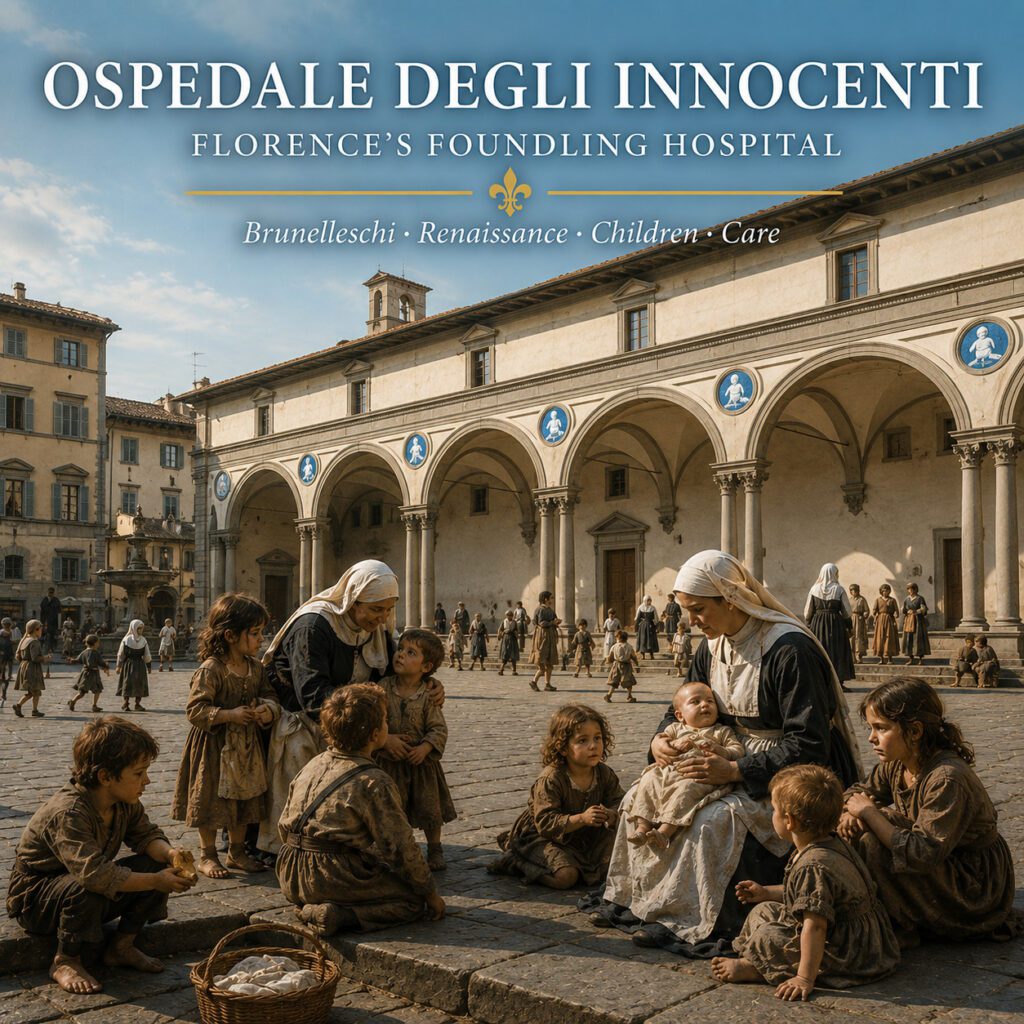
Few buildings unite Renaissance architecture and human compassion as powerfully as the Ospedale degli Innocenti. Designed by Filippo Brunelleschi and begun in 1419, the Ospedale degli Innocenti Florence was created to receive and care for abandoned children. Its elegant loggia on Piazza della Santissima Annunziata became one of the defining works of early Renaissance architecture.
Today, the historic complex can be explored through the Museo degli Innocenti. Behind Brunelleschi’s harmonious façade lies a much deeper story involving abandoned infants, Florentine guilds, wet nurses, education and centuries of organised care for children.
Construction began: 1419
Architect: Filippo Brunelleschi
Patron: Arte della Seta, the Silk Guild
First child received: 1445
Original purpose: Care of abandoned children
Location: Piazza della Santissima Annunziata, Florence
Today: Istituto degli Innocenti and Museo degli Innocenti
Why it matters: Renaissance architecture combined with more than six centuries of organised care for children
The Innocenti is one of the key institutions in our Historic Hospitals of Florence – Complete Guide.
What Was the Ospedale degli Innocenti?
The word ospedale can be misleading for modern visitors. The Innocenti was not founded primarily as a hospital for sick patients in the contemporary sense. Instead, it was an institution created to receive, protect and raise abandoned children.
In medieval and Renaissance Italy, an ospedale could provide many forms of assistance. Such institutions might care for the sick, shelter pilgrims, help the poor or protect children whose families could no longer support them.
The Innocenti became one of Florence’s most important charitable institutions. Its history therefore belongs not only to architecture but also to the history of childhood, poverty and social welfare.
The historic word ospedale had a broader meaning than the modern English word “hospital”. The Ospedale degli Innocenti was primarily an institution for abandoned children rather than a hospital for the sick.
Why Florence Needed an Institution for Abandoned Children
Infant abandonment was a serious social problem in medieval and Renaissance cities. Poverty, illness, illegitimacy and the death or absence of parents could leave families unable to care for a newborn child.
Before specialised institutions developed, abandoned infants might be left at churches, monasteries or charitable foundations. Their chances of survival could be poor.
Creating an institution specifically dedicated to children represented a more organised response. Florence possessed the wealth, religious organisations and powerful guilds necessary to support such an ambitious charitable project.
The Innocenti therefore emerged from the same civic culture that financed churches, public buildings and works of art, but its purpose was explicitly social.
The Arte della Seta and the Foundation of the Innocenti
The powerful Arte della Seta, Florence’s Silk Guild, played a central role in establishing and administering the Innocenti.
Florentine guilds did far more than regulate trades. They participated in politics, supported religious institutions, commissioned works of art and financed charitable projects.
The decision to create a purpose-built institution for abandoned children was therefore both charitable and civic. Florence was providing care while also expressing an ideal of an organised and responsible urban society.
This social role of the guilds also belongs to the wider history explored in our Medieval Republic of Florence – Guilds, Power and Civic Life.
Florence’s guilds helped shape much of the city visitors see today. Their patronage extended beyond churches and artworks to institutions providing practical assistance to vulnerable members of society.
Brunelleschi and the Birth of Renaissance Architecture
In 1419, Filippo Brunelleschi was commissioned to design the new institution. The project became one of the landmarks in the development of Renaissance architecture.
Brunelleschi moved away from the visual complexity associated with much late medieval architecture. Instead, he created a design based on clear geometry, repeated forms and carefully controlled proportions.
The famous loggia facing Piazza della Santissima Annunziata uses rounded arches supported by slender columns. Pale wall surfaces contrast with grey pietra serena, making the underlying architectural structure particularly easy to read.
The result appears remarkably calm. Each element relates logically to the next, creating the balance and mathematical order that became fundamental to Renaissance architecture.
Stand beneath the loggia and look along the sequence of columns and arches. Brunelleschi’s repeated proportions make the architecture feel almost rhythmic, demonstrating how geometry could create visual harmony.
An Institution Designed for Children
The importance of the Innocenti extends far beyond its famous façade. Brunelleschi was designing an institution intended to function as a community for children, caregivers and administrators.
Courtyards, living areas, service spaces and religious environments formed part of a complex organised around everyday needs. Architecture therefore served a practical social purpose.
This makes the Innocenti particularly significant. One of the foundational works of Renaissance architecture was not created for a Medici ruler or private palace but for vulnerable children.
The First Child: Agata Smeralda
The Innocenti began receiving abandoned children in 1445. The first recorded infant arrived on 5 February and was given the name Agata Smeralda.
Her name survived because the institution maintained extensive records of the children entrusted to its care. Over the centuries, these archives accumulated thousands of individual stories.
The records transform the history of the Innocenti from an abstract story of charity into something deeply personal. Behind the harmonious architecture were real children whose lives began under difficult circumstances.
Agata Smeralda, received in February 1445, is remembered as the first child admitted to the Innocenti. Her name remains one of the most moving human connections with the institution’s earliest history.
How Children Were Left at the Innocenti
In the earliest period, infants could be left anonymously at the institution. A basin beneath the external loggia provided a place where a child could be entrusted to the hospital without requiring the parent to reveal their identity.
Later, a smaller opening known as the finestra ferrata, or barred window, was used for abandoned babies. Such arrangements attempted to preserve anonymity while protecting the child.
Parents sometimes left small objects with an infant. A medal, coin, piece of cloth, religious image or other token might be divided into two parts, with one half remaining with the child.
These objects could preserve a fragile connection between parent and child and, in some cases, provide a means of identification if circumstances later allowed the family to reclaim the child.
The identification tokens preserved by the Innocenti are among its most poignant historical objects. Small and ordinary in themselves, they represent the hope that separation between parent and child might not be permanent.
Wet Nurses and a Network Beyond Florence
Caring for large numbers of infants required an extensive network of wet nurses. Many babies were therefore entrusted to women living outside the institution, often in the countryside surrounding Florence.
The children could spend their earliest years with these families before returning to the Innocenti. As a result, the institution’s system of care extended far beyond Piazza della Santissima Annunziata.
Wet nursing was essential because safe alternatives to breast milk did not exist. The health and survival of an infant could depend heavily on the availability and quality of this care.
The history of the Innocenti therefore reveals the largely invisible labour of generations of women whose work was fundamental to the institution.
Growing Up at the Innocenti
The responsibilities of the institution did not end when an infant survived the first vulnerable years of life. Children required food, clothing, religious instruction, education and preparation for adulthood.
Boys and girls followed different paths according to the expectations of their time. Some learned practical skills or trades, while others were prepared for domestic work, marriage or religious life.
The Innocenti therefore became much more than a place of emergency refuge. It created a structured environment intended to accompany children through different stages of their lives.
Ideas about childhood differed greatly from those of today. Nevertheless, the Innocenti represented an important attempt to provide abandoned children with long-term care rather than simply temporary shelter.
The Famous Babies by Andrea della Robbia
Among the most recognisable features of the façade are the glazed terracotta medallions depicting swaddled infants.
These works are associated with Andrea della Robbia and were added after Brunelleschi’s original architectural design.
The blue-and-white medallions fit so naturally into the spandrels between the arches that they have become inseparable from the visual identity of the Innocenti.
The image of the swaddled child immediately communicates the purpose of the institution. Over time, it became one of Florence’s most recognisable symbols of care for children.
The medallions also demonstrate the characteristic Florentine relationship between art and social institutions. Even a building devoted to charity could become a setting for works of exceptional artistic quality.
Art Inside the Ospedale degli Innocenti
The artistic heritage of the Ospedale degli Innocenti Florence extends far beyond its famous façade.
Religious paintings and other artworks formed part of the institution’s life and reflected both devotion and patronage. Art could serve religious and educational purposes while also expressing the prestige of patrons and administrators.
The Innocenti therefore provides another example of how Renaissance art permeated institutions far beyond princely courts and private palaces.
Its collections also make the Museo degli Innocenti much more than a museum of social history. Architecture, artworks and individual lives are presented as parts of the same institutional story.
Piazza della Santissima Annunziata
The setting of the Innocenti is almost as important as the building itself. Piazza della Santissima Annunziata is one of Florence’s most harmonious urban spaces.
Brunelleschi’s loggia established an architectural language that later buildings around the square would echo. Repeated arcades eventually created a remarkable sense of visual unity.
The Basilica della Santissima Annunziata occupies the northern side of the piazza, while the equestrian monument to Ferdinando I de’ Medici stands near its centre.
For visitors, the square provides an excellent place to appreciate how a single Renaissance building could influence the development of an entire urban space.
Do not simply photograph the façade and leave. Walk across Piazza della Santissima Annunziata and look back towards the Innocenti. From a distance, Brunelleschi’s rhythm of arches and columns becomes much easier to appreciate.
The Museo degli Innocenti
Today, visitors can explore the history of the institution through the Museo degli Innocenti.
The museum brings together architecture, art, archival material and personal stories of children who lived under the institution’s care.
This combination makes it very different from a conventional Florentine art museum. Paintings and sculptures appear alongside evidence of everyday lives, allowing visitors to understand both the cultural importance and the human purpose of the building.
The museum also provides access to spaces within the historic complex and helps explain how the institution changed over the centuries.
The Museo degli Innocenti is located at Piazza della Santissima Annunziata 13. Opening hours, exhibitions and access arrangements can change, so check current information before visiting.
The Innocenti Archives and the Stories of Children
One of the institution’s greatest treasures is not an artwork but its extraordinary historical archive.
Centuries of records document children admitted to the Innocenti and the administration of their care. Names, dates, payments to wet nurses, identifying objects and other details allow historians to reconstruct aspects of childhood rarely visible in traditional historical sources.
These records are particularly valuable because most of the children involved came from families that left little other written evidence.
The archive therefore preserves lives that might otherwise have disappeared almost entirely from Florentine history. For this reason, the Innocenti is important not only to architectural historians but also to scholars studying families, women, childhood, poverty and social welfare.
From Renaissance Foundling Hospital to Modern Institution
The Innocenti survived because it continually adapted.
Florence changed from a republic to a ducal and grand-ducal capital, later became part of unified Italy and eventually developed modern systems of social welfare.
Ideas about abandonment, adoption, childhood and institutional care also changed profoundly. The original foundling hospital therefore evolved into an organisation with broader responsibilities relating to children and families.
Today, the Istituto degli Innocenti continues to work in the field of childhood and adolescence. This gives the historic complex an important continuity: the methods have changed with society, but children remain at the centre of the institution.
The Innocenti is not simply a Renaissance monument. The institution continues to work on issues concerning children and families, extending a tradition that began more than six centuries ago.
From the Innocenti to Modern Children’s Healthcare
The history of the Innocenti also provides an interesting contrast with modern paediatric institutions in Florence.
Its original mission centred on abandonment and social care rather than specialised medical treatment. Centuries later, institutions such as the Ospedale Pediatrico Meyer emerged from a very different understanding of childhood, in which children increasingly received medical care specifically adapted to their needs.
Together, the two institutions illustrate a much longer Florentine history of responsibility towards children, from Renaissance charitable welfare to modern paediatric medicine.
The comparison is especially useful because it shows how ideas of care evolved rather than simply replacing one institution with another.
The Innocenti and Florence’s Wider Tradition of Care
The Ospedale degli Innocenti did not exist in isolation.
Nearby Santa Maria Nuova had provided organised care for sick patients since the thirteenth century, while the Misericordia di Firenze developed a long tradition of voluntary assistance and patient transport.
The Innocenti added another form of care to this network: long-term protection and support for children.
Together, these institutions demonstrate that Florence’s social history cannot be separated from its religious confraternities, guilds, charitable foundations and civic organisations.
How to Include the Innocenti in a Florence Walk
The Innocenti is easy to combine with other major sights. Piazza della Santissima Annunziata lies only a short walk north of the Duomo.
The Galleria dell’Accademia is nearby, making the museum a particularly convenient addition for visitors already planning to see Michelangelo’s David.
Santa Maria Nuova is also within walking distance. A route connecting the two institutions offers an unusual way to explore Florence by focusing on the places through which Florentines cared for sick and vulnerable people.
Combine Santa Maria Nuova with the Innocenti and the nearby Accademia. The route brings together Renaissance art and architecture with two very different chapters in Florence’s history of care.
Frequently Asked Questions About the Ospedale degli Innocenti
What was the Ospedale degli Innocenti?
The Innocenti was founded to receive and care for abandoned children. It was not primarily a hospital for sick patients in the modern sense.
Who designed the Ospedale degli Innocenti?
Filippo Brunelleschi designed the famous building, with construction beginning in 1419. Its loggia became one of the foundational works of early Renaissance architecture.
Who financed the Innocenti?
The powerful Arte della Seta, Florence’s Silk Guild, played the central role in establishing and administering the institution.
Who was Agata Smeralda?
Agata Smeralda was the first recorded child received by the Innocenti in February 1445.
What are the babies on the façade?
The glazed terracotta medallions depict swaddled infants and are associated with Andrea della Robbia. They were added after Brunelleschi’s original design and became one of the institution’s most recognisable symbols.
Can you visit the Ospedale degli Innocenti?
Yes. The Museo degli Innocenti allows visitors to explore the architecture, artworks, archives and social history of the institution.
What does the Istituto degli Innocenti do today?
The institution continues to work on issues concerning children, adolescents and families, maintaining an important connection with its centuries-old mission.
Why the Ospedale degli Innocenti Is Worth Visiting
The Ospedale degli Innocenti Florence is worth visiting because its importance operates on several levels at once. Architecturally, Brunelleschi’s loggia is one of the foundational works of the Renaissance. Socially, the institution preserves more than six centuries of history relating to abandoned children and organised care.
The personal stories make the building particularly moving. Agata Smeralda, the identification tokens left with infants and the records of wet nurses remind us that behind the harmonious architecture were thousands of individual lives.
The Innocenti also reveals something essential about Florence itself. Renaissance culture was not expressed only through magnificent churches and private palaces. Architecture, art and civic wealth could also be used to create institutions intended to protect society’s most vulnerable children.
That combination of beauty, history and humanity makes the Innocenti one of the most rewarding places for understanding a less familiar side of Florence.
The Innocenti demonstrates that some of Florence’s greatest Renaissance architecture was created not for political power or private wealth, but for the care of children.
Further Reading on Firenze Casa
Continue exploring Florence’s long history of healthcare, charity and social responsibility:
- Historic Hospitals of Florence – Complete Guide
- Santa Maria Nuova – Florence’s Historic Hospital
- Misericordia di Firenze – Centuries of Caring for Florence
- San Giovanni di Dio – Florence’s Historic Vespucci Hospital
- Ospedale Pediatrico Meyer – The History of Florence’s Children’s Hospital
- The Medieval Republic of Florence – Guilds, Power and Civic Life
- History of Florence – Complete Guide
References
- Istituto degli Innocenti – History of the Institute
- Museo degli Innocenti – Museum, Collections and Visitor Information
- Archivio Storico dell’Istituto degli Innocenti – Historical Records and Documentation
- Encyclopaedia Britannica – Filippo Brunelleschi
- Treccani – Filippo Brunelleschi and Renaissance Architecture
- Gallerie degli Uffizi – Andrea della Robbia and Florentine Glazed Terracotta
- Comune di Firenze – Piazza della Santissima Annunziata and Florentine Cultural Heritage

