
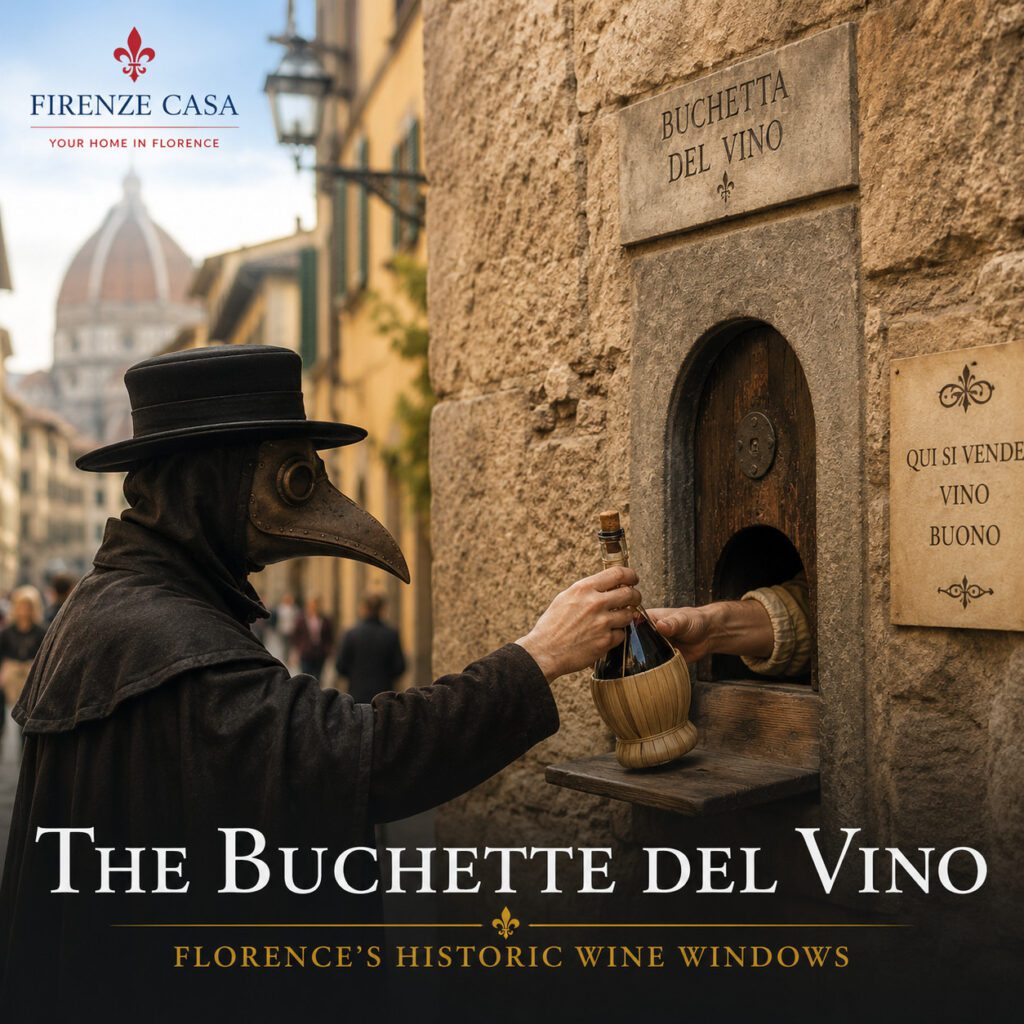
The buchette del vino in Florence are among the city’s smallest and most distinctive reminders of everyday life in the past. Set into the stone façades of historic palaces, these little openings once allowed Florentine families to sell wine from their Tuscan estates directly to customers standing in the street.
At first glance, they can look like tiny doors, niches or decorative details. Yet behind their modest appearance lies a fascinating story of vineyards, noble families, commerce, architecture and changing social habits. Today, some historic wine windows have even returned to use, connecting a centuries-old Florentine tradition with modern city life.
Italian name: Buchette del vino
Meaning: Small wine windows or wine openings
Main period: Particularly widespread from the late sixteenth century onwards
Original purpose: Direct sale of wine from private palaces
Connection: Florentine families, Tuscan estates and urban commerce
Surviving examples: Around 170 in the municipality of Florence
Today: Most are historic features, while a small number have returned to use
Best for: Discovering Florence through small architectural details
What Are the Buchette del Vino?
The Italian expression buchette del vino can be translated as “little wine holes” or, more elegantly, “wine windows”. They are small openings set into the ground-floor walls of historic Florentine palaces, usually at a convenient height for someone standing in the street.
Many have the appearance of miniature doorways or tabernacles. Their size was practical: large enough for a traditional flask of wine to pass through but small enough to preserve the security and privacy of the residence. A typical opening was approximately 23 centimetres wide and 36 centimetres high.
Behind the opening, a servant or employee could receive payment and hand wine to the customer. The buyer remained outside, so the transaction required neither a conventional shop nor entry into the family’s private palace.
When walking through Florence, look at palace walls around waist or chest height. A small arched opening with a wooden or metal hatch may be a centuries-old wine window. Once you recognise their characteristic shape, you will start noticing them throughout the historic centre.
How the Wine Windows Began
The oldest surviving buchette appear to date mainly from the final decades of the sixteenth century. Their development was closely connected with Florence’s wealthy landowning families, many of whom possessed both prestigious residences in the city and agricultural estates in the Tuscan countryside.
Those estates produced wine, olive oil, grain and other agricultural goods. Wine could be transported into Florence and sold directly from the family’s urban residence, creating a remarkably efficient connection between countryside and city.
The system also reveals an aspect of Florentine wealth that can easily be overlooked. Banking, textiles and international commerce were enormously important, but land and agricultural production also formed part of the economic world of many of Florence’s great historic families.
Why Florentine Families Sold Wine from Their Palaces
Successful Florentine merchants and bankers frequently invested their wealth in agricultural land. Owning estates outside the city provided income and food supplies while also becoming an important expression of social status.
Wine presented a particularly useful commercial opportunity. Direct sales allowed landowners to sell their own production without transforming the ground floor of an elegant family residence into a conventional shop or tavern.
A customer simply approached the window and requested wine. A servant inside handled the transaction, while the private life of the palazzo remained separated from the commercial activity taking place in the street.
This relationship between family wealth, land and wine can still be recognised in names associated with Florence today. Historic families such as the Antinori and Frescobaldi combined urban prestige with agricultural estates and viticulture.
A buchetta del vino connected two very different sides of Florence. Behind the wall stood the private residence of a wealthy family; outside waited ordinary customers purchasing wine for everyday use. A tiny opening allowed aristocratic Florence and street life to meet without either entering the other’s space.
Who Used Florence’s Wine Windows?
The customers were not primarily members of Florence’s wealthy elite. Neighbours, craftsmen, workers and other residents could purchase wine directly from the household, often bringing their own flask or container.
This was everyday commerce rather than the refined wine-tasting culture we associate with Tuscany today. Wine formed an ordinary part of Florentine life, and purchasing it through a wine window could be as practical as buying other household provisions.
That everyday function is precisely what makes the surviving windows so interesting. A monumental palace may tell us about wealth and status, while a tiny opening in the same façade reveals how that household interacted economically with the neighbourhood around it.
The Architecture of the Buchette del Vino
Most wine windows are remarkably modest. The typical form consists of a small opening framed by stone and historically protected by a wooden or metal hatch. Some resemble miniature arched doorways, while others are rectangular or more elaborately framed.
Their design was primarily functional. The opening needed to accommodate a wine flask while remaining small enough to protect the building. Yet Florentine attention to architecture meant that some examples received elegant stone surrounds that harmonised with the façade of the palace.
The resemblance to a tiny religious tabernacle can be striking. In this case, however, the opening had nothing to do with devotion: it was a miniature point of sale embedded directly into the architecture.
The wine windows were functional rather than monumental. Their small scale is exactly what makes them such fascinating evidence of everyday Florentine history. Visitors can walk within centimetres of one without ever noticing it.
Buchette del Vino During Times of Plague
The wine windows acquired another practical advantage during periods of epidemic disease. Florence experienced repeated outbreaks of plague, including serious epidemics during the seventeenth century.
The buchette were not invented because of the plague. They already existed as commercial openings. Their design, however, allowed wine to pass from seller to customer while the two remained physically separated.
People did not understand infectious disease in the modern microbiological sense, but they had long recognised that close contact could be dangerous during epidemics. The architecture of the wine window therefore provided an unexpectedly useful barrier.
Historical descriptions also indicate attempts to handle payment while reducing direct contact. A system created for commercial convenience could therefore adapt to extraordinary circumstances.
The buchette del vino were primarily commercial structures. Their usefulness during epidemics was a secondary advantage of a system that already allowed goods and payment to pass through a physical barrier.
Where to Find Buchette del Vino in Florence
Around 170 historic wine windows are documented within the municipality of Florence. Some remain beautifully preserved, others have been altered or sealed, and a few are so inconspicuous that they almost disappear into the surrounding masonry.
Examples survive throughout the historic centre and Oltrarno. They can be found around Via Santo Spirito, Via delle Belle Donne, Borgo degli Albizi, Via della Colonna and numerous other streets on both sides of the Arno.
Several particularly interesting examples are associated with important historic buildings. A wine window survives at the rear of Palazzo Antinori on Via del Trebbio, another can be seen at Palazzo Pazzi Quaratesi on Via del Proconsolo, and an example survives at the rear of Palazzo Medici Riccardi on Via Ginori.
Via delle Belle Donne is particularly interesting because the same street preserves another form of Florence’s hidden urban history in its unusual name. The Oltrarno is equally rewarding because historic palaces, workshops and residential streets remain closely intertwined.
Do not try to find every wine window during a single walk. Their real charm comes from discovering them unexpectedly. Walking through Florence becomes much more interesting once old façades are no longer simply walls but surfaces filled with clues to the city’s past.
Some Wine Windows Are Almost Invisible
Not every surviving buchetta looks like the beautifully restored examples often seen in photographs. Some have lost their original doors, others have been incorporated into later alterations and a number are visible only as outlines in the masonry.
This makes the precise number partly dependent on how surviving and altered examples are classified. The official Florentine tourism service currently refers to approximately 170 within the municipality.
More important than the exact number is their extraordinary concentration. Wine windows were not an isolated curiosity belonging to one or two families. They were a recognisable feature of Florentine commercial life for generations.
From Forgotten Openings to Florentine Icons
For generations, many wine windows attracted relatively little attention. Some were sealed or altered, while others remained unnoticed in palace walls. Research and preservation initiatives gradually changed this situation by documenting surviving examples and explaining their original function.
Today, the buchette have become one of the most recognisable details of Florence’s lesser-known history. What once appeared to be an insignificant hole in a wall can now be understood as evidence of agricultural estates, noble families, commerce and everyday life.
This rediscovery places them naturally among the Hidden Stories of Florence. Like unusual street names, vanished buildings and traces of forgotten trades, the wine windows reveal a city that becomes visible only when we know what to look for.
The Modern Revival of Florence’s Wine Windows
The story did not end when traditional direct wine sales disappeared. In recent years, a small number of historic windows have returned to active use. Some establishments now serve wine, cocktails, coffee, gelato or other products through restored openings.
The basic gesture is remarkably similar to the historical transaction: something passes directly from inside the building to a person standing in the street. The social context, however, has changed completely. Historically, customers generally bought wine for household consumption; today, using a restored buchetta is more likely to form part of an aperitivo or an evening walk through Florence.
The revival attracted particular international attention during the COVID-19 pandemic. Once again, the physical separation provided by the little openings suddenly appeared remarkably practical.
The original wine windows served practical everyday commerce. Their modern revival preserves the same simple gesture – passing something through a small opening in a palace wall – while giving it an entirely new social meaning.
From Wine Windows to the Florentine Aperitivo
The modern revival creates an appealing connection between historic wine commerce and the contemporary Italian ritual of aperitivo. A glass served through a centuries-old opening brings two very different periods of Florentine social life briefly together.
Aperitivo is not simply about drinking before dinner. It is a social pause between the working day and the evening, usually accompanied by conversation and something small to eat. Our guide to the Florentine aperitivo tradition explores this culture in greater detail.
For a broader introduction to the city’s drinking traditions, see The Drinks of Florence – Wine, Cocktails and Tuscan Traditions.
Wine, Tuscany and the Florentine Families
The buchette del vino reveal how closely Florence has always been connected with the surrounding countryside. Wealth created in banking, commerce and manufacturing was frequently invested in rural estates, while those estates supplied the city with agricultural products.
Some of the historic names associated with Florentine wine remain familiar today. The Antinori family’s long relationship with Tuscan viticulture continues at Antinori nel Chianti Classico, where wine, family history, architecture and landscape remain closely connected.
The Frescobaldi provide another striking example. Their history combines medieval banking and international commerce with rural estates and centuries of viticulture. Our article on the Frescobaldi family follows this remarkable development.
For the wider regional context, our guide to Chianti wine explores the wine region south of Florence and the importance of Sangiovese to Tuscan wine culture.
A Tiny Window into Florence’s Economy
The buchette are particularly revealing because they connect several parts of the Florentine economy within a single architectural feature. Behind them stood families whose fortunes might originate in banking, textiles or international trade. Beyond the city walls lay agricultural estates producing wine. In the street stood local customers purchasing that wine.
The little opening in the wall connected all three worlds. It allowed rural production to reach an urban market while maintaining the distinction between a prestigious private residence and ordinary commercial activity.
This is why the wine windows deserve to be understood as more than picturesque curiosities. Their architecture is small, but the economic story behind them is surprisingly large.
Wine Windows and Florence’s Hidden Everyday History
The buchette del vino fit perfectly into the hidden history of Florence because they occupy almost no space yet tell an unusually rich story. They connect vineyards with palaces, powerful families with ordinary customers and architecture with everyday commerce.
Nothing about these little openings competes with the grandeur of the Duomo, Palazzo Vecchio or the Uffizi. That contrast is precisely what makes them interesting. Monumental Florence tells us how the city wanted to represent itself; details such as the wine windows tell us something about how people actually lived.
They also belong to a wider family of tiny architectural clues. Florence preserves small openings associated with very different functions, including the charitable openings used to assist the Poveri Vergognosi. At first sight the principle appears similar, but their purposes could hardly have been more different: one belonged to commerce, the other to discreet charity.
The wine windows tell a story of estates, commerce and wealthy Florentine families. Florence’s historic charity openings tell almost the opposite story: how assistance could reach people who had fallen into poverty without publicly exposing their circumstances. Tiny openings in old walls can reveal very different sides of the same city.
A Slower Way to Discover Florence
Wine windows reward visitors who explore Florence without concentrating exclusively on famous monuments. Walk slowly through streets lined with old palazzi and pay attention to stonework, doorways, coats of arms and small architectural details.
Once you recognise the characteristic form of a buchetta, you begin noticing them throughout the city. Each discovery creates a small connection between the modern street and the people who stood at the same opening centuries ago.
Some windows remain silent traces of the past, while others have acquired a new life. Together, they demonstrate how many layers of Florence can coexist along a single street.
Why the Buchette del Vino Are Worth Discovering
The survival of the buchette del vino gives Florence physical evidence of an everyday commercial practice that endured for centuries. They connect noble palaces with Tuscan vineyards, wealthy landowners with ordinary customers and architectural history with daily life.
Their small scale makes that connection especially powerful. These openings were never intended as monuments or tourist attractions. They existed because people needed a practical way to buy and sell wine.
That practical purpose also explains why their modern revival feels surprisingly natural. When a glass or another product once again passes through a centuries-old opening, the buchetta stops being merely an architectural relic.
For a moment, historic and modern Florence meet through one of the smallest doors in the city.
Interesting Facts About the Buchette del Vino
- The oldest surviving wine windows appear to date mainly from the late sixteenth century.
- They allowed wine produced on private estates to be sold directly from Florentine palaces.
- Many noble Florentine families combined urban wealth with agricultural estates outside the city.
- A typical wine window was large enough for a traditional wine flask to pass through.
- The official Florentine tourism service describes a characteristic size of approximately 23 × 36 centimetres.
- The windows were not invented because of plague, although their design proved useful during epidemics.
- Around 170 examples are documented within the municipality of Florence.
- Examples survive at buildings associated with famous families, including Antinori, Pazzi and Medici.
- Many historic buchette are sealed or no longer used commercially.
- A small number have returned to active use.
- Modern establishments may serve wine, cocktails, coffee, gelato or other products through restored openings.
- Many examples remain surprisingly easy to miss unless you know what to look for.
Frequently Asked Questions About the Buchette del Vino
What are the buchette del vino?
The buchette del vino are small historic openings in the walls of Florentine palaces. They were used to sell wine from family estates directly to customers standing in the street.
When did Florence’s wine windows appear?
The oldest surviving examples appear to date mainly from the final decades of the sixteenth century. The practice subsequently became a distinctive feature of Florentine wine commerce.
Why did noble families sell wine from their palaces?
Many Florentine families owned agricultural estates that produced wine. Direct sales allowed them to bring this production into the city and sell it without creating a conventional shop within their private residence.
Were the wine windows invented during the plague?
No. They already existed as commercial openings. Their design, however, allowed sellers and customers to remain physically separated and therefore proved useful during periods of epidemic disease.
How many wine windows survive in Florence?
Current official Florentine tourism information refers to approximately 170 examples within the municipality of Florence. Their state of preservation varies considerably.
Where can you see buchette del vino in Florence?
Examples survive throughout the historic centre and Oltrarno, including Via Santo Spirito, Via delle Belle Donne, Borgo degli Albizi and Via della Colonna. Historic examples can also be seen at buildings including Palazzo Antinori, Palazzo Pazzi Quaratesi and Palazzo Medici Riccardi.
Are any wine windows still in use?
Yes. A small number of restored historic windows have returned to active use and may serve wine or other products. Most surviving examples, however, remain historic architectural features.
Can you buy wine from every buchetta del vino?
No. The overwhelming majority are no longer functioning sales points. Some belong to private buildings, while others have been sealed or preserved simply as historic features.
Why are the wine windows important?
They provide unusually direct evidence of everyday commerce in historic Florence and reveal the close relationship between noble families, urban palaces, Tuscan vineyards and ordinary street life.
Further Reading on Firenze Casa
- Hidden Stories of Florence – Complete Guide
- Poveri Vergognosi – Florence’s Secret Charity Holes
- Via delle Belle Donne – A Curious Florence Street
- The Most Famous Florentine Families in History
- The Frescobaldi Family – Florence’s Banking and Wine Dynasty
- The Drinks of Florence – Wine, Cocktails and Tuscan Traditions
- Chianti Wine – The Wine That Shaped Tuscany
- Florentine Aperitivo Tradition – Vinsanto & Vermouth
- Vin Santo – Tuscany’s Traditional Dessert Wine
- Antinori nel Chianti Classico – Architecture, Heritage & Tasting in Tuscany
References
- Associazione Buchette del Vino – historical research and documentation of Florence’s wine windows.
- Comune di Firenze – documentation and Open Data concerning the buchette del vino.
- Feel Florence – Wine Windows, official Florence tourism information.
- Visit Tuscany – historical and cultural resources concerning the wine windows of Florence.
- Corsini, Diletta and Giordano, Lucrezia – studies and documentation of the buchette del vino in Florence and Tuscany.
- Historical studies on wine production, noble estates and direct wine sales in early modern Florence.

