
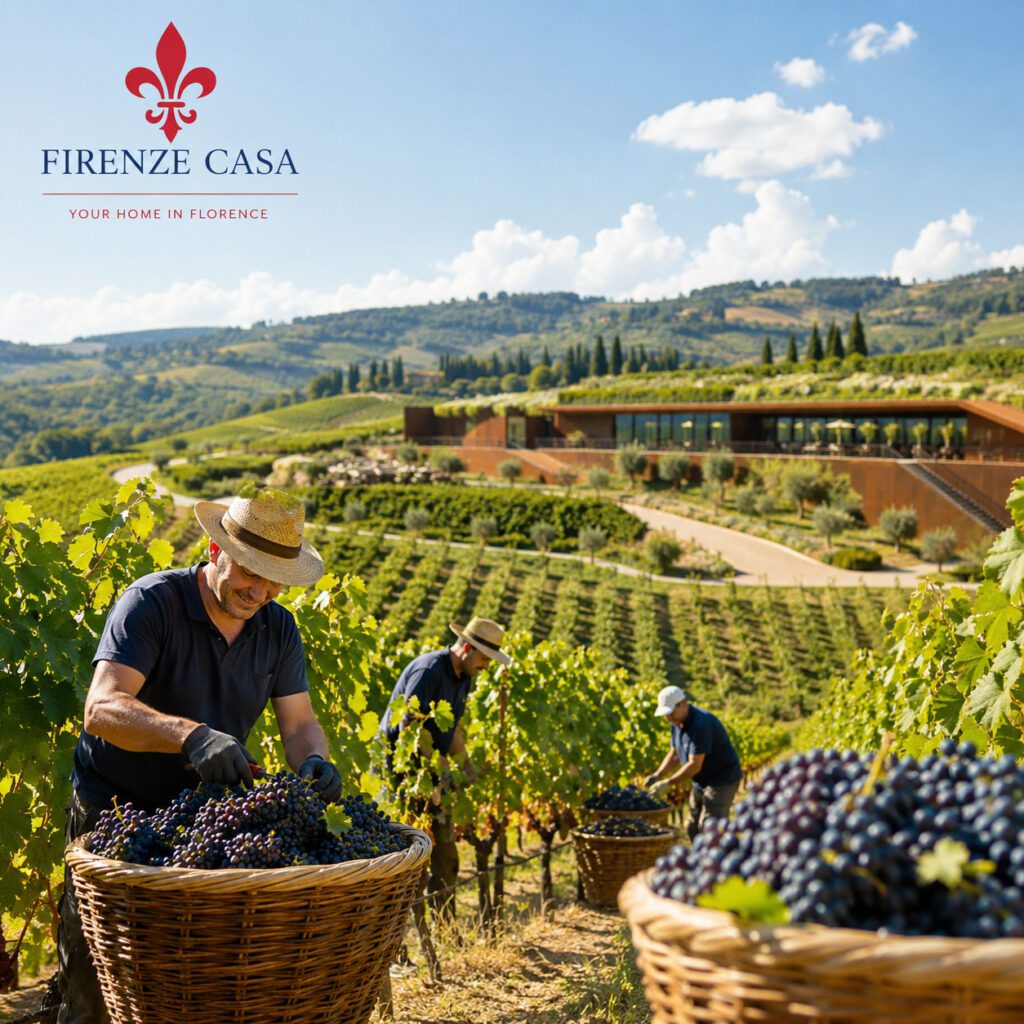
Few wineries combine architecture, landscape and wine as impressively as Antinori nel Chianti Classico. Located near Bargino, about 25 kilometres south of Florence, the estate represents the modern face of a family whose documented wine tradition reaches back to 1385.
Opened in 2012, the winery is largely concealed within the Tuscan hillside rather than standing above it. Underground cellars, sweeping spiral staircases, contemporary art, vineyards and a panoramic restaurant create an experience extending far beyond wine production. To discover the family behind the project, see our guide to The Antinori Family: Wine, Tradition and Renaissance Influence.
Location: Bargino, south of Florence
Opened: 2012
Architects: Archea Associati
Wine region: Chianti Classico
Highlights: Architecture, cellars, tastings, contemporary art and Rinuccio 1180
From Florence: About 25 km
Historical Timeline of Antinori nel Chianti Classico
| Year | Milestone |
|---|---|
| 1385 | Giovanni di Piero Antinori joins the Florentine Winemakers’ Guild, marking the documented beginning of the family’s wine tradition. |
| 1970s | Tignanello becomes one of the influential wines associated with the emergence of the Super Tuscan movement. |
| Early 2000s | The Antinori family develops plans for a new flagship winery in Chianti Classico. |
| 2004 | Construction begins near Bargino. |
| 2012 | Antinori nel Chianti Classico opens. |
| 2022 | The estate is named World’s Best Vineyard. |
| Today | The winery welcomes visitors from around the world as one of Tuscany’s best-known contemporary wine destinations. |
Why Was the Winery Built?
After centuries of winemaking, the Antinori family already possessed several prestigious estates across Tuscany. The new winery was therefore conceived as more than another production facility. It was intended to bring modern winemaking, family history, architecture and hospitality together in a single flagship location.
Contemporary wine production requires precise temperature control, efficient logistics and carefully organised movement of grapes and wine. At the same time, the family wanted a place capable of welcoming visitors and communicating its long connection with Tuscany.
Bargino offered an ideal setting within the Chianti Classico landscape. Rather than creating a highly visible monument, however, the project was designed so that the countryside would remain the dominant visual element.
The Vision of Piero Antinori
Piero Antinori was a central figure behind the project and one of the most influential personalities in modern Italian wine. Under his leadership, Antinori combined centuries of family tradition with a willingness to experiment and modernise.
That philosophy had already shaped wines such as Tignanello and Solaia. The new winery translated the same idea into architecture: history should provide a foundation for innovation rather than prevent it.
The result is a building that combines sophisticated production technology with an unusually strong respect for its surroundings. It represents both the continuity of the Antinori family and its vision for future generations.
Architecture Inspired by the Tuscan Landscape
The Florentine architectural practice Archea Associati designed the winery around a deceptively simple idea: the building should become part of the hill rather than compete with it.
Much of the complex therefore sits inside the hillside, while vineyards continue across parts of the roof. From a distance, relatively little of the enormous structure is visible.
Terracotta, exposed concrete, timber and Corten steel connect the contemporary architecture with the colours and textures of the Tuscan landscape. Long horizontal openings frame views of vineyards and hills, while two monumental spiral staircases have become the building’s most recognisable architectural features.
The winery reverses the traditional relationship between architecture and landscape. Instead of placing a monumental building on top of a Tuscan hill, much of the architecture disappears beneath it.
A Winery Hidden Inside the Hills
Placing large parts of the winery underground has practical as well as aesthetic advantages. Production and ageing areas benefit from the naturally stable environment of the hillside, while the landscape above remains largely uninterrupted.
Visitors gradually discover the scale of the complex as they move through courtyards, staircases, production areas and cellars. This contrast between the discreet exterior and expansive interior is one of the most memorable aspects of the visit.
The Gravity-Flow Winemaking Process
The architecture also supports the production process. Grapes enter at higher levels and can move through successive stages of winemaking with the assistance of gravity.
This reduces the need for mechanical pumping and allows grapes and young wine to be handled more gently. Underground spaces also provide naturally favourable conditions for fermentation and ageing.
The building therefore demonstrates how architecture can serve winemaking rather than merely provide an impressive setting for it.
From Vineyard to Bottle
Visits introduce guests to the relationship between vineyards, grape varieties and cellar work. Sangiovese naturally receives particular attention because it forms the foundation of Chianti Classico.
Inside the winery, modern stainless-steel fermentation equipment exists alongside oak barrels and larger wooden casks. The contrast illustrates how contemporary technology and traditional ageing methods can work together.
If you are new to wine tasting, our Tuscan Wine for Beginners – Complete Guide explains Sangiovese, acidity, tannins, aromas and the basic tasting process.
Antinori and Chianti Classico
The winery lies within Chianti Classico, the historic wine territory between Florence and Siena. Sangiovese remains the defining grape of this landscape and gives many of its wines their characteristic combination of red fruit, acidity and tannic structure.
Antinori’s connection with the area extends far beyond the Bargino winery. The family’s long history demonstrates how closely Florentine wealth, rural estates and wine production became intertwined over the centuries.
For a deeper look at the denomination and its history, see Chianti Wine – The Wine That Shaped Tuscany. Another important historic perspective is provided by the Ricasoli family, whose Castello di Brolio estate became closely associated with the development of Chianti.
Art, Design and the Visitor Experience
Antinori nel Chianti Classico was conceived as a cultural destination as well as a working winery. Contemporary artworks appear throughout the complex, while the architecture continually frames the surrounding countryside.
Guided visits combine the history of the Antinori family with explanations of winemaking, architecture and landscape. This broader approach makes the estate interesting even for visitors who are not wine specialists.
Architects, photographers and design enthusiasts now visit alongside wine travellers, making Bargino one of Tuscany’s most distinctive examples of contemporary architecture integrated into a historic agricultural landscape.
Rinuccio 1180: Dining Above the Vineyards
A visit can also include Rinuccio 1180, the estate’s panoramic restaurant. Its name recalls Rinuccio Antinori, one of the family’s early documented ancestors.
The restaurant focuses on Tuscan cuisine and pairs seasonal dishes with wines from Antinori estates. Large windows overlook vineyards and the Chianti hills, reinforcing the connection between food, wine and landscape.
This relationship is central to Tuscan dining culture. Our Florentine and Tuscan Food – Complete Guide provides a broader introduction to the regional dishes and ingredients visitors encounter around Florence.
If you want to combine the winery tour with lunch at Rinuccio 1180, reserve both in advance. This is particularly advisable during weekends and the main travel seasons.
Visiting Antinori nel Chianti Classico
Address: Via Cassia per Siena 133, Località Bargino, 50026 San Casciano Val di Pesa, Florence
Location: Approximately 25 km south of Florence in the Chianti Classico wine region
Recommended visit: Allow around 2–4 hours for a tour, tasting and possible lunch
Best seasons: Spring and autumn are particularly attractive; September and October bring the atmosphere of the grape harvest
Getting there: Travelling by car is generally the most convenient option
Reservations: Guided tours, tastings and restaurant reservations should be arranged in advance
The winery makes an excellent destination for a half-day excursion from Florence and can also form part of a longer exploration of Chianti. Our guide to Chianti from Florence provides ideas for discovering the surrounding countryside.
Interesting Facts About Antinori nel Chianti Classico
- Much of the winery lies beneath the vineyards, allowing the Tuscan landscape to remain visually dominant.
- More than six centuries separate the Antinori family’s documented wine tradition in 1385 from the winery’s opening in 2012.
- The building was designed by the Florentine architectural practice Archea Associati.
- The production areas use gravity to help move grapes and wine through different stages of winemaking.
- The estate combines wine production, architecture, contemporary art, gastronomy and tourism.
- The monumental spiral staircases have become architectural symbols of the winery.
- In 2022, the estate was named World’s Best Vineyard.
Frequently Asked Questions
Can you visit Antinori nel Chianti Classico without booking?
Advance booking is strongly recommended. Tours and tastings can fill quickly, particularly at weekends and during the main travel seasons.
How long does a visit take?
Allow roughly two to four hours for a tour and tasting. Lunch at Rinuccio 1180 can easily extend the visit to half a day.
Is the winery suitable for visitors who are not wine experts?
Yes. Architecture, family history, landscape and contemporary art make the estate interesting even without specialist wine knowledge.
Can visitors buy wine at the estate?
Yes. The estate has a wine shop where visitors can purchase Antinori wines and selected products.
Is Antinori nel Chianti Classico worth visiting without a wine tasting?
Yes. The architecture and its integration into the Tuscan landscape are major attractions in their own right.
How far is Antinori nel Chianti Classico from Florence?
The winery is approximately 25 kilometres south of Florence at Bargino, making it suitable for a half-day or longer excursion.
Why Antinori nel Chianti Classico Is Worth Visiting
Antinori nel Chianti Classico offers something unusual even in a region filled with historic wine estates. Instead of recreating a traditional Tuscan villa or castle, it demonstrates how contemporary architecture can become part of an ancient agricultural landscape.
The experience also connects several themes central to Tuscany: Sangiovese, Chianti Classico, family history, food, architecture and the relationship between Florence and its countryside.
For visitors staying in Florence, it is therefore much more than a winery tour. It is an accessible introduction to how one of Tuscany’s oldest wine families interprets its heritage in the twenty-first century.
Further Reading on Firenze Casa
- The Wines of Tuscany – Complete Guide
- The Antinori Family: Wine, Tradition and Renaissance Influence
- Tuscan Wine for Beginners: The Complete Guide
- Chianti Wine – The Wine That Shaped Tuscany
- The Ricasoli Family: Wine and Chianti
- The Frescobaldi Family: Florence’s Banking and Wine Dynasty
- Florentine and Tuscan Food – Complete Guide
- Chianti from Florence
References
- Marchesi Antinori – Antinori nel Chianti Classico and family history.
- Archea Associati – Antinori Winery Project.
- World’s Best Vineyards.
- Consorzio Vino Chianti Classico.
- Comune di San Casciano in Val di Pesa.
- Najemy, John M. – A History of Florence 1200–1575.
- Brucker, Gene – studies on Renaissance Florence.

