
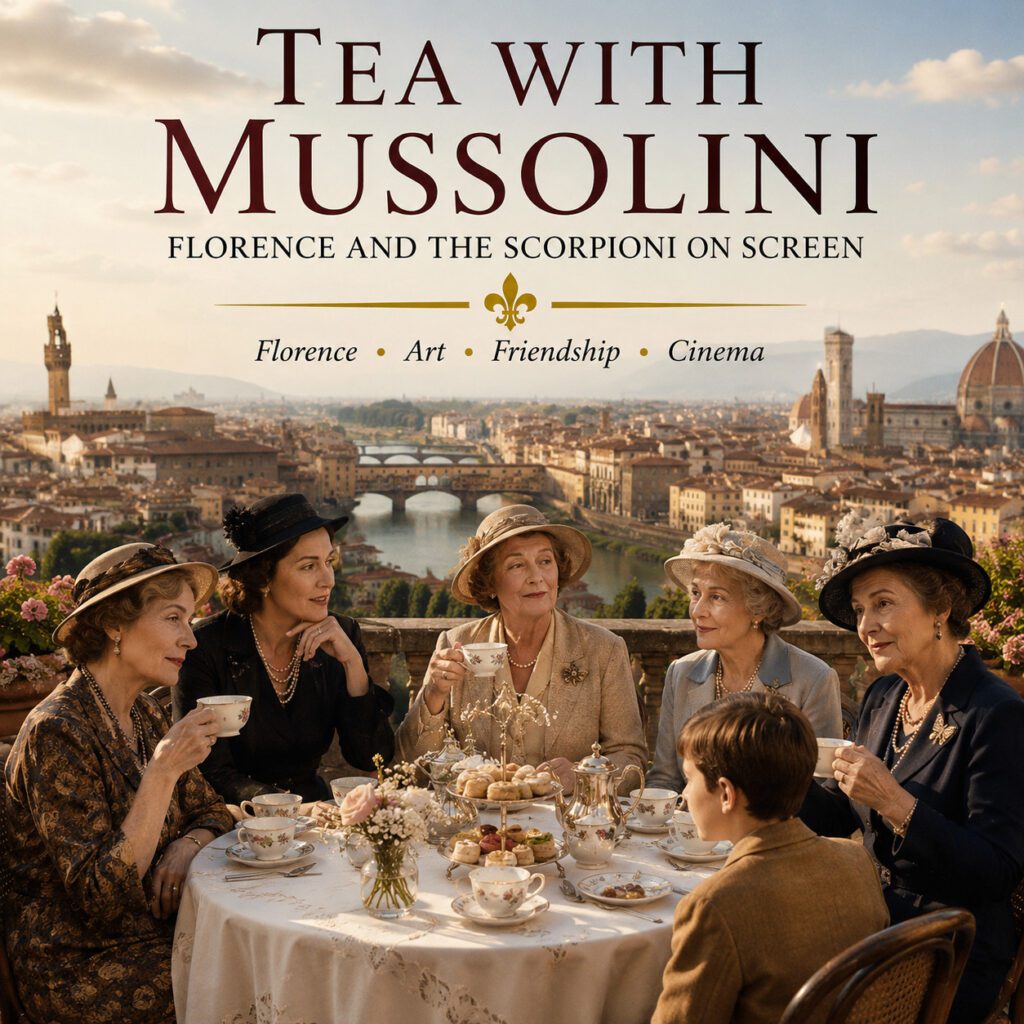
Few films capture Florence’s eccentric international community as affectionately as Tea with Mussolini. The story of Tea with Mussolini Florence combines Franco Zeffirelli’s memories of childhood with the world of British expatriates who made the Tuscan capital their home during the years surrounding the Second World War.
Released in 1999, the film follows young Luca and a remarkable group of predominantly British women known as the Scorpioni. Florence provides much more than an elegant setting: its cafés, churches, art and expatriate culture shape the characters and their understanding of Italy. The film belongs naturally within our Movies Filmed in Florence – Famous Films and Locations, while some of its most memorable Tuscan scenes were created outside the city, particularly in San Gimignano.
Film: Tea with Mussolini
Released: 1999
Director: Franco Zeffirelli
Setting: Florence and Tuscany before and during the Second World War
Main cast: Maggie Smith, Judi Dench, Joan Plowright, Cher and Lily Tomlin
Central theme: British expatriates, art, friendship and wartime Italy
Key places: Florence and San Gimignano
Historical inspiration: Franco Zeffirelli’s childhood and Florence’s foreign community
Tea with Mussolini Florence – A Personal Story
Tea with Mussolini differs from many films set in Florence because Franco Zeffirelli drew extensively on his own childhood memories. The fictional Luca grows up among adults whose personalities, prejudices and loyalties reflect the complicated international society that Zeffirelli encountered as a boy.
The film begins in the Florence of the 1930s, when foreign residents still formed a highly visible part of the city’s cultural life. British women gather for tea, discuss art and politics, visit churches and galleries, and maintain social customs that seem almost immune to events developing around them. Fascism and war eventually make that comfortable world impossible to preserve.
Zeffirelli described Tea with Mussolini as a story rooted in his own youth. Luca reflects aspects of the director’s childhood, although the film combines memory, fictionalisation and historical events rather than presenting a literal autobiography.
Franco Zeffirelli and His Florence
Franco Zeffirelli was born in Florence in 1923 and maintained a profound connection with the city throughout his life. Before becoming internationally known as a director of theatre, opera and cinema, he grew up surrounded by the artistic heritage that later influenced much of his work.
This personal connection gives Tea with Mussolini Florence a different character from films created by visiting directors. Zeffirelli was not simply choosing attractive Renaissance locations. He was reconstructing a world that belonged to his own memory: foreign residents, Florentine families, art lovers, cafés and the tensions of Fascist Italy.
His Florence is affectionate but not entirely nostalgic. The film recognises the beauty and cultivated habits of expatriate society while also showing its insularity and occasional inability to understand the political danger developing around it.
Who Were the Scorpioni?
The Scorpioni form the heart of the film. They are predominantly older British women living in Florence who have developed their own social circle, complete with rituals, friendships, rivalries and strong opinions about Italian culture.
Zeffirelli based this world on foreign women he remembered from his youth rather than presenting the Scorpioni as a formally documented organisation with fixed membership. The film transforms those memories into a colourful ensemble whose members respond very differently to Fascism and war.
Lady Hester Random, played by Maggie Smith, embodies confidence in British social status and diplomacy. Mary Wallace, played by Joan Plowright, provides Luca with affection and stability, while Judi Dench’s Arabella represents an almost boundless devotion to art and Florence.
Florence had attracted a substantial British and Anglo-American community long before the period shown in the film. Writers, collectors, artists and wealthy foreign residents became an important part of Florentine cultural life.
The British Community Behind Tea with Mussolini
The expatriate world portrayed in Tea with Mussolini had deep historical roots. Florence attracted British residents through its art, architecture, climate and social environment. Some stayed for a season, while others established permanent homes in the city or surrounding hills.
By Zeffirelli’s childhood, this international community had developed its own institutions and social networks. Churches, libraries, clubs, pensions and tearooms helped foreigners maintain connections with their home culture while living in Tuscany.
Evidence of this much older international Florence can still be discovered at the Cimitero degli Inglesi, where British writers, American artists, Swiss families and other Protestant residents were buried during the nineteenth century.
Zeffirelli gently satirises the expatriates’ tendency to create their own social world, particularly when the Scorpioni behave as though British manners could protect them from Italian politics. At the same time, their attachment to Florence is genuine: they do not merely consume the city as tourists but regard it as part of their lives.
Florence Cafés and the World of the Scorpioni
Café culture plays an important symbolic role in Tea with Mussolini Florence. Tea represents continuity, ritual and the determination of the British women to preserve their familiar social world even as Italy changes around them.
Florence had a long tradition of cafés frequented by intellectuals, artists, politicians and foreign visitors. Establishments such as Caffè Paszkowski became much more than places to eat or drink: they functioned as meeting points within the city’s cultural and social life.
The film exaggerates this environment for comic effect, but the basic idea is historically plausible. Foreign residents really did create recognisable social worlds within Florence, and cafés formed part of that urban culture.
When exploring central Florence, look beyond the monuments and notice the historic cafés and meeting places. They help explain why expatriate life in Florence developed such a distinctive social character.
Why Art Matters So Much in Tea with Mussolini
For the Scorpioni, art is almost a moral language. Paintings, frescoes, sculpture and architecture represent values that seem more permanent than politics. Judi Dench’s Arabella expresses this devotion most exuberantly, but the entire group treats Florence’s artistic heritage as something worth defending.
This idea reflects Zeffirelli’s own relationship with the city. Florence surrounded him with Renaissance art from childhood, and his later career in opera, theatre and cinema repeatedly demonstrated his fascination with visual beauty and historical settings.
Foreign fascination with Renaissance Florence was by no means confined to Zeffirelli’s fictional characters. English collectors such as Herbert Percy Horne settled in the city and built extraordinary collections; his former home survives today as the Museo Horne.
In Tea with Mussolini, however, art is not simply decorative. It gives the characters a reason to remain emotionally attached to Italy even when the political regime becomes increasingly hostile to them.
Tea with Mussolini and Fascist Florence
The title refers to one of the film’s defining encounters. Lady Hester believes that her social position and contact with Benito Mussolini offer reassurance that British residents in Italy will remain protected. Her confidence reflects both her personality and the dangerous illusion that established social rules will continue to function as politics becomes more extreme.
As relations between Fascist Italy and Britain deteriorate, the position of the expatriates changes dramatically. The women who once moved confidently through Florentine society find themselves increasingly regarded as enemy foreigners.
The shift gives Tea with Mussolini Florence much of its emotional force. A city that had offered culture, friendship and a sense of home becomes part of a country at war with Britain.
Italy entered the Second World War on 10 June 1940 on the side of Germany. British citizens living in Italy suddenly became nationals of an enemy state, fundamentally changing the position of expatriate communities.
Florence Before the Second World War
The Florence shown at the beginning of the film still belongs to the international city that had developed over previous generations. Foreign residents could move between Italian and expatriate social circles while enjoying museums, churches, cafés and private homes.
Yet Fascism had already transformed Italian political life. Benito Mussolini had ruled the country since the 1920s, and the regime increasingly controlled public institutions and political expression. The apparent normality surrounding the Scorpioni therefore exists alongside forces that the women do not always fully understand.
Zeffirelli uses this contrast effectively. Elegant social rituals continue while the political world around them becomes progressively more threatening.
San Gimignano – A Major Tea with Mussolini Film Location
Although Florence lies at the emotional centre of the story, some of the film’s most memorable sequences take place in San Gimignano. The medieval Tuscan town, famous for its surviving towers, provides a visually powerful setting for the wartime section of the film.
The Scorpioni are transferred away from Florence, and San Gimignano becomes central to their experiences during the conflict. Its medieval streets and monumental squares create a very different environment from the sophisticated expatriate world of pre-war Florence.
This distinction is important when exploring Tea with Mussolini filming locations. Not every scene that viewers may remember as part of the film’s Tuscan world was actually shot in Florence. San Gimignano deserves recognition as one of the production’s principal locations in its own right.
Tea with Mussolini is strongly associated with Florence, but San Gimignano plays a major role in the film. The two places create complementary images of Tuscany: cosmopolitan Renaissance Florence and a smaller medieval hill town.
Piazza della Cisterna and Medieval Tuscany on Screen
San Gimignano’s historic centre provides the film with an exceptionally well-preserved medieval setting. Piazza della Cisterna, surrounded by stone buildings and towers, conveys a sense of enclosed community very different from Florence’s broad Renaissance spaces.
Zeffirelli uses this architecture without allowing it to become merely picturesque. Wartime restrictions and uncertainty change the emotional meaning of the beautiful setting. The Scorpioni may still admire art and architecture, but they can no longer experience Tuscany simply as cultured foreign residents.
For visitors interested in the film, San Gimignano therefore makes an excellent day trip from Florence. Walking through its historic centre reveals how effectively Zeffirelli used genuine Tuscan architecture to support the story.
The Scorpioni and the Defence of Art
One of the film’s most memorable themes is the determination to protect cultural heritage. The Scorpioni’s devotion to art becomes more than an eccentric pastime when war threatens the places and objects they love.
Zeffirelli treats this idea with both humour and sincerity. The women can appear theatrical, yet their willingness to defend art gives their eccentricity moral weight. Florence and Tuscany are worth protecting not because they belong exclusively to Italians or foreigners, but because their cultural heritage transcends nationality.
Art functions almost like another character in Tea with Mussolini. It connects the British expatriates with Italy and gives their attachment to Florence and Tuscany a meaning that survives political conflict.
Luca – Zeffirelli’s Alter Ego
Young Luca provides the emotional bridge between the Italian and foreign worlds of the film. His uncertain family situation brings him into contact with the Scorpioni, whose influence helps shape his education and understanding of art. Through him, Zeffirelli transforms personal memory into a broader coming-of-age story.
The women teach Luca languages, manners and culture, but he also observes their weaknesses and contradictions. As he grows older, he becomes increasingly capable of navigating the political dangers that his older companions sometimes fail to recognise.
This autobiographical dimension gives Tea with Mussolini Florence unusual warmth. The film is not simply remembering a city; it is remembering the people who helped a child understand that city.
Mary Wallace and Zeffirelli’s Childhood
Joan Plowright’s Mary Wallace is one of the film’s gentlest characters. She takes responsibility for Luca’s welfare and offers him the stability that his family circumstances cannot always provide.
Through Mary, the film acknowledges the important role foreign women played in Zeffirelli’s childhood. Their influence extended beyond lessons in English or appreciation of art; they offered companionship and emotional support that remained significant in his memory decades later.
Lady Hester – British Certainty in Fascist Italy
Maggie Smith’s Lady Hester Random provides some of the film’s sharpest comedy. Proud of her social connections and convinced of Britain’s importance, she initially believes that political upheaval can be managed through status, manners and personal influence.
Her confidence makes the eventual collapse of this worldview particularly effective. The political realities of Fascist Italy cannot be negotiated according to the rules of a Florentine tearoom, and her supposed protection proves fragile.
Yet Zeffirelli does not reduce Lady Hester to a caricature. Her loyalty and courage emerge more clearly as circumstances become difficult, allowing the film to treat the Scorpioni with affection even while making fun of them.
The ensemble cast is one of the film’s greatest strengths. Maggie Smith, Judi Dench, Joan Plowright, Cher and Lily Tomlin create sharply different personalities while maintaining the sense of an eccentric but closely connected community.
Elsa Morganthal and the American Perspective
Cher’s Elsa Morganthal introduces a very different type of foreigner into the story. Wealthy, glamorous and American, she stands outside the social codes that define Lady Hester and parts of the British community.
Elsa’s apparent flamboyance initially makes her easy for some characters to underestimate. As the political situation worsens, however, generosity and courage matter more than social respectability. The film gradually overturns several of the assumptions established in its early scenes.
This contrast adds another dimension to the international Florence portrayed on screen. The foreign community was never culturally uniform, and Tea with Mussolini uses its characters to make that diversity visible.
Florence as Home Rather Than Tourist Destination
One of the most appealing aspects of Tea with Mussolini Florence is that the characters do not behave like conventional tourists. They have routines, friendships and favourite places, and they argue about Florence because they consider themselves part of its social world.
This gives the city a lived-in quality that differs from many travel films. Churches and artworks appear within daily life rather than as items on an itinerary. Even the Scorpioni’s eccentric devotion to culture comes from familiarity rather than novelty.
This relationship between foreign residents and everyday Florence continued long after the period shown in the film. British-born writer Magdalen Nabb, for example, settled in Florence in 1975 and later transformed the city’s neighbourhoods and ordinary residents into the world of her Marshal Guarnaccia novels.
Tea with Mussolini Florence and the Reality of War
As the Second World War progresses, the light social comedy of the early film gives way to uncertainty and danger. Foreign nationality becomes politically significant, personal relationships are tested and the characters must reconsider assumptions that once seemed permanent.
Florence itself experienced a difficult wartime history. German occupation followed the fall of Mussolini’s regime in 1943, and the city became part of the military struggle as Allied forces advanced through Italy.
In August 1944, retreating German forces destroyed the bridges across the Arno except Ponte Vecchio, while buildings around its approaches suffered extensive destruction. The historical background gives the later sections of the film a seriousness that contrasts deliberately with the tea parties and cultural discussions of the opening scenes.
The Second World War left physical scars across Florence. Destruction around the Arno in 1944 dramatically altered parts of the historic centre, even though many of the city’s major monuments survived.
Fact, Memory and Fiction in Tea with Mussolini
Visitors should not treat the film as a documentary account of Zeffirelli’s childhood or Florence during Fascism. Characters combine memories and fictional invention, while events are shaped to create a coherent cinematic story.
That does not make the film historically uninteresting. On the contrary, it captures something difficult for conventional history to reproduce: the atmosphere of a vanished expatriate society as remembered by someone who encountered it as a child.
The most rewarding approach is therefore to separate individual factual claims from the broader cultural world the film evokes. The Scorpioni may belong partly to cinema, but the foreign Florence behind them certainly existed.
Exploring Tea with Mussolini Locations in Florence
Unlike Inferno, Tea with Mussolini does not lend itself to a simple chase-style route through famous monuments. Its connection with Florence is broader and more atmospheric. The best way to explore the film is to combine places associated with expatriate culture, art and Zeffirelli’s own Florentine background.
A walk through the historic centre can include elegant streets and squares associated with foreign residents before continuing towards the Arno. Churches, historic cafés and galleries help reconstruct the cultural environment that fascinated the Scorpioni.
Visitors with more time can then make the journey to San Gimignano, where the film’s wartime Tuscan world becomes much more immediately recognisable.
Explore central Florence for the expatriate culture and artistic world behind the story, then visit San Gimignano as a separate day trip. Together the two places provide a better understanding of Tea with Mussolini than treating the film as a conventional location walk.
Tea with Mussolini and the British in Florence
The film becomes even more interesting when viewed within the wider history of the British presence in Florence. Long before Zeffirelli’s childhood, writers, artists, collectors and wealthy families had settled in the city and surrounding hills. Their presence influenced cultural institutions, collecting, social life and parts of Florence’s urban identity.
One of the best-known examples is Elizabeth Barrett Browning, who made Florence her home in the nineteenth century and became closely associated with the Anglo-Florentine cultural world. Other foreign collectors and intellectuals left museums, libraries and institutions that still survive today.
By the 1930s, the world portrayed in Tea with Mussolini Florence represented the later phase of a much older relationship. The Scorpioni belong to a tradition stretching back through generations of Anglo-Florentine life, even if Zeffirelli treats them with considerable comic licence.
Tea with Mussolini and A Room with a View
Tea with Mussolini and A Room with a View – Florence Through the Locations of the Film offer fascinating companion portraits of British Florence. Both feature English travellers or residents surrounded by art, social convention and the seductive atmosphere of Italy, but they belong to very different historical moments.
A Room with a View takes place in the relatively secure world of Edwardian travel, where Florence challenges personal and social conventions. Tea with Mussolini moves forward into the Fascist era, when the international society built over previous generations faces political forces capable of destroying its comfortable assumptions.
The literary origins of Forster’s story are explored separately in E. M. Forster and A Room with a View, connecting the film cluster naturally with our Florence in Literature articles.
Watch A Room with a View and Tea with Mussolini together. They provide complementary portraits of British Florence before the First World War and during the years surrounding the Second World War.
Zeffirelli’s Florence on Screen
Zeffirelli approaches Florence differently from directors who discover the city primarily as an external location. His images carry the perspective of someone reconstructing a place he knew personally. Even when the film becomes nostalgic, that nostalgia has a biographical foundation.
The city also reflects themes that appeared throughout Zeffirelli’s career: visual richness, historical atmosphere, music, theatre and a deep fascination with Italian cultural heritage. Tea with Mussolini brings these interests together within one of his most personal films.
The result is neither a conventional war film nor a straightforward Florence travelogue. It is a memory of people, places and attitudes filtered through decades of experience.
Watching Tea with Mussolini Before Visiting Florence
Watching the film before travelling offers an unusual introduction to Florence because it encourages visitors to think about the people who came from abroad and made the city their home. The Renaissance monuments remain important, but so do cafés, conversations, social customs and the everyday experience of living among them.
The film can also inspire a deeper exploration of twentieth-century Florence. Fascism, the Second World War and the liberation of the city often receive less attention from visitors than the Medici and Renaissance, yet they form an essential part of Florence’s modern history.
Finally, the film provides an excellent reason to combine Florence with San Gimignano. Seeing both places reveals how Zeffirelli used different Tuscan environments to tell one deeply personal story.
Frequently Asked Questions
Is Tea with Mussolini based on a true story?
The film draws strongly on Franco Zeffirelli’s childhood memories, but it combines autobiography, fictional characters and historical events rather than reproducing his life literally.
Who were the Scorpioni?
The film’s Scorpioni were inspired by foreign women Zeffirelli remembered from his childhood in Florence. They should not be understood as a formally documented organisation with fixed membership.
Was Tea with Mussolini filmed in Florence?
Florence is central to the film and its story, but important scenes were also filmed in San Gimignano, particularly during the wartime part of the narrative.
Why was there such a large British community in Florence?
For generations, Florence attracted British writers, artists, collectors and wealthy residents through its art, architecture and cultural life. Many stayed long enough to create institutions and lasting social networks.
What period does Tea with Mussolini depict?
The story begins in Fascist Italy during the 1930s and continues through the Second World War, when British residents became enemy nationals after Italy entered the conflict.
Is San Gimignano worth visiting after watching the film?
Yes. Some of the film’s most memorable wartime scenes are associated with San Gimignano, making it an excellent companion destination to Florence.
Why Tea with Mussolini Florence Is Worth Exploring
Tea with Mussolini Florence is worth exploring because the film preserves the memory of a side of the city that visitors can easily overlook. Behind the Renaissance masterpieces existed an international community of residents who built friendships, developed routines and formed intense attachments to Florence.
The Scorpioni allow Zeffirelli to remember that world with humour and affection while placing it against the much darker background of Fascism and war. Their eccentricities make them entertaining, but their loyalty to one another and to the art they love gives the story lasting emotional weight.
Exploring the film opens several doors into Florence’s history: the British expatriate community, Zeffirelli’s childhood, twentieth-century café culture, wartime Florence and the long relationship between foreigners and Tuscany.
Perhaps that is the film’s greatest achievement. Tea with Mussolini does not simply show Florence as somewhere beautiful to visit. It remembers Florence as a place that people from very different backgrounds could come to regard as home.
Further Reading on Firenze Casa
- Movies Filmed in Florence – Famous Films and Locations
- A Room with a View – Florence Through the Locations of the Film
- E. M. Forster and A Room with a View
- Cimitero degli Inglesi Florence – Quiet Historic Site
- Elizabeth Barrett Browning – Florence, Life and Work
- Museo Horne – A Renaissance Home Recreated
- Caffè Paszkowski Florence – Music and Café Culture
- Florence in Literature – Complete Guide
References
- Franco Zeffirelli – Tea with Mussolini.
- Franco Zeffirelli – Autobiographical writings and memoirs.
- John Mortimer – Tea with Mussolini screenplay.
- British Film Institute – Tea with Mussolini.
- Fondazione Franco Zeffirelli – Franco Zeffirelli and Florence.
- Comune di Firenze – Florence during the Second World War.
- Encyclopaedia Britannica – Franco Zeffirelli.
- Imperial War Museums – Italy and the Second World War.
- Comune di San Gimignano – History and cultural heritage.
- Toscana Film Commission – Film production and locations in Tuscany.

