
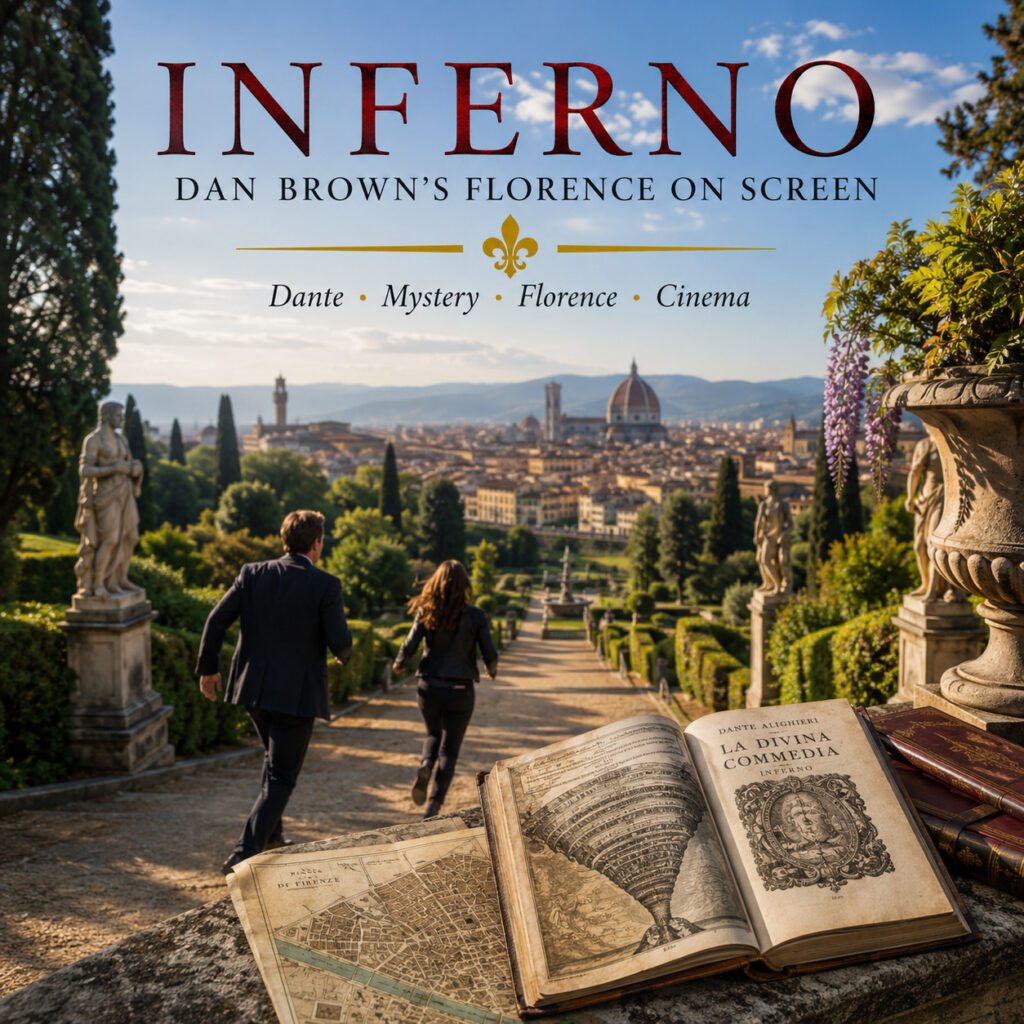
Inferno Florence turns the historic city into a fast-moving cinematic puzzle. Ron Howard’s 2016 thriller, based on Dan Brown’s novel, follows Robert Langdon through gardens, palaces, hidden passages and monumental squares while Florence becomes far more than a backdrop.
Starring Tom Hanks as Robert Langdon and Felicity Jones as Sienna Brooks, the film uses some of Florence’s most recognisable places as essential parts of the story. For the wider cinematic context, see our Movies Filmed in Florence – Complete Guide.
Film: Inferno
Director: Ron Howard
Released: 2016
Based on: Dan Brown’s 2013 novel Inferno
Robert Langdon: Tom Hanks
Sienna Brooks: Felicity Jones
Major Florence locations: Boboli Gardens, Palazzo Vecchio, Vasari Corridor and Baptistery of San Giovanni
Literary inspiration: Dante Alighieri and the Divine Comedy
Florence as a Star of Inferno
Few cities could provide a better setting for a thriller built around art, symbols, hidden passages and historical mysteries. Florence contains medieval streets, Renaissance palaces, monumental churches and centuries of political history within a remarkably compact area.
Ron Howard uses this geography aggressively. Robert Langdon and Sienna Brooks move through spaces that already possess strong historical identities, while rapid editing transforms the city into an interconnected maze.
This cinematic Florence belongs to a much wider tradition. Films such as A Room with a View, Hannibal and Tea with Mussolini have interpreted the city in completely different ways. In Inferno, however, Florence becomes a landscape of pursuit, coded messages and concealed routes.
Florence is not simply attractive scenery in Inferno. Its architecture, history and physical layout repeatedly influence the action, making the city function almost like another character.
The Film and Dan Brown’s Novel
Inferno is based on Dan Brown’s 2013 novel of the same name, another instalment in the adventures of Harvard professor Robert Langdon. Both versions connect Florence with Dante, Renaissance art and a modern threat, but the film necessarily condenses and changes parts of the original story.
For that reason, the literary and cinematic versions deserve to be explored separately. Our Dan Brown’s Inferno – Florence Through the Novel article concentrates on Brown’s book, its historical references and the role Florence plays in the written narrative.
This guide instead follows the city seen on screen and the real Florence locations that give Ron Howard’s film its distinctive visual identity.
Dante Behind the Story
The title immediately points towards the cultural figure underlying the mystery: Dante Alighieri. The first part of Dante’s Divine Comedy, the Inferno, provided Dan Brown with a powerful mixture of punishment, symbolism, moral choices and unforgettable imagery.
Dante was born in Florence in 1265, and although political exile eventually forced him from the city, Florence remained deeply embedded in his writing. Political rivals, Florentine families, personal memories and conflicts repeatedly appear throughout the Divine Comedy.
The full historical and literary background is explored in our Dante Alighieri and the Divine Comedy guide.
Dan Brown uses Dante as the intellectual foundation of the thriller, but the real poet and his relationship with medieval Florence are considerably more fascinating than the fictional mystery alone suggests.
Boboli Gardens – The Great Chase Through the Medici Landscape
The Boboli Gardens provide some of the most memorable outdoor sequences in Inferno Florence. Robert Langdon and Sienna enter the vast historic garden while attempting to escape their pursuers, turning one of Florence’s most elegant landscapes into the setting for a tense chase.
In reality, Boboli developed behind Palazzo Pitti as the monumental garden of the Medici court. Terraces, avenues, sculptures, fountains and grottoes transformed the hillside into an organised landscape that influenced formal garden design far beyond Florence.
The film makes excellent use of the garden’s scale. Long paths and dense vegetation create uncertainty, while statues and architecture constantly remind viewers that the action is unfolding inside an extraordinary historic environment rather than an ordinary park.
The Buontalenti Grotto
One of Boboli’s most unusual monuments, the Grotta del Buontalenti, fits naturally into the mysterious visual language of Inferno. The grotto combines architecture, sculpture and deliberately artificial natural forms, creating a space where stone, decoration and fantasy seem to merge.
For visitors following the film, Boboli is especially rewarding because the genuine Medici garden remains far more complex than its screen appearance suggests.
Allow at least two hours for the Boboli Gardens rather than visiting only the locations associated with Inferno. The film provides a reason to enter, but the real attraction is the extraordinary Renaissance and grand-ducal landscape itself.
Palazzo Pitti – From Medici Palace to Film Location
Boboli cannot be separated from Palazzo Pitti. The enormous palace became the principal residence of the Medici Grand Dukes after Eleonora di Toledo acquired it in 1549.
In the cinematic geography of Inferno, palace, gardens and the route towards central Florence appear to form part of a continuous world of hidden movement and pursuit. Historically, that connection is surprisingly appropriate.
The Medici deliberately created a relationship between their residence south of the Arno and the political centre around Palazzo Vecchio. The most extraordinary expression of that connection was the Vasari Corridor.
The Vasari Corridor – Florence’s Real Secret Passage
If any Florentine monument seems created for a Robert Langdon thriller, it is the Vasari Corridor.
Built in 1565 for Cosimo I de’ Medici and designed by Giorgio Vasari, the elevated passage connected Palazzo Vecchio with Palazzo Pitti. It crossed the Uffizi, continued above the Ponte Vecchio and allowed the Medici court to move between government and residence without travelling through the streets below.
In Inferno, Langdon and Sienna use the corridor during their escape through Florence. The idea seems almost too convenient for fiction, yet the basic historical concept is genuine: Florence really does possess an elevated private route constructed for its ruling dynasty.
The Vasari Corridor did not need to be invented for the film. Its original purpose as a protected Medici passage between Palazzo Vecchio and Palazzo Pitti already makes it one of Florence’s most remarkable pieces of political architecture.
Palazzo Vecchio – The Political Heart of Inferno
The action eventually reaches Palazzo Vecchio, the great fortified palace overlooking Piazza della Signoria. Few buildings could provide a more convincing setting for a historical thriller.
Constructed as the seat of Florentine government, Palazzo Vecchio later became closely associated with Cosimo I de’ Medici. Its enormous chambers, staircases, artworks and hidden architectural spaces create exactly the atmosphere of history and secrecy required by the film.
Salone dei Cinquecento
The monumental Salone dei Cinquecento plays a particularly important role. Originally created during the republican period, the enormous hall was later transformed under Cosimo I and Giorgio Vasari into a spectacular expression of Medici power.
The film draws attention to the famous words cerca trova – “seek and you shall find” – visible high in one of Vasari’s battle paintings. Those words became associated with theories concerning Leonardo da Vinci’s lost Battle of Anghiari, although the historical reality remains considerably more complicated than the thriller suggests.
This mixture of authentic architecture, genuine art and speculative interpretation is characteristic of the Dan Brown formula. A real historical detail becomes the starting point for a fictional mystery.
Piazza della Signoria on Screen
Outside Palazzo Vecchio lies Piazza della Signoria, one of Florence’s most dramatic urban spaces. The square already contains many of the elements a filmmaker might otherwise have to construct: monumental sculpture, medieval architecture, a fortress-like palace and centuries of political history.
For Inferno, the piazza immediately establishes the historic centre of Florence. The Torre di Arnolfo rising above Palazzo Vecchio is particularly effective as a visual landmark and allows the audience to recognise the city almost instantly.
Yet Piazza della Signoria is more than a beautiful backdrop. It was the stage for speeches, ceremonies, political conflict and public executions. That real history gives the location an intensity that cinema can exploit without inventing it.
Ponte Vecchio and the Route Across the Arno
The movement between Palazzo Pitti, the Vasari Corridor and Palazzo Vecchio inevitably brings another Florentine icon into the story: Ponte Vecchio.
The medieval bridge crosses the Arno beneath part of the Vasari Corridor. Its jewellery shops, irregular architecture and crowded pedestrian space make it instantly recognisable, while the elevated passage above it creates a second, largely hidden layer.
This is a perfect example of why Florence works so well in Inferno. A visitor walking across the bridge sees shops and river views; above them runs a private Renaissance corridor originally created for one of Europe’s most powerful ruling families.
The Baptistery of San Giovanni
The Baptistery of San Giovanni near Florence Cathedral provides another crucial connection between the thriller and Dante.
Dante himself was baptised in this ancient Florentine building and referred affectionately to the Baptistery in the Divine Comedy. Its appearance in Inferno therefore makes thematic sense: the film repeatedly connects modern events with Florence’s most famous medieval poet.
The octagonal Baptistery, its marble exterior and celebrated bronze doors also create a visually distinctive setting. As elsewhere in the film, an authentic monument performs two roles at once – historical landmark and component of a fictional puzzle.
The Baptistery is not simply a convenient film location. Dante was baptised here, giving the building a genuine biographical connection with the poet whose Inferno inspired Dan Brown’s modern thriller.
Real Florence and Cinematic Geography
Following Inferno filming locations in Florence also reveals how cinema changes geography. Films frequently compress distances, alter routes or suggest connections between spaces that function differently in reality.
Inferno is particularly interesting because many of its locations really are historically connected. Palazzo Pitti, the Boboli Gardens, the Vasari Corridor, Ponte Vecchio and Palazzo Vecchio all belong to the physical and political landscape created or transformed under Medici rule.
The cinematic route may simplify that geography, but the underlying urban connections are real. Exploring them on foot therefore offers something more rewarding than simply reproducing scenes from the movie.
Can You Follow Inferno Through Florence?
Yes. Several of the most important Florence locations can be combined into an excellent thematic walk, although entrance tickets and opening hours need to be considered for individual monuments.
A logical route begins around Palazzo Pitti and the Boboli Gardens before continuing towards Ponte Vecchio and Piazza della Signoria. Palazzo Vecchio can then be explored in detail before continuing towards Piazza del Duomo and the Baptistery.
The Vasari Corridor follows part of the same historical axis, although access should always be checked separately rather than assuming it functions as an ordinary pedestrian shortcut.
Boboli Gardens → Palazzo Pitti → Ponte Vecchio → Piazza della Signoria → Palazzo Vecchio → Piazza del Duomo and the Baptistery.
Novel, Film and the Real City
There are ultimately three different versions of Inferno Florence.
Dan Brown’s novel constructs a literary mystery around Dante, history and the geography of Florence. Ron Howard then transforms that story into a visual thriller in which movement through the city becomes particularly important.
Finally, there is the real Florence. Its monuments have histories extending far beyond both novel and film. Palazzo Vecchio was a centre of political power. Boboli expressed Medici court culture. The Vasari Corridor connected government and residence. The Baptistery belonged to Dante’s own Florence.
Understanding these layers makes following Inferno much more interesting. The movie can introduce the places, but their genuine stories are ultimately richer.
Why Florence Works So Well in Inferno
Inferno Florence succeeds because the city already contains everything the thriller needs. It offers hidden passages, monumental halls, ancient religious buildings, formal gardens, powerful dynasties, famous artworks and the legacy of one of world literature’s greatest poets.
Ron Howard turns these elements into a rapid cinematic journey, while Tom Hanks’ Robert Langdon provides the intellectual detective through whom the audience interprets them.
Yet the most satisfying part of visiting the locations afterwards is discovering where fiction ends and history begins. The secret corridor is real. The Medici connections are real. Dante’s relationship with Florence is real. What cinema adds is a new narrative connecting them.
For visitors who already know Florence through Renaissance painting and architecture, following Inferno therefore provides another way to experience the city – as one of Europe’s most extraordinary natural film sets.
Frequently Asked Questions
Was Inferno filmed in Florence?
Yes. Significant parts of Ron Howard’s 2016 film were shot in Florence, including scenes associated with Palazzo Vecchio, the Boboli Gardens and other locations in the historic centre.
Which Florence locations appear in Inferno?
Important locations include the Boboli Gardens, Palazzo Pitti area, Vasari Corridor, Ponte Vecchio, Palazzo Vecchio and the Baptistery of San Giovanni.
Who plays Robert Langdon in Inferno?
Tom Hanks plays Harvard professor Robert Langdon, returning to the role he previously played in The Da Vinci Code and Angels & Demons.
Is Inferno based on Dante?
The film is based on Dan Brown’s novel, which uses Dante’s Divine Comedy – especially the Inferno – as a central source of imagery, symbols and clues.
Can you visit the Inferno locations in Florence?
Yes. Many are major public attractions, although admission requirements and access vary between museums, gardens and historic buildings.
Is the film geographically accurate?
Not always. Like many films, Inferno compresses and adapts geography for dramatic purposes, although several of the locations are genuinely connected through Florentine and Medici history.
Further Reading on Firenze Casa
- Movies Filmed in Florence – Complete Guide
- Dan Brown’s Inferno – Florence Through the Novel
- Dante Alighieri and the Divine Comedy
- Florence in Literature – Complete Guide
- Boboli Gardens – Florence’s Great Medici Garden
- Vasari Corridor – The Secret Passage of the Medici
- Palazzo Vecchio – Florence’s Historic Government Palace
- Palazzo Pitti – The World of the Medici
References
- Sony Pictures – Inferno.
- Brown, Dan. Inferno.
- Alighieri, Dante. Divine Comedy: Inferno.
- Visit Tuscany – Inferno Film Locations in Florence.
- Toscana Film Commission – Film Production and Locations in Tuscany.
- Gallerie degli Uffizi – Boboli Gardens and Vasari Corridor.
- Musei Civici Fiorentini – Palazzo Vecchio and Salone dei Cinquecento.
- Opera di Santa Maria del Fiore – Baptistery of San Giovanni.
- Vasari, Giorgio. Lives of the Most Excellent Painters, Sculptors, and Architects.

