
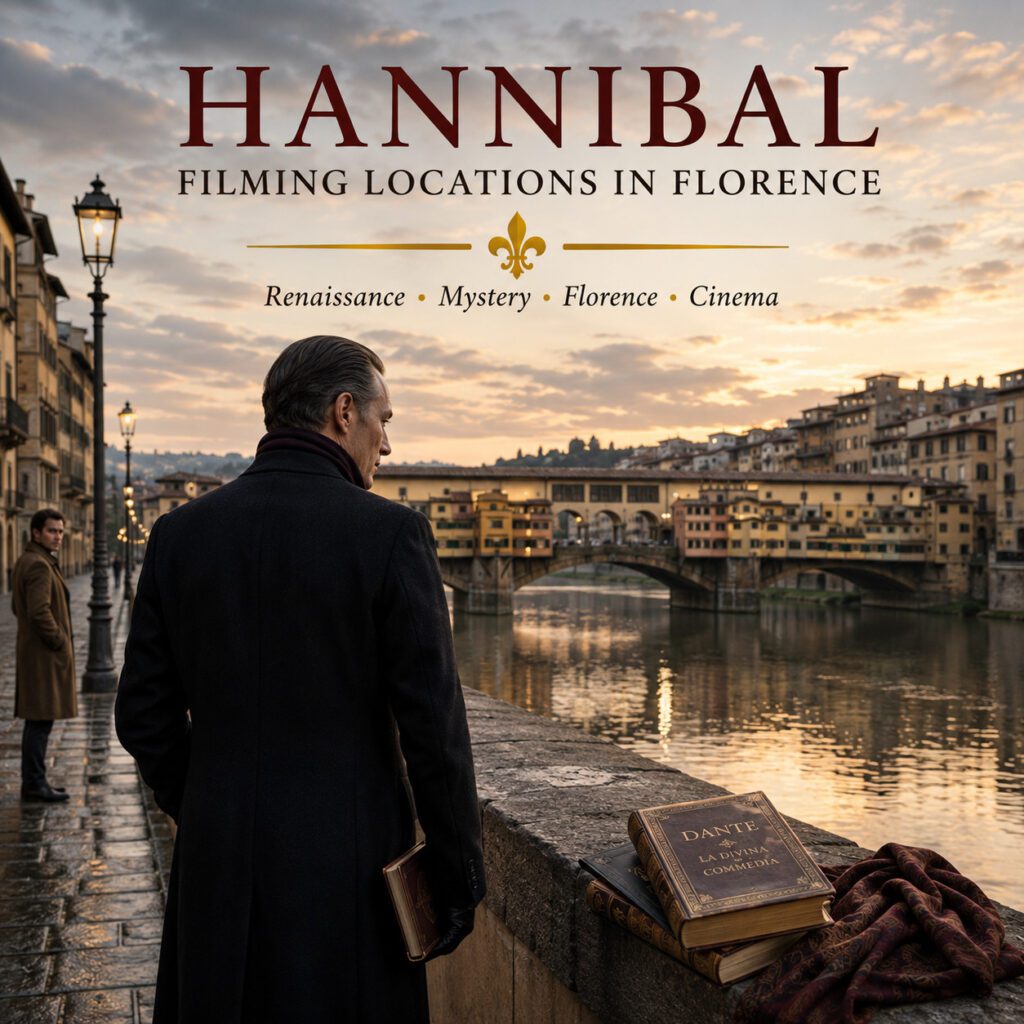
Florence has rarely looked as beautiful – or as unsettling – as it does in Ridley Scott’s Hannibal. The Hannibal filming locations in Florence transform Renaissance palaces, medieval streets and monumental squares into the sophisticated hiding place of one of cinema’s most disturbing characters.
Released in 2001, Hannibal returns to Dr Hannibal Lecter ten years after The Silence of the Lambs. Living under another identity in Florence, Lecter surrounds himself with art, literature and Renaissance history. The film is one of the darkest examples in our Movies Filmed in Florence – Famous Films and Locations, and exploring its real settings reveals how carefully Ridley Scott connects fiction with Florence’s political and cultural past.
Film: Hannibal
Released: 2001
Director: Ridley Scott
Based on: Thomas Harris’s novel Hannibal
Hannibal Lecter: Anthony Hopkins
Inspector Rinaldo Pazzi: Giancarlo Giannini
Key Florence locations: Palazzo Vecchio, Piazza della Signoria, Palazzo Capponi alle Rovinate and streets of the historic centre
Florentine theme: Renaissance beauty, scholarship, conspiracy and violence
Hannibal and Florence
When viewers encounter Hannibal Lecter again, he has escaped the United States and established a new life in Florence. Under the name Dr Fell, he moves through a world of Renaissance art, books and academic scholarship that seems almost perfectly suited to his cultivated personality.
Anthony Hopkins plays Lecter with the intelligence and refinement that made the character famous, while Giancarlo Giannini portrays Florentine police inspector Rinaldo Pazzi. Pazzi begins to suspect that the elegant scholar living in Florence may actually be the fugitive he recognises from an international wanted notice.
Florence is therefore central to the first part of the story. Its beauty provides Lecter with concealment, but its history also foreshadows the violence that follows. The Hannibal filming locations in Florence work particularly well because the filmmakers rarely need to invent historical atmosphere: the city already possesses it.
Hannibal was directed by Ridley Scott and adapted from Thomas Harris’s 1999 novel. Anthony Hopkins returned as Hannibal Lecter, while Julianne Moore took over the role of FBI agent Clarice Starling.
Why Florence Was Perfect for Hannibal Lecter
Hannibal Lecter is portrayed as a man of exceptional education and highly developed aesthetic tastes. He understands literature, music, art and history and feels comfortable among objects carrying complex cultural associations.
Florence gives this aspect of the character a believable home. Renaissance masterpieces appear throughout the city, while libraries, churches and palaces preserve centuries of intellectual and political history.
Yet Renaissance Florence also experienced political rivalry, conspiracy, assassination and public execution. Ridley Scott exploits this contradiction: the Florence of Hannibal is beautiful precisely because beauty and darkness exist side by side.
Palazzo Vecchio – A Key Hannibal Filming Location
Palazzo Vecchio is among the most important historic settings associated with the Florentine part of Hannibal. Rising above Piazza della Signoria, the medieval fortress-palace has stood at the centre of Florentine political life for more than seven centuries.
Its monumental architecture immediately connects the film with the political world of Renaissance Florence. Heavy stone walls, courtyards and historic interiors create an atmosphere that feels both cultured and intimidating.
The building also provides an ideal setting for Lecter’s intellectual persona. He does not hide in an anonymous modern environment but places himself symbolically within Florence’s historic and scholarly world.
For visitors tracing Hannibal Florence locations, Palazzo Vecchio is especially rewarding because its genuine history is every bit as dramatic as its cinematic role.
Palazzo Vecchio began as the seat of Florence’s medieval republican government and later became closely associated with Cosimo I de’ Medici. Its rooms preserve layers of republican, Medici and civic history.
Piazza della Signoria in Hannibal
Outside Palazzo Vecchio lies Piazza della Signoria, the monumental civic heart of Florence. The square fits perfectly into the visual world of Hannibal because beauty and historical violence already coexist there.
Today visitors see sculptures, cafés and crowds, but the piazza once served as the stage for political ceremonies, public punishments and executions. Girolamo Savonarola was executed here in 1498, and the Loggia dei Lanzi adds another dramatic element with its open arches and monumental sculptures.
Among the Hannibal filming locations in Florence, Piazza della Signoria demonstrates particularly well how the film uses genuine history to create psychological tension.
Visit Piazza della Signoria early in the morning. Before the largest crowds arrive, its stone façades and monumental sculptures create an atmosphere much closer to the Florence seen in Ridley Scott’s film.
Inspector Rinaldo Pazzi and Florence’s Past
The name of Inspector Rinaldo Pazzi creates an unmistakable historical association. Florence remembers the Pazzi name above all through the conspiracy of 1478, one of the most dramatic political plots of the Renaissance. Our article on The Pazzi Family – Florence’s Most Famous Conspiracy explores the family and the events behind this historical parallel in detail.
Members of the Pazzi family and their allies attempted to assassinate Lorenzo and Giuliano de’ Medici during Mass in Florence Cathedral on 26 April 1478. Giuliano was killed, while Lorenzo survived.
The conspiracy collapsed quickly. Several conspirators suffered brutal reprisals as Medici supporters regained control of the city. Hannibal deliberately plays with this historical memory through Inspector Pazzi, connecting the modern thriller with a Renaissance story of betrayal, ambition and punishment.
The Pazzi Conspiracy took place on 26 April 1478 inside Florence Cathedral. Its failure strengthened Lorenzo de’ Medici and became one of the defining episodes of Renaissance Florence.
Francesco de’ Pazzi and the Historical Parallel
The film draws particular attention to Francesco de’ Pazzi, one of the principal conspirators in the 1478 plot. After the attack failed, Francesco was captured and hanged from Palazzo della Signoria together with Archbishop Francesco Salviati.
This episode provides Hannibal with one of its most disturbing historical parallels. Lecter understands exactly what the Pazzi name means in Florence and uses that knowledge with characteristic cruelty.
The reference works because Florence itself remembers the conspiracy through buildings, artworks and historical narratives. Viewers who know the story recognise the threat before the film fully resolves it.
Palazzo Capponi alle Rovinate – Hannibal’s Florentine World
One of the fascinating locations associated with Hannibal is Palazzo Capponi alle Rovinate, a historic palace in central Florence. The building helps create the private Florentine world inhabited by Lecter under his assumed identity.
The palace belongs to the architectural fabric that makes the film’s Florence so convincing. Its restrained Renaissance character differs from the monumental scale of Palazzo Vecchio, giving the story a more intimate urban setting.
The surrounding streets are equally important. Florence’s narrow lanes allow the camera to move quickly between public monuments and enclosed spaces, reinforcing the feeling that Lecter can disappear into the historic city.
Many Florence filming locations are historic buildings rather than conventional film attractions. Some remain private or have restricted access, so the surrounding streets and façades are often the most practical way to experience them.
The Streets Around Santa Croce
The eastern part of Florence’s historic centre provides an especially atmospheric setting for the film. Around the Basilica of Santa Croce, narrow streets connect medieval and Renaissance buildings with small squares, palaces and residential façades.
These streets give Ridley Scott an environment where Hannibal Lecter can appear completely at home. The character moves through Florence not as a tourist but as someone who understands its language, history and rhythms.
For visitors, the area is ideal for exploring on foot. Even away from exact camera positions, the architecture preserves much of the visual character associated with Hannibal Florence locations.
The Arno and Florence at Night
The Arno gives the film a broader view of Florence. Reflections on the water, illuminated buildings and the dark outlines of bridges create an elegant atmosphere that contrasts with the tension surrounding Lecter.
Ridley Scott uses light to transform familiar places. Florence during the day can appear warm and inviting; at night, the same architecture becomes secretive and unpredictable.
The river therefore contributes to the film’s visual duality. Beauty remains visible, but darkness changes its meaning. An evening walk beside the Arno is one of the easiest ways for visitors to experience something of this cinematic atmosphere.
Florence Cathedral and the Pazzi Conspiracy
Brunelleschi’s dome provides one of the visual signatures of Florence, but the cathedral also has a direct historical connection with the Pazzi story referenced in Hannibal.
On 26 April 1478, conspirators attacked Lorenzo and Giuliano de’ Medici during Mass inside Santa Maria del Fiore. Giuliano was killed, while Lorenzo escaped and survived.
The same monument can therefore symbolise artistic genius and political violence – exactly the contradiction that makes Florence such an effective setting for Hannibal. The wider story also belongs to the history of the Medici family and the dynasty that shaped Florence.
The Pazzi Conspiracy was not merely a family feud. Banking interests, Florentine politics, papal involvement and opposition to growing Medici power all contributed to the crisis.
Art and Scholarship in Hannibal’s Florence
Lecter’s fascination with Florence is intellectual as well as aesthetic. The city provides a setting where his knowledge of Renaissance art, literature and Italian history becomes part of his disguise.
His cultivated behaviour makes him plausible within scholarly surroundings because he genuinely understands the material he discusses. This makes the character more disturbing: refinement and brutality are not presented as opposites within Lecter but as qualities that coexist.
Florence reinforces that tension because the Renaissance itself combined extraordinary artistic achievement with fierce political competition and episodes of spectacular violence.
Dante and Hannibal’s Florence
Dante Alighieri and the Divine Comedy form another part of the cultural landscape surrounding the film. Florence is inseparable from Dante’s biography, even though political exile meant that he spent the final years of his life away from his native city.
Dante’s visions of sin, punishment and the afterlife complement the darker themes surrounding Lecter. The connection also demonstrates how Hannibal uses Florence differently from a conventional thriller: literature and history become part of the psychological architecture of the film.
Dante was born in Florence in 1265. Although the city later exiled him, Florence remains filled with places, monuments and traditions connected with his life and works.
Ridley Scott’s Visual Interpretation of Florence
Ridley Scott presents Florence with obvious admiration, but he avoids turning the city into a simple travel advertisement. His camera emphasises stone, shadow, narrow streets and monumental architecture.
Interior and exterior spaces often feel connected. A character can move from a quiet Renaissance room into a crowded piazza and then disappear down a narrow medieval street.
This physical density gives the film tension. Florence feels simultaneously open and enclosed, public and secretive. Among films shot in the city, Hannibal offers one of the most distinctive visual interpretations of Florence.
How Hannibal Uses Real Florentine History
The film’s historical references are not accidental decoration. The Pazzi Conspiracy provides a framework linking Inspector Pazzi’s fate with Florence’s Renaissance past.
Palazzo Vecchio and Piazza della Signoria reinforce this connection because they witnessed centuries of political conflict. Florence’s public spaces once functioned as places where power, punishment and political allegiance became highly visible.
The result is a thriller in which location and history interact. The audience does not need to understand every reference, but knowing the background makes several scenes considerably more powerful.
Reality and Cinema in Hannibal
As with almost every production filmed in a historic city, cinematic Florence should not be treated as a precise geographical map. Editing can connect buildings and streets that are farther apart in reality, while interiors and exteriors may be combined to represent a single fictional location.
This does not make location hunting less interesting. On the contrary, comparing the real city with the film reveals how directors reconstruct geography to serve a story.
When following Hannibal through Florence, look for architectural relationships rather than expecting every route on screen to work in reality. Cinema creates its own map of the city.
A Walk Through the Hannibal Filming Locations in Florence
A walk inspired by Hannibal can begin at Piazza della Signoria. Spend time looking at Palazzo Vecchio and the Loggia dei Lanzi before exploring the surrounding streets.
From the piazza, continue through the historic centre towards the area associated with Palazzo Capponi alle Rovinate and then towards Santa Croce. The narrow streets between these landmarks provide much of the atmosphere that makes the film’s Florence convincing.
From Santa Croce, walk back towards the Arno. An evening extension along the river offers a different perspective and recalls the darker visual mood Ridley Scott creates after sunset.
Piazza della Signoria → Palazzo Vecchio → historic streets → Palazzo Capponi alle Rovinate area → Santa Croce → Arno. Allow around two hours for a relaxed walk, longer if you visit Palazzo Vecchio or Santa Croce.
Best Time to Explore Hannibal’s Florence
Early morning provides the best opportunity to see Piazza della Signoria and surrounding streets before the largest crowds arrive. Stone façades and quieter streets make it easier to recognise the city seen on screen.
Evening offers an entirely different experience. Streetlights, illuminated monuments and shadows along narrow streets bring the atmosphere closer to Ridley Scott’s darker interpretation.
Hannibal and A Room with a View – Two Different Florences
Comparing Hannibal with A Room with a View – Florence Through the Locations of the Film demonstrates the extraordinary flexibility of Florence as a film location. Both productions use the historic city extensively, yet they create almost opposite emotional effects.
James Ivory presents Florence as a place of discovery, romance and liberation. Ridley Scott finds beauty too, but surrounds it with secrecy, violence and psychological menace.
Piazzas, palaces and Renaissance artworks remain essentially the same. Lighting, narrative and character transform what they mean. This contrast is one of the most fascinating aspects of exploring Florence through cinema.
Watch A Room with a View and Hannibal close together. They demonstrate how the same historic city can become romantic and liberating in one film, then elegant and threatening in another.
Hannibal and Inferno – Two Dark Visions of Florence
Hannibal and Inferno both use Florence for darker stories, yet their interpretations differ considerably. Hannibal emphasises elegance, scholarship and menace, creating a Florence that often feels contemplative and secretive.
Inferno, by contrast, turns the city into a rapidly unfolding puzzle filled with routes, clues and pursuit. The literary background of the latter can be explored in our article Dan Brown’s Inferno – Florence Through the Novel.
Both stories draw strength from genuine Florentine history. Renaissance politics, literature and architecture provide a depth that a fictional city could not easily reproduce.
Watching Hannibal Before Visiting Florence
Watching the film before visiting Florence makes its historical references easier to recognise. Palazzo Vecchio, Piazza della Signoria and the surrounding streets gain another layer when encountered in person.
However, the film should also encourage viewers to investigate the real history behind its fiction. The Pazzi Conspiracy, Medici Florence and the political role of Palazzo Vecchio are far more complex than the references required by the thriller.
That is where following film locations becomes particularly rewarding. Cinema provides the starting point; Florence supplies the deeper story.
Frequently Asked Questions
Was Hannibal filmed in Florence?
Yes. Ridley Scott filmed important parts of Hannibal in Florence, using historic streets, palaces and public spaces to create Lecter’s Italian world.
Which Florence locations appear in Hannibal?
Important settings include Palazzo Vecchio, Piazza della Signoria, Palazzo Capponi alle Rovinate and streets of the historic centre.
Is Inspector Rinaldo Pazzi based on the Pazzi family?
He is a fictional character, but his surname deliberately evokes the historic Pazzi family and the conspiracy against the Medici in 1478.
What happened in the Pazzi Conspiracy?
Conspirators attacked Lorenzo and Giuliano de’ Medici inside Florence Cathedral in 1478. Giuliano was killed, but Lorenzo survived and the conspiracy failed.
Can you walk between the main Hannibal locations?
Yes. Palazzo Vecchio, Piazza della Signoria, the Santa Croce area and many atmospheric streets used to evoke the film lie within Florence’s compact historic centre.
Why does Florence work so well in Hannibal?
The city combines Renaissance beauty and scholarship with a genuine history of political rivalry, conspiracy and violence – themes that fit Lecter’s cultivated but disturbing character perfectly.
Why the Hannibal Filming Locations in Florence Are Worth Exploring
The Hannibal filming locations in Florence are worth exploring because Ridley Scott uses the city with unusual intelligence. Renaissance architecture is not merely an elegant background for Hannibal Lecter; Florence’s history becomes part of the story.
Palazzo Vecchio evokes political power. Piazza della Signoria recalls public punishment. The Pazzi name connects the fictional inspector with one of the Renaissance city’s most notorious conspiracies, while Florence’s artistic and literary heritage provides Lecter with an environment perfectly suited to his cultivated persona.
Walking through these locations reveals another advantage of exploring Florence through cinema. A familiar monument can suddenly encourage you to investigate a historical episode you might otherwise have overlooked.
Hannibal presents a deliberately dark Florence, but the city behind the film is even more fascinating. Its beauty, art, intellectual history and political violence genuinely existed side by side – which is precisely why Florence works so well on screen.
Further Reading on Firenze Casa
- Movies Filmed in Florence – Famous Films and Locations
- A Room with a View – Florence Through the Locations of the Film
- Palazzo Vecchio – Political Heart of Florence
- The Pazzi Family – Florence’s Most Famous Conspiracy
- The Medici Family – The Dynasty That Shaped Florence
- Basilica of Santa Croce – Florence’s Monumental Church
- Dante Alighieri and the Divine Comedy
- Dan Brown’s Inferno – Florence Through the Novel
References
- Thomas Harris – Hannibal.
- Ridley Scott – Hannibal.
- Metro-Goldwyn-Mayer / Universal Pictures – Hannibal.
- Comune di Firenze – Historic centre and cultural heritage.
- Musei Civici Fiorentini – Palazzo Vecchio.
- Encyclopaedia Britannica – Pazzi Conspiracy.
- Archivio di Stato di Firenze – Medici and Pazzi history.
- Toscana Film Commission – Film production and locations in Tuscany.

