
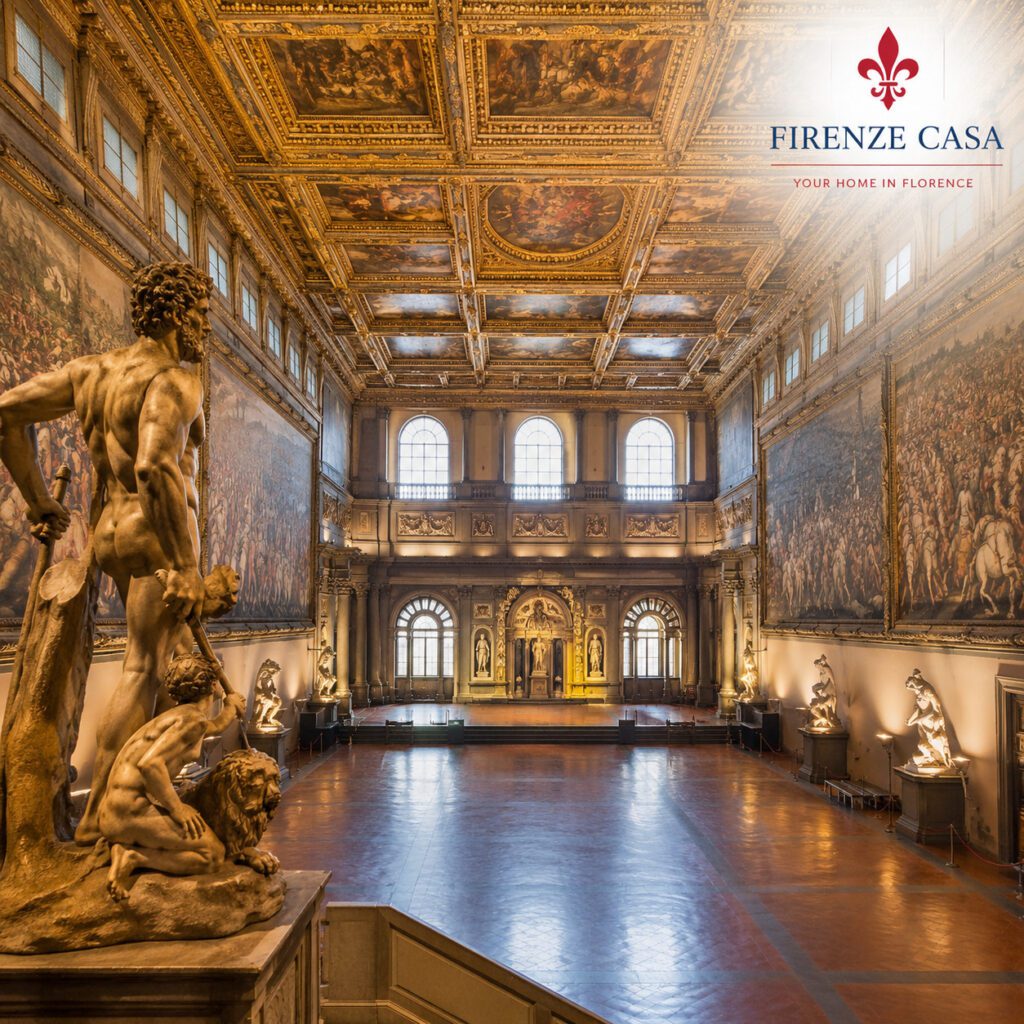
Palazzo Vecchio Florence is not a conventional art museum. It is the place to visit if you want to understand how Florence was governed, how the Florentine Republic functioned and how the Medici transformed political power into dynastic rule. For more than seven centuries, this fortress-like palace on Piazza della Signoria has stood at the centre of Florentine political life.
The paintings, sculptures and monumental rooms inside Palazzo Vecchio are important, but they form part of a much larger story. Here, art was often created to express authority, celebrate military victories or strengthen the image of those who ruled Florence. Walking through the palace therefore means walking through the political history of the city itself.
Original function: Seat of Florentine republican government
Main highlight: Salone dei Cinquecento
Best for: Florentine political history, Medici rule and Renaissance interiors
Important figures: Savonarola, Cosimo I de’ Medici, Giorgio Vasari and Eleonora di Toledo
Suggested visit: About 2 hours
Tower: Torre di Arnolfo
Location: Piazza della Signoria
Current function: Florence City Hall and museum
Why Palazzo Vecchio Is Different from a Conventional Museum
Most museums bring objects from different places together inside galleries. Palazzo Vecchio works in the opposite way. The building itself is the principal historical object, while its rooms, frescoes, sculptures and architectural changes document more than seven centuries of political life.
The vast Salone dei Cinquecento began as a meeting hall for the Florentine Republic before Cosimo I de’ Medici transformed it into a spectacular expression of ducal authority. Private apartments reveal the emergence of a Medici court inside what had once been a republican government building, while hidden passages, council chambers and the Torre di Arnolfo add further layers to the story.
Even today, Palazzo Vecchio has not become merely a monument to a vanished political system. It remains Florence’s town hall and also forms one of the essential stops in our complete guide to Florence museums.
Visit the Uffizi primarily for Renaissance masterpieces. Visit Palazzo Vecchio to understand Florence itself – its republic, political conflicts, Medici rulers and the way power shaped the city.
From Palazzo dei Priori to Palazzo Vecchio
Construction began at the end of the thirteenth century, when Florence needed a secure seat for its governing officials, known as the Priori. Tradition attributes the design to Arnolfo di Cambio, the architect also associated with Florence Cathedral and Santa Croce. The building became known first as the Palazzo dei Priori and later as the Palazzo della Signoria.
Its fortress-like appearance was deliberate. Heavy stone walls, battlements and the commanding tower expressed civic authority, but they also offered protection in a city where political rivalries could become violent.
Medieval Florence was wealthy and increasingly powerful, yet its government operated within an environment of intense competition between families, factions and social groups. The name Palazzo Vecchio – the “Old Palace” – came later, after the Medici court eventually transferred its principal residence to Palazzo Pitti.
Palazzo Vecchio was not built as a Medici palace. It began as the fortified seat of the Florentine Republic. This makes the later Medici transformation of the building especially significant.
The Florentine Republic and Its Palace
Florence developed one of medieval Europe’s most complex systems of civic government. Political authority rested with councils, magistrates and elected officials, although participation remained restricted and powerful families exercised enormous influence.
The system was far removed from modern democracy, yet republican government became an important part of Florentine identity. Palazzo Vecchio stood at the centre of this system, and decisions concerning taxation, diplomacy, warfare and the administration of the city passed through its rooms.
The palace was therefore not simply a symbolic building. It functioned as the working heart of a powerful commercial republic.
This republican origin explains one of the great historical tensions inside Palazzo Vecchio. Rooms created for civic government would later become instruments for celebrating hereditary Medici rule.
Piazza della Signoria – Florence’s Political Stage
The political history of Palazzo Vecchio cannot be separated from Piazza della Signoria. For centuries, the square served as Florence’s principal civic stage, where political announcements, public ceremonies, celebrations, protests and executions unfolded directly outside the palace.
The sculptures surrounding the square reinforced this political symbolism. Michelangelo’s David originally stood near the entrance to Palazzo Vecchio, where Florentines could interpret the young biblical hero as a symbol of the republic defending itself against more powerful enemies.
A replica now occupies the outdoor position, while the original stands in the Accademia Gallery. The nearby Loggia dei Lanzi later became another spectacular expression of political and artistic power.
Piazza della Signoria was therefore much more than a beautiful public square. It was the place where government met the people of Florence.
Spend a few minutes in Piazza della Signoria. Look at Palazzo Vecchio, the David replica, the Loggia dei Lanzi and the plaque marking Savonarola’s execution. The square provides the historical introduction to everything you will see inside.
The Entrance – From Fortress to Palace
Approaching the main entrance reveals the defensive character of the medieval building. Once inside, however, the atmosphere changes. The first courtyard introduces elegant Renaissance decoration within the severe stone shell of the former republican palace.
This contrast continues throughout the building. Palazzo Vecchio moves constantly between fortress and residence, republic and duchy, public authority and private court life.
Its architecture therefore records political change almost as clearly as a written chronicle.
Michelozzo’s Courtyard
Michelozzo redesigned the first courtyard during the fifteenth century, while later decorations transformed it further for Medici celebrations. Elegant columns, painted surfaces and architectural details create a refined environment that contrasts strongly with the exterior.
The courtyard demonstrates how successive generations adapted an existing government building rather than replacing it. This pattern would become even more pronounced under Cosimo I, when the medieval republican palace was reshaped into a residence suitable for a Renaissance duke.
Savonarola and the Crisis of the Republic
Few figures illustrate the turbulent politics of Florence better than Girolamo Savonarola. After the Medici were expelled in 1494, the Dominican preacher became one of the most influential voices in the city. He promoted moral and religious reform while supporting a new republican political order.
His influence did not last. Political opposition increased, his conflict with Pope Alexander VI intensified and Florentine support weakened. In 1498, authorities arrested Savonarola and brought him to Palazzo Vecchio, where he was interrogated before being executed with two fellow friars in Piazza della Signoria.
A circular plaque in the square marks the place traditionally associated with their execution. Visiting Palazzo Vecchio after the San Marco Museum therefore connects two important stages of Savonarola’s story: his religious world and his political downfall.
The Salone dei Cinquecento – A Republican Hall
The Salone dei Cinquecento is the most dramatic room in Palazzo Vecchio, but its importance goes far beyond size and decoration. Girolamo Savonarola’s republican government commissioned the hall in the late fifteenth century to accommodate the Great Council of Florence.
The enormous space represented an ambitious attempt to broaden participation in republican government. Hundreds of citizens could assemble here to debate and vote.
The architecture therefore reflected a particular political idea: Florence as a republic governed through civic institutions rather than a hereditary court. That original purpose makes what happened next particularly revealing.
From Republican Assembly to Medici Theatre of Power
When Cosimo I de’ Medici consolidated his authority during the sixteenth century, the meaning of the Salone dei Cinquecento changed completely. A room designed for republican government became a monumental setting for ducal power.
Giorgio Vasari directed an extensive transformation. Enormous battle scenes celebrated Florentine military victories, while the elaborate ceiling and surrounding decoration presented Cosimo’s government as powerful, successful and legitimate.
The room therefore tells two opposing political stories at once. Its scale recalls the ambitions of the Florentine Republic, while its surviving decoration celebrates the dynasty that ultimately replaced republican government with hereditary rule.
The Salone dei Cinquecento is not simply a room filled with enormous paintings. Architecture, ceiling decoration and battle scenes work together as political communication. The Medici transformed a republican assembly hall into a visual argument for their own authority.
Leonardo and Michelangelo – Art in the Service of the Republic
Before the Medici transformation, the Salone dei Cinquecento became the setting for one of the most famous episodes in Renaissance art. Florence commissioned Leonardo da Vinci and Michelangelo to create monumental battle scenes for the hall.
Leonardo worked on the Battle of Anghiari, while Michelangelo prepared the Battle of Cascina. These were not merely decorative commissions: both subjects celebrated Florentine military history and were intended for the political heart of the republic.
The projects therefore demonstrate how republican Florence also understood the power of art to shape civic identity. Neither work survived in its intended form, although their preparatory work and later copies became enormously influential.
The Mystery of Leonardo’s Battle of Anghiari
Leonardo’s lost Battle of Anghiari has fascinated historians for centuries. Contemporary observers admired his intense depiction of soldiers fighting over a standard, but the experimental wall-painting technique failed and the work deteriorated.
Later renovations transformed the hall. Speculation has repeatedly suggested that traces of Leonardo’s painting might survive behind Vasari’s decoration, although no definitive evidence confirms the survival of a complete hidden mural.
The mystery is intriguing, but it should not distract from the larger historical story. The disappearance of Leonardo’s republican commission beneath the later Medici transformation almost symbolises the political changes that reshaped Florence itself.
Cosimo I de’ Medici Changes Florence
Cosimo I de’ Medici became Duke of Florence in 1537 and later Grand Duke of Tuscany. His rise marked a decisive stage in Florence’s transformation from a politically turbulent republic into the centre of a hereditary territorial state.
Cosimo understood architecture and art as instruments of government. Palazzo Vecchio therefore had to do more than provide rooms for administration and residence: it needed to communicate the authority of the Medici dynasty.
He commissioned extensive renovations and decorative programmes throughout the palace. Historical scenes, mythology and representations of military success repeatedly connected Medici rule with the prosperity and destiny of Florence.
This wider transformation belongs to the history of the Medici family and the dynasty that shaped Florence.
Giorgio Vasari – Architect of Medici Power
Giorgio Vasari became one of Cosimo I’s most important artistic collaborators. Today he is famous as a painter, architect and author of the Lives of the Most Excellent Painters, Sculptors, and Architects.
Inside Palazzo Vecchio, however, he also functioned as a designer of political imagery. Vasari coordinated complex decorative programmes in which individual paintings formed part of larger narratives.
Mythology, history and military victory all helped present Cosimo as the legitimate and successful ruler of Florence. Understanding this purpose changes the experience of the palace: instead of asking only who painted a particular fresco, it becomes equally interesting to ask why that image was placed there and what political message visitors were expected to understand.
The Medici Apartments – Government Becomes a Court
The transformation of Palazzo Vecchio also affected private life. Cosimo I and his family lived within the former republican palace, introducing the rituals and spaces of a Renaissance court into the historic seat of civic government.
The Medici apartments reveal this change particularly clearly. Monumental political rooms coexist with private chambers, devotional spaces and richly decorated residential areas.
Palazzo Vecchio had become both a seat of government and a dynastic home. This combination symbolised a profound political shift, as power became increasingly associated not simply with offices and councils but with a ruling family.
The Apartments of the Elements
The Quartiere degli Elementi introduces visitors to an elaborate world of classical mythology. Vasari and his collaborators filled the rooms with stories involving ancient gods, cosmic forces and heroic figures.
For a Renaissance court, mythology offered a sophisticated political language. The qualities of gods and heroes could be associated symbolically with contemporary rulers.
Classical imagery therefore reinforced ideas of order, virtue, strength and legitimate authority. The rooms are beautiful, but their real interest becomes clearer when seen as part of the wider Medici programme of self-representation.
Eleonora di Toledo – The Private Side of Power
Eleonora di Toledo married Cosimo I in 1539 and became Duchess of Florence. Her apartments reveal another side of Palazzo Vecchio, where family life and court ceremony existed beside the machinery of government.
Her rooms provide a more intimate contrast to the Salone dei Cinquecento. They remind visitors that the Medici did not merely govern from the palace; they lived there.
Eleonora later became closely associated with Palazzo Pitti, which she acquired in 1549. The eventual movement of the court across the Arno contributed to the old government palace becoming known as Palazzo Vecchio.
The Chapel of Eleonora
Agnolo Bronzino decorated Eleonora’s private chapel with brilliant frescoes. The small space provides a striking contrast with the monumental halls elsewhere in the building.
Here, art served personal devotion within the private world of the duchess. The chapel therefore helps visitors understand the range of activities taking place inside Palazzo Vecchio, from public government and diplomatic ceremony to family life and private prayer.
The Hall of the Geographical Maps – Knowledge and Government
The Sala delle Carte Geografiche is one of the most fascinating rooms in the palace. Painted maps cover the doors of cabinets, while a large globe evokes the expanding geographical knowledge of sixteenth-century Europe.
For the Medici court, geography was not simply an academic interest. Knowledge of territories, trade routes and distant regions belonged to the intellectual culture of government.
Maps could represent both curiosity about the world and the ability of a ruler to comprehend and organise it. Visitors interested in the connection between Medici power and scientific knowledge can explore another side of this culture at the Museo Galileo.
The map room shows another form of political power: knowledge. Renaissance rulers collected maps, scientific instruments and information about distant territories as part of a broader culture of government and prestige.
The Studiolo of Francesco I – A Prince’s Private World
The Studiolo of Francesco I presents yet another aspect of Medici rule. Francesco, son of Cosimo I, developed strong interests in natural science, alchemy, collecting and the relationship between nature and human craftsmanship.
His small study contained paintings and concealed cabinets for rare and curious objects. Unlike the public grandeur of the Salone dei Cinquecento, the Studiolo was intensely private.
The contrast is revealing. Palazzo Vecchio contains both the public image rulers wished to present to Florence and the more personal intellectual worlds they created for themselves.
Secret Passages and the Practical Architecture of Power
Hidden staircases, concealed doors and narrow passages run through parts of Palazzo Vecchio. They are fascinating not simply because they feel mysterious, but because they reveal how a fortified seat of government and court actually functioned.
Rulers, officials and servants needed ways to move between public rooms and private areas. Security mattered, while discretion could also be important.
Specialised tours sometimes provide access to parts of this hidden architectural network. These passages make Palazzo Vecchio feel less like a static museum and more like the complex political machine it once was.
The Vasari Corridor – Connecting the Centres of Medici Power
Cosimo I’s transformation of Florence extended far beyond Palazzo Vecchio. In 1565, Giorgio Vasari created the famous elevated corridor connecting the political centre of the city with the Medici residence across the Arno.
The route passed from the Palazzo Vecchio and Uffizi area, crossed Ponte Vecchio and continued towards Palazzo Pitti. It allowed members of the ruling family to move through Florence with greater privacy and security.
The corridor also created an extraordinary physical connection between government, administration and dynastic residence. Palazzo Vecchio, the Uffizi and Palazzo Pitti became parts of a single Medici geography of power.
The Torre di Arnolfo – Power Above Florence
The Torre di Arnolfo rises approximately 95 metres above Piazza della Signoria. Its distinctive profile has represented Florentine civic authority for centuries.
Climbing the tower provides a different perspective on the political city below. Piazza della Signoria, the dense historic centre, the cathedral and surrounding hills become part of a wider urban landscape.
From above, it is easier to understand how closely Florence’s civic, religious and commercial centres developed together. The ascent involves numerous steps and confined historic spaces, so it may not suit every visitor, and access can also depend on weather and current safety conditions.
Prisoners Inside the Palace
Palazzo Vecchio could represent authority in its most severe form. Political power did not only produce ceremonies and magnificent rooms; it could also determine imprisonment, exile and death.
Cosimo de’ Medici, later known as Cosimo the Elder, was imprisoned within the palace during the political struggles of the fifteenth century before being exiled. Decades later, Savonarola faced imprisonment here following his fall from power.
These stories provide a useful counterpoint to the splendour of the decorated interiors. Palazzo Vecchio was a real centre of government, and political conflict in Florence could have dramatic personal consequences.
Art as Political Communication
Palazzo Vecchio provides one of the clearest demonstrations in Florence of art being used to communicate political ideas. Cosimo I did not commission vast decorative programmes simply because he appreciated beautiful objects.
Battle scenes celebrated military success. Mythological figures suggested virtues associated with rulers, while historical narratives connected Medici government with the destiny of Florence.
Even the organisation of rooms could reinforce hierarchy and authority. This makes Palazzo Vecchio particularly interesting for visitors who do not normally spend hours studying paintings.
Instead of asking only, “Is this a famous painting?”, ask, “Why did the Medici want this image here?” The palace immediately becomes a much more interesting historical experience.
Palazzo Vecchio and Palazzo Pitti – Two Forms of Medici Power
Palazzo Pitti and Palazzo Vecchio tell different chapters of the same political story. Palazzo Vecchio grew from a medieval civic fortress and still communicates government, defence and public authority.
Palazzo Pitti developed into a grand court residence expressing dynastic splendour on a very different scale. Visiting both makes the transformation of Florence particularly clear.
At Palazzo Vecchio, the Medici inserted themselves into the historic institutions and spaces of the republic. At Palazzo Pitti, they increasingly lived like the rulers of a European court.
Palazzo Vecchio or the Uffizi?
The answer depends on what you want to understand about Florence. Choose the Uffizi Gallery if your priority is seeing one of the world’s greatest collections of Renaissance painting.
Choose Palazzo Vecchio if you want to understand Florence as a political city. Here, the rooms themselves tell the story of republican government, Savonarola, Cosimo I and the rise of Medici dynastic power.
The artworks matter because they remain inside the political environment for which many of them were created. Palazzo Vecchio is therefore less about moving from masterpiece to masterpiece and more about understanding how power worked.
If Renaissance painting is your priority, choose the Uffizi. If you want Florence’s political history to become understandable, choose Palazzo Vecchio. If you have time, visit both – they explain two very different sides of the Renaissance city.
Palazzo Vecchio Is Still Florence’s Town Hall
Perhaps the most remarkable fact about Palazzo Vecchio is that its political story never completely ended. The building still serves as Florence’s city hall, and parts of the municipal administration continue to function within its historic walls.
This creates an extraordinary continuity. The institutions have changed completely since the medieval republic, yet Florence still governs itself from the same building that witnessed factional struggles, Savonarola’s rise and fall, Medici rule and centuries of civic history.
Palazzo Vecchio is therefore not simply a preserved monument to political power. It remains part of the living government of Florence.
Highlights for a History-Focused Visit
If your main interest is Florentine history rather than seeing every decorated room, concentrate on the places that best explain the political development of the palace:
- Piazza della Signoria – Florence’s historic civic and political stage.
- Michelozzo’s Courtyard – where the medieval fortress begins to reveal its Renaissance transformation.
- Salone dei Cinquecento – created for republican government and later transformed into a celebration of Medici power.
- Medici Apartments – evidence of the transition from civic government building to dynastic court.
- Chapel of Eleonora – the private world of the ducal family.
- Sala delle Carte Geografiche – geography, knowledge and Renaissance ideas of rulership.
- Studiolo of Francesco I – the private intellectual world of a Medici prince.
- Secret passages – the practical and hidden architecture of political life.
- Torre di Arnolfo – the great symbol of Florentine civic authority.
How Long Do You Need at Palazzo Vecchio?
Allow around two hours for a good visit. This gives you enough time to understand the principal political rooms, explore the Medici apartments and appreciate the building without rushing.
If you add the Torre di Arnolfo or a specialised tour of the secret passages, allow additional time. Visitors particularly interested in Florentine history can easily spend three hours inside the complex.
When Is the Best Time to Visit?
Morning is often a good choice if you want to explore the palace before the historic centre becomes busiest. Later afternoon can also be pleasant, depending on seasonal opening hours.
Because Palazzo Vecchio still performs civic functions, access arrangements can occasionally change for official events. Tower access may also depend on weather and safety conditions.
Check current official information before visiting if a particular part of the palace is especially important to you.
Where Is Palazzo Vecchio?
Palazzo Vecchio stands directly on Piazza della Signoria in the heart of historic Florence. The Uffizi begins beside the square, Ponte Vecchio lies only a few minutes away and Florence Cathedral is within comfortable walking distance.
Its location makes the palace exceptionally easy to integrate into a historical walk through central Florence. However, its surroundings are not merely convenient: Piazza della Signoria, the Uffizi and the route towards the Arno all form part of the same political landscape.
A Medici Power Walk Through Florence
Palazzo Vecchio provides an excellent starting point for tracing the transformation of Medici Florence. Begin in Piazza della Signoria and explore the palace rooms reshaped for Cosimo I.
Afterwards, walk through the Uffizi area towards Ponte Vecchio. Cross the Arno and continue towards Palazzo Pitti.
In doing so, you move physically from Florence’s old civic centre towards the grand residence of its ruling dynasty. The route makes the transition from republic to courtly state surprisingly easy to visualise.
The Vasari Corridor reinforces this relationship from above. Its route connected these centres of Medici authority and turned the historic city itself into part of a dynastic architectural system.
What to Combine with Palazzo Vecchio
Piazza della Signoria
Explore the square before entering the palace. Its sculptures, public space and political associations provide essential context for the rooms inside.
Loggia dei Lanzi
The open-air sculpture gallery beside Palazzo Vecchio demonstrates how art and political representation extended beyond the palace walls into the civic square.
Uffizi Gallery
The Uffizi Gallery offers the perfect contrast. Palazzo Vecchio explains political power, while the Uffizi reveals the extraordinary artistic culture that flourished alongside it.
Bargello Museum
The nearby Bargello Museum adds another important dimension to the civic centre. Its medieval palace and exceptional Renaissance sculpture collection connect political architecture with artists such as Donatello, Michelangelo and Verrocchio.
Ponte Vecchio and Palazzo Pitti
Continue from Piazza della Signoria through the Uffizi area towards the Arno and across Ponte Vecchio. The route leads naturally towards Palazzo Pitti and follows the geography of Medici Florence.
From Medici Florence to Firenze Capitale
The political history represented by Palazzo Vecchio did not end with the Medici. Centuries later, Florence became the capital of the newly unified Kingdom of Italy from 1865 to 1871, introducing another chapter in the city’s relationship with government and national power.
During this period, the royal court occupied Palazzo Pitti while Florence underwent enormous urban changes. Our guide to Florence as Capital of Italy – Firenze Capitale 1865–1871 follows this later transformation from Renaissance political centre to temporary national capital.
Palazzo Vecchio at a Glance
| Category | Information |
|---|---|
| Historic names | Palazzo dei Priori, Palazzo della Signoria, Palazzo Vecchio |
| Original function | Seat of Florentine republican government |
| Later role | Residence and political centre of Cosimo I de’ Medici |
| Key political space | Salone dei Cinquecento |
| Major transformation | Republican palace to Medici ducal residence |
| Important figures | Savonarola, Cosimo I de’ Medici, Giorgio Vasari, Eleonora di Toledo |
| Famous lost projects | Leonardo’s Battle of Anghiari and Michelangelo’s Battle of Cascina |
| Tower | Torre di Arnolfo |
| Suggested visit | About 2 hours, longer with tower or special tour |
| Location | Piazza della Signoria |
| Current function | Florence City Hall and museum |
Frequently Asked Questions About Palazzo Vecchio Florence
Is Palazzo Vecchio worth visiting if I am not particularly interested in art?
Yes. In fact, Palazzo Vecchio is one of the best museums in Florence for visitors primarily interested in history. The building explains the Florentine Republic, Medici rule and the political development of the city through the actual rooms where much of that history unfolded.
Is Palazzo Vecchio an art museum?
It contains important Renaissance art, but describing it simply as an art museum misses its main appeal. Palazzo Vecchio is a historic seat of government whose architecture and decoration tell the political story of Florence.
What is Palazzo Vecchio famous for?
The palace is famous as Florence’s historic seat of government, for the Salone dei Cinquecento, its Medici apartments, the Torre di Arnolfo and its position on Piazza della Signoria.
Was Palazzo Vecchio built by the Medici?
No. The palace originated as the seat of the Florentine Republic. The Medici later transformed substantial parts of it, particularly under Cosimo I.
Did the Medici live in Palazzo Vecchio?
Yes. Cosimo I de’ Medici and his family used the palace as a ducal residence before Palazzo Pitti became their principal court residence.
What was the Salone dei Cinquecento originally used for?
It was created during the republican period as a meeting hall for the Great Council. Cosimo I later transformed it into a magnificent ceremonial space celebrating Medici rule.
Did Leonardo da Vinci paint inside Palazzo Vecchio?
Leonardo worked on the Battle of Anghiari for the Salone dei Cinquecento. His experimental technique failed, and the work did not survive in its intended form.
Did Michelangelo work in the Salone dei Cinquecento?
Michelangelo received a commission for the Battle of Cascina as a counterpart to Leonardo’s project. He produced preparatory work but never completed the planned mural.
What happened to Savonarola at Palazzo Vecchio?
Savonarola was imprisoned and interrogated within the palace complex after his political downfall. He was executed with two fellow friars in Piazza della Signoria on 23 May 1498.
Why is it called Palazzo Vecchio?
The name means “Old Palace” and became associated with the building after the Medici court transferred its principal residence to Palazzo Pitti.
Is Palazzo Vecchio still Florence’s town hall?
Yes. Palazzo Vecchio continues to serve as Florence’s city hall while large sections of the historic building function as a museum.
Why Palazzo Vecchio Is Worth Visiting
Palazzo Vecchio Florence tells the political story of the city in a way no conventional art museum can reproduce. Its medieval walls recall the turbulent world of the Florentine Republic, while the Salone dei Cinquecento preserves both republican ambition and the later triumph of Medici dynastic rule.
Cosimo I and Giorgio Vasari transformed much of the palace into an extraordinary visual statement of authority. Battle scenes, mythology and lavish apartments were not simply decoration; they helped construct an official image of Medici power.
Then there are the human stories: Savonarola moving from political influence to imprisonment and execution, Leonardo and Michelangelo competing for the walls of the great hall, and Cosimo I reshaping both the palace and Florence itself.
Step outside afterwards and Piazza della Signoria looks different. The statues, palace façade and surrounding streets no longer form only one of Florence’s most beautiful squares. They become part of a political stage where republicans, Medici rulers, artists and citizens competed over the future of the city.
Perhaps the strongest connection with the past survives in the simplest fact of all: more than seven centuries after Palazzo Vecchio became the centre of Florentine government, Florence still governs itself from within these walls.
Further Reading on Firenze Casa
- Florence Museums – The Complete Guide
- Girolamo Savonarola – The Preacher Who Challenged Florence
- Cosimo I de’ Medici – The Duke Who Transformed Florence
- The Medici Family – The Dynasty That Shaped Florence
- Palazzo Pitti – The World of the Medici
- Uffizi Gallery – History and Medici Legacy
- Florence as Capital of Italy – Firenze Capitale 1865–1871
References
- Musei Civici Fiorentini – Official information on Palazzo Vecchio, its collections and historic rooms.
- Comune di Firenze – Historical and civic information on Palazzo Vecchio.
- Gallerie degli Uffizi – Historical resources on the Medici, Giorgio Vasari and Renaissance Florence.
- Encyclopaedia Britannica – Historical background on the Medici family, Cosimo I and the Florentine Republic.
- UNESCO World Heritage Centre – Historic Centre of Florence.

