
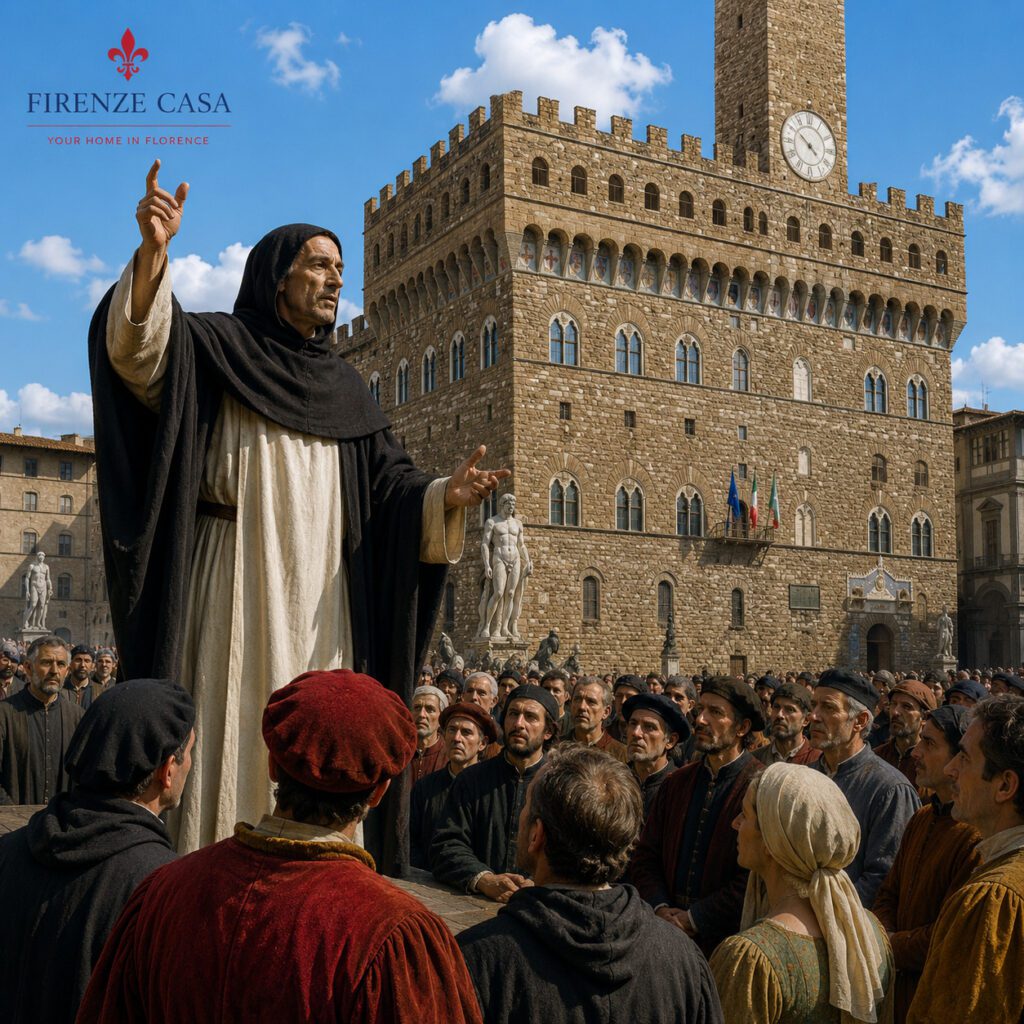
Girolamo Savonarola was one of the most controversial figures in the history of Florence. A Dominican friar from Ferrara, he arrived in a city celebrated for Renaissance culture, Medici patronage and extraordinary artistic achievement. Yet from the pulpit of San Marco, Savonarola increasingly condemned the luxury, corruption and moral decline he believed surrounded him.
His sermons attracted enormous audiences. After the fall of Medici rule in 1494, his influence extended far beyond religion and into the political life of the Florentine Republic. For several remarkable years, Florence became associated with Savonarola’s vision of Christian renewal.
His rise was dramatic, but so was his fall. In May 1498, Savonarola was executed in Piazza della Signoria, only a short distance from Palazzo Vecchio. More than five centuries later, Florence still preserves numerous traces of the preacher who tried to change the city.
Born: 21 September 1452, Ferrara
Religious order: Dominican
Main Florentine base: San Marco
Political turning point: Expulsion of the Medici in 1494
Followers: Piagnoni
Famous event: Bonfire of the Vanities, 1497
Conflict: Pope Alexander VI
Executed: 23 May 1498, Piazza della Signoria
Why he matters: Savonarola reveals the religious, political and social tensions behind Renaissance Florence
Savonarola is one of the central personalities in our History of Florence – Important Florentine Figures.
Who Was Girolamo Savonarola?
Girolamo Savonarola was born in Ferrara on 21 September 1452. He came from a respected family and received an education that included philosophy and medicine. However, as a young man he became increasingly dissatisfied with the society around him and eventually chose a religious life.
In 1475, Savonarola entered the Dominican convent of San Domenico in Bologna. His intellectual abilities and intense religious convictions soon became apparent, while his theological studies helped shape the preaching style that later made him famous.
His first period in Florence began in the early 1480s, when he was sent to the Dominican convent of San Marco. Initially, his sermons attracted relatively little attention.
After spending several years preaching elsewhere in northern Italy, however, Savonarola returned to Florence in 1490 as a far more compelling public speaker. His sermons increasingly presented the city as a place with a special spiritual destiny while warning that divine punishment would follow if Florentines failed to reform their lives.
Savonarola’s story reveals a Florence very different from the familiar image of harmonious Renaissance beauty. His career exposes the religious tensions, political instability and social conflict that existed alongside the city’s extraordinary artistic achievements.
Florence Before Savonarola
The Florence Savonarola encountered was one of Europe’s great cultural centres. Lorenzo de’ Medici dominated political life, while poets, philosophers and artists flourished within the wider world of Medici patronage.
Yet Renaissance Florence was not politically tranquil. Formally, the city remained a republic, although the Medici family had created an extensive network of influence that allowed them to exercise considerable power without ruling as hereditary monarchs.
Florentine society also contained sharp political and economic divisions. Memories of factional struggle remained strong, and the relationship between republican institutions and Medici dominance was never entirely free of tension.
Savonarola’s preaching entered this complicated environment. He attacked corruption among both secular and ecclesiastical elites and criticised excessive luxury, creating a striking contrast with the sophisticated court culture associated with Lorenzo’s Florence.
Savonarola should not simply be understood as an enemy of Renaissance art. His central concern was moral and religious reform, particularly the rejection of corruption, vanity, excessive luxury and behaviour he considered incompatible with Christian life.
Savonarola and Lorenzo de’ Medici
The relationship between Girolamo Savonarola and Lorenzo de’ Medici became one of the most famous episodes in Florentine history. Later accounts sometimes present the two men almost as symbolic opposites: the magnificent Renaissance statesman and the uncompromising Dominican preacher.
The historical relationship was more complicated. Savonarola certainly criticised the political and moral world associated with Medici Florence, yet Lorenzo also played a role in bringing him back to the city.
Both men therefore belonged to the same extraordinary historical moment, even though they represented profoundly different visions of Florence.
A famous tradition claims that Lorenzo summoned Savonarola to his deathbed at the Medici villa at Careggi in 1492 and that the friar refused him absolution because Lorenzo would not agree to restore Florentine liberty. The dramatic story has been repeated for centuries, although historians have questioned important elements of the later accounts.
Lorenzo died on 8 April 1492. His son Piero inherited the family’s political position but lacked his father’s authority and diplomatic skill. Within only two years, the political world Savonarola had criticised began to collapse.
The French Invasion and the Fall of the Medici
In 1494, King Charles VIII of France invaded Italy with an army on his way towards the Kingdom of Naples. The invasion destabilised the fragile balance of power among the Italian states.
For Florence, the consequences were immediate. Piero de’ Medici negotiated concessions with the French king that provoked outrage in the city, and the Medici were driven from Florence in November 1494.
Savonarola had previously preached warnings of approaching punishment and political upheaval. When a foreign army appeared and Medici dominance collapsed, many Florentines interpreted events as confirmation of his prophetic authority.
He also participated in negotiations with Charles VIII. Consequently, his prestige increased dramatically and he became one of the most influential voices in the restored Florentine Republic.
The wider French intervention is explored in The French in Florence – Politics, Art and Cultural Influence.
Savonarola never became an official ruler of Florence. His power rested largely on religious authority, public support and influence over political debate rather than on holding the city’s highest political office.
Savonarola’s Vision for a Christian Republic
After the expulsion of the Medici, Florence needed to rebuild its political institutions. Savonarola supported a broader republican government and backed the creation of a Great Council influenced in part by the political system of Venice.
At the same time, his political ideas were inseparable from religion. Savonarola imagined Florence as a Christian republic whose citizens would embrace moral reform and whose government would serve a divine purpose.
His followers became known as the Piagnoni, or “weepers”. Meanwhile, opponents such as the Arrabbiati resisted his influence, while other political factions continued competing for control of the republic.
For a period, Savonarola’s authority was extraordinary. Religious processions moved through the streets, children participated in campaigns for moral reform and activities associated with gambling, ostentatious luxury and behaviour judged immoral came under increasing pressure.
This extraordinary fusion of religion and politics forms a central chapter in Religion and Power in Renaissance Florence.
The Bonfire of the Vanities
The event most commonly associated with Girolamo Savonarola is the Bonfire of the Vanities.
In February 1497, objects considered symbols of worldly vanity were collected and burned in Piazza della Signoria. These reportedly included luxury clothing, cosmetics, mirrors, playing cards, books and other possessions regarded by Savonarola’s followers as morally dangerous or excessively worldly.
The event later acquired an almost mythical place in popular accounts of Renaissance Florence. It is sometimes claimed that masterpieces by artists such as Botticelli were destroyed.
Although Botticelli’s relationship with the religious atmosphere of Savonarola’s Florence has generated considerable discussion, specific dramatic claims concerning famous masterpieces burned in the bonfire should be treated cautiously.
What is certain is that the event symbolised an attempt to replace values associated with luxury and display with a more austere vision of Christian society.
The Bonfire of the Vanities is often described as the destruction of Renaissance masterpieces. The historical evidence is less straightforward. The burning of luxury and supposedly immoral objects is well documented, but some of the most dramatic stories surrounding famous artworks remain uncertain.
Conflict with Pope Alexander VI
Savonarola’s growing political influence and uncompromising preaching eventually brought him into direct conflict with Pope Alexander VI, Rodrigo Borgia.
The dispute involved several issues. Savonarola criticised corruption within the Church, resisted attempts to silence his preaching and remained connected with Florence’s political opposition to alliances favoured by the pope.
Alexander VI ordered Savonarola to stop preaching and later summoned him to Rome. Savonarola did not fully comply with these demands.
In May 1497, the pope excommunicated him. Savonarola disputed the validity of the action and continued defending his mission, but his conflict with Rome became increasingly dangerous while support within Florence began to weaken.
The Trial by Fire
One of the strangest episodes in Savonarola’s final months occurred in April 1498.
A Franciscan friar challenged Savonarola’s supporters to demonstrate divine favour through an ordeal by fire. Eventually, Fra Domenico da Pescia, one of Savonarola’s closest followers, was expected to walk through flames against a Franciscan opponent.
A large crowd gathered in Piazza della Signoria to witness the event. However, disputes over the conditions delayed proceedings for hours, while rain added further confusion.
The ordeal never took place.
For many spectators, the anticlimax was disastrous for Savonarola’s credibility. Public frustration intensified, and his opponents quickly seized the opportunity.
The Arrest of Savonarola
On 8 April 1498, opponents attacked the convent of San Marco. Fighting broke out, and Savonarola was eventually arrested together with several close associates.
He was taken to Palazzo Vecchio and interrogated under torture. The surviving trial records are problematic because confessions were extracted under extreme pressure and documents were altered during the proceedings.
Ultimately, Savonarola and two fellow Dominicans, Fra Domenico da Pescia and Fra Silvestro Maruffi, were condemned.
The final scene of his life took place in the political heart of Florence.
The Execution in Piazza della Signoria
On 23 May 1498, Girolamo Savonarola, Domenico da Pescia and Silvestro Maruffi were brought into Piazza della Signoria.
The three friars were formally degraded from the clergy and executed by hanging. Their bodies were then burned.
Afterwards, the authorities disposed of their ashes in the Arno, preventing followers from collecting physical relics.
Today, a circular marble plaque set into the pavement of Piazza della Signoria commemorates the place traditionally associated with the execution.
Visitors often walk directly across one of the most important Savonarola sites without noticing it. Near Palazzo Vecchio, a circular inscription in the pavement commemorates the place where Savonarola and his companions were executed on 23 May 1498.
San Marco – The Florence of Savonarola
For visitors who want to understand Savonarola, the most important place in Florence is the convent of San Marco.
The complex had already been transformed during the Medici period, with architectural work by Michelozzo and the celebrated frescoes of Fra Angelico. Savonarola became prior of San Marco in 1491 and turned the convent into the spiritual centre of his reform movement.
Today, the Museo di San Marco preserves spaces closely associated with him. Visitors can see cells connected with Savonarola and objects traditionally associated with his life.
The contrast is remarkable. San Marco combines the serene religious art of Fra Angelico with memories of one of the most turbulent religious and political episodes in Florentine history.
Savonarola and Renaissance Art
The relationship between Savonarola and Florentine art is more complicated than the familiar image of a preacher attempting to destroy the Renaissance.
His attacks were primarily directed against art and objects he considered indecent, excessively luxurious or spiritually harmful. Religious art itself remained an important part of the world in which he lived.
Some Florentine artists appear to have been influenced by the intense religious climate of the period. Fra Bartolomeo became one of Savonarola’s followers, while the question of his influence on Botticelli continues to attract scholarly debate.
Rather than treating Savonarola simply as an enemy of art, it is more revealing to understand him as part of a broader debate about the purpose of images, wealth and culture within Christian society.
Savonarola’s Florence was not a rejection of religious art. The deeper conflict concerned luxury, morality and the purposes that images and possessions should serve within Christian life.
Was Savonarola a Fanatic or a Reformer?
Few historical figures invite such sharply contrasting interpretations.
To his enemies, Savonarola was a dangerous fanatic whose religious movement threatened Florentine culture and political stability. To his followers, however, he was a courageous reformer confronting corruption in both Church and society.
Even after his execution, supporters continued to preserve his memory. Some regarded him as a martyr, while later attempts were made to strengthen his religious reputation.
Modern historians generally place Savonarola within the political and religious tensions of late fifteenth-century Italy rather than reducing him to either stereotype.
His calls for Church reform appeared decades before the Protestant Reformation, whereas his political ideas emerged from Florence’s own long republican tradition.
Those contradictions are precisely what make him so compelling. Savonarola was simultaneously a prophetic Dominican preacher and a central figure in one of the most sophisticated cities of Renaissance Europe.
Savonarola is most interesting when we resist choosing too quickly between “hero” and “fanatic”. His extraordinary rise shows how deeply religion, politics and social anxiety were intertwined in Renaissance Florence.
Following Savonarola Through Florence Today
Savonarola’s story can still be followed on foot through the historic centre.
Begin at San Marco, where his preaching and reform movement had their spiritual base. From there, walk south towards Florence Cathedral and continue to the political heart of the city.
Piazza della Signoria represents the other end of his story. Palazzo Vecchio recalls his arrest, interrogation and the political institutions he sought to influence, while the pavement plaque outside commemorates his execution.
The route also demonstrates how compact Renaissance Florence was. Monastery, cathedral and seat of government all stood within a relatively short walk of one another, allowing religion and politics to interact within the same urban spaces.
Combine a morning visit to the Museo di San Marco with a walk to Piazza della Signoria. The route turns Savonarola’s biography into a journey through Florence, from the convent where his influence grew to the square where his life ended.
The Legacy of Girolamo Savonarola
Savonarola’s political influence lasted only a few years, yet his place in Florentine history has endured for more than five centuries.
His career demonstrates that Renaissance Florence was never simply a city of artistic beauty and enlightened patronage. It was also a society marked by fierce political competition, profound religious belief, economic inequality and anxiety about moral decline.
Most importantly, Savonarola forces us to look beyond the polished image of Renaissance Florence. The same streets that produced extraordinary paintings, sculpture and architecture also witnessed religious processions, factional conflict, political revolution and public execution.
That tension is part of what makes Florence historically so compelling. Girolamo Savonarola did not destroy Renaissance Florence, nor did he permanently remake it according to his vision. Nevertheless, for a brief and extraordinary moment, the Dominican preacher became one of the most powerful voices in the city.
Savonarola reminds us that the Renaissance was not a peaceful procession from one masterpiece to the next. Florence’s cultural brilliance existed alongside political instability, religious fear and intense disagreement over what kind of society the city should become.
Further Reading on Firenze Casa
Continue exploring the people, politics and religious conflicts that shaped Renaissance Florence:
- History of Florence – Important Florentine Figures
- Lorenzo de’ Medici – The Magnificent Ruler of Renaissance Florence
- The Medici Family – The Dynasty That Shaped Florence
- Religion and Power in Renaissance Florence
- The French in Florence – Politics, Art and Cultural Influence
- Cosimo I de’ Medici – The Duke Who Transformed Florence
- History of Florence – Complete Guide
References
- Encyclopaedia Britannica – Girolamo Savonarola
- Treccani – Dizionario Biografico degli Italiani: Girolamo Savonarola
- Museo di San Marco, Florence – Historical Documentation on Girolamo Savonarola and the Dominican Convent
- Comune di Firenze – Historical Documentation on Piazza della Signoria and Savonarola
- Weinstein, Donald – Savonarola: The Rise and Fall of a Renaissance Prophet
- Ridolfi, Roberto – The Life of Girolamo Savonarola
- Najemy, John M. – A History of Florence 1200–1575
- Martines, Lauro – Fire in the City: Savonarola and the Struggle for the Soul of Renaissance Florence

