
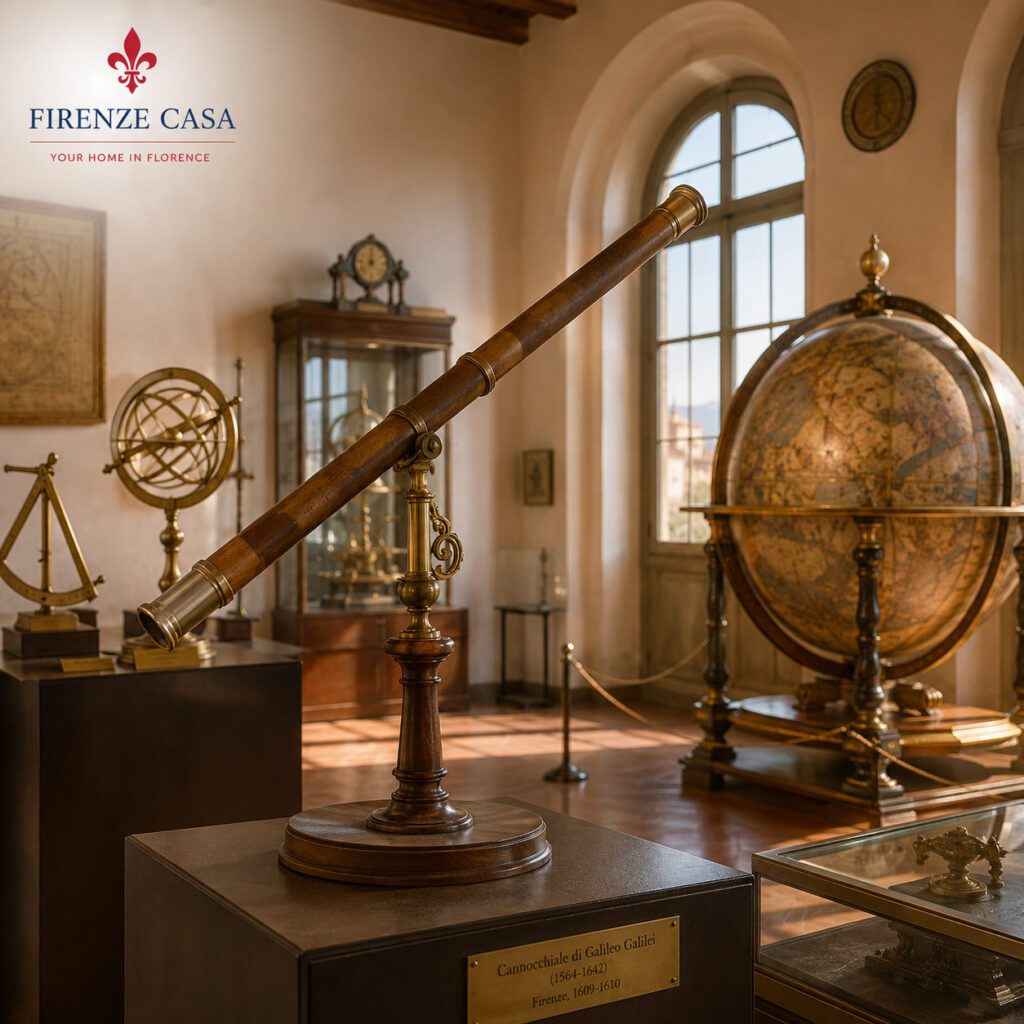
Museo Galileo Florence reveals a side of the city that many visitors never discover. Just a few steps from the Uffizi, historic telescopes, globes, clocks and scientific instruments tell the story of a Florence shaped not only by art, but also by observation, experimentation and discovery. At the centre stands Galileo Galilei, whose work transformed our understanding of the universe.
Florence immediately brings to mind Michelangelo, Botticelli, Brunelleschi and Leonardo da Vinci. Yet the Renaissance and early modern period also changed the way Europeans observed and understood the natural world. Museo Galileo explores this fascinating scientific dimension through instruments associated with astronomy, mathematics, navigation, medicine, timekeeping and experimental physics.
Official name: Museo Galileo – Istituto e Museo di Storia della Scienza
Main highlight: Original instruments associated with Galileo Galilei
Best for: Science, astronomy, history and technology
Major collections: Medici and Lorraine scientific instruments
Suggested visit: 1.5–2 hours
Location: Piazza dei Giudici, beside the Uffizi and River Arno
Nearby: Uffizi Gallery, Palazzo Vecchio, Ponte Vecchio and Santa Croce
Why Visit Museo Galileo Florence?
The museum answers a simple but important question: what happened in Renaissance Florence beyond painting, sculpture and architecture? Artists and scientists shared an intense interest in observation, geometry, proportion and the natural world, while wealthy patrons collected scientific instruments alongside paintings, sculptures and precious objects.
Museo Galileo brings this culture of curiosity to life. Its displays range from beautifully decorated astronomical instruments to devices designed for practical experiments, and some resemble works of art as much as scientific equipment.
The museum also suits visitors who want something different after several days of Renaissance painting. Instead of another sequence of altarpieces and portraits, you encounter telescopes, celestial globes, mechanical devices and instruments created to measure the world.
For a wider overview of Florence’s museums, including art, archaeology, science and smaller collections, see our complete guide to Florence museums.
A Museum Dedicated to the History of Science
Museo Galileo occupies Palazzo Castellani, a historic building close to the River Arno and the Uffizi Gallery. The institution preserves one of the world’s most important collections of historic scientific instruments, with roots largely in collections assembled by the Medici and later expanded under the House of Lorraine.
These rulers did not regard science as something completely separate from culture and political prestige. Mathematical knowledge, astronomy and sophisticated instruments reflected education, power and intellectual ambition. Over centuries, the collections grew to include objects associated with many branches of scientific inquiry.
Today, the museum uses these instruments to tell a much broader story about how Europeans learned to observe, measure and experiment.
Renaissance Florence was not only an artistic laboratory. Mathematics, engineering, astronomy and the study of nature formed part of the same intellectual culture. The scientific collections assembled by the Medici show how closely curiosity, prestige and patronage could interact at the Florentine court.
Galileo Galilei – The Man Behind the Museum
Galileo Galilei was born in Pisa in 1564 and became one of the most influential figures in the history of science. His career developed across several Italian cities, including Pisa, Padua and Florence, while mathematics, mechanics and astronomy stood at the centre of his work.
Galileo did not invent the telescope, but he dramatically improved its scientific use. By pointing such instruments towards the night sky, he observed phenomena that challenged established ideas about the heavens. Mountains and craters appeared on the Moon, countless stars emerged where the naked eye saw only darkness, and most famously, Galileo observed four moons orbiting Jupiter.
Those observations carried enormous implications. They showed that not everything in the heavens revolved around the Earth and provided powerful evidence for a changing understanding of the cosmos.
Our separate article on Galileo Galilei in Florence follows his wider story through the Medici court, his trial, Arcetri, Santa Croce and the scientific legacy he left in the city.
Galileo’s Telescopes
Among the museum’s greatest treasures are original telescopes associated with Galileo. To modern eyes, these instruments appear surprisingly modest because they lack the enormous lenses, sophisticated mounts and electronic technology of contemporary observatories. Their historical importance, however, is extraordinary.
With telescopes of this type, Galileo made observations that changed astronomy forever. He carefully recorded what he saw and published his discoveries in 1610 in the Sidereus Nuncius, or Starry Messenger.
Seeing the instruments in person creates an unusual connection with scientific history. A device that looks almost simple became a tool for questioning humanity’s place in the universe.
Spend time looking closely at Galileo’s surviving telescopes. Their simple appearance makes their significance even more remarkable. Instruments of this kind allowed Galileo to observe the Moon, the stars and Jupiter’s satellites, helping to transform European astronomy.
The Moons of Jupiter
In January 1610, Galileo observed several small points of light near Jupiter. Night after night, their positions changed, and Galileo soon realised that these objects were not distant fixed stars but bodies orbiting Jupiter. Today we know them as Io, Europa, Ganymede and Callisto.
Galileo called them the Medicean Stars in honour of the Medici family. The choice was scientifically memorable and politically astute because naming the newly observed celestial bodies after his powerful patrons strengthened Galileo’s relationship with the Medici court.
Soon afterwards, he returned to Tuscany and served Cosimo II de’ Medici as mathematician and philosopher. Science and patronage therefore came together even in the night sky.
Galileo and the Medici
Galileo’s relationship with the Medici helps connect Museo Galileo directly with the wider history of Florence. He had taught mathematics to the young Cosimo II before Cosimo became Grand Duke of Tuscany, and following his astronomical discoveries, Galileo dedicated the newly observed moons of Jupiter to the Medici dynasty.
The gesture carried considerable symbolic value. Galileo gained the support of one of Italy’s most powerful courts, while the Medici associated their name with a spectacular astronomical discovery. His position in Tuscany allowed him to pursue research and writing while enjoying prestigious court patronage.
The relationship also demonstrates that the legacy of the Medici family extended far beyond Botticelli, Michelangelo and Renaissance architecture. Their court supported intellectual and scientific activity as well.
From Art Patronage to Scientific Patronage
Visitors often associate Medici patronage almost exclusively with art, but Museo Galileo broadens that picture. Scientific instruments could cost considerable sums and required highly specialised craftsmanship, so courts collected them as evidence of learning, technological sophistication and access to the most advanced knowledge of the period.
Astronomical devices, globes and mathematical instruments could also impress visitors. Their intricate construction and beautiful decoration blurred the boundary between scientific equipment and luxury object.
In this sense, a finely crafted instrument could function at court much like a painting, sculpture or precious piece of furniture. It demonstrated both intellectual curiosity and wealth.
The Armillary Spheres and Celestial Globes
Some of the museum’s most visually striking objects represent the structure of the heavens. Armillary spheres use interconnected rings to model celestial circles and astronomical relationships, while globes map either the Earth or the sky.
Before digital simulations, such instruments helped scholars visualise complex ideas about astronomy and geography. They also became beautiful objects in their own right. Brass rings, engraved markings and carefully constructed mechanisms reveal extraordinary craftsmanship.
These objects provide an excellent example of the connection between beauty and knowledge that runs throughout Museo Galileo Florence.
The Santucci Armillary Sphere
One of the museum’s most spectacular objects is the monumental armillary sphere created by Antonio Santucci in the late sixteenth century. Its complex system of rings presents a model of the cosmos according to astronomical concepts of its period, and the object impresses through both scale and craftsmanship.
Standing before it, visitors can appreciate how scientific models also communicated intellectual ambition. This was not merely a small practical instrument kept in a scholar’s study, because its elaborate construction turned cosmology into something visible and magnificent.
The sphere also reminds us how dramatically ideas about the universe changed during the generations surrounding Galileo.
Understanding the Universe Before Galileo
To appreciate Galileo’s importance, it helps to understand the intellectual world he challenged. For centuries, European astronomy drew heavily on a geocentric model associated with the ancient astronomer Ptolemy, placing Earth at the centre while the heavens moved around it.
Nicolaus Copernicus proposed a heliocentric model during the sixteenth century, placing the Sun rather than Earth at the centre of the planetary system. Galileo’s telescopic observations added important evidence to the debate.
The moons orbiting Jupiter demonstrated that celestial bodies could revolve around something other than Earth, while his observations of Venus also created serious problems for traditional geocentric explanations. Science did not change overnight, but the old model faced increasingly powerful challenges.
Galileo and the Church
Galileo’s support for heliocentrism eventually brought him into conflict with church authorities. The controversy developed over many years and involved scientific, theological and institutional questions.
In 1632, Galileo published his Dialogue Concerning the Two Chief World Systems, a book comparing competing models of the universe and strongly favouring heliocentric arguments. The Roman Inquisition summoned him the following year.
After his trial in 1633, Galileo had to renounce his support for heliocentrism and spent the remainder of his life under house arrest. The episode later became one of history’s most famous examples of tension between scientific inquiry and institutional authority, although the historical circumstances were considerably more complex than the simplified version often told today.
Galileo’s Finger – An Unusual Museum Object
Museo Galileo contains one exhibit that surprises almost every visitor: preserved remains associated with Galileo, including one of his fingers. The story began long after his death, when Galileo’s body was transferred to a monumental tomb in the Basilica of Santa Croce during the eighteenth century.
Admirers removed several anatomical remains as relics, and some eventually entered collections connected with the history of science. The display may appear strange to modern visitors, but it reflects the almost heroic status Galileo acquired among later generations of scientists and intellectuals.
His physical remains became secular relics of scientific genius.
Museo Galileo preserves anatomical remains associated with Galileo, including a finger. Admirers removed several remains when his body was transferred to its monumental tomb in Santa Croce during the eighteenth century. They later became unusual relics of one of history’s most celebrated scientists.
Galileo’s Tomb in Santa Croce
Museo Galileo tells the story of Galileo’s scientific achievements, while the Basilica of Santa Croce provides another important connection with his life. Galileo died in 1642, and his remains eventually received a monumental tomb inside Santa Croce, where several other celebrated figures from Italian history also rest.
The monument stands opposite the tomb of Michelangelo. That proximity creates a remarkable symbolic pairing: one man transformed art and sculpture, while the other transformed humanity’s understanding of nature and the heavens.
The full story of Galileo’s burial, his years in Arcetri and his relationship with Florence is explored in our Galileo Galilei – Science, the Medici and Florence guide.
Measuring Time
Timekeeping forms another fascinating part of the collection. Accurate measurement of time became increasingly important for astronomy, navigation and scientific experimentation, while clockmakers and instrument makers developed ever more sophisticated mechanisms.
Museo Galileo displays devices that illustrate this technological evolution. Some objects served practical purposes, while others demonstrate mechanical ingenuity and courtly craftsmanship.
Galileo himself studied the behaviour of pendulums and recognised their potential importance for timekeeping, and these investigations contributed to later developments in precision clocks.
Navigation and Finding Your Place in the World
Scientific instruments also helped travellers understand their position on Earth. Navigation depended on astronomical observations, mathematical calculations and increasingly sophisticated instruments, while sailors needed to determine direction and latitude far from familiar coastlines.
Astrolabes, compasses and other devices connected astronomy directly with practical exploration. Their development formed part of a wider European expansion of geographical knowledge.
Florence itself was not a major maritime republic like Venice or Genoa, yet Florentine scholars, mapmakers, merchants and instrument makers participated in this expanding world of geographical information.
Medicine and the Human Body
The history of science also includes attempts to understand the human body. Medical instruments and anatomical models reveal how physicians and scholars studied anatomy, disease and physical processes.
Renaissance Italy played an important role in the development of anatomical investigation, with direct observation increasingly supplementing knowledge inherited from ancient authorities. This intellectual shift resembled changes occurring in astronomy.
Visitors particularly interested in natural history, anatomy and scientific collecting can continue this side of Florence at La Specola, the city’s historic natural history museum.
Scientific Instruments as Works of Art
One of the pleasures of Museo Galileo is discovering how beautiful scientific instruments can be. Brass, wood, glass and precious materials appear throughout the collection, while makers decorated instruments with engraved numbers, zodiac symbols, geometric patterns and elaborate details.
Precision mattered, but appearance mattered too. A Medici prince did not necessarily want an important scientific object to look purely functional, because court culture demanded craftsmanship worthy of the owner’s status.
As a result, some instruments resemble jewellery or sculpture. Visitors interested primarily in art may therefore find Museo Galileo much more visually rewarding than expected.
Experimentation and the Accademia del Cimento
Galileo’s influence continued after his death. In seventeenth-century Florence, the Accademia del Cimento promoted experimental investigation under Medici patronage, and its members studied natural phenomena through carefully designed experiments and instruments.
The academy’s name referred to testing or trial, reflecting its emphasis on empirical investigation. Researchers examined subjects such as temperature, air pressure and physical properties, making specialised instruments essential to their work.
The collection at Museo Galileo preserves important evidence of this experimental culture and demonstrates how Galileo’s approach influenced later generations in Tuscany.
Science Under the House of Lorraine
Medici rule in Tuscany ended in the eighteenth century, but scientific collecting continued. The House of Lorraine inherited the Grand Duchy and expanded interest in scientific education and experimentation, while new instruments reflected developments in physics, electricity, chemistry and other fields.
This later material prevents the museum from becoming solely a monument to Galileo. Instead, visitors can follow changing approaches to science across several centuries, and the collections reveal a gradual transition from Renaissance courtly science towards increasingly specialised modern disciplines.
That broader perspective makes Museo Galileo particularly valuable as a history museum.
Why Museo Galileo Feels Different from Florence’s Art Museums
After several days in Florence, even passionate art lovers can experience museum fatigue. Another room of Renaissance paintings may begin to demand more concentration than expected, while Museo Galileo changes the rhythm completely.
Visitors encounter objects designed to answer questions: Where are we? How does the sky move? How can we measure time? What happens when objects fall? How can we observe something too distant for the naked eye?
That makes the museum highly accessible even without specialist scientific knowledge. Many exhibits encourage curiosity before explanation: you first wonder what an object does, then its purpose reveals something about how people once understood the world.
Is Museo Galileo Good for Children?
Museo Galileo can work particularly well for families with older children who enjoy science, astronomy or mechanical objects. Telescopes, globes and unusual instruments often provide more immediate visual interest than long galleries of paintings, while the story of Galileo gives the museum a strong narrative.
A scientist points a telescope towards Jupiter, discovers moons no one had recognised before and becomes involved in one of history’s most famous intellectual controversies. That story can make seventeenth-century science surprisingly approachable.
Younger children may find some historical instruments difficult to understand without explanation, so families should focus on a selection of visually engaging objects rather than trying to examine every display.
Highlights of Museo Galileo Florence
If your time is limited, concentrate on these objects and themes:
- Galileo’s telescopes – original instruments connected with his revolutionary astronomical observations.
- The moons of Jupiter – the story of Galileo’s discovery and his connection with the Medici family.
- The Santucci Armillary Sphere – a spectacular model of the cosmos.
- Celestial and terrestrial globes – beautiful objects combining geography, astronomy and craftsmanship.
- Galileo’s anatomical remains – among the museum’s most unusual exhibits.
- Historic timekeeping instruments – evidence of the growing importance of precise measurement.
- Scientific instruments from the Medici collections – objects that connect science with Florentine court culture.
- Experimental instruments – devices associated with the development of empirical science in Tuscany.
How Long Do You Need at Museo Galileo?
Most visitors should allow approximately one and a half to two hours for Museo Galileo Florence. That provides enough time to understand the main story of Galileo, examine the most important instruments and explore the Medici scientific collections without rushing.
Visitors with a strong interest in astronomy or the history of science may easily stay longer, while families can shorten the visit by concentrating on Galileo, telescopes, globes and the most visually impressive instruments.
The museum’s manageable size makes it easy to combine with another attraction in central Florence.
When Is the Best Time to Visit?
Museo Galileo works well throughout the day because most of the experience takes place indoors. It can be particularly useful during Florence’s hot summer afternoons, when a museum visit offers welcome relief after a morning spent walking through the historic centre.
Rainy days provide another obvious opportunity. Crowds often feel more manageable than at the Uffizi or Accademia, although visitor numbers naturally vary.
Check the museum’s official website for current opening times and ticket information before visiting.
Where Is Museo Galileo in Florence?
Museo Galileo occupies Palazzo Castellani on Piazza dei Giudici, immediately beside the River Arno. The location could hardly be more central, with the Uffizi Gallery nearby and Piazza della Signoria and Palazzo Vecchio only a few minutes away.
Ponte Vecchio also lies within easy walking distance. Santa Croce lies farther east and makes a particularly meaningful combination because Galileo’s monumental tomb stands inside the basilica.
The museum therefore fits easily into almost any walking itinerary through central Florence.
What to Combine with Museo Galileo
Several nearby attractions create excellent combinations.
Uffizi Gallery
The Uffizi Gallery stands almost next door. Visiting both museums demonstrates two very different aspects of Medici collecting: extraordinary art and sophisticated scientific instruments.
Palazzo Vecchio
Palazzo Vecchio, the former centre of Florentine government, adds political history to the story of Medici Florence and helps place Galileo’s court patronage within the wider world of grand-ducal power.
Ponte Vecchio
A short walk along the Arno brings you towards Ponte Vecchio and creates an easy transition into the Oltrarno.
Santa Croce
Continue Galileo’s story at the basilica containing his monumental tomb. Michelangelo’s tomb stands nearby, creating one of Florence’s most remarkable encounters between art and science.
La Specola
Visitors interested in scientific and natural history collections can also explore La Specola. Together, the two museums reveal very different aspects of Florence’s long engagement with science, anatomy and the natural world.
A Galileo Walk Through Florence
Museo Galileo provides the obvious starting point for exploring Galileo’s connection with the city. Begin with his telescopes and the instruments that explain his scientific world, then walk east towards Santa Croce and visit Galileo’s monumental tomb inside the basilica.
The route takes only a relatively short time, yet it connects scientific objects with the later commemoration of the man who used them. Along the way, you pass through the same historic city that linked scholars, artists, patrons and political leaders during some of Florence’s most important centuries.
Visitors with more time can continue the story through our Galileo Galilei in Florence guide, which also explores Villa Il Gioiello at Arcetri, where Galileo spent his final years.
Combine Museo Galileo with Santa Croce. First see Galileo’s original scientific instruments and learn about his discoveries, then walk to the basilica to visit his monumental tomb. The combination turns two separate attractions into one fascinating story about science, Florence and the legacy of Galileo.
Museo Galileo or Another Art Museum?
Visitors with only one day in Florence will probably prioritise the Uffizi, Accademia and the city’s major monuments. With several days available, however, the calculation changes.
After visiting the great Renaissance collections, Museo Galileo provides exactly the kind of variety that can make a longer stay more interesting. Choose the museum if you enjoy astronomy, science, history, technology or beautifully crafted historic objects.
It also works well for travellers who simply want to discover a side of Florence beyond Michelangelo and Botticelli. For many visitors, that unexpected perspective becomes the museum’s greatest strength.
Museo Galileo or Leonardo da Vinci Museum?
Visitors sometimes confuse Florence’s different science-related attractions. Museo Galileo focuses on the history of science through important historic collections and original scientific instruments, with Galileo and the Medici collections at the centre of its story.
Leonardo-themed attractions generally concentrate more specifically on Leonardo’s machines, inventions and reconstructed models, so the experiences are quite different.
Choose Museo Galileo if you want original historic instruments and a broader exploration of scientific history. A Leonardo-focused museum may appeal more strongly to visitors primarily interested in interactive models and Leonardo’s engineering ideas.
Museo Galileo at a Glance
| Category | Information |
|---|---|
| Official name | Museo Galileo – Istituto e Museo di Storia della Scienza |
| Main highlight | Original instruments associated with Galileo Galilei |
| Best for | Science, astronomy, history and technology |
| Major collections | Medici and Lorraine scientific instruments |
| Suggested visit | 1.5–2 hours |
| Historic figure | Galileo Galilei |
| Location | Piazza dei Giudici, beside the Uffizi and River Arno |
| Nearby attractions | Uffizi Gallery, Palazzo Vecchio, Ponte Vecchio, Santa Croce |
| Good for families | Especially children interested in science and astronomy |
Interesting Facts About Museo Galileo
- The museum preserves one of the world’s most important collections of historic scientific instruments.
- Original telescopes associated with Galileo form part of the collection.
- Galileo observed four moons orbiting Jupiter in 1610.
- He named these moons the Medicean Stars in honour of his Medici patrons.
- The four moons are now known as Io, Europa, Ganymede and Callisto.
- The museum contains preserved anatomical remains associated with Galileo.
- Medici rulers collected scientific instruments as well as art and luxury objects.
- The monumental Santucci Armillary Sphere illustrates historical ideas about the structure of the cosmos.
- Later collections document scientific developments under the House of Lorraine.
- Galileo’s monumental tomb stands in the Basilica of Santa Croce.
Frequently Asked Questions About Museo Galileo Florence
Is Museo Galileo worth visiting?
Yes, particularly if you enjoy science, astronomy or history. It also provides an excellent alternative for visitors who want a break from Florence’s many art museums.
What is Museo Galileo famous for?
The museum is best known for its historic scientific instruments and objects connected with Galileo Galilei, including original telescopes associated with his astronomical work.
Are Galileo’s telescopes really in the museum?
Yes. Museo Galileo preserves original telescopes associated with Galileo and his groundbreaking astronomical observations.
Why did Galileo name Jupiter’s moons after the Medici?
Galileo wanted to honour his powerful Tuscan patrons. Calling them the Medicean Stars linked his spectacular astronomical discovery with the Medici dynasty.
Does Museo Galileo really have Galileo’s finger?
The museum preserves anatomical remains associated with Galileo, including a finger. Admirers removed several remains during the eighteenth-century transfer of his body to its monumental tomb.
How long should I spend at Museo Galileo?
Around one and a half to two hours suits most visitors. Science enthusiasts may want considerably more time.
Is Museo Galileo suitable for children?
Yes, especially for children interested in astronomy, inventions and mechanical objects. Families may want to concentrate on the most visually engaging exhibits.
Is Museo Galileo close to the Uffizi?
Yes. The museum stands immediately beside the Uffizi area near the River Arno, making the two attractions very easy to combine.
Where is Galileo buried?
Galileo’s monumental tomb stands inside the Basilica of Santa Croce in Florence.
Is Museo Galileo mainly about Galileo?
No. Galileo forms the central figure, but the collections cover a much broader history of scientific instruments, astronomy, mathematics, navigation, medicine, physics and experimentation.
Why Museo Galileo Is Worth Visiting
Museo Galileo Florence reveals that the city’s extraordinary creativity extended far beyond painting, sculpture and architecture. Historic telescopes, astronomical models, globes and experimental instruments introduce visitors to generations of people who tried to measure and understand the natural world.
Galileo provides the museum with its most compelling story. His observations of the Moon and Jupiter transformed astronomy, while his relationship with the Medici connected scientific discovery directly with Florence.
Yet the museum reaches beyond one famous scientist. It traces changing ideas about astronomy, time, navigation, medicine and experimental physics across several centuries and demonstrates how science, craftsmanship and court culture interacted in Tuscany.
After the Uffizi, Accademia and Florence’s great Renaissance churches, this different perspective can feel remarkably refreshing. Florence changed the way Europe looked at art, and Museo Galileo reminds us that the city also helped change the way people looked at the universe.
Further Reading on Firenze Casa
- Florence Museums – The Complete Guide
- Galileo Galilei – Science, the Medici and Florence
- The Medici Family – The Dynasty That Shaped Florence
- Uffizi Gallery – History and Medici Legacy
- La Specola – Florence’s Historic Natural History Museum
- Palazzo Vecchio – Inside the Political Heart of Florence
References
- Museo Galileo – Official museum information, collections and historical resources.
- Museo Galileo – Galileo Portal and resources on Galileo Galilei, his instruments and astronomical observations.
- Encyclopaedia Britannica – Historical background on Galileo Galilei and the development of modern astronomy.
- Basilica di Santa Croce – Historical information on Galileo’s monumental tomb.
- UNESCO World Heritage Centre – Historic Centre of Florence.

